Formic Acid Market Size, Share & Industry Analysis, By Grade (85%, 94%, 99%, and Others), By Application (Agriculture, Leather & Textile, Chemical, Rubber, Pharmaceuticals, and Others), and Regional Forecast, 2026-2034
 Download Free Sample
KEY MARKET INSIGHTS
 Listen to Audio Version
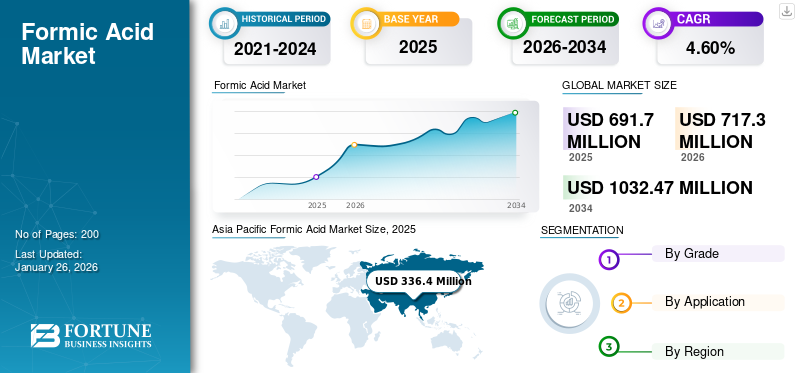
The global formic acid market size was valued at USD 691.7 million in 2025 and is projected to grow from USD 717.3 million in 2026 to USD 1032.47 million by 2034 at a CAGR of 4.60% during the forecast period. Asia Pacific dominated the formic acid market with a market share of 8.00% in 2025.
Formic acid (HCOOH) is a colorless, pungent, and corrosive organic acid widely used in industries such as agriculture, leather, textile dyeing, chemicals, and pharmaceuticals. It serves as a preservative, antibacterial agent, and pH regulator in animal feed, as well as a key component in leather tanning and rubber production.
Market growth is driven by increasing demand for silage preservatives in agriculture, expanding use of industrial chemicals, and the shift toward eco-friendly alternatives in leather and textile processing. Additionally, increasing research into bio-based formic acid production methods, rising product adoption in animal feed additives, and growing sustainable agricultural practices further boost its market potential. Various key players, such as BASF SE, Eastman Chemical Company, and Mitsubishi Gas Chemical Company, Inc., are operating in the market.
Download Free sample to learn more about this report.
Formic Acid Market Key Takeaways
 Global Market Size & Forecast
- 2025 Market Size: USD 691.7 Million
- 2026 Market Size: USD 717.3 Million
- 2034 Forecast Market Size: USD 1,032.47 Million
- CAGR: 4.60% from 2026–2034
 Market Share
- Asia Pacific dominated the market with a 49.00% share in 2025.
- The 85% Grade segment is projected to hold 56.92% of the market in 2026.
- The Agriculture segment is projected to account for 41.35% of the market in 2026.
 Key Regional Highlights
North America
The market was valued at USD 52.4 million in 2025 and is projected to reach USD 54.1 million in 2026.
Asia Pacific
The market was valued at USD 336.4 million in 2025 and is projected to reach USD 350.3 million in 2026.
Europe
The market was valued at USD 221.3 million in 2025 and is projected to reach USD 229.1 million in 2026.
U.S.
The market is projected to reach USD 46.0 million by 2026.
Japan
The market is projected to reach USD 7.9 million by 2026.
Read More

FORMIC ACID MARKET TRENDS
Increasing Product Utilization in Fuel Cell Technology to Create Opportunity for Market Growth
Formic acid is widely used in animal feed preservation due to its acidifying nature and antimicrobial properties, which help suppress the growth of harmful bacteria such as Campylobacter, Escherichia coli, and Salmonella, thereby improving animal health and productivity. Its role in agriculture extends beyond feed preservation to silage treatment and pH regulation, driving the global market.
Beyond traditional applications, the product is gaining higher traction in fuel cell technology as a potential energy carrier. When used in direct formic acid fuel cells (DFAFCs), it undergoes a reaction with water and CO₂ to generate electricity, offering a cost-effective and safer alternative to hydrogen fuel. Notably, in January 2016, a Dutch student team developed a fuel-cell-powered bus that runs on formic acid, highlighting its viability in clean energy solutions. Increasing research into hydrogen storage alternatives and the push for renewable energy grades have further expanded opportunities for products in power applications. Moreover, the rising focus on the production of bio-based formic acid to reduce the carbon footprint, integration of AI and automation in production facilities, and growing improvement in manufacturing technologies for enhanced product quality and cost-effective production are expected to contribute to steady market growth.
MARKET DYNAMICS
MARKET DRIVERS
Increasing Dependency on Domestic Agricultural Activities to Drive Market Growth
The market is poised for steady growth, driven by the expanding agriculture industry worldwide and increasing demand for efficient feed preservation solutions. The growing global emphasis on efficient animal nutrition, coupled with stricter regulations on synthetic additives, is bolstering the shift toward organic acid-based preservatives, including formic acid. Furthermore, advancements in biotechnology and sustainable production methods, such as bio-based formic acid derived from renewable feedstocks, are expected to open new avenues for market expansion. As the agriculture sector continues to modernize, the product demand for feed preservation and broader industrial applications is anticipated to rise, reinforcing its market presence worldwide.
Expanding Leather and Textile Industry to Drive Market Growth in the Coming Years
The formic acid market growth is driven by its expanding applications in the leather and textile industries. As a key tanning agent, this product enhances leather durability and reduces processing time, making it an essential component in leather manufacturing. Additionally, its role as a dye-fixing agent in the textile industry boosts fabric quality and color retention capability. With rising demand for high-quality leather products and textiles, especially in the fashion, automotive, and upholstery sectors, the market is expected to witness steady growth in the coming years.
MARKET RESTRAINTS
High Level of Toxic Chemicals Hampers Market Growth
High-grade formic acid poses significant health risks when exposure exceeds safe limits, causing nose and throat irritation, shortness of breath, nausea, and vomiting. Thus, regulatory bodies such as OSHA, NIOSH, and IDLH have set exposure limits between 5 ppm and 10 ppm. Additionally, its high reactivity with oxidizing agents such as peroxides, permanganates, and perchlorates, and with chemically active metals and strong acids, necessitates stringent handling and storage measures. These safety requirements increase operational costs and impact overall consumption in end-use applications.
MARKET OPPORTUNITIES
Growing Product Adoption as a Chemical Derivative and Intermediate in Pharmaceutical Compounds Offers Lucrative Opportunity
Formic acid is utilized in creating formates, esters, and solvents because of its antimicrobial and anti-inflammatory characteristics. It also serves as a precursor in pharmaceutical substances and chemical derivatives that are subsequently used in drug formulation. Additionally, it plays a role in sample preparation for drug analysis. The rising demand for high-quality pharmaceutical products and derivatives is anticipated to provide profitable opportunities for the formic acid market.
MARKET CHALLENGES
Stringent Regulations Pose a Challenge to the Market
The market faces several challenges due to stringent regulations by the government for the safe disposal of formic acid residues along with regulatory compliance costs associated with approvals. Moreover, unstable prices of raw materials such as methanol and carbon monoxide, supply chain disruptions, availability of substitutes in certain applications, and competition from alternative chemicals further pose challenges to the market. Asia Pacific witnessed a growth from USD 322.7 million in 2023 to USD 323.0 million in 2024.
Download Free sample to learn more about this report.
IMPACT OF COVID-19
By the end of 2019, COVID-19 impacted the world, including the global economy and business. The pandemic limited the flow of the chemical industry and massively impacted the entire supply chain. Formic acid manufacturers globally had to face a shortage of the workforce and essential raw materials owing to the trade restrictions to ensure public safety. This has limited the business operations, including manufacturing activities, sales & marketing, and product demand decrease. However, post-pandemic, governments of many countries provided funds to chemical companies to ramp up production and meet the growing demand from required applications, which has strengthened the supply chain.
IMPACT OF TRADE PROTECTIONISM
Trade protectionism significantly impacts the market by altering the dynamics of global supply chains and influencing market accessibility. Many of the countries worldwide have imposed tariffs to protect domestic chemical industries. On the other hand, cross-border trade has also faced delays owing to strict environmental compliance measures. Furthermore, disruptions in the supply chain due to geopolitical instability have affected global market equilibrium.
SEGMENTATION ANALYSIS
By Grade
85% Grade Accounted for the Dominant Market Share due to its Growing Adoption in Agriculture Industry
Based on the grade, the market is segmented into 85%, 94%, 99%, and others.
The 85% grade segment is projected to dominate the market with a share of 56.92% in 2026. This growth is attributed to the increasing 85% grade consumption from the agriculture industry due to its ability to work as an antibacterial and preservative agent in livestock feed. Moreover, the growing agriculture industry worldwide, coupled with rising technological innovation in agro products, is also boosting the segment growth.
The 94% grade segment will grow substantially during the forecast period due to its rising penetration across several end-use industries. Its eco-friendly nature surges its adoption in leather processing and textile applications. Its applications are also rapidly increasing in the manufacturing of pharmaceuticals, cosmetics, disinfectants, and detergents.
The 99% and other segments are forecasted to have significant growth during the forecast period. The others segment includes several grades such as 82%, 75%, 76%, 99.7%, and 88%. The growing demand for such grades and 99% grades in the manufacturing of rubbers, which are further utilized in the production of tires, electronics applications, and consumer goods, is fueling the growth of the segments.
By Application
To know how our report can help streamline your business, Speak to Analyst
Agriculture Segment Leads the Market due to Rising Product Consumption in Pesticides Manufacturing
Based on the application, the market is segmented into agriculture, leather & textile, chemical, rubber, pharmaceuticals, and others.
The agricultural segment is projected to dominate the market with a share of 41.35% in 2026. Formic acid consumption is rising rapidly in the agricultural segment for the synthesis of chemicals and manufacturing of pesticides. It is also adopted as a preservative to prevent the spoilage of livestock winter food and antibacterial in animal feed. Additionally, the acid is also utilized in chicken feed to kill Salmonella bacteria in poultry farms. The growing government initiative globally to increase agriculture production while reducing the dependency on imports from other countries will lead to segment growth during the forecast period.
- The leather & textile segment is expected to hold a 19.5% share in 2024.
The chemical industry segment is growing at a rapid pace and is estimated to continue during the forecasted timeline. As a pH regulator, the product demand is rising in neutralizing the alkaline environment, thereby surging its adoption in textile and leather production.
Moreover, the growing demand for leather from several leading industries such as construction, aerospace, automotive, sports, and consumer goods, is promoting product adoption in the leather segment. It is highly consumed in the tanning industry to neutralize and disinfect lime while hair removal from raw skin. Its consumption is also flourishing rapidly in leather dyeing as a uniform agent. On the other hand, in textiles, formic acid is adopted to neutralize the alkaline solution while washing the fabric and to stabilize the color of synthetic and natural fibers, including nylon and wool.
FORMIC ACID MARKET REGIONAL OUTLOOK
Based on region, the market is segmented into North America, Europe, Asia Pacific, Latin America, and Middle East & Africa.
Asia Pacific
Asia Pacific Formic Acid Market Size, 2025 (USD Million)
To get more information on the regional analysis of this market, Download Free sample
Asia Pacific recorded a market size of USD 336.4 million in 2025, capturing 49.00% of the global market share, and is projected to reach USD 350.3 million in 2026. The region is also expected to witness a significant growth rate during the forecast period. This is attributed to the growing agriculture industry in the region. The increasing demand for pesticides in China, Japan, and India, along with the rising importance of organic agro products, is expected to drive the regional market growth. Moreover, the growing expansion of textile and chemical industries, coupled with the increase in the company's focus on investments in R&D activities and expanding their businesses in Asia Pacific will further bolster the market growth. The Japan market is projected to reach USD 7.9 million by 2026, the China market is projected to reach USD 140.7 million by 2026, and the India market is projected to reach USD 114.5 million by 2026.
- In China, the leather & textile segment is estimated to hold a 19% market share in 2024.
To know how our report can help streamline your business, Speak to Analyst
Europe
The Europe market accounted for USD 221.3 million in 2025, representing 32.00% of the global industry, and is expected to reach USD 229.1 million in 2026. Europe represents a significant market, with increasing demand for preservatives in livestock feed and the expansion of the leather-based products industry. The region's focus on sustainable and eco-friendly chemical solutions and growing supportive environmental policies contribute to market growth. The Germany market is projected to reach USD 38.7 million by 2026.
North America
In 2025, North America generated USD 52.4 million, contributing 8.00% to global market revenue, and is projected to grow to USD 54.1 million in 2026. In North America, the market is significantly driven by the presence of large-scale producers and the expansion of end-use industries. The U.S., in particular, is expected to lead the market due to its advanced agricultural sector and the growing product use as a de-icing agent. The rising demand for organic poultry and the subsequent need for organic acid-based feed preservatives further support market expansion in this region. The U.S. market is projected to reach USD 46 million by 2026.
Latin America and Middle East & Africa
Latin America accounted for USD 44 million in 2025, representing 6.00% of the global market share, and is projected to reach USD 45.3 million in 2026. The Middle East & Africa market generated USD 37.6 million in 2025, representing 5.00% of the global market landscape, and is expected to reach USD 38.6 million in 2026. In Latin America and the Middle East & Africa, the market is supported by increasing industrial applications, especially in the agriculture and leather industries. These regions are expected to grow at a moderate pace during the forecast period. Moreover, the rising demand for silage preservatives and antibacterial agents, as well as an expanding animal feed additives sector, contributes toward the market growth in the regions. Advancements in agricultural practices and the growing livestock industry also subsidize market expansion in these regions.
COMPETITIVE LANDSCAPE
KEY INDUSTRY PLAYERS
Focus on Strategic Partnerships and Technological Advancements is the Key Market Strategy of Companies to Sustain the Competition
The market is highly competitive, with key players focusing on expanding their capacity, strategic partnerships, and technological advancements to strengthen their market positions. Major companies include BASF SE, Eastman Chemical Company, and Mitsubishi Gas Chemical Company, Inc. These companies dominate the industry through extensive product portfolios and global distribution networks. Chinese manufacturers also contribute significantly to market supply, benefiting from cost-effective production. Increasing demand for eco-friendly and bio-based formic acid is driving innovation, while regulatory compliance and raw material costs remain critical challenges for industry players.
LIST OF KEY FORMIC ACID COMPANIES PROFILED
- BASF SE (Germany)
- Koei Chemical Co., Ltd. (Japan)
- Eastman Chemical Company (U.S.)
- Perstorp AB (Sweden)
- Mudanjiang Fengda Chemicals Co., Ltd (China)
- Tokyo Chemical Industry Co., Ltd (Japan)
- Mitsubishi Gas Chemical Company, Inc. (Japan)
- Nacalai Tesque Inc. (Japan)
- FUJIFILM Wako Pure Chemical Corporation (Japan)
- Chongqing Chuandong Chemical (Group) Co., Ltd., (China)
REPORT COVERAGE
The report provides a detailed analysis of the market. It focuses on key aspects, such as leading companies, types, printing methods used to produce these products, and end-use industries of the product. Besides this, it offers insights into the market and current industry trends and highlights key industry developments. In addition to the factors mentioned above, the report also encompasses several factors contributing to the market's growth.
Request for Customization to gain extensive market insights.
Report Scope & Segmentation
|
ATTRIBUTE |
DETAILS |
|
Study Period |
2021-2034 |
|
Base Year |
2025 |
|
Estimated Year |
2026 |
|
Forecast Period |
2026-2034 |
|
Historical Period |
2021-2024 |
|
Unit |
Value (USD Million) Volume (Kiloton) |
|
Growth Rate |
CAGR of 4.60% from 2026 to 2034 |
|
Segmentation |
By Grade
|
|
By Application
|
|
|
By Region
|
Frequently Asked Questions
Fortune Business Insights says that the global market size was valued at USD 691.7 million in 2025 and is projected to reach USD 1032.47 million by 2034.
Recording a CAGR of 4.60%, the market is slated to exhibit steady growth during the forecast period of 2026-2034.
The agriculture segment is the leading application in the market.
Increasing dependency on domestic agricultural activities to drive market growth.
BASF SE, Eastman Chemical Company, and Mitsubishi Gas Chemical Company, Inc. are the major players in the global market.
Asia Pacific dominated the market in terms of share in 2025.
The rising expansion of the textile industry and agriculture industry is expected to drive product adoption.



- 2021-2034
- 2025
- 2021-2024
- 200
Get 30-60 hrs Free Customization
Expand Regional and Country Coverage, Segments Analysis, Company Profiles, Competitive Benchmarking, and End-user Insights.


















Related Reports
-
US +1 833 909 2966 ( Toll Free )
-
Get In Touch With Us