Fragrance-Free Skincare Market Size, Share & Industry Analysis, By Product Type (Facial Care, Sun Care, Body Care, Baby Skincare, and Others), By Product Form (Creams & Lotions, Gels, Serums & Liquids, Balms & Ointments, and Others), By Price Range (Economy, Mid-Range, and Premium), By End-User (Individual Consumers, Dermatology Clinics, Hospitals & Medical Centers, Beauty Salons & Medispas, and Others), By Distribution Channel (Pharmacies & Drug Stores, Supermarkets & Hypermarkets, Specialty Beauty Stores, Online Retail, and Others), and Regional Forecast, 2026-2034
 Download Free Sample
(Offer valid till 15th Oct 2026)

Fragrance-Free Skincare Market Size and Future Outlook
 Listen to Audio Version
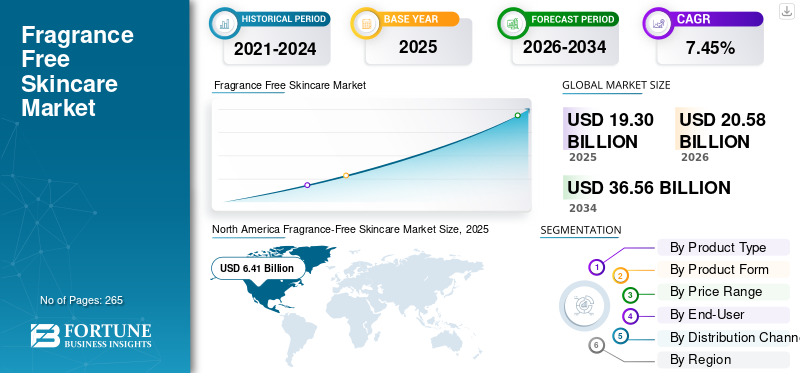
The global fragrance-free skincare market size was valued at USD 19.30 billion in 2025 and is projected to grow from USD 20.58 billion in 2026 to USD 36.56 billion by 2034, exhibiting a CAGR of 7.45% during the forecast period. North America dominated the fragrance-free skincare market with a market share of 33.21% in 2025.
More and more customers are opting for hypoallergenic, mild formulas that do not contain any perfumes, as they have sensitive, allergy-prone, acne-prone, or post-treatment skin and need gentle products. Thus, cleansers, moisturizers, serums, sunscreens, and baby skincare products are experiencing increased demand due to a better understanding of conditions such as contact dermatitis and fragrance sensitivity. More frequent recommendations from dermatologists and the popularity of minimalistic skincare regimens are encouraging consumers to avoid perfumed products and products containing masking fragrances. Further market development comes from labeling attention, promotion of clean beauty, ingredient transparency, and easy access through pharmacies, specialty stores, and online markets.
The major players operating in the market are L'Oréal S.A. (CeraVe), Galderma Group AG (Cetaphil), Beiersdorf AG (Eucerin), Kenvue Inc. (Neutrogena), and Unilever PLC (Paula’s Choice). The key competitive approach used by these companies is product innovation and portfolio development through the introduction of dermatologist-tested, clinically proven, and fragrance-free products that cater to sensitive, acne-prone, dry, and aging skin.
Download Free sample to learn more about this report.
FRAGRANCE-FREE SKINCARE MARKET TRENDS
Growing Demand for Skin-Barrier-Friendly Formulations is Emerging as a Key Trend
The increase in skin sensitivity and irritation problems, along with fragrances that cause allergies, has encouraged consumers to use less complicated skin care products. This trend is resulting in the launch of more fragrance-free products that contain ingredients such as ceramides, hyaluronic acid, niacinamide, and other components that help in forming a skin barrier and in the launch of more dermatologically proven skin care products and boosting sales of pharmaceuticals as well as online stores.
MARKET DYNAMICS
MARKET DRIVERS
Download Free sample to learn more about this report.
Increasing Prevalence of Sensitive Skin and Fragrance-Related Irritation to Accelerate Market Growth
There has been an increased interest in fragrance-free products due to the rising incidence of skin sensitivity, contact dermatitis, allergies, and irritation from added fragranced products. More people are conscious of what they put on their skin and tend to pick cleansers, moisturizers, serums, and sunscreen products that have fewer irritants. Dermatologists, pharmacies, and online skin care experts tend to promote the use of fragrance-free products to help manage sensitive skin, acne-prone skin, and compromised skin. In addition, this encourages manufacturers to develop more clinically proven products. Furthermore, the clean beauty movement is increasing demand for fragrance-free products that minimize irritant exposure and address concerns such as oily skin and allergic reactions. Growing awareness that certain essential oils may cause sensitivity is further encouraging consumers to choose transparent, low-irritation skincare formulations, driving fragrance-free skincare market growth.
|
Rank |
Market Driver |
Expected Impact on Market Growth |
CAGR Contribution |
Impact: 2026-2028 |
Impact: 2029-2031 |
Impact: 2032-2034 |
|
1 |
Rising prevalence and awareness of sensitive skin, allergies, and fragrance-related irritation |
High |
2.90% |
High |
High |
High |
|
2 |
Increasing dermatologist recommendations and demand for clinically tested skincare |
High |
2.35% |
Medium |
High |
High |
|
3 |
Growing preference for transparent, minimalist, and low-irritation formulations |
High |
1.95% |
High |
High |
High |
|
4 |
Expansion of online retail, pharmacies, and dermo cosmetic distribution channels |
Medium |
1.60% |
High |
High |
Medium |
|
5 |
Product innovation in skin-barrier-supporting and multifunctional fragrance-free formulations |
Medium |
1.30% |
Medium |
High |
High |
|
6 |
Others |
Low |
0.75% |
Low |
Low |
Low |
|
Total Positive Growth Contribution |
10.85% |
MARKET RESTRAINTS
High Formulation and Product Development Costs to Restrict Adoption
Creating fragrance-free skin care products calls for precise selection of natural ingredients, stability tests, clinical trials, and different preservation methods while ensuring efficacy and safety. This translates into increased costs involved in the production of such products, especially for small companies. As a result, these products are sold at higher prices, restricting their use among cost-sensitive buyers.
|
Rank |
Market Restraint |
Expected Impact on Market Growth |
Negative CAGR Contribution (2026-2034) |
Impact: 2026-2028 |
Impact: 2029-2031 |
Impact: 2032-2034 |
|
1 |
Higher formulation, testing, and production costs leading to premium product pricing |
High |
-1.45% |
High |
High |
Medium |
|
2 |
Consumer confusion regarding fragrance-free, unscented, natural, and hypoallergenic claims |
Medium |
-0.95% |
High |
Medium |
Low |
|
3 |
Limited awareness and weaker product accessibility in price-sensitive and developing markets |
Medium |
-0.65% |
High |
Medium |
Medium |
|
4 |
Others |
Low |
-0.35% |
Low |
Low |
Low |
|
Total Negative Growth Impact |
-3.40% |
MARKET OPPORTUNITIES
Expansion through Personalized Sensitive-Skin Solutions to Offer Numerous Growth Opportunities
The growing trend for personalized skin care products can serve as a window for fragrance-free brands to create tailored solutions for specific issues such as eczema, acne, rosacea, dry skin, and sensitivity post-procedures. Companies can take advantage of technology through digital skin tests, along with working with dermatologists and mixing raw materials according to the specific needs of customers, in order to increase the relevancy of their products.
MARKET CHALLENGES
Consumer Confusion About Fragrance-Free Claims Creates Market Challenges
Confusion around labeling terms such as "fragrance free," "unscented," and "hypoallergenic" can leave customers unsure about their choices. On the one hand, products that are marked as unscented can still include some ingredients that mask odors. On the other hand, a fragrance-free label does not necessarily mean that a particular product will be suitable for all types of sensitive skin. This places additional requirements on companies to educate their customer base properly.
Segmentation Analysis
By Product Type
Frequent Daily Usage Application to Drive Facial Care Segment Dominance
By product type, the market is segmented into facial care, sun care, body care, baby skincare, and others.
The facial care segment accounted for the leading market share due to the increased usage of cleansers, moisturizers, serums, and treatment products compared to other categories such as body, sun, and baby care products. Increasing worries over sensitivity, acne, dryness, and skin barrier issues have made people consider using fragrance-free products on a regular basis. This is why frequent buying, increased product variety, and doctor’s recommendations are leading to high revenue generation through facial care products.
The sun care segment is anticipated to rise at the fastest CAGR of 8.90% over the forecast period.
To know how our report can help streamline your business, Speak to Analyst
By Product Form
Extensive Application in Treating Dry and Sensitive Skin Concerns to Drive Growth of Creams & Lotions Segment
Based on product form, the market is divided into creams & lotions, gels, serums & liquids, balms & ointments, and others.
The creams & lotions segment led the fragrance-free skincare market share in 2025, owing to their extensive usage in facial moisturizers, body care, baby skincare, and treatment purposes. The creamy nature of these products, along with the good moisturizing effect, makes them ideal for use in dry, sensitive, eczema-affected, and impaired barrier skin types. Therefore, their extensive use by all age groups and increased frequency of use contribute to their higher revenue share in the market.
The serums & liquids segment is anticipated to rise at the fastest CAGR of 8.69% over the forecast period.
By Price Range
Balanced Pricing and Clinical Benefits to Drive Dominance of Mid-Range Segment
Based on the price range, the market is segmented into economy, mid-range, and premium.
The mid-range segment led in terms of revenue as it features fragrance-free products that are dermatologically tested and hypoallergenic. Consumers seek high-quality products for sensitive skin but are unwilling to pay premium prices. There is an increased demand for affordable cleansers, moisturizers, sunscreen products, and even treatments. This has led to the segment being widely available from various retail channels, and thus contributing greatly to revenue generation.
The premium segment is projected to grow at the fastest CAGR of 8.33% during the forecast period.
By End-User
Broad-Level Routine At-Home Usage to Fuel Individual Consumers Segment Growth
Based on end-user, the market is divided into individual consumers, dermatology clinics, hospitals & medical centers, beauty salons & Medispas, and others.
The individual consumers segment led in terms of market share in 2025, as cleansers, moisturizers, sunscreens, serums, and body care products that do not contain any fragrances are mostly bought for regular home consumption. An increasing awareness regarding sensitive skin, allergies, breakouts, and barrier problems is compelling consumers to choose products that are gentler on the skin themselves.
The dermatology clinics segment is anticipated to rise at the fastest CAGR of 9.02% over the forecast period.
By Distribution Channel
Wide Product Access and Convenience to Sustain Dominance of Online Retail Segment
Based on the distribution channel, the market is segmented into pharmacies & drug stores, supermarkets & hypermarkets, specialty beauty stores, online retail, and others.
The online retail segment accounted for the dominant share of revenue in 2025, owing to the ability of customers to readily compare products without fragrances according to their ingredients, skin problems, certification, price, and customer reviews. Online shopping sites give wider access to dermatologically approved, specialized, imported, and direct-to-consumer products that might not be available in stores. As a result, the convenience of delivery at home, frequent discounts, and subscriptions boost the role of the online retail channel in generating revenue.
The specialty beauty stores segment is projected to grow at the fastest CAGR of 7.58% during the forecast period.
Fragrance-Free Skincare Market Regional Outlook
By region, the market is categorized into Europe, North America, Asia Pacific, South America, and the Middle East & Africa.
North America
North America Fragrance-Free Skincare Market Size, 2025 (USD Billion)
To get more information on the regional analysis of this market, Download Free sample
North America dominated the global market and is projected to grow at a CAGR of 6.72% in the coming years. The region reached a valuation of USD 6.41 billion in 2025. Such skin care products have gained popularity in North America due to rising awareness about skin sensitivities, skin allergies, eczema, and skin irritation caused by fragrances. Dermatologists recommend fragrance-free beauty and personal care, which has contributed to the growing demand for clinically tested and hypoallergenic skin care products that also help repair the skin barrier. The availability of various skin care brands, drug stores, specialty stores, and online portals is helping the market grow in the region.
U.S. Fragrance-Free Skincare Market
With North America’s strong contribution and the U.S. dominance in the region, the U.S. market reached USD 4.99 billion in 2025, accounting for roughly 25.85% of the global sales. The growth of the country’s market can be attributed to factors such as increasing awareness of sensitive skin, dermatologist recommendations, consumer spending, and the availability of clinically proven products.
Europe
Europe held the second-largest share in 2025, valued at USD 6.06 billion, accounting for 31.38% of the global market. As consumers become more aware of skin sensitivities, eczema, allergies, and fragrance sensitivity, there is a higher preference for hypoallergenic and clinically tested skin care products. In turn, physician recommendations and in-pharmacy sales have increased the demand for fragrance-free cleansers, moisturizers, sunscreen, and therapeutic products in Europe.
U.K. Fragrance-Free Skincare Market
The U.K. market size in 2025 reached USD 1.11 billion, representing roughly 5.75% of global market revenues.
Germany Fragrance-Free Skincare Market
Germany’s market reached USD 1.29 billion in 2025, equivalent to around 6.70% of the global market sales.
Asia Pacific
Asia Pacific ranked third in the global market, reaching USD 5.30 billion in 2025 and growing at a CAGR of 9.40% over the forecast period. The region’s market is on the rise owing to increasing skin sensitivity, the effects of pollution, and the advantages of mild formulations. Increasing consumption among the growing middle class, high e-commerce penetration, and the availability of dermatologist-approved products are enhancing accessibility in key urban areas.
Japan Fragrance-Free Skincare Market
The Japanese market in 2025 was valued at USD 0.98 billion, accounting for roughly 5.10% of global revenues. The popularity of fragrance-free beauty care in Japan has risen in tandem with increasing consumer preference for gentler products that cause minimal irritation, particularly among consumers with sensitive, dry, and aging skin. High consumer demand for ingredient disclosure, dermatologist testing, minimal skincare, and technologies that support the skin barrier has spurred brands to offer more fragrance-free beauty products.
China Fragrance-Free Skincare Market
China’s market in 2025 was at USD 1.67 billion, representing roughly 9.01% of global market sales.
India Fragrance-Free Skincare Market
The Indian market size in 2025 was at USD 1.15 billion, accounting for roughly 10.91% of the global market revenues.
South America and Middle East & Africa
South America and the Middle East & Africa markets are expected to witness moderate growth during the forecast period. However, the South American market size reached USD 0.86 billion in 2025. The growing knowledge of sensitive skin conditions, along with the increasing purchasing power of the middle class in urban areas, is likely to drive the market in South America. In the Middle East & Africa region, the UAE reached a valuation of USD 0.12 billion in 2025.
South Africa Fragrance-Free Skincare Market
The South African market value reached USD 0.11 billion in 2025, representing roughly 0.57% of the global market revenues.
COMPETITIVE LANDSCAPE
Key Industry Players
Focus on Product Innovation and Clinical Positioning to Strengthen Market Competition
The fragrance-free skincare products industry enjoys moderate competition, with firms such as L'Oréal S.A., Galderma Group AG, Beiersdorf AG, Kenvue Inc., and Unilever PLC bolstering their market power through innovative product developments. Firms have diversified their portfolios for clinically validated, hypoallergenic, and skin barrier-friendly formulations, catering to issues associated with sensitive, acne-prone, eczema-prone, and aging skin. The focus is on clinical validation, ingredient information, pharmacy availability, and online educational content to establish consumer trust in these brands. Additionally, firms have employed strategies such as e-commerce expansion, premium branding, dermatologist collaborations, and new product launches to boost their market reach, strengthen their brand differentiation, and ensure customer loyalty.
LIST OF KEY FRAGRANCE-FREE SKINCARE COMPANIES PROFILED
- L’Oréal S.A. (France)
- Galderma Group AG (Switzerland)
- Beiersdorf AG (Germany)
- Kenvue Inc. (U.S.)
- The Estée Lauder Companies Inc. (U.S.)
- Unilever PLC (U.K.)
- The Procter & Gamble Company (S.)
- Kao Corporation (Japan)
- Laboratoires Pierre Fabre (France)
- Rohto Pharmaceutical Co., Ltd. (Japan)
KEY INDUSTRY DEVELOPMENTS
- March 2026: Galderma Group AG launched Cetaphil Advanced Daily Defense Serum and Repair & Renew Serum. The fragrance-free, hypoallergenic AM/PM system uses Gallic-AOX Power technology to protect sensitive skin during the day and support barrier repair overnight, strengthening Cetaphil’s position in high-performance sensitive-skin treatments.
- March 2026: Kenvue Inc. presented new Neutrogena and Aveeno clinical research at the American Academy of Dermatology Annual Meeting. The initiative highlighted Hydro Boost hydration, Aveeno oat-based barrier care, peri-procedural skincare, and sensitive-skin solutions, supporting stronger dermatologist engagement and clinical positioning for fragrance-free product ranges.
- September 2025: Galderma Group AG launched Cetaphil’s Skin Activator Hydrating & Firming line. The fragrance-free and hypoallergenic range targets ageing, thinning, and fragile skin, while a partnership with Mariska Hargitay supported promotion through advertising, retail, e-commerce, public relations, and social media.
- August 2025: Galderma Group AG launched the Cetaphil Nourishing Oil to Foam Cleanser. The fragrance-free cleanser combines makeup removal with 24-hour hydration and barrier support, enabling Cetaphil to address demand for effective but non-stripping cleansing products for normal-to-dry sensitive skin.
- March 2025: Kenvue Inc. presented 14 clinical studies covering skin hydration, longevity, sun protection, and sensitive-skin care. Research included the fragrance-free Neutrogena Hydro Boost Water Cream and Aveeno eczema-care regimens, helping the company reinforce product credibility among dermatologists and consumers.
REPORT COVERAGE
The global fragrance-free skincare market analysis includes a comprehensive study of the market and forecast by all the market segments included in the report. This qualitative and quantitative report includes details on the market dynamics and trends that are expected to drive the market over the forecast period. It provides information on key aspects, including technological advancements, the regulatory environment, and product launches. Along with market sizing, it details partnerships, mergers and acquisitions, and key industry developments. The global research report combines the outlook for the market with a detailed competitive landscape, including market share and profiles of key players.
Request for Customization to gain extensive market insights.
Report Scope & Segmentation
| ATTRIBUTE | DETAILS |
| Study Period | 2021-2034 |
| Base Year | 2025 |
| Estimated Year | 2026 |
| Forecast Period | 2026-2034 |
| Historical Period | 2021-2024 |
| Growth Rate | CAGR of 7.45% from 2026 to 2034 |
| Unit | Value (USD Billion) |
| Segmentation | By Product Type, Product Form, Price Range, End-User, Distribution Channel, and Region |
| By Product Type |
|
| By Product Form |
|
| By Price Range |
|
| By End-User |
|
| By Distribution Channel |
|
| By Region |
|
Frequently Asked Questions
According to Fortune Business Insights, the global market value stood at USD 19.30 billion in 2025 and is projected to reach USD 36.56 billion by 2034.
In 2025, the market value stood at USD 6.41 billion.
The market is expected to grow at a CAGR of 7.45% over the forecast period.
By product type, the facial care segment led the market.
The key factors driving the global market are heightened awareness of sensitive skin, increasing concerns about fragrance-based irritation, better dermatologist recommendations, and greater demand for clinically tested, transparent, and skin barrier-building products.
L'Oréal S.A. (CeraVe), Galderma Group AG (Cetaphil), Beiersdorf AG (Eucerin), Kenvue Inc. (Neutrogena), and Unilever PLC (Paula’s Choice) are the major players in the global market.
North America dominated the market in terms of share.



- 2021-2034
- 2025
- 2021-2024
- 265
-
(Offer valid till 15th Oct 2026)
Get 30-60 hrs Free Customization
Expand Regional and Country Coverage, Segments Analysis, Company Profiles, Competitive Benchmarking, and End-user Insights.



















Related Reports
-
US +1 833 909 2966 ( Toll Free )
-
Get In Touch With Us