Fresh Produce Market Size, Share & Industry Analysis, By Product Type (Fresh Fruits {Citrus, Berries, Bananas, Pome fruits, Stone fruits, Tropical fruits, Melons, Avocados, and Others}, Fresh Vegetables {Leafy Greens, Root Vegetables, Legumes, Cruciferous, Tomato, Cucumber, Capsicum, Eggplant, Zucchini, and Others}, Fresh Seafood {Finfish, Shellfish, Mollusks and Others}, and Fresh Meat {Poultry, Pork, Beef, Mutton, and Others}), By Source (Organic and Conventional), By End User (Retail, Foodservice, and Food Manufacturing), and Regional Forecast, 2026-2034
 Download Free Sample
(Offer valid till 15th Oct 2026)

Fresh Produce Market Size and Industry Overview
 Listen to Audio Version
The global fresh produce market size was valued at USD 3,575.43 billion in 2025 and is projected to grow from USD 3752.25 billion in 2026 to USD 5768.88 billion by 2034, exhibiting a CAGR of 5.52% during the forecast period. Asia Pacific dominated the global market with a market share of 53.50% in 2025.
The market includes fresh, minimally processed agricultural and animal-origin food products intended for human consumption. Such products are sold through retail, foodservice, and food manufacturing channels. This includes plant based products such as fresh fruits, fresh vegetables, fresh seafood and fresh meat. Consumers increasingly prioritize fresh produce for their role in reducing chronic diseases, with majority consumers starting or increasing intake for health consciousness among consumers, targeting items such as bananas, apples, broccoli, and tomatoes.
Companies such as Dole Plc, Chiquita Brands International S.A.R.L., Del Monte Foods, Inc. and others are some of the key players operating in this market. These companies are making investments in geographic expansions and strategic acquisition, resulting in higher product sales and supporting market growth.
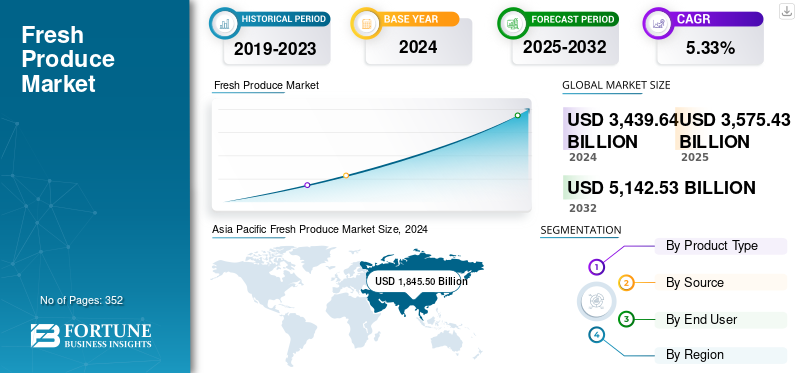
Download Free sample to learn more about this report.
Fresh Produce Market Key Takeaways
 Market Size & Forecast
- 2025 Market Size: USD 3,575.43 billion
- 2026 Market Size: USD 3752.25 billion
- 2034 Forecast Market Size: USD 5768.88 billion
- CAGR: 5.52% from 2026–2034
 Market Share
- Asia Pacific dominated the fresh produce market with a 53.50% share in 2025.
- The fresh vegetables segment is expected to grow at a CAGR of 5.05% during the forecast period.
- The organic segment is projected to record the fastest growth with a CAGR of 5.77% during the forecast period.
 Key Regional Highlights
Asia Pacific
Asia Pacific remained the largest regional market, generating USD 2016.88 billion in 2026 and benefiting from strong consumption across major agricultural economies.
Europe
Europe is expected to remain the second-largest regional market, reaching USD 615.25 billion in 2026 due to steady demand for fresh and healthy food products.
North America
North America generated USD 373 billion in 2026, supported by increasing consumer preference for nutritious and sustainably sourced produce.
U.S.
The market reached USD 263.71 billion in 2026, driven by strong retail demand and growing health-conscious consumer behavior.
Japan
The market reached USD 170.79 billion in 2026, accounting for 4.53% of global revenue, supported by consistent demand for high-quality fresh produce.
Read More

FRESH PRODUCE MARKET TRENDS
Rising Adoption of Semi-Processed Produce to Shape Industry Growth
Industry associations highlight that foodservice operators, particularly quick-service restaurants, institutional caterers, and corporate dining providers, are increasingly relying on pre-cut and ready-to-use produce to ensure consistency, reduce preparation time, and manage labor shortages. This trend has accelerated investments in centralized processing facilities, advanced washing and packaging technologies, and modified-atmosphere packaging, which extend freshness and enhance food safety.
Download Free sample to learn more about this report.
MARKET DYNAMICS
MARKET DRIVERS
Consumer Awareness about Health Benefits Associated with Fruits and Vegetables Consumption Support Market Growth
Fruits and vegetables are strongly associated with nutrient density, dietary fiber, vitamins, minerals, and beneficial phytonutrients, while remaining comparatively low in calories, which makes them a preferred choice for individuals trying to manage weight, blood sugar, cholesterol, and overall metabolic health. This sustained behavioral shift supports consistent demand not only for staple items (bananas, apples, onions, tomatoes, potatoes), but also for higher-value produce including berries, leafy greens, exotic fruits, and premium varieties, thereby improving category value growth even when volume expansion is moderate. The health benefits associated with fresh fruits and vegetables consumption boost the fresh produce market growth.
MARKET RESTRAINTS
Post-Harvest Loss and Perishable Nature Impedes Market Growth
The global fresh produce market is significantly constrained by high post-harvest losses, stemming from inadequate harvesting practices, poor storage infrastructure, insufficient cold-chain coverage, and inefficient transportation systems. Fruits and vegetables are among the most perishable food categories, making them highly vulnerable to quality deterioration and wastage before reaching end consumers.
MARKET OPPORTUNITIES
Investment in Traceability in Fresh Produce Supply Chains to Pave Growth Opportunities
Traceability also plays a critical role in meeting evolving consumer preferences. Digital traceability solutions, such as QR codes on packaging linked to farm-level data, allow consumers to access detailed product information, enhancing trust and brand differentiation. Large global fresh produce companies and retailers have invested in blockchain-enabled traceability systems to improve food safety response times and supply chain transparency.
Fresh Produce Market Segmentation Analysis
By Product Type
Fresh Vegetables Accounted for Majority Market Share Due to Better Accessibility
The market is segmented by product type into fresh fruits, fresh vegetables, fresh seafood, and fresh meat.
Fresh fruits are further segmented into citrus, berries, bananas, pome fruits, stone fruits, tropical fruits, melons, avocados and others. Fresh vegetables are further segmented into leafy greens, root vegetables, legumes, cruciferous, tomato, cucumber, capsicum, eggplant, zucchini and others. Fresh seafood is also classified into finfish, shellfish, mollusks and others. Fresh meat is segmented into poultry, pork, beef, mutton and others.
The fresh vegetables segment is projected to dominate the market with a share of 30.40% in 2026. In comparison to other product types, fresh vegetables are less expensive, especially in seasonal and local markets. This cost-effectiveness makes them highly accessible, particularly in price-sensitive groups. Moreover, fresh vegetables have minimal food safety risks compared to fresh seafood and meat, which require strict handling and temperature control to minimize bacterial contamination.
In addition, the fresh vegetables segment is expected to register a growth of 5.05% CAGR during the forecast period. They have a prolonged shelf life than fresh seafood and meat, which reduces the chances of food waste at the retail and household levels.
By Source
Conventional Source Accounts for Leading Market Share Due to Efficient Farming Practices
Based on source the market is segmented into organic and conventional.
The conventional segment is expected to lead the market, contributing 89.32% globally in 2026. Conventional fresh produce is more economical as compared to organic produce owing to efficient farming practices, lower production costs, and higher yields. Moreover, regular produce is widely available throughout the year, unlike organic supply, which faces supply and seasonal limitations.
The organic sector will exhibit the highest CAGR of 5.77% over the forecast period. Compared to conventional fresh produce, organic items are minimally exposed to artificial chemicals or herbicides and locally grown, which is a major reason consumers choose organic items. Moreover, it has superior quality and taste, which supports repeat purchasing.
By End User
To know how our report can help streamline your business, Speak to Analyst
Retail Channels Held Majority Market Share Due to Easy Access to Fresh Produce
By end-user, the market is trifurcated into retail, foodservice, and food manufacturing.
The retail segment will account for 62.43% market share in 2026. Retail channels, including supermarkets/hypermarkets, grocery stores, and convenience stores, offer consistent and easy access to fresh vegetables, seafood, and meat. Their long operating hours, and widespread presence make it easier for most of the consumers to shop for fresh produce daily.
The foodservice channel is another major category which will depict a 5.18% CAGR during the forecast period. Foodservice operators procure large volumes of fresh produce, which is used in the preparation of various cuisines. Today, most consumers visit quick-service restaurants and cafés to socialize with their families and peers, which boosts the consumption of out-of-home food.
Fresh Produce Market Regional Outlook
By geography, the market is categorized into Europe, North America, Asia Pacific, South America, the Middle East & Africa.
Asia Pacific
Asia Pacific Fresh Produce Market Size, 2025 (USD Billion)
To get more information on the regional analysis of this market, Download Free sample
In 2025, the Asia Pacific market stood at USD 1912.79 Billion, representing 53.50% of global demand, and is projected to grow to USD 2016.88 Billion in 2026. It is one of the fastest and largest evolving fresh produce markets worldwide, where daily meals are prepared utilizing freshly sourced vegetables and fruits. The consumption pattern of the region is highly influenced by a strong preference for home-cooked meals and local culinary practices. Moreover, rising disposable income, population growth, and improved retail infrastructure are additional factors that support the market.
India Fresh Produce Market
The Indian market in 2026 was around USD 268.25 billion, accounting for roughly 7.02% of global market revenues.
China Fresh Produce Market
China’s market in 2026 reached USD 1107.75 billion, representing roughly 28.78% of global market sales.
Japan Fresh Produce Market
The Japanese market reached around USD 170.79 billion in 2025, accounting for roughly 4.53% of global market revenues.
North America
The market in North America reached USD 355.27 Billion in 2025, representing 9.94% of total market revenue, and is projected to reach USD 373 Billion in 2026. Fresh produce is considered a vital component of the North American food system and is extensively incorporated into daily meals across institutions, households, and restaurants. Predominantly, the regional growth is backed by advanced cold chain logistics, robust retail penetration, and a well-developed supply chain, allowing wide consumer access and year-round availability.
U.S. Fresh Produce Market
In 2026, the U.S. market hit USD 263.71 billion. The consistent expansion of the foodservice industry is a well-known driver of fresh produce in the U.S. Institutional kitchens, quick-service restaurants, and cafes depend heavily on the supply of fresh vegetables, seafood, meat, and other components to meet consumer expectations and menu requirements.
Europe
Europe contributed approximately USD 589.45 Billion to the global market in 2025, accounting for 16.49% share, and is expected to reach USD 615.25 Billion in 2026. Europe’s fresh produce market is well-built and highly influenced by regulatory frameworks and regional diversity. Consumption of fresh meat, fruits, and vegetables is ingrained in the region's seasonal eating habits and traditional diets, rather than convenience-based items. Unlike developing markets, the European expansion is not volume-centric; instead, it is evolving with respect to structure and value.
Germany Fresh Produce Market
The market in Germany in 2026 reached around USD 110.52 billion, representing roughly 2.91% of global market revenues.
France Fresh Produce Market
France’s fresh produce market reached approximately USD 95.33 billion in 2025, equivalent to around 2.77% of global market sales.
South America
The South America market generated USD 264.36 Billion in 2025, representing 7.39% of the global market landscape, and is expected to reach USD 275.69 Billion in 2026. South America is recognized as a prominent consumer and producer of fresh items, supported by a robust farming base and favorable weather conditions. The region is renowned for producing large quantities of meat, fresh fruits, and vegetables, which are primarily consumed domestically via home cooking and traditional markets.
Middle East & Africa
Middle East & Africa maintained a strong presence in the global market, reaching USD 453.56 Billion in 2025, accounting for 12.69% share, and is expected to reach USD 471.42 Billion in 2026 and the majority of countries rely heavily on imports to fulfill their fresh items requirements. Challenging climatic conditions, limited arable land, and water scarcity restrict the local production of fresh meat, vegetables, and fruits. Africa is estimated to be worth USD 203.27 billion in 2025 Africa’s fresh produce sector is highly dependent on local smallholder agriculture, which serves as the main source of fresh vegetables, livestock, and fruits across the continent. Small-scale local farmers account for a substantial share of agricultural production and are the key distributors to regional and local markets.
Saudi Arabia Fresh Produce Market
Saudi Arabia is set to grow at a CAGR of 4.35% during the forecast period. In the majority of Muslim countries, consumers seek fresh produce, particularly meat that complies with halal practices and transparency in sourcing.
COMPETITIVE LANDSCAPE
Key Industry Players
Geographic Expansions and Strategic Acquisition are used by Companies to Expand Market Share
The fresh produce industry exhibits a fragmented structure and is characterized by capital-intensive investments, steady geographic expansion, selective acquisitions, and increasing emphasis on product innovation and sustainability. Companies that successfully integrate these strategies while managing agricultural volatility and supply chain complexity are better positioned to expand market share and sustain long-term growth.
LIST OF FRESH PRODUCE COMPANIES PROFILED
- Fyffes (Ireland)
- Chiquita Brands International S.A.R.L. (Switzerland)
- Dole Plc (Ireland)
- Del Monte Foods, Inc. (U.S.)
- Greenyard NV (Belgium)
- Koch Foods (U.S.)
- Mission Produce (U.S.)
- T&G Global (New Zealand)
- Taylor Farms (U.S.)
- Tyson Foods, Inc. (U.S.)
KEY INDUSTRY DEVELOPMENTS
- December 2025: Solum Partners completed a majority strategic investment in Greenyard NV, partnering with the company's founding Deprez Family following Greenyard's delisting from Euronext Brussels in September 2025.
- November 2025: Dole partner, Nature's Produce, an importer and distributor of fresh fruit and vegetable markets, constructed a new high-tech ripening and distribution hub to support “ready-to-eat” exotics and strengthen Dole’s brand in Poland.
- October 2025: Fyffes and Morrisons announced a major in-store brand activation campaign for bananas and pineapples, across all 488 Morrisons stores in the U.K.
- October 2024: Chiquita introduced Yelloway One, a hybrid banana variety resistant to Fusarium wilt (TR4) and black sigatoka, marking a key advance in sustainable farming of banana production.
- June 2025: Del Monte launched its patented Pinkglow pineapple in the UAE, marking the fruit's entry into the Middle East market exclusively via talabat mart.
REPORT COVERAGE
The global fresh produce market analysis includes a comprehensive study of the market size & forecast by all the market segments included in the report. It includes details on the market dynamics and market trends expected to drive the market over the forecast period. It provides information on key aspects, including an overview of technological advancements, the regulatory environment, and product launches. Additionally, it details partnerships, mergers & acquisitions, as well as key industry developments and investments by key regions. The global market research report also provides an in-depth competitive landscape with information on the market share and profiles of key operating players.
Request for Customization to gain extensive market insights.
Report Scope & Segmentation
| ATTRIBUTE | DETAILS |
| Study Period | 2021-2034 |
| Base Year | 2025 |
| Estimated Year | 2026 |
| Forecast Period | 2026-2034 |
| Historical Period | 2021-2024 |
| Growth Rate | CAGR of 5.52% from 2026-2034 |
| Unit | Value (USD Billion) |
|
Segmentation |
By Product Type
By Source
By End User
By Region
|
Frequently Asked Questions
Fortune Business Insights says that the global market value stood at USD 3575.43 billion in 2025 and is projected to reach USD 5768.88 billion by 2034.
In 2025, Asia Pacifics market value stood at USD 1912.79 billion.
The market is expected to exhibit a CAGR of 5.52% during the forecast period
By product type, the fresh vegetable segment led the global market in 2026.
Growing consumer awareness of the health benefits associated with fruits and vegetables consumption is a key factor driving the fresh produce market.
Dole Plc, Chiquita Brands International S.A.R.L., Del Monte Foods, Inc. and others are a few of the players in the Fresh Produce market.
Asia Pacific dominated the global market with a market share of 53.50% in 2025.
Rising adoption of semi-processed produce to shape industry growth.



- 2021-2034
- 2025
- 2021-2024
- 352
-
(Offer valid till 15th Oct 2026)
Get 30-60 hrs Free Customization
Expand Regional and Country Coverage, Segments Analysis, Company Profiles, Competitive Benchmarking, and End-user Insights.




















Related Reports
-
US +1 833 909 2966 ( Toll Free )
-
Get In Touch With Us