Gamma Butyrolactone Market Size, Share & Industry Analysis, By Application (Pyrrolidones Synthesis, Pharmaceuticals & Agrochemical Synthesis, Electronics & Semiconductor, Specialty Chemicals & Polymers, and Others), and Regional Forecast, 2026-2034
 Download Free Sample
(Offer valid till 31st Oct 2026)

GAMMA BUTYROLACTONE MARKET Size and Industry Overview
 Listen to Audio Version
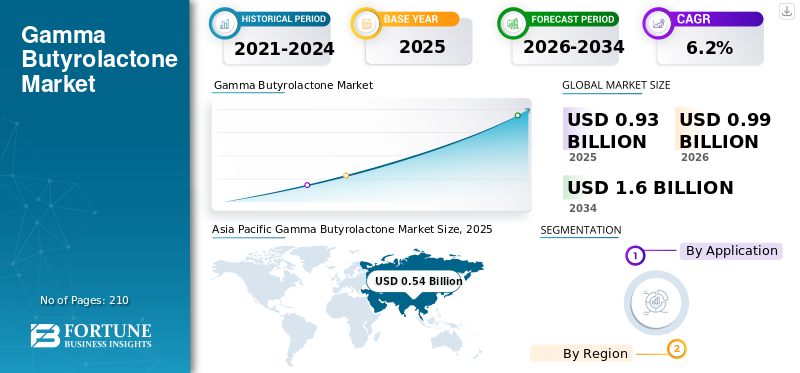
The global gamma butyrolactone market size was USD 0.93 billion in 2025. The market is projected to grow from USD 0.99 billion in 2026 to USD 1.60 billion by 2034 at a CAGR of 6.2% during the forecast period. Asia Pacific dominated the gamma butyrolactone market with a market share of 58.06% in 2025.
Gamma Butyrolactone (GBL) is a specialty chemical and cyclic ester solvent used primarily as a high purity intermediate and reaction medium in regulated and performance-critical applications. It is produced within integrated C4 chemical value chains and valued for its strong solvency, low volatility, and chemical stability. GBL is most commonly consumed as a precursor to pyrrolidone derivatives, including N-methyl-2-pyrrolidone (NMP), as well as directly in pharmaceuticals, electronics, and specialty chemical manufacturing. The major demand driver is the rapid expansion of lithium ion battery and energy storage supply chains, where GBL-derived pyrrolidones are essential processing solvents, structurally linking GBL demand to electric vehicle and battery capacity growth. BASF PETRONAS Chemicals, Mitsubishi Chemical, Dairen Chemical, and Chang Chun Group are a few of the major players in the market.
Download Free sample to learn more about this report.
GAMMA BUTYROLACTONE MARKET Key Takeaways
 Market Size & Forecast
- 2025 Market Size: USD 0.93 billion
- 2026 Market Size: USD 0.99 billion
- 2034 Forecast Market Size: USD 1.60 billion
- CAGR: 6.2% from 2026–2034
 Market Share
- Asia Pacific dominated the gamma butyrolactone market with a market share of 58.06% in 2025.
- The pyrrolidones synthesis segment is anticipated to hold the dominant gamma butyrolactone market share during the forecast period.
- The electronics & semiconductor segment is anticipated to rise with a CAGR of 6.5% over the forecast period.
 Key Regional Highlights
Asia Pacific
Asia Pacific is expected to remain the leading regional market, supported by strong demand from pyrrolidone synthesis and lithium-ion battery manufacturing activities.
North America
North America is witnessing increasing demand as battery materials, energy storage, and semiconductor manufacturing investments continue to expand across the region.
Europe
Europe’s market is primarily driven by pharmaceutical and agrochemical synthesis applications, supported by its established API and fine chemicals industry.
U.S.
The market was valued at approximately USD 0.12 billion in 2025, accounting for around 12.9% of global sales, supported by growing battery and semiconductor manufacturing capacity.
Japan
The market reached approximately USD 0.09 billion in 2025, representing nearly 9.7% of global sales, driven by electronics, semiconductor, and battery materials production.
Read More

GAMMA BUTYROLACTONE MARKET TRENDS
Battery and Electronics Supply Chains to Reshape GBL Demand Landscape
The global market is increasingly shaped by downstream battery and electronics supply chains rather than traditional solvent markets. Demand growth is shifting toward Asia Pacific and, increasingly, North America, where lithium ion batteries, cathode materials, and high purity chemical manufacturing are expanding. This has driven increasing demand for consistent, ultra-high purity GBL used as a precursor to pyrrolidones such as NMP. As a result, producers are prioritizing process optimization, debottlenecking, and quality control over volume-led expansion, reinforcing GBL’s positioning as a specialty intermediate rather than a commodity chemical, driving gamma butyrolactone market growth in tandem.
MARKET DYNAMICS
MARKET DRIVERS
Download Free sample to learn more about this report.
Electric Vehicle Expansion Accelerates Pyrrolidone Consumption Driving Market Growth
The single most important demand driver for GBL is the rapid expansion of electric vehicle and energy storage manufacturing. GBL is a critical upstream intermediate for producing pyrrolidones, particularly NMP, which remains essential for lithium ion battery cathode processing despite substitution efforts. Growth in EV production directly translates into rising demand for battery-grade solvents and intermediates, structurally underpinning GBL consumption. This linkage has reduced demand volatility and increased long-term contract sales, especially in Asia Pacific, making EV capacity additions a key leading indicator for global GBL demand growth.
MARKET RESTRAINTS
Strict Regulatory Controls Constrain Market Liquidity and Trade
Strict regulatory oversight is a major restraint on the global GBL market. Due to its potential misuse, GBL is tightly controlled in Europe, North America, and parts of Asia, with licensing, customer qualification, and traceability requirements. These controls limit spot-market trading, slow customer onboarding, and increase compliance costs for producers. While regulation strengthens barriers to entry, it also restricts market flexibility and cross-border trade, particularly for smaller buyers. As a result, demand growth can lag downstream consumption in regions where regulatory approvals delay supply access.
MARKET OPPORTUNITIES
Growing Demand for High Purity Grades Unlock Value beyond Volume Growth
A key opportunity in the GBL market lies in the growing demand for high purity level and application-specific grades. Pharmaceuticals, electronics, and battery materials increasingly require ultra-low impurity levels, enabling producers to capture pricing premiums and deepen customer relationships. This trend favors integrated, technically advanced manufacturers capable of meeting stringent quality and documentation standards. Rather than pursuing large capacity expansions, leading players are investing in purification, quality assurance, and customized specifications. This shift allows GBL producers to enhance margins and resilience even in periods of moderate volume growth.
MARKET CHALLENGES
Substitution Pressure on NMP to Limit Long-Term Battery Linkage
The primary strategic challenge witnessed in the GBL market is the risk of downstream substitution, particularly in battery applications. Regulatory pressure on NMP, especially in Europe, has accelerated research into alternative solvents and processing technologies. While large-scale substitution remains limited in the near term, continued innovation could gradually reduce pyrrolidone intensity per unit of battery capacity. This creates long-term uncertainty for GBL demand growth tied to EVs. Producers must therefore balance battery exposure with diversification into pharmaceuticals, electronics, and specialty chemicals to sustain growth and mitigate single-application risk.
SEGMENTATION ANALYSIS
By Application
To know how our report can help streamline your business, Speak to Analyst
Ongoing Battery Manufacturing Scale-Up Drives Structural Demand for Product in Pyrrolidones Synthesis
Based on application, the market is segmented into pyrrolidones synthesis, pharmaceuticals & agrochemical synthesis, electronics & semiconductor, specialty chemicals & polymers, and others.
The pyrrolidones synthesis segment is anticipated to hold the dominant gamma butyrolactone market share during the forecast period. Demand for the product in pyrrolidones synthesis is primarily driven by the rapid scale-up of lithium ion battery manufacturing for electric vehicles and energy storage systems. GBL is a key precursor for N-methyl-2-pyrrolidone (NMP), which remains a critical solvent in cathode slurry preparation due to its superior solvency and process reliability. Despite ongoing substitution efforts, the expansion of global battery capacity continues to structurally support high-volume, long-term demand for GBL-based pyrrolidones.
In electronics & semiconductor applications, GBL demand is driven by the expansion of advanced manufacturing nodes that require ultra-high purity solvents for cleaning, photoresist processing, and precision chemical steps. Growth in semiconductor fabs, display panels, and advanced packaging increases solvent intensity per unit of output, while tighter contamination tolerances favor GBL over lower-performance alternatives. As a result, demand growth is less volume-driven and more value-driven, reinforcing GBL consumption in high-spec electronics manufacturing.
The electronics & semiconductor segment is anticipated to rise with a CAGR of 6.5% over the forecast period.
GAMMA BUTYROLACTONE MARKET REGIONAL OUTLOOK
By region, the market is segmented into Asia Pacific, North America, Europe, Latin America, and the Middle East & Africa.
Asia Pacific
Asia Pacific Gamma Butyrolactone Market Size, 2025 (USD Billion)
To get more information on the regional analysis of this market, Download Free sample
The Asia Pacific region is expected to dominate the market during the forecast period. In Asia Pacific, gamma-butyrolactone demand is primarily driven by pyrrolidone synthesis, supported by the region’s dominance in lithium ion battery and cathode materials manufacturing, particularly in China, South Korea, and Japan. Large-scale production of N-methyl-2-pyrrolidone for battery processing underpins high-volume, structurally resilient demand. Electronics and semiconductor manufacturing provides strong secondary support, especially in Japan, South Korea, and Taiwan, where high purity GBL is required. Pharmaceutical and chemical applications contribute incremental growth but remain secondary to battery-linked consumption.
Japan Gamma Butyrolactone Market
Japan’s market reached approximately USD 0.09 billion in 2025, equivalent to around 9.7% of global sales.
China Gamma Butyrolactone Market
China’s market is projected to be one of the largest worldwide, with 2025 revenues valued at around USD 0.23 billion, representing roughly 24.7% of global sales.
India Gamma Butyrolactone Market
India’s market reached approximately USD 0.06 billion in 2025, equivalent to around 6.5% of global sales.
North America
In North America, GBL demand is mainly driven by pyrrolidone synthesis as battery and energy storage manufacturing increasingly localizes in the U.S. New cathode, cell, and materials facilities require reliable supplies of NMP and related solvents, directly supporting GBL consumption. Electronics and semiconductor manufacturing provides emerging support as new fabs come online, while pharmaceuticals and specialty chemicals offer stable baseline demand. Together, these applications position North America as a high-growth but still developing GBL market relative to Asia Pacific.
U.S. Gamma Butyrolactone Market
The U.S. market value analytically approximated at around USD 0.12 billion in 2025, accounting for roughly 12.9% of global sales.
Europe
In Europe, pharmaceuticals and agrochemical synthesis is the primary driver of gamma-butyrolactone demand, reflecting the region’s strong API and fine chemicals manufacturing base and stringent quality requirements. Pyrrolidones synthesis provides important secondary support, particularly in battery materials and polymer applications, although regulatory pressure on NMP tempers growth. The electronics and specialty chemical industry contribute a niche but high-value demand. Overall, Europe’s GBL consumption is driven more by regulated, high purity applications than by large-scale battery manufacturing.
U.K. Gamma Butyrolactone Market
U.K.’s market reached approximately USD 0.03 billion in 2025, equivalent to around 3.2% of global market share.
Germany Gamma Butyrolactone Market
Germany’s market reached approximately USD 0.05 billion in 2025, equivalent to around 5.4% of global sales.
Latin America
In Latin America, gamma butyrolactone demand is primarily driven by pharmaceuticals and agrochemical synthesis, supported by regional crop protection, manufacturing, and formulation activities, particularly in Brazil and Mexico. Pyrrolidones synthesis and electronics applications remain limited due to lower integration in battery and semiconductor supply chains. Specialty chemicals and other industrial applications provide steady baseline consumption. As a result, regional demand growth is moderate and closely tied to agricultural cycles and import-linked chemical production rather than technology-driven applications.
Brazil Gamma Butyrolactone Market
Brazil’s market reached approximately USD 0.01 billion in 2025, equivalent to around 1.1% of global sales.
Middle East & Africa
In the Middle East & Africa, the product’s demand is mainly driven by specialty chemicals and polymers, particularly in the Middle East where integrated petrochemical complexes support downstream chemical production processes. Pyrrolidones synthesis offers emerging growth potential as producers seek to move up the value chain, while pharmaceuticals provide stable but smaller volumes. Electronics demand remains minimal. Overall, regional GBL growth is driven by industrial diversification strategies and incremental downstream integration rather than end-market pull from batteries or electronics.
Saudi Arabia Gamma Butyrolactone Market
Saudi Arabia’s market reached approximately USD 0.01 billion in 2025, equivalent to around 1.1% of global sales.
COMPETITIVE LANDSCAPE
Key Industry Players
Integrated Producers Tighten Grip as Purity and Regulation Drive Global Market
The global gamma butyrolactone market is moderately consolidated and characterized by high regulatory, quality, and integration barriers. Production is concentrated among a limited number of integrated chemical producers with access to C4 feedstocks and downstream pyrrolidone or specialty solvent chains. Competition is driven less by price and more by purity capability, regulatory compliance, supply reliability, and long-term customer relationships, particularly in battery, electronics, and pharmaceutical applications. Asia Pacific dominates capacity and marginal supply, while Europe and North America focus on high purity, regulated demand. The top global producers include BASF PETRONAS Chemicals, Mitsubishi Chemical, Dairen Chemical, and Chang Chun Group, which collectively influence global supply balance and pricing dynamics.
LIST OF KEY GAMMA BUTYROLACTONE COMPANIES PROFILED
- Ashland (U.S.)
- BASF PETRONAS Chemicals Sdn. Bhd. (Malaysia)
- BYN Chemical Co., Ltd (China)
- Chang Chun Group (Taiwan)
- Dairen Chemical Corporation (Taiwan)
- Hefei TNJ Chemical Industry Co.,Ltd. (China)
- Mitsubishi Chemical Group Corporation (Japan)
- Shiny Chemical Industrial Co., Ltd. (Taiwan)
- Tokyo Chemical Industry Co., Ltd. (Japan)
- Xuchang Ruida Biotechnology Co., Ltd. (China)
REPORT COVERAGE
The global market report provides a detailed analysis of the market. It focuses on key aspects such as profiles of leading companies, product types, and leading applications of the product. Besides this, it offers insights into the analysis of key market trends and highlights key industry developments. In addition to the aforementioned factors, it encompasses several factors that have contributed to the growth of the market over recent years.
Request for Customization to gain extensive market insights.
Report Scope & Segmentation
| ATTRIBUTE | DETAILS |
| Study Period | 2021-2034 |
| Historical Period | 2021-2024 |
| Base Year | 2025 |
| Estimated Year | 2026 |
| Forecast Period | 2026-2034 |
| Unit | Volume (Kiloton); Value (USD Billion) |
| Growth Rate | CAGR of 6.2% during 2026-2034 |
| Segmentation | By Application, and Region |
| By Application |
|
| By Region |
|
Frequently Asked Questions
Fortune Business Insights says that the global market size was USD 0.93 billion in 2025 and is projected to record a valuation of USD 1.60 billion by 2034.
In 2025, Asia Pacific stood at USD 0.54 billion.
Registering a CAGR of 6.2%, the market will exhibit steady growth during the forecast period.
The pyrrolidones synthesis application is expected to lead this market during the forecast period.
The electric vehicle expansion accelerates pyrrolidone consumption in turn driving market growth.
BASF PETRONAS Chemicals, Mitsubishi Chemical, Dairen Chemical, and Chang Chun Group are the major players operating in the market.
Asia Pacific dominated the market in terms of share in 2025.
The battery supply chains to prompt wider product demand creating market growth opportunities.



- 2021-2034
- 2025
- 2021-2024
- 210
-
(Offer valid till 31st Oct 2026)
Get 30-60 hrs Free Customization
Expand Regional and Country Coverage, Segments Analysis, Company Profiles, Competitive Benchmarking, and End-user Insights.


















-
US +1 833 909 2966 ( Toll Free )
-
Get In Touch With Us