Gene Editing Market Size, Share & Industry Analysis, By Offering (Products {Instruments, Consumables, and Software & Analytical Tools} and Services), By Technology (CRISPR, TALENs, ZFNs, Meganucleases, and Others), By Application (Therapeutic, Research, Diagnostics, and Others), By End User (Pharmaceutical & Biotechnology Companies, Research & Academic Institutes, CROs & CDMOs, and Others), and Regional Forecast, 2026-2034
 Download Free Sample
Gene Editing Market Size and Future Outlook
 Listen to Audio Version
The global gene editing market size was valued at USD 10.31 billion in 2025 and is projected to grow from USD 10.98 billion in 2026 to USD 35.02 billion by 2034, exhibiting a CAGR of 15.60% during the forecast period. North America dominated the global gene editing market with a market share of 43.35% in 2025.
Gene editing refers to the technology that enables scientists to make highly precise changes in the DNA of an organism. They have wide applications in various fields, such as therapeutics for the treatment of genetic disorders and various diagnostic assays. With the advancements in gene editing tools, such as CRISPR, TALENs, and base editors, which enable more efficient gene modification, the market is expected to grow substantially in the near future. Also, the rising prevalence of congenital diseases, rising investment activities, and advancements in personalized medicine are estimated to further support global market growth.
- For instance, in July 2025, the Cystic Fibrosis Foundation pledged an additional investment of up to USD 24.0 million in Prime Medicine to continue the development of a gene editing therapy for individuals with cystic fibrosis (CF).
Furthermore, many key industry players, including Thermo Fisher Scientific, Agilent Technologies, Inc., GenScript, Revvity, Inc., and Takara Bio Inc., are investing in innovative technologies for gene editing.
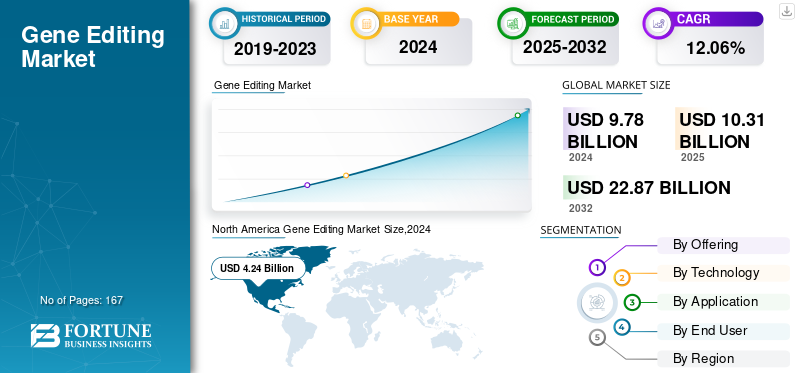
Download Free sample to learn more about this report.
Gene Editing Market Key Takeaways
 Market Size & Forecast
- 2025 Market Size: USD 10.31 Billion
- 2026 Market Size: USD 10.98 Billion
- 2034 Forecast Market Size: USD 35.02 Billion
- CAGR: 15.60% from 2026–2034
 Market Share
- North America dominated the gene editing market with a 43.35% share in 2025.
- The Products segment is projected to dominate the market with a 71.76% share in 2026.
- The CRISPR segment is expected to lead the market with a 61.58% share in 2026.
 Key Regional Highlights
Asia Pacific
Asia Pacific reached USD 2.01 billion in 2025 and is projected to grow to USD 2.16 billion in 2026.
North America
North America generated USD 4.47 billion in 2025 and is projected to reach USD 4.76 billion in 2026.
Europe
Europe accounted for USD 2.68 billion in 2025 and is expected to reach USD 2.85 billion in 2026.
U.S.
The market is projected to reach USD 4.34 billion by 2026.
Japan
The market is projected to reach USD 0.45 billion by 2026.
Read More

MARKET DYNAMICS
MARKET DRIVERS
Rising Demand of Personalized Medicine and Expanding Pipeline Candidates to Drive Market Growth
The rising demand for precision medicine, along with the rapid expansion of therapeutic pipelines, is anticipated to boost the global gene editing market growth. The growing focus on personalized medicine, driven by its effectiveness and accelerated investments in CRISPR and other gene-editing platforms, supports market growth. These technologies enable precise genomic modifications, allowing the development of curative therapies for conditions such as sickle cell disease, β-thalassemia, and various rare genetic disorders. In addition, expanding clinical trials and pipeline candidates for these conditions are anticipated to drive the market growth in the coming years. Additionally, an increasing number of approvals from regulatory bodies reiterating the safety of these gene-edited therapies further propels market growth.
- For instance, in January 2024, Vertex Pharmaceuticals Incorporated received marketing authorization from the Saudi Food and Drug Authority (SFDA) for CASGEVY (exagamglogene autotemcel [exa-cel]), a CRISPR/Cas9 gene-edited therapy, for the treatment of sickle cell disease (SCD) and transfusion-dependent beta thalassemia (TDT). Such developments are expected to drive the market growth over the forecast period.
MARKET RESTRAINTS
Shortage of Skilled Workforce to Restrict Market Growth
One of the significant factors impeding the market growth is the shortage of a skilled workforce in the market. To cater to the increasing global demand for gene editing technologies, the requirement for trained professionals capable of performing complex workflows, such as CRISPR workflows, high-throughput sequencing systems, and GMP-grade manufacturing, is needed. Developing and commercializing gene-edited therapies requires specialized expertise in molecular biology, bioinformatics, genomic engineering, and regulatory compliance. However, significant gaps in advanced research infrastructure and technical training programs are evident, resulting in a shortage of skilled workers. As a result, the limited availability of qualified researchers, technicians, and research institutes remains a key factor restraining market operations globally.
- For instance, in March 2023, the U.S. Government Accountability Office reported shortages in the number of current and projected laboratory and biomanufacturing technicians to support the development of regenerative medicine and advanced therapies.
MARKET OPPORTUNITIES
Expanding Disease Indication by Gene Editing Technology Offers Market Growth Opportunities
The increasing number of research initiatives aimed at expanding gene editing applications across a broader range of disease indications presents a strong growth opportunity for the market. As gene editing technologies are applied to a wider range of diseases, the potential patient base and treatment demand increase, directly boosting market revenues. This expansion fosters ongoing R&D, resulting in new therapeutic discoveries and shorter innovation cycles. These initiatives are supported by increasing clinical trial activity and cross-sector collaborations that accelerate the discovery process. Underscoring these factors, many key operating entities are actively focusing on their clinical trials for new product development.
- For instance, in November 2025, CorrectSequence Therapeutics Co., Ltd. completed dosing of its first patient in the Investigator-Initiated Trial (IIT) of the base-editing therapy CS-121, targeting APOC3 for chylomicronemia/hypertriglyceridemia.
MARKET CHALLENGES
Off-Target Effects of Gene Therapies Pose a Significant Challenge for Market
The off-target effects of gene therapies pose a significant challenge to the market. Unintended genetic modifications at non-target sites by gene editing tools may lead to unwanted mutations, altered gene functions, or even tumorigenic risks. These factors limit broader clinical adoption and slow the commercialization of these gene-edited therapies.
- For instance, in July 2025, NIH published a study titled ‘Off-target effects in CRISPR-Cas genome editing for human therapeutics: Progress and challenges’ reported substantial off-target genotoxicity concerns delaying its clinical translation of gene editing therapies.
GENE EDITING MARKET TRENDS
Integration of AI and Automation for Efficient Gene Editing Workflows is a Prominent Trend Observed
The integration of artificial intelligence (AI) and automation into gene editing workflows has become a prominent trend observed market landscape. These AI-driven algorithms enable faster and more precise optimization of gene-editing outcomes. Meanwhile, automation technologies streamline high-throughput experimentation, data analysis, and quality control, significantly reducing human error and processing time. Leading players are adopting AI-powered platforms and robotic systems to accelerate CRISPR screening and validation processes. This convergence of AI and automation enhances research productivity, lowers operational costs. These factors are strengthening the efficiency and scalability of gene editing solutions.
- For instance, in August 2025, Researchers from Stanford University School of Medicine, Princeton University, the University of California, Berkeley, and Google DeepMind developed CRISPR-GPT, an artificial intelligence (AI) system designed to automate and enhance CRISPR-based gene editing experiments.
Download Free sample to learn more about this report.
Segmentation Analysis
By Offering
Recurring and Considerable Spend on Products to Propel Segmental Growth
Based on the offering, the market is divided into products and services.
The products segment is projecteed to dominate the market with a share of 71.76% in 2026. The dominance of the segment is attributed to the recurring consumption of various kits, RNAs, nucleases, enzymes, transfection reagents, and other critical reagents in workflows. Various new product launches, compatible with large-scale production and automation, are expected to drive market growth. Highlighting these factors, many key companies are participating in strategic collaborations to launch innovative products and cater to increasing demand.
- For instance, in May 2025, Aldevron, in collaboration with Integrated DNA Technologies (IDT), successfully manufactured a personalized CRISPR gene editing drug product to treat an infant with urea cycle disorder (UCD).
The services segment is expected to grow at a CAGR of 14.57% during the forecast period.
To know how our report can help streamline your business, Speak to Analyst
By Technology
Varied Applications of CRISPR Technology to Drive Segmental Growth
Based on the technology, the market is segmented into CRISPR, TALENs, ZFNs, Meganucleases, and others.
The CRISPR segment is projecteed to dominate the market with a share of 61.58% in 2026. The segment's dominance can be attributed to its superior efficiency and cost-effectiveness compared to other genome editing tools. CRISPR offers higher editing efficiency, multiplexing capability, and compatibility with high-throughput workflows, which reduces development time and cost. Additionally, the increasing application of technology in therapeutics and diagnostics has led to extensive adoption across various sectors.
- For instance, in January 2025, EditCo Bio launched XDel Knockout Cells, an innovative product designed to revolutionize the field of CRISPR gene editing. By leveraging a groundbreaking guide RNA (gRNA) design strategy, XDel technology ensured robust, reliable, and reproducible gene knockout results, thereby accelerating research in functional genomics, disease modeling, and drug development. Such varied applications are expected to drive the segmental growth.
The TALENs segment is projected to grow at a CAGR of 11.13% during the study period.
By Application
Therapeutic Efficiency of Gene-Edited Therapies to Lead Segmental Growth
Based on application, the market is segmented into therapeutic, research, diagnostics, and others.
The research segment is projecteed to dominate the market with a share of 51.51% in 2026. This can be attributed to the effectiveness demonstrated by gene editing therapies for various critical conditions. With the rising global prevalence of congenital and inherited disorders, the need for precise and targeted treatment options continues to grow. Also, growing investment from pharmaceutical and biotechnology companies toward expanding clinical applications contributes to segmental growth. Furthermore, the segment is set to hold 26.5% share in 2025.
- For example, in May 2025, the Children’s Hospital of Philadelphia (CHOP) and Penn Medicine. Successfully treated a child diagnosed with severe carbamoyl phosphate synthetase 1 (CPS1) deficiency, a rare genetic disorder, with a customized CRISPR gene editing therapy. Such developments are expected to drive the segment's growth.
The diagnostics segment is projected to grow at a CAGR of 14.05% during the study period.
By End User
Surging Need for Therapeutic Applications in Pharmaceutical and Biotechnology Companies Boosted Segment Growth
Based on end user, the market is segmented into pharmaceutical & biotechnology companies, research & academic institutes, CROs & CDMOs, and others.
Pharmaceutical & biotechnology companies led the market in 2024. These companies utilize various gene editing products at a large scale for the development of various therapeutic applications. Additionally, these companies are increasingly investing in the advancement of their infrastructure, thereby maximizing their commercialization capabilities. Furthermore, the pharmaceutical and biotechnology companies segment is set to hold a 45.51% share in 2026.
- For instance, in September 2025, YolTech Therapeutics received USD 45.0 million in funding from the AstraZeneca-CICC healthcare investment fund. The development aimed to support the advancement of YolTech's clinical programs and global strategic execution.
The research & academic institutes segment is projected to grow at a CAGR of 10.36% during the study period.
Gene Editing Market Regional Outlook
By geography, the market is categorized into Europe, North America, Asia Pacific, Latin America, and Middle East & Africa.
North America
The market in North America reached USD 4.47 Billion in 2025, representing 43.35% of total market revenue, and is projected to reach USD 4.76 Billion in 2026. The leading position of North America was attributed to robust infrastructure, along with increasing investment activities in the region. Also, the presence of leasing companies and favorable government policies strengthened the market dominance. Additionally, strategic collaboration among biotechnology and pharmaceutical companies in the region is necessary to further drive regional growth. Similarly, in the U.S., strategic collaboration and increasing investment by key companies are expanding research and development to boost market growth. The U.S. market is valued at USD 4.34 billion by 2026.
North America Gene Editing Market Size,2025 (USD Billion)
To get more information on the regional analysis of this market, Download Free sample
- For instance, in April 2024, Regeneron Pharmaceuticals, Inc., collaborated with Mammoth Biosciences, Inc., to develop and commercialize in vivo CRISPR-based gene editing therapies for multiple tissues and cell types. In 2025, the U.S. market is estimated to reach USD 2.03 billion.
Europe
Other regions, such as Europe, are expected to experience notable growth in the coming years. During the forecast period, Europe contributed approximately USD 2.68 Billion to the global market in 2025, accounting for 25.97% share, and is expected to reach USD 2.85 Billion in 2026. The growth in the region is attributed to the expansion of the rising demand for precision medicine and favorable government policies. Backed by these factors, countries including the U.K. market is valued at USD 0.60 billion by 2026, while the Germany market is valued at USD 0.68 billion by 2026.
Asia Pacific
In 2025, the Asia Pacific market stood at USD 2.01 Billion, representing 19.47% of global demand, and is projected to grow to USD 2.16 Billion in 2026, China and India are both estimated to reach USD 0.55 billion and USD 0.29 billion, respectively, in 2025. The growth in the Asia Pacific region is driven by increasing collaboration between governments and pharmaceutical companies. The Japan market is valued at USD 0.45 billion by 2026, the China market is valued at USD 0.60 billion by 2026, and the India market is valued at USD 0.31 billion by 2026.
Latin America & Middle East & Africa
Middle East & Africa maintained a strong presence in the global market, reaching USD 0.55 Billion in 2025, accounting for 5.34% share, and is expected to reach USD 0.57 Billion in 2026. The Latin America market accounted for USD 0.6 Billion in 2025, representing 5.87% of the global industry, and is expected to reach USD 0.63 Billion in 2026. Increasing collaboration among academics and rising awareness of genomic medicines are expected to drive market growth in these regions further. In the Middle East & Africa, the GCC is set to reach a value of USD 0.23 billion by 2025.
COMPETITIVE LANDSCAPE
Key Industry Players
Strategic Acquisitions by Key Players to Cater to Increasing Demand and Propel Market Growth
The global gene editing market has a semi-consolidated market structure, comprising prominent players such as Thermo Fisher Scientific Inc., Agilent Technologies, Inc., and GenScript, among others. The significant market share of these companies is due to numerous new product launches. Acquisitions, technological advancements, and strategic activities, including collaborations, acquisitions, and capacity expansion.
- For instance, in July 2024, Agilent Technologies Inc. acquired BIOVECTRA, a leading specialized contract development and manufacturing organization, for USD 925.0 million. The acquisition expanded the company’s CDMO specialization in oligonucleotides and CRISPR therapeutics.
Other notable players in the global market include Takara Bio Inc., Precision BioSciences Creative Biogene. These companies are expected to prioritize the new product launches to increase their global market share during the forecast period.
LIST OF KEY GENE EDITING COMPANIES PROFILED:
- Thermo Fisher Scientific Inc. (U.S.)
- Agilent Technologies, Inc. (U.S.)
- GenScript (China)
- Revvity, Inc. (U.S.)
- Takara Bio Inc. (Japan)
- Precision BioSciences (U.S.)
- Creative Biogene (U.S.)
- Regeneron Pharmaceuticals Inc. (U.S.)
- Bio-Techne (U.S.)
- Danaher Corporation (U.S.)
KEY INDUSTRY DEVELOPMENTS
- November 2025: SOHM, Inc. received FDA commentary and industry analyses signaling continued evolution of regulatory pathways for genome-editing technologies. These developments highlighted increasing regulatory focus on precision-engineered genetic tools, non-viral delivery approaches, and scalable manufacturing frameworks.
- November 2022: Ionis Pharmaceuticals, Inc. collaborated with Metagenomi to leverage the company’s extensive expertise in RNA-targeted therapeutics and Metagenomi's versatile next-generation gene editing systems to pursue a mix of validated and novel genetic targets that have the potential to expand therapeutic options for patients.
- June 2022: Precision BioSciences, Inc., collaborated with Novartis Pharma AG to develop a custom ARCUS nuclease designed to insert, in vivo, a therapeutic transgene at a safe harbor location in the genome as a potential one-time transformative treatment option for diseases, including certain hemoglobinopathies such as sickle cell disease and beta thalassemia.
- October 2021: ElevateBio, LLC acquired AgBiome Delta, LLC’s Life Edit Therapeutics, Inc. Life Edit offered a powerful suite of gene editing technologies that have the potential to remove, add, or alter any genomic sequence of interest. The development enhanced the company’s genome editing capabilities as well as its iPSC, viral vector, and cell engineering platforms.
- October 2020: Merck KGaA collaborated with PanCELLa and Takara Bio USA, Inc., to accelerate research leading to the development of new therapies.
REPORT COVERAGE
The global gene editing market analysis provides a detailed study of the market size & forecast by all the market segments included in the report. The report also provides insights into market dynamics and trends expected to drive the market during the forecast period. The global market report also comprises key aspects, such as an overview of technological advancements, product launches, insights on strategic partnerships, mergers & acquisitions, and key industry developments by key regions. The global market forecast also provides a detailed competitive landscape, including market share and profiles of major industry players.
Request for Customization to gain extensive market insights.
Report Scope & Segmentation
| Attribute | Details |
| Study Period | 2021-2034 |
| Base Year | 2025 |
| Forecast Period | 2026-2034 |
| Historical Period | 2021-2024 |
| Growth Rate | CAGR of 15.60% from 2026-2034 |
| Unit | Value (USD Billion) |
| Segmentation | By Offering, Technology, Application, End User, and Region |
| By Offering |
|
| By Technology |
|
| By Application |
|
| By End User |
|
| By Region |
|
Frequently Asked Questions
Fortune Business Insights states that the global market value stood at USD 10.31 billion in 2025 and is projected to reach USD 35.02 billion by 2034.
In 2025, the market value stood at USD 4.47 billion.
The market is expected to exhibit a CAGR of 15.60% during the forecast period of 2026-2034.
The products segment led the market in terms of offering.
The increasing focus on personalized medicine is driving market growth
Thermo Fisher Scientific Inc., Agilent Technologies, Inc., and GenScript are among the major players in the global market.
North America dominated the market in 2025.



- 2021-2034
- 2025
- 2021-2024
- 167
Get 30-60 hrs Free Customization
Expand Regional and Country Coverage, Segments Analysis, Company Profiles, Competitive Benchmarking, and End-user Insights.













.webp)






Related Reports
-
US +1 833 909 2966 ( Toll Free )
-
Get In Touch With Us