Germany Cloud Computing Market Size, Share & Analysis, By Type (Public Cloud, Private Cloud, and Hybrid Cloud), By Service (Infrastructure as a Service (IaaS), Platform as a Service (PaaS), and Software as a Service (SaaS)), By Enterprise Type (SMEs and Large Enterprises), By Industry (BFSI, IT and Telecommunications, Government, Consumer Goods and Retail, Healthcare, Manufacturing, and Others) and Regional Forecast, 2025-2032
 Download Free Sample
KEY MARKET INSIGHTS
 Listen to Audio Version
Germany cloud computing market size was valued at USD 41.10 billion in 2024. The market is projected to grow from USD 53.94 billion in 2025 to USD 128.29 billion by 2032, exhibiting a CAGR of 15.40% over the forecast period.
Germany's cloud computing sector is changing quickly, driven by a focus on digital transformation and a commitment to data sovereignty. Businesses nationwide are developing customized cloud strategies that prioritize security, compliance, and operational efficiency. The market features a strong mix of local innovation and partnerships with global technology providers. Cloud solutions are playing a key role in developments in areas like Industry 4.0, digital health services, and artificial intelligence. This positions Germany as a leader in creating a connected and future-ready digital economy.
- Germany has become Europe’s biggest cloud computing market, growing rapidly at around 25% each year.
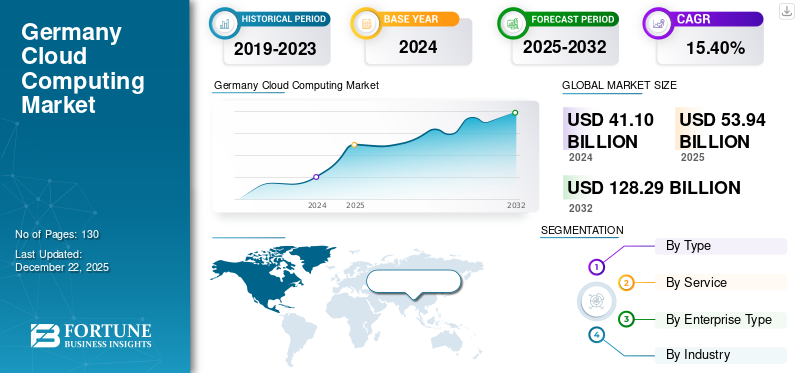
Download Free sample to learn more about this report.
Germany Cloud Computing Market Trends
Advancements in Cloud Storage and Networking to be the Key Driver for Market Growth
Improvements in cloud storage, such as object storage and hybrid storage solutions, are helping businesses manage large and varied data more efficiently. Object storage allows for flexible and scalable organization of unstructured data, like media files and backups. Hybrid storage combines on-premises and cloud resources to provide a balance between security and scalability. On the networking side, the rollout of 5G is significantly boosting cloud connectivity. It offers faster speeds, lower latency, and more reliable connections. This makes cloud applications run more smoothly, supports real-time data processing, and creates new opportunities for technologies like IoT and edge computing.
Key takeaways
- The Germany Cloud Computing Market is projected to be worth USD 128.29 billion in 2032.
- By type segmentation, public cloud accounted for around 59.4% of the Germany Cloud Computing Market in 2024.
- In the by service segmentation, Infrastructure as a Service (IaaS) is projected to grow at a CAGR of 17.5% during the forecast period.
- In the enterprise type segmentation, Large Enterprises accounted for around 55.70% of the market in 2024.
Germany Cloud Computing Growth Factors
Growing Demand for AI and Big Data Analytics to Boost Market Growth
Rapid improvements in AI, IoT, and big data analytics data analytics are pushing German organizations to move to cloud platforms that can handle real-time data processing and compute-heavy tasks. Key sectors like manufacturing, healthcare, automotive, and retail are relying more on cloud solutions to manage large amounts of data, allow for predictive analytics, and encourage automation. This trend supports quicker innovation cycles, improves operational efficiency, and provides scalable resources that help businesses remain competitive in a technology-driven market.
- Germany’s 108 million active mobile connections in early 2025, surpassing the population at 128% penetration, highlight the rapid rise in data generation, driving strong demand for cloud computing solutions.
Germany Cloud Computing Market Restraints
Fragmented Compliance Requirement Across Industries Limits Market Growth
In Germany, compliance requirements for cloud computing extend well beyond the General Data Protection Regulations (GDPR). Sectors like finance, healthcare, and government must follow specific rules. This includes BaFin’s strict IT standards for financial institutions and strong data protection measures for handling sensitive medical data. These regulations can differ greatly between industries, resulting in a complicated and fragmented compliance environment. Consequently, cloud service providers must tailor their solutions to meet these specific needs. This customization leads to higher costs, slower deployment times, and less scalability.
Germany Cloud Computing Market Segmentation Analysis
By Type
Based on type analysis, the market is divided into public, private, and hybrid.
In Germany, public cloud solutions hold the majority in the market as they are affordable, set up quickly, and can grow with business needs. As companies seek digital growth, many choose public cloud platforms for their simplicity and efficiency. At the same time, hybrid cloud is expected to grow with the highest CAGR as organizations want to keep better control over sensitive data while still taking advantage of cloud technology. Due to strict data protection laws and specific compliance rules, German businesses are increasingly mixing on-premises infrastructure with cloud services to find a balance between control, flexibile, and regulatory requirements.
By Service
Based on service analysis, the market is segregated into infrastructure as a service, platform as a service, and software as a service.
Software as a Service (SaaS) is expected to hold a majority in the market. Companies are increasingly using ready-made cloud applications to improve operations, enhance collaboration, and reduce internal IT complexity. The benefits of quick deployment and simplicity make SaaS a popular option for both small and medium-sized enterprises (SMEs) and large companies. At the same time, Infrastructure as a Service (IaaS) is expected to grow with the highest CAGR as businesses invest in flexible, on-demand infrastructure to support advanced computing, big data projects, and fast-changing digital needs.
By Enterprise Type
Based on enterprise type, the market is segmented into Large Enterprises and SMEs.
In Germany, large companies hold a majority in adopting cloud technology. They use these technologies to improve scalability, simplify operations, and speed up innovation in sectors like manufacturing, finance, and automotive. Recently, small and medium-sized enterprises (SMEs) have started to adopt cloud solutions more quickly. Attracted by the cost effective, flexibility, and user-friendly nature of modern cloud services, SMEs see the benefits that cloud offers for their digital growth.
- A survey shows that nearly 97% of German businesses with 50 or more employees are now using cloud computing as part of their operations.
By Industry
Based on industry, the market is segmented into BFSI, IT and Telecom, Government, Consumer Goods, Healthcare, Manufacturing, and Others.
Cloud computing in Germany is becoming more popular as industries see its value. The IT and Telecom sector is expected to hold a majority in the market as cloud platforms help improve network performance, support real-time services, and manage data growth. In healthcare, the move toward digital patient care and AI-supported diagnostics is pushing providers to choose secure and flexible cloud solutions. Even traditional sectors like manufacturing and logistics are updating their processes with cloud-based tools for automation and supply chain management.
List of Key Companies in the Germany Cloud Computing Market
In Germany’s cloud computing market, leading players like SAP SE, IONOS, Hetzner Online, and Bechtle are driving innovation and adoption in various sectors. SAP SE, recognized for its expertise in enterprise software, provides cloud solutions designed for large organizations pursuing digital transformation and streamlined business processes. IONOS emphasizes scalable and easy-to-use cloud services for startups and small to medium-sized businesses, assisting them with flexible infrastructure options.
Hetzner Online is known for its reliable and affordable hosting and cloud services. This makes it a popular choice for businesses that prioritize efficient performance and data privacy within Germany. At the same time, Bechtle offers a wide range of IT services and cloud solutions. They aim at enterprises with tailored strategies that meet specific industry and compliance needs.
LIST OF KEY COMPANIES STUDIED:
- SAP SE (Germany)
- IONOS (Germany)
- Hetzner Online Gmbh (Germany)
- Bechtle AG (Germany)
- CANCOM (Germany)
- StackIT (Germany)
- Nordcloud (Germany)
- Plusserver (Germany)
- LeaseWeb (Germany)
- Instinctools (Germany)
- Colobridge Gmbh (Germany)
- Pwrteams (Germany)
KEY INDUSTRY DEVELOPMENTS
- July 2025: Oracle has announced a USD 2 billion investment over the next five years to expand its AI and cloud infrastructure in Germany. This initiative will significantly grow Oracle Cloud Infrastructure (OCI) in Frankfurt, supporting both public and private sector organizations with advanced AI capabilities, sovereign cloud solutions, and multicloud services.
- June 2025: Nvidia and Deutsche Telekom have launched Europe’s first industrial AI cloud in Germany, aimed at supporting manufacturing, robotics, and digital simulation through high-performance computing. Operated by Deutsche Telekom, the AI factory’s first phase will deploy 10,000 Nvidia GPUs to power advanced industrial applications.
REPORT COVERAGE
This report provides an in-depth analysis of the cloud computing landscape in Germany, examining key developments, market dynamics, and emerging trends. It explores the growing adoption of hybrid and multi-cloud strategies driven by the demand for flexibility and enhanced data governance. The study highlights how Germany's strict data protection regulations are shaping cloud deployment decisions across industries. It also covers sector-specific adoption in finance, healthcare, and manufacturing, where cloud technologies are being leveraged to drive efficiency and innovation. Additionally, the report evaluates strategic partnerships, government initiatives, and the rise of next-generation cloud services that are collectively defining the future of Germany’s digital economy.
Request for Customization to gain extensive market insights.
Report Scope & Segmentation
|
ATTRIBUTE |
DETAILS |
|
Study Period |
2019-2032 |
|
Base Year |
2024 |
|
Estimated Year |
2025 |
|
Forecast Period |
2025-2032 |
|
Historical Period |
2019-2023 |
|
Growth Rate |
CAGR of 15.40% from 2025 to 2032 |
|
Unit |
Value (USD Billion) |
|
Segmentation |
By Type · Public Cloud · Private Cloud · Hybrid Cloud |
|
By Service · Infrastructure as a Service (IaaS) · Platform as a Service (PaaS) · Software as a Service (SaaS) |
|
|
By Enterprise Type · SMEs · Large Enterprises |
|
|
By Industry · BFSI · IT and Telecommunications · Government · Consumer Goods and Retail · Healthcare · Manufacturing · Others |
Frequently Asked Questions
Fortune Business Insights says that the Germany cloud computing market was worth USD 41.10 billion in 2024.
The market is expected to exhibit a CAGR of 15.40% during the forecast period of 2025-2032.
By industry, the IT and Telecommunications industry is set to lead the market.
SAP SE, IONOS, Hetzner Online, and Bechtle AG are the leading players in the market.



- 2019-2032
- 2024
- 2019-2023
- 130
Get 30-60 hrs Free Customization
Expand Regional and Country Coverage, Segments Analysis, Company Profiles, Competitive Benchmarking, and End-user Insights.




















Related Reports
-
US +1 833 909 2966 ( Toll Free )
-
Get In Touch With Us