Gift Card Market Size, Share & Industry Analysis, By Card Type (Closed Loop and Open Loop), By Card Format (Physical and Digital), By End-Use (Consumer Gifting, Corporate Rewards & Incentives, and Government/Welfare Prepaid), By Distribution Channel (Online Channels and Offline/In-store Channels), By Redemption Category (Retail, Food & Beverage, Entertainment & Gaming, Travel & Hospitality, and Others), and Regional Forecast, 2026-2034
 Download Free Sample
(Offer valid till 30th Sep 2026)

KEY MARKET INSIGHTS
 Listen to Audio Version
The global gift card market size was valued at USD 1,400.09 billion in 2025 and is projected to grow from USD 1,491.31 billion in 2026 to USD 2,221.03 billion by 2034, exhibiting a CAGR of 5.11% during the forecast period. Asia Pacific dominated the global gift card market with a market share of 37.76% in 2025.
Gifting cards are the stored-value cards that can be used to purchase goods or services at retailers & other public shopping settings. They are emerging as a popular gifting item among consumers globally. The growing internet penetration and increasing number of youngsters opting for virtual payments are driving the demand for such products. In addition, the consistent businesses’ allocation of physical or digital cards to their team members as a part of employee engagement activity is favoring the global market growth.
The prominent players operating in the global market include Amazon.com, Inc., Blackhawk Network Holdings, Inc. (BHN), Apple Inc., InComm Payments, and Mastercard Inc. These companies invest in conducting innovations in the digital redemption, mobile wallet integration, and corporate incentive program support to increase their e-gift product sales.
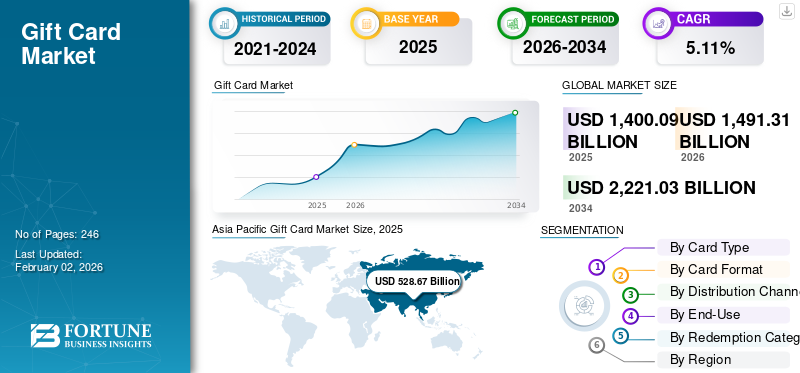
Download Free sample to learn more about this report.
Gift Card Market Key Takeaways
 Market Size & Forecast
- 2025 Market Size: USD 1,400.09 billion
- 2026 Market Size: USD 1,491.31 billion
- 2034 Forecast Market Size: USD 2,221.03 billion
- CAGR: 5.11% from 2026–2034
 Market Share
- Asia Pacific dominated the market with a 37.76% share in 2025.
- Closed Loop segment held 62.34% market share in 2025.
- Consumer Gifting segment accounted for 60.84% market share in 2025.
 Key Regional Highlights
North America
North America held the second-largest market share.
Asia Pacific
Asia Pacific led the market with a 37.76% share in 2025.
Europe
Europe was valued at USD 265.46 billion in 2025.
U.S.
The U.S. market reached USD 310.20 billion in 2025.
Rest of the World
The Rest of the World is expected to witness the fastest growth, led by the Middle East & Africa region.
Read More

MARKET DYNAMICS
MARKET DRIVERS
Retailers’ Consistent Integration of Consumer Loyalty and Cashbacks with Gifting Cards to Drive Market Growth
Retailers and other merchants increasingly offer loyalty and cashback cards to enhance their value proposition to their customers. Increasing number of retailers offering loyalty and cashback in the form of gifting cards is driving the global gift cards market growth. Furthermore, advancements in the development of digital payment systems and gateways to enable customers to use received cards from merchants smoothly are positively contributing to the market revenue growth.
MARKET RESTRAINTS
Risk of Fraud and Security Vulnerabilities Associated with Gifting Cards to Restrain Market Growth
Increasing incidences of misuse of gifting cards, including money laundering, card cloning, and credential theft, lead to the minimal usage of such products, restraining the global market growth. In addition, the increasing risk of fraudulent code-encrypted physical cards is incurring additional costs to the retailers, negatively impacting the market growth.
MARKET OPPORTUNITIES
Increasing Smartphone and Digital Wallet Adoption to Create Opportunities for Market Growth
Increasing smartphone and digital wallet adoption is expected to increase the consumers’ usage of redemption cards to convert card value into wallet money, creating newer market growth opportunities. According to the GSM Association, the percentage of smartphones connected among the total global population is expected to increase from 80% in 2024 to 91% by 2030. In addition, the growing manufacturers’ incorporation of the QR code features in the digital cards to make such products user-friendly and convenient is favoring the global market growth.
MARKET CHALLENGES
Uncertain Regulatory Compliance and Legal Complexities to Challenge Key Players’ Business Revenue Growth
A few global markets restrict or ban the expiry dates and inactivity fees of the cards to protect consumers under certain conditions. Uncertain legal complexities and regulatory compliance associated with the digital cards are posing challenges to the key players conducting business operations in the international markets. In addition, uncertain policies or continuous policy updates associated with digital cards are limiting their usage among consumers.
GIFT CARD MARKET TRENDS
Evolving Corporate Gifting and Employee Wellness Trend to Favor Market Growth
The evolving corporate gifting trend involving the incentivizing of employees in the form of vouchers and gifting cards, coupled with the growing corporate sector, is favoring the global market growth. In addition, increasing corporate firms’ implementation of employee wellness programs to reward employees with seasonal bonuses in the form of redemption cards is accelerating the gift card market growth.
Download Free sample to learn more about this report.
Segmentation Analysis
By Card Type
Wider Adoption of Closed Loop-based Gifting Cards Among Retailers Led to the Dominance of the Closed Loop Segment
By card type, the market is bifurcated into closed loop and open loop.
The closed-loop gifting cards are the prepaid cards that are restricted to a specific merchant, ecosystem, or brand. Through closed-loop-based card types, businesses retain spending within their network and better reduce revenue leakage. The closed-loop segment exhibited a leading global gift card market share of 62.34% in 2025. The segment’s major share is attributed to the wider adoption of closed-loop system-based cards among brands, retailers, and other businesses globally.
The open loop-based cards’ greater flexibility, broad usability, and better integration capability with other financial ecosystems mainly drive the open loop segment is projected to grow at the fastest rate of 5.68% during 2026-2034. Furthermore, the rising demand for the reloadable prepaid cards exhibiting open-loop type’s gifting card capabilities is favoring the segment’s growth.
To know how our report can help streamline your business, Speak to Analyst
By Card Format
Greater Adoption of Physical Card Among Retail Environment Steered the Leading Share of the Physical Segment
Based on the card format, the market is segmented into physical and digital.
The physical segment exhibited a leading global market share of 54.23% in 2025. The segment is projected to grow at the fastest rate of 5.62% from 2026 to 2034. The segment’s leading share is attributed to the greater physical card adoption in the retailer environment for in-store gifting and impulse purchases. Furthermore, consistent corporate settings’ implementation of bulk gifting programs involving the provision of physical cards to employees is driving the physical segment’s growth.
Rising smartphone adoption and increasing consumer preference for contactless & instant transactions that support the usage of digital cards are driving the digital segment’s growth. In addition, consistent card-gifting companies’ provision of custom messages, animated agreements, designs, and scheduling to the users to enhance their gifting experience is positively contributing to the segment’s growth.
By Distribution Channel
Significant Retailers' Utilization of Online Platforms to Deliver Cards Drives the Online Channels Segment’s Growth
Based on the distribution channel, the market is bifurcated into online channels and offline/in-store channels.
Online channels’ segment exhibited a leading global market share of 61.22% in 2025. The segment’s leading share is attributed to the significant businesses’ utilization of online retailing platforms and websites to provide gifting cards to their customers. The major online platforms the businesses use are retailers’ websites, digital marketplaces, digital apps, and fintech portals. Increasing online portals integration with digital wallets, QR code payments, and mobile banking systems is enhancing the card usage from online channels, driving the segmental revenue growth at a fastest rate of 5.58% during 2026-2034.
Many consumers receive gifting cards directly from retailing shops when they purchase items. Consumers prefer examining items’ designs & features before making a purchasing decision at offline stores, generating significant sales of gifting cards that retailers, along with shop goods, sell. Consistent shopping malls’ provision of discounted coupons and gifting cards as a part of their sales promotional activities is positively contributing to the offline/in-store channels segmental growth.
By End-Use
Greater Individual Consumers’ Adoption of Cards as a Gifting Option Led to the Dominance of Consumer Gifting
Based on end-use, the market is segmented into consumer gifting, corporate rewards & incentives, and government/welfare prepaid.
The consumer gifting segment exhibited a leading global market share of 60.84% in 2025. The segment is projected to grow at the fastest rate of 5.38% during 2026-2034. Personalized gift cards provide better flexibility and convenience in usage over traditional forms of gifting options. The consumer gifting segment’s leading share is attributed to the high individual consumers’ adoption of gifting cards over traditional gifting options. In addition, increasing gift-giving and festival celebration trends are expected to increase gifting card purchases by individual customers, driving the consumer gifting segment’s growth.
Increasing corporate firms’ adoption of gift cards to use them further in their company’s rewards and recognition activities is mainly driving the corporate rewards & incentives segmental growth. Furthermore, shifting firms’ preference toward digital and automated gifting solutions is driving the segmental revenue growth.
By Redemption Category
High Gift Card Purchases of Retailers’ Environment Propels the Governance of Retail Segment
Based on redemption category, the market is segmented into retail, food & beverage, entertainment & gaming, travel & hospitality, and others.
The retail segment exhibited a leading global market share of 54.33% in 2025. The segment’s leading share is attributed to the high retailers’ demand for gifting cards to sell them with their regular goods, including consumer electronics, home goods, beauty products, etc. Furthermore, consistent Amazon, Walmart, and other retailers’ provision of gifting cards as a part of their customer acquisition and loyalty strategies is accelerating the retail segment’s growth.
The entertainment & gaming segment is projected to grow at the fastest rate of 6.69% during 2026-2034. The segment’s fastest growth is attributed to the rapid expansion of entertainment platforms, online gaming ecosystems, and subscription-based content services globally. Consistent PlayStation Network, Xbox Live, and other platforms provision of digital cards to encourage players to achieve better performance in gaming is driving the segment’s growth.
Gift Card Market Regional Outlook
By geography, the market is categorized into North America, Europe, Asia Pacific, South America, and Middle East & Africa.
Asia Pacific
Asia Pacific Gift Card Market Size, 2025 (USD Billion) To get more information on the regional analysis of this market, Download Free sample
The Asia Pacific region exhibited a leading global market share of 37.76% in 2025. The region’s market size is expected to reach USD 565.80 billion in 2026. Increasing usage of mobile-first payment platforms and rising smartphone adoption are accelerating the market growth across India, China, and Southeast Asia. Furthermore, rising demand for app-based services and online gaming is driving the sales of digital cards across the region.
North America
The North American region exhibited a second-leading global market share in 2025. Greater consumers’ acceptance of gifting cards as a mode of farewell-giving option and robust digital payment infrastructure is positively contributing to the market revenue generation across the North American region. Increasing consumer spending on seasonal shopping events, including Christmas, Black Friday, and others, is driving the region’s market growth.
The U.S. market size reached USD 310.20 billion in 2025. A wider retailer network and increasing consumers’ usage of gifting cards on dining, entertainment, and e-commerce platforms are driving the U.S. market growth. In addition, evolving gift-giving and festival celebration trends are driving the sales of such products across the U.S.
Middle East & Africa
The Middle East & Africa region is projected to grow at the fastest rate of 6.54% during 2026-2034. Rising smartphone adoption and consistent implementation of government-backed cashless payment initiatives in the UAE and Saudi Arabia are mainly driving the region’s market growth. In addition, expanding corporate infrastructural facilities and significant corporate firms’ spending on employee wellness programs are favoring the region’s market growth.
Europe
The European region held a third-leading global market share in 2025. The European market size reached USD 265.46 billion in 2025. Mature corporate gifting landscape and robust adoption of online payment solutions are generating considerable market revenues across Western Europe. Expanding retail infrastructural facilities and increasing internet penetration are positively contributing to the market growth across Russia and the Eastern European region.
South America
Increasing corporate firms’ provision of rewards in the form of coupons, gifting cards, and vouchers to their employees is mainly driving South American market growth. In addition, consistent key players’ partnerships with retailer networks to provide gifting cards are further favoring market growth across the region. In the South American region, the Brazilian market size reached USD 75.37 billion in 2025.
COMPETITIVE LANDSCAPE
Key Industry Players
Consistent Focus on Expanding Network of Product Distribution to Help Key Players Build Market Positions
The global market is characterized by key companies, including Amazon.com, Inc., Blackhawk Network Holdings, Inc. (BHN), Apple Inc., InComm Payments, and Mastercard Inc. These companies focus on building a retailer network to increase their sales of open-loop system-based products across markets. In addition, they partner with banks and fintech firms for continuous product innovation and scalability.
LIST OF KEY GIFT CARD COMPANIES PROFILED
- com, Inc. (U.S.)
- Blackhawk Network Holdings, Inc. (BHN) (U.S.)
- Apple Inc. (U.S.)
- InComm Payments (U.S.)
- Mastercard Inc. (U.S.)
- Walmart Inc. (U.S.)
- Fiserv, Inc. (U.S.)
- Starbucks Corporation (U.S.)
- Qwikcilver Solutions Pvt. Ltd. (India)
- PayPal Holdings, Inc. (U.S.)
KEY INDUSTRY DEVELOPMENTS
- December 2025: VoucherCart, a global provider of gifting card and voucher technology solutions, announced its integration with Lightspeed Restaurant (K-Series) POS to enable venues to sell and redeem digital and physical gifting cards.
- August 2025: Fold, a Bitcoin personal finance app, partnered with Blackhawk Network (BHN), a gifting card and incentive platform, to distribute the Fold Bitcoin Gifting Card to its customers.
- August 2025: Cinépolis India, in partnership with Pine Labs Private Limited, launched all-digital Cinépolis Gifting Cards in the Indian market.
- October 2022: InComm Payments, a global pay-tech company, acquired Card Network (TCN), an Australian multi-brand gifting card provider, to expand its business across Australia.
- September 2022: Pine Labs Private Limited, an Indian merchant commerce omnichannel platform, established a merger agreement with Qwikcilver Solutions Private Limited to strengthen its distribution of prepaid, stored value, and gifting cards across foreign markets.
REPORT COVERAGE
Request for Customization to gain extensive market insights.
Report Scope & Segmentation
|
ATTRIBUTE |
DETAILS |
|
Study Period |
2021-2034 |
|
Base Year |
2025 |
|
Estimated Year |
2026 |
|
Forecast Period |
2026-2034 |
|
Historical Period |
2021-2024 |
|
Growth Rate |
CAGR of 5.11% from 2026-2034 |
|
Unit |
Value (USD Billion) |
|
Segmentation |
By Card Type · Closed Loop · Open Loop |
|
By Card Format · Physical · Digital |
|
|
By Distribution Channel · Online Channels · Offline/In-store Channels |
|
|
By End-Use · Consumer Gifting · Corporate Rewards & Incentives · Government/Welfare Prepaid |
|
|
By Redemption Category · Retail · Food & Beverage · Entertainment & Gaming · Travel & Hospitality · Others |
|
|
By Region · North America (By Card Type, Card Format, Distribution Channel, End-Use, Redemption Category, and Country) o U.S. (By Card Type) o Canada (By Card Type) o Mexico (By Card Type) · Europe (By Card Type, Card Format, Distribution Channel, End-Use, Redemption Category, and Country) o Germany (By Card Type) o France (By Card Type) o Italy (By Card Type) o Spain (By Card Type) o U.K. (By Card Type) o Russia (By Card Type) o Rest of Europe (By Card Type) · Asia Pacific (By Card Type, Card Format, Distribution Channel, End-Use, Redemption Category, and Country) o China (By Card Type) o India (By Card Type) o Japan (By Card Type) o Australia (By Card Type) o Rest of Asia Pacific (By Card Type) · South America (By Card Type, Card Format, Distribution Channel, End-Use, Redemption Category, and Country) o Brazil (By Card Type) o Argentina (By Card Type) o Rest of South America (By Card Type) · Middle East & Africa (By Card Type, Card Format, Distribution Channel, End-Use, Redemption Category, and Country) o South Africa (By Card Type) o UAE (By Card Type) · Rest of the Middle East & Africa (By Card Type) |
Frequently Asked Questions
Fortune Business Insights says that the global market value stood at USD 1,400.09 billion in 2025 and is projected to reach USD 2,221.03 billion by 2034.
In 2025, the market value stood at USD 528.67 billion.
At a CAGR of 5.11%, the market is expected to grow during the forecast period.
By card type, the closed-loop segment is expected to exhibited a leading global market share throughout the forecast period.
The retailers consistent integration of consumer loyalty and cashbacks with gifting cards is set to drive the global market.
Amazon.com, Inc., Blackhawk Network Holdings, Inc. (BHN), Apple Inc., InComm Payments, and Mastercard Inc. are among the prominent players in the market.
Asia Pacific dominated the market in 2025.
The increasing smartphone and digital wallet adoption to create opportunities for digital gift cards is expected to favor the adoption rate of these services.



- 2021-2034
- 2025
- 2021-2024
- 246
-
(Offer valid till 30th Sep 2026)
Get 30-60 hrs Free Customization
Expand Regional and Country Coverage, Segments Analysis, Company Profiles, Competitive Benchmarking, and End-user Insights.



















Related Reports
-
US +1 833 909 2966 ( Toll Free )
-
Get In Touch With Us