Green Hydrogen Production Equipment Market Size, Share & Industry Analysis, By Equipment Type (Electrolyzer Stacks & Modules, Water Treatment Systems, Power Conversion Systems, and Gas Purification Systems), By Installation Type (Indoor Fixed, Outdoor Fixed, Containerized Modular, and Mobile Systems), By Power Integration (Grid-Connected, Direct-Coupled Solar, and Direct-Coupled Wind), By Energy Storage Integration (Non-Dedicated and Dedicated Storage), By End User (Utilities, Mobility & Refueling, Captive Industrial Users, and Merchant H2 Producers), and Regional Forecast, 2026-2034
 Download Free Sample
Green Hydrogen Production Equipment Market Size and Future Outlook
 Listen to Audio Version
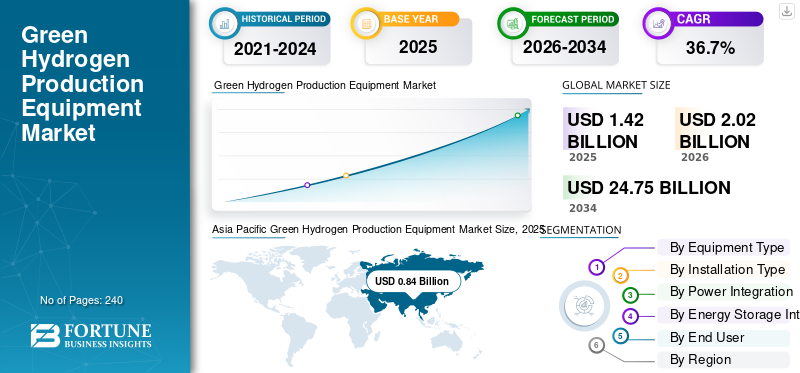
The global green hydrogen production equipment market size was valued at USD 1.42 billion in 2025. The market is projected to grow from USD 2.02 billion in 2026 to USD 24.75 billion by 2034, exhibiting a CAGR of 36.7% during the forecast period. Asia Pacific dominated the green hydrogen production equipment market with a market share of 59.15% in 2025.
The global market is positioned for strong long-term growth as governments, utilities, and industrial companies accelerate the energy transition and reduce dependence on fossil fuels. Green hydrogen production uses electrolyzer to split water into hydrogen and oxygen using electricity generated from renewable energy sources, creating hydrogen produced with significantly lower greenhouse gas emissions. Rising investment in clean energy, infrastructure development, and large-scale hydrogen facilities is expanding the market size across the world.
Key companies, including thyssenkrupp nucera, Nel Hydrogen, Siemens Energy, Plug Power, ITM Power, John Cockerill Hydrogen, Bloom Energy, LONGi Hydrogen, Accelera by Cummins, and Enapter, are investing in capacity expansion, technology development, localization, and strategic partnerships to secure large-scale projects. Major suppliers such as Siemens Energy and Nel ASA are strengthening electrolyzer manufacturing, modular system design, digital controls, and balance-of-plant capabilities to support new green hydrogen projects. Demand is particularly strong in refining, ammonia, chemicals, steel, maritime fuels, and energy systems where direct electrification is difficult. Improving production efficiency, greater manufacturing scale, and standardized equipment platforms are also expected to make green hydrogen solutions more cost effective.
Future market expansion will depend on reliable renewable power availability, supportive policy frameworks, hydrogen transport infrastructure, and firm long-term purchase agreements. Large-scale hydrogen projects are expected to create substantial demand for electrolyzer stacks, water treatment systems, power conversion equipment, gas purification units, compressors, storage integration, and safety controls. Green hydrogen will also support hydrogen fuel cell applications, including fuel cell vehicles, backup power systems, and distributed clean energy solutions. The Middle East is emerging as a major production and export hub due to low-cost solar resources, while Europe and Asia are advancing industrial decarbonization programs. Although high capital costs and limited infrastructure remain challenges, technology improvements, project standardization, and rising private investment are expected to strengthen commercial viability and support sustained market growth.
Download Free sample to learn more about this report.
Green Hydrogen Production Equipment Market KEY TAKEAWAYS
 Global Market Size & Forecast
- 2025 Market Size: USD 1.42 billion
- 2026 Market Size: USD 2.02 billion
- 2034 Forecast Market Size: USD 24.75 billion
- CAGR: 36.7% from 2026–2034
 Market Share
- Asia Pacific dominated the market with a 59.15% share in 2025.
- Electrolyzer stacks and modules led with a 46.6% share in 2025.
- Outdoor fixed non-containerized systems held the largest share at 36.8% in 2025.
 Key Regional Highlights
Asia Pacific
Asia Pacific is the largest regional market, projected to reach USD 14.91 billion by 2034 from USD 1.20 billion in 2026, growing at a 37.1% CAGR.
North America
North America is projected to grow from USD 0.21 billion in 2026 to USD 2.21 billion by 2034, registering a 34.0% CAGR and accounting for 10.5% of the global market in 2026.
Europe
Europe is projected to grow from USD 0.41 billion in 2026 to USD 4.72 billion by 2034, registering a 35.5% CAGR and accounting for 20.5% of the global market in 2026.
U.S.
The U.S. market is estimated at USD 0.17 billion in 2026, representing 80.6% of North America and 8.5% of global revenues, with a 33.7% CAGR.
Japan
The market is witnessing steady growth, supported by technological advancements, rising consumer demand, and increasing adoption across key industries.
Read More

GREEN HYDROGEN PRODUCTION EQUIPMENT MARKET TRENDS
Increasing Deployment of Large-Scale Electrolyzer Systems to Drive Market Growth
Green hydrogen projects are shifting from pilot-scale installations to multi-megawatt production facilities, increasing demand for high-capacity electrolyzer stacks, power conversion systems, water treatment units, gas purification equipment, cooling systems, and advanced plant controls. Refining, ammonia, chemicals, steel, and synthetic-fuel producers are adopting modular and scalable equipment to reduce project execution time and integrate variable renewable electricity. Equipment manufacturers are consequently expanding standardized product platforms, automated production capacity, and balance-of-plant capabilities to improve system efficiency, reliability, and cost competitiveness. The growing use of containerized modules, digital monitoring, predictive maintenance, and flexible-load operation is further supporting the commercialization of industrial-scale green hydrogen facilities.
- In October 2025, Plug Power delivered the first 10 MW electrolyzer module for Galp’s 100 MW green hydrogen project at the Sines refinery in Portugal. The facility is planned to use ten 10 MW modules and represents one of Europe’s few green hydrogen projects under development at this scale. The project demonstrates rising demand for modular, large-capacity electrolyzer equipment to decarbonize refining and other hard-to-abate industrial operations.
MARKET DYNAMICS
MARKET DRIVERS
Download Free sample to learn more about this report.
Rising Investments in Industrial Decarbonization and Large-Scale Hydrogen Projects to Accelerate Market Growth
Increasing investment in low-carbon industrial production is driving demand for green hydrogen production equipment market growth. Refining, ammonia, chemicals, steel, and synthetic-fuel producers are deploying electrolyzers to replace fossil-based hydrogen and reduce process emissions. Government incentives, hydrogen auctions, carbon-reduction mandates, and renewable-energy expansion are improving project economics and accelerating demand for electrolyzer stacks, power conversion systems, water treatment units, purification equipment, and plant controls. The transition from pilot projects to multi-megawatt facilities is also supporting standardized, modular, and high-capacity equipment procurement.
- In March 2026, thyssenkrupp nucera was selected to supply fifteen 20 MW electrolyzer units, totaling 300 MW, for the first phase of Moeve’s Onuba green hydrogen project in Huelva, Spain. The project reached a final investment decision and is designed to support industrial decarbonization at the La Rábida Energy Park, demonstrating growing commercial investment in large-scale green hydrogen production equipment.
|
Rank |
Market Drivers |
Overall Impact Rank |
CAGR Contribution (2026–2034) |
Impact 2026–2028 |
Impact 2029–2031 |
Impact |
|
1 |
Rising investments in industrial decarbonization and large-scale green hydrogen projects |
High |
12.0% |
High |
High |
High |
|
2 |
Government incentives, hydrogen auctions, tax credits, and public funding programs |
High |
10.0% |
High |
High |
Medium |
|
3 |
Expanding availability of renewable energy and declining renewable-power costs |
Medium-High |
8.5% |
Medium |
High |
High |
|
4 |
Electrolyzer technology improvements, manufacturing scale-up, and equipment standardization |
Medium |
7.5% |
Medium |
High |
High |
|
5 |
Development of hydrogen infrastructure, industrial hubs, and long-term offtake agreements |
Medium-Low |
6.5% |
Medium |
High |
High |
|
6 |
Others, including mobility applications, export projects, distributed energy systems, and clean-energy integration |
Low |
4.0% |
Low |
Medium |
Medium |
|
|
Total Positive Growth Contribution |
|
48.5% |
|
|
|
MARKET RESTRAINTS
High Capital Costs and Uncertain Project Economics to Limit Market Expansion
Green hydrogen production projects require substantial upfront investment in electrolyzer stacks, power conversion equipment, water treatment, gas purification, cooling, compression, and plant-control systems. Project economics are further constrained by high renewable-electricity costs, low electrolyzer utilization, limited hydrogen transport infrastructure, and uncertain long-term offtake. Delays in permitting, financing, grid connections, and final investment decisions can also postpone equipment orders and reduce manufacturing-capacity utilization. In addition, rapid equipment-price competition and evolving certification requirements may pressure supplier margins and increase execution risk, particularly for first-of-a-kind and export-oriented projects.
MARKET OPPORTUNITIES
Government Funding and Large-Scale Project Development to Create Significant Growth Opportunities
Expanding public funding, hydrogen auctions, tax incentives, and industrial decarbonization programs are creating strong opportunities for green hydrogen production equipment suppliers. Governments are supporting electrolyzer deployment, domestic manufacturing, component localization, and technology development to reduce production costs and improve energy security. This is increasing demand for electrolyzer stacks, power electronics, water treatment systems, gas purification equipment, controls, and modular balance-of-plant solutions. Opportunities are particularly strong in green ammonia, refining, steel, synthetic fuels, and export-oriented hydrogen projects, where developers require standardized and scalable equipment platforms.
- In May 2026, the European Commission selected nine hydrogen production projects across seven European Economic Area countries under the third European Hydrogen Bank auction. The projects are expected to deploy nearly 1.1 GW of electrolyzer capacity and receive approximately EUR 1.09 billion (~ USD 1.25 billion) in support, creating substantial procurement opportunities for electrolyzer and associated production-equipment suppliers.
MARKET CHALLENGES
Project Delays, Limited Offtake, and Regulatory Uncertainty to Challenge Market Growth
Despite a large announced project pipeline, many green hydrogen projects face difficulties in securing long-term buyers, competitive renewable electricity, financing, permits, and supporting infrastructure. High hydrogen production costs and uncertain demand can delay final investment decisions and equipment orders. Suppliers also face challenges from underutilized manufacturing capacity, aggressive price competition, evolving certification rules, and the need to guarantee system efficiency and durability at commercial scale. These factors can extend project timelines, weaken order visibility, and increase execution risk across the equipment value chain.
Segmentation Analysis
By Equipment Type
Electrolyzer Stacks and Modules Dominated the Market Due to Their Core Role in Hydrogen Production
Based on equipment type, the market is segmented into electrolyzer stacks and modules, water treatment and feed systems, power conversion and electrical systems, gas separation, drying, and purification systems, cooling and thermal management systems, pumps, valves, process compressors, and piping systems, and instrumentation, control, and safety systems.
The electrolyzer stacks and modules segment accounted for the largest green hydrogen production equipment market share in 2025, representing approximately 46.6% of total revenue. Their dominance is attributable to their central role in the electrochemical conversion of water into hydrogen and oxygen and their high contribution to total electrolyzer-system cost. Rising deployment of multi-megawatt alkaline, PEM, solid oxide, and AEM electrolyzer projects continues to support demand for high-capacity stacks and modular electrolyzer units.
Instrumentation, control, and safety systems are projected to emerge as the fastest-growing equipment segment, registering a CAGR of 41.6% from 2026 to 2034. The growth is driven by the increasing adoption of plant automation, remote monitoring, predictive maintenance, leak detection, process optimization, and automated load-management systems. The expansion of large-scale hydrogen facilities is also increasing the need for advanced control and safety infrastructure.
To know how our report can help streamline your business, Speak to Analyst
By Installation Type
Outdoor Fixed Non-Containerized Systems Led the Market Owing to Their Suitability for Large-Scale Projects
Based on installation type, the market is segmented into indoor fixed systems, outdoor fixed non-containerized systems, containerized modular systems, offshore-designed systems, and mobile and relocatable systems.
Outdoor fixed non-containerized systems held the largest share of the global market in 2025, accounting for approximately 36.8% of total revenue. These systems are widely used in large industrial, utility-scale, and export-oriented green hydrogen projects where permanent outdoor installations provide greater flexibility for integrating high-capacity electrolyzer, power equipment, cooling systems, and gas-processing units.
Offshore-designed systems are expected to record the fastest CAGR of 40.6% during 2026-2034. The growth is supported by rising interest in offshore wind-to-hydrogen projects, platform-based electrolysis, and hydrogen production near offshore renewable-generation assets. Their market share remains comparatively small, but continued investment in offshore energy hubs is expected to support rapid expansion.
By Power Integration
Grid-Connected Renewable Supply Dominated Due to Established Grid Access and Renewable Procurement
Based on power integration, the market is segmented into grid-connected renewable supply, direct-coupled solar, direct-coupled wind, direct-coupled hydropower or geothermal, direct-coupled multi-renewable hybrid, and hybrid grid-and-dedicated renewable supply.
The grid-connected renewable supply segment accounted for the largest market share in 2025, representing approximately 38.1% of global revenue. Its leading position is supported by the ability of electrolyzer operators to use existing grid infrastructure while sourcing renewable electricity through power purchase agreements, renewable certificates, or dedicated grid-delivered renewable power. Grid access also helps improve electrolyzer utilization and operating flexibility.
Hybrid grid-and-dedicated renewable supply is projected to be the fastest-growing segment, registering a CAGR of 41.4% from 2026 to 2034. This configuration combines grid reliability with dedicated renewable generation, enabling higher operating hours, reduced exposure to renewable intermittency, and improved plant utilization. Increasing project emphasis on flexible electricity sourcing is expected to support segment growth.
By Energy Storage Integration
Non-Dedicated Energy Storage Systems Dominated Due to Reliance on Grid Balancing and Flexible Electrolyzer Operation
Based on energy storage integration, the market is divided into non-dedicated energy storage and dedicated energy storage systems.
Non-dedicated energy storage systems accounted for the largest share of the global market in 2025. Most green hydrogen projects rely on grid balancing, flexible electrolyzer operation, renewable oversizing, or hybrid electricity sourcing rather than installing dedicated battery systems. This reduces upfront capital costs and avoids the need for large-scale short-duration storage.
Dedicated energy storage systems are expected to register the fastest CAGR of 40.9% during 2026-2034. The growth is driven by remote, off-grid, and directly coupled renewable hydrogen projects that require battery systems for power smoothing, voltage support, startup operations, and short-duration balancing. Increasing deployment of solar- and wind-linked electrolyzers is expected to strengthen demand for dedicated storage integration.
By End User
Captive Industrial Users Segment Led the Market Owing to Established Hydrogen Demand Across Process Industries
Based on end user, the market is segmented into utilities and integrated energy companies, mobility and refueling operators, captive industrial users, merchant hydrogen producers, and others, including government, research, and pilot projects.
The captive industrial users segment accounted for the largest market share in 2025, representing approximately 38.2% of total revenue. Their dominance is supported by established hydrogen demand in refining, ammonia, chemicals, methanol, steel, and other industrial processes. These users are investing in on-site electrolyzer systems to replace fossil-based hydrogen, reduce emissions, and meet corporate and regulatory decarbonization targets.
Merchant hydrogen producers are projected to emerge as the fastest-growing end-user segment, recording a CAGR of 39.6% from 2026 to 2034. The growth is driven by centralized hydrogen-production facilities, hydrogen hubs, long-term supply agreements, and rising demand from industrial customers that do not produce hydrogen on-site. Export-oriented hydrogen and green-ammonia projects are also supporting merchant production capacity.
Green Hydrogen Production Equipment Market Regional Outlook
By region, the market is categorized into North America, Europe, Asia Pacific, the Middle East & Africa, and South America.
Asia Pacific
Asia Pacific Green Hydrogen Production Equipment Market Size, 2025 (USD Billion)
To get more information on the regional analysis of this market, Download Free sample
Asia Pacific is the largest regional market, supported by large-scale electrolyzer deployment, strong manufacturing capacity, and expanding industrial decarbonization programs. China leads regional demand, while India, Japan, South Korea, and Oceania are increasing investments in refining, ammonia, steel, mobility, utilities, and export-oriented hydrogen projects. The region is also witnessing rising adoption of containerized modular systems, hybrid grid-and-renewable configurations, dedicated energy storage, and advanced control and safety equipment.
The Asia Pacific market size is projected to grow from USD 1.20 billion in 2026 to USD 14.91 billion by 2034, registering a CAGR of 37.1% over the forecast period. The region is expected to account for approximately 59.1% of the global market in 2026.
China Green Hydrogen Production Equipment Market
The China market size is projected to reach USD 0.80 billion in 2026, accounting for approximately 67.0% of the Asia Pacific market and 39.5% of the global market in the same year. The market is forecast to expand at a CAGR of 37.4% during 2026–2034.
India Green Hydrogen Production Equipment Market
The India market size is projected to reach USD 0.13 billion in 2026, accounting for approximately 11.0% of the Asia Pacific market and 6.5% of the global market in the same year. The market is projected to grow at a CAGR of 39.8% during 2026-2034.
North America
North America remains a key market, driven by clean hydrogen incentives, industrial decarbonization programs, hydrogen hub development, and growing investment in renewable-powered electrolysis. Demand is increasing across refining, chemicals, ammonia, mobility, and merchant hydrogen production. The region is also witnessing greater adoption of containerized modular systems, hybrid grid-and-renewable configurations, advanced power conversion equipment, and automated control and safety systems.
The North America market size is projected to grow from USD 0.21 billion in 2026 to USD 2.21 billion by 2034, registering a CAGR of 34.0% over the forecast period. The region is expected to account for approximately 10.5% of the global market in 2026.
U.S. Green Hydrogen Production Equipment Market
The U.S. represents the largest market in North America, supported by hydrogen hubs, federal and state incentives, industrial decarbonization projects, and investments in clean fuel infrastructure. Captive industrial users currently lead equipment demand, while merchant hydrogen producers are expected to record the fastest growth.
The U.S. market size is projected to reach USD 0.17 billion in 2026, accounting for approximately 80.6% of the North American market and 8.5% of the global market in the same year. The market is further expected to expand at a CAGR of 33.7% during 2026-2034.
Europe
Europe is an important region in the market, supported by industrial decarbonization targets, renewable hydrogen auctions, carbon-pricing mechanisms, and public funding programs. Demand is expanding across refining, chemicals, ammonia, steel, mobility, and synthetic-fuel applications. The region is also witnessing increased deployment of containerized modular systems, offshore-designed electrolyzer, direct wind-powered installations, and hybrid grid-and-renewable configurations.
The Europe market size is projected to grow from USD 0.41 billion in 2026 to USD 4.72 billion by 2034, registering a CAGR of 35.5% over the forecast period. Europe is expected to account for approximately 20.5% of the global market in 2026.
U.K. Green Hydrogen Production Equipment Market
The U.K. market size is projected to reach USD 0.04 billion in 2026, accounting for approximately 9.4% of the European market and 1.9% of the global market in the same year. The market is forecast to expand at a CAGR of 35.2% during 2026-2034.
Germany Green Hydrogen Production Equipment Market
The Germany market size is projected to reach USD 0.09 billion in 2026, accounting for approximately 21.4% of the European market and 4.4% of the global market in the same year. The market is further expected to expand at a CAGR of 33.5% during 2026-2034.
Middle East & Africa
The Middle East & Africa region is emerging as the fastest-growing region in the market. It is supported by abundant solar and wind resources, large-scale export-oriented hydrogen and ammonia projects, and increasing government-backed investment in renewable energy infrastructure. Demand is expanding across merchant hydrogen production, utilities, refining, chemicals, fertilizers, and industrial decarbonization applications. The region is also witnessing strong adoption of outdoor fixed systems, direct-coupled solar configurations, multi-renewable hybrid systems, and dedicated energy storage.
The Middle East & Africa market size is projected to grow from USD 0.15 billion in 2026 to USD 2.21 billion by 2034, registering a CAGR of 40.2% over the forecast period. The region is expected to account for approximately 7.3% of the global market in 2026.
GCC countries Green Hydrogen Production Equipment Market
The GCC countries market size is projected to reach USD 0.08 billion in 2026, accounting for approximately 51.7% of the Middle East & Africa market and 3.8% of the global market in the same year. The market is projected to expand at a CAGR of 40.4% during 2026-2034.
South America
South America is an emerging market, supported by abundant renewable-energy resources, increasing development of export-oriented hydrogen projects, and growing industrial decarbonization activity. Brazil, Argentina, Chile, and other regional markets are attracting investment in green ammonia, refining, mining, steel, mobility, and merchant hydrogen production. Demand is also increasing for outdoor fixed systems, containerized modular equipment, direct-coupled solar and wind configurations, and dedicated energy storage solutions.
The South America market size is projected to grow from USD 0.05 billion in 2026 to USD 0.70 billion by 2034, registering a CAGR of 38.1% over the forecast period. The region is expected to account for approximately 2.6% of the global market in 2026.
Brazil Green Hydrogen Production Equipment Market
The Brazil market size is projected to reach USD 0.03 billion in 2026, accounting for approximately 50.2% of the South American market and 1.3% of the global market in the same year. The market is projected to expand at a CAGR of 40.3% during 2026-2034.
COMPETITIVE LANDSCAPE
Key Industry Players
Major Players Focus on Manufacturing Scale and Strategic Project Partnerships to Drive Competitive Growth
The global green hydrogen production equipment market is moderately consolidated, with leading participants including thyssenkrupp nucera, Nel Hydrogen, Siemens Energy, Plug Power, ITM Power, John Cockerill Hydrogen, Accelera by Cummins, McPhee Energy, Bloom Energy, and Enapter. These companies compete through electrolyzer efficiency, stack durability, manufacturing scale, modular system design, project-execution capability, and lifecycle service offerings. Market participants are expanding alkaline and proton exchange membrane electrolyzer portfolios while investing in automated stack manufacturing, digital monitoring, predictive maintenance, power-management systems, and balance-of-plant integration. Strategic supply agreements with refiners, steel producers, utilities, renewable-energy developers, and merchant hydrogen companies are becoming increasingly important as projects transition from pilot-scale installations to multi-megawatt and gigawatt-scale facilities.
- In February 2025, Siemens Energy announced the start of production at its new gigawatt-scale electrolyzer manufacturing facility in Berlin, Germany. The facility is designed to increase annual electrolyzer production capacity to support large-scale green hydrogen projects and strengthen the company’s ability to deliver industrial-scale PEM electrolyzer systems. The investment highlights the industry’s shift toward localized manufacturing, supply-chain expansion, and scalable electrolyzer production to meet rising global hydrogen demand.
- In January 2025, Nel ASA received a purchase order from Samsung C&T for a 10 MW alkaline electrolyzer system to be deployed in a green hydrogen project in South Korea. The agreement demonstrates increasing collaboration between electrolyzer manufacturers and global industrial companies to develop renewable hydrogen production facilities and expand commercial-scale deployment.
LIST OF KEY GREEN HYDROGEN PRODUCTION EQUIPMENT COMPANIES PROFILED
- thyssenkrupp nucera AG & Co. KGaA (Germany)
- Nel ASA (Norway)
- Siemens Energy AG (Germany)
- Plug Power Inc. (U.S.)
- ITM Power PLC (U.K.)
- John Cockerill Hydrogen (Belgium)
- Bloom Energy Corporation (U.S.)
- Sunfire GmbH (Germany)
- Enapter AG (Germany)
- Accelera by Cummins (U.S.)
KEY INDUSTRY DEVELOPMENTS
- July 2026: John Cockerill Hydrogen announced the production of its first electrolyzer stack assembled at its Belfort facility in France and the start of equipment production for a new 40 MW green hydrogen project in the Netherlands. The development highlights the company’s strategy to expand European manufacturing capacity and strengthen its position in large-scale alkaline electrolyzer projects.
- April 2026: Nel Hydrogen received an approximately USD 7 billion purchase order from Mesure Process for containerized PEM electrolyzer equipment for a European hydrogen-refueling project. Repeating order highlights growing demand for modular systems that can reduce installation complexity and accelerate project deployment.
- June 2026: Hygreen Energy signed a strategic memorandum of understanding with Hyundai Engineering & Construction (Hyundai E&C) to supply alkaline electrolyzer solutions for global green hydrogen projects. Under the collaboration, Hygreen Energy will provide alkaline electrolyzer stacks and core electrolysis equipment, while Hyundai E&C will contribute EPC integration and large-scale infrastructure development capabilities. The partnership demonstrates the increasing importance of cooperation between electrolyzer manufacturers and EPC companies for accelerating commercial hydrogen project execution.
- September 2025: Accelera by Cummins supplied a 35 MW PEM electrolyzer system to Linde’s hydrogen production facility in Niagara Falls, New York. The system, Accelera’s largest electrolyzer installation at the time, is powered by renewable hydroelectricity and demonstrates the growing deployment of high-capacity PEM technology for industrial hydrogen production.
- July 2025: Siemens Energy was selected to provide an electrolyzer for a semiconductor-sector decarbonization project in Japan, supported by stacks manufactured at its gigawatt-scale electrolyzer facility in Berlin. The development reflects increasing competition based on industrial-scale manufacturing and application-specific system integration.
REPORT COVERAGE
The global green hydrogen production equipment market analysis includes a comprehensive study of the market size & forecast by all the market segments included in the report. It includes details on the market dynamics and market trends expected to drive the market over the forecast period. It provides information on key aspects, including an overview of technological advancements, the regulatory environment, and product launches. Additionally, it details partnerships, mergers & acquisitions, as well as key industry developments and prevalence by key regions. The global market research report also provides a detailed competitive landscape with information on the market share and profiles of key operating players.
Request for Customization to gain extensive market insights.
Report Scope & Segmentation
| ATTRIBUTE | DETAILS |
| Study Period | 2021-2034 |
| Base Year | 2025 |
| Estimated Year | 2026 |
| Forecast Period | 2026-2034 |
| Historical Period | 2021-2024 |
| Growth Rate | CAGR of 36.7% from 2026-2034 |
| Unit | Value (USD Billion) |
| Segmentation | By Equipment Type, By Installation Type, By Power Integration, By Energy Storage Integration, By End User, and By Region |
| By Equipment Type |
|
| By Installation Type |
|
| By Power Integration |
|
| By Energy Storage Integration |
|
| By End User |
|
| By Region |
|
Frequently Asked Questions
According to Fortune Business Insights, the global market value stood at USD 1.42 billion in 2025 and is projected to reach USD 24.75 billion by 2034.
In 2025, the market value stood at USD 0.84 billion.
The market is expected to exhibit a CAGR of 36.7% during the forecast period.
By equipment type, the electrolyzer stacks and modules segment dominated with 46.6% of the market share in 2025.
Rising investments in industrial decarbonization and large-scale hydrogen projects to accelerate market growth.
thyssenkrupp nucera AG & Co. KGaA, Nel ASA, Siemens Energy AG, Plug Power Inc., and ITM Power PLC are the major players in the global market.
Asia Pacific dominated with the largest market share in 2025.


- 2021-2034
- 2025
- 2021-2024
- 240
Get 30-60 hrs Free Customization
Expand Regional and Country Coverage, Segments Analysis, Company Profiles, Competitive Benchmarking, and End-user Insights.










Related Reports
-
US +1 833 909 2966 ( Toll Free )
-
Get In Touch With Us