Handloom Sarees Market Size, Share & Industry Analysis, By Material (Cotton, Silk, Linen, and Wool), By Distribution Channel (E-commerce/Online and Retail Outlets/Offline), and Regional Forecast, 2026-2034
 Download Free Sample
(Offer valid till 30th Sep 2026)

Handloom Sarees Market Future Outlook
 Listen to Audio Version
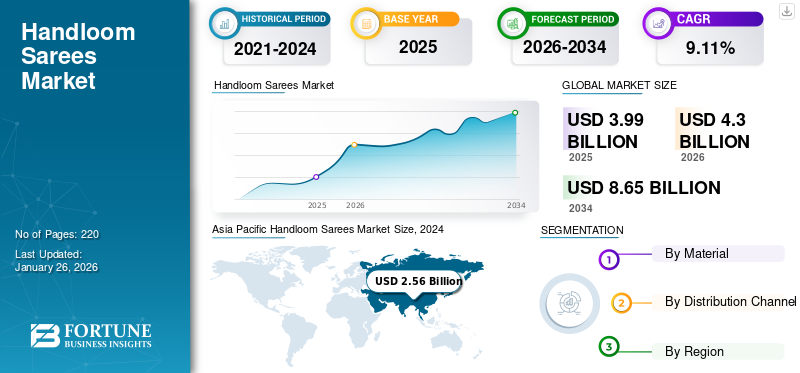
The global handloom sarees market size was valued at USD 3.99 billion in 2025 and is projected to grow from USD 4.30 billion in 2026 to USD 8.65 billion by 2034, exhibiting a CAGR of 9.11% during the forecast period. Asia Pacific dominated the handloom sarees market with a market share of 68.82% in 2024.
Handloom sarees are traditional Indian clothes crafted using age-old weaving techniques. These sarees hold great traditional importance and are cherished for their skillful craftsmanship and timeless elegance. These sarees are available in diversified styles and each saree has unique features and regional influences, from the intricate Kanjeevarams of Tamil Nadu to the vibrant of Maheswari Sarees of Madhya Pradesh and Banarasis of Uttar Pradesh. Furthermore, companies such as Maheshwari Handloom, BHOLI SAREES, Ajmera Fashion Limited, and HMR Handlooms are continuously indulging in innovation by using eco-friendly raw materials, sustainable packaging, and attractive printing designs to stay competitive.
Download Free sample to learn more about this report.
GLOBAL HANDLOOM SAREES MARKET Key Takeaways
 Market Size & Forecast
- 2025 Market Size: USD 3.99 Billion
- 2026 Market Size: USD 4.30 Billion
- 2034 Forecast Market Size: USD 8.65 Billion
- CAGR: 9.11% from 2026–2034
 Market Share
- Asia Pacific dominated the handloom sarees market with a 68.82% share in 2024.
- The cotton segment held the largest market share due to strong demand for breathable, durable, and traditional handloom sarees.
- The retail outlets/offline segment accounted for the dominant share of the global market, supported by specialty stores and personalized shopping experiences.
 Key Regional Highlights
Asia Pacific
Asia Pacific led the market, driven by cultural demand and handloom support.
North America
North America’s growth is driven by sustainable fashion trends and diaspora demand.
Europe
Europe’s growth is driven by demand for ethical fashion and handcrafted apparel.
U.S.
Growing appreciation for artisanal craftsmanship and sustainable fashion is driving demand for premium handloom sarees.
Japan
Increasing consumer interest in traditional textiles, handcrafted fashion products, and sustainable clothing is supporting market growth.
Read More

Download Free sample to learn more about this report.
MARKET DYNAMICS
Market Drivers
Increasing Popularity of Traditional Handloom Sarees to Boost Market Growth
The increasing popularity of traditionally handcrafted sarees both nationally and internationally drives the global handloom sarees market growth. These sarees provide attractive patterns and designs that are not easily replicated by machine-made textiles, which add to their exclusivity. This uniqueness appeals to consumers who need personalized, high-quality, and unique rather than mass-produced options. Furthermore, a large number of traditional waving techniques such as khadi, maheshwari, banarasi, and kanjivaram are being revived and marketed as luxury products, helping to raise awareness regarding the product, particularly among young generations looking to reconnect with their cultural roots. Government support and promotional campaigns have further played a crucial role in improving the production and sales of handloom sarees across the countries, boosting the growth of the handloom sarees industry.
MARKET RESTRAINTS
High Cost of Sarees Services to Restrain Market Growth
The handloom sarees are costly owing to the labor-intensive, time-intensive, and skilled craftsmanship involved in the creation of sarees. These sarees are often made up of high-quality fibers such as wool, cotton, and pure silk, which are more expensive than other machine-made fabrics. In addition, the use of natural dyes and materials such as zari, further results in enhancing the cost of the product. Furthermore, the handloom silk sarees are produced in limited quantities, which makes them more exclusive. The limited availability of this saree and the uniqueness of each product add to the cost of production, which restricts the growth of the market.
MARKET OPPORTUNITY
Growing use of Social Media Marketing by Manufacturers to Favor Market Expansion
The rising social media marketing by manufacturers of handcraft Indian sarees to promote products, brands, and services fuels the product demand. The social media platform enables a wide range of promotional activities such as sharing and creating engaging content, running target advertising campaigns, and interacting with the audience. In addition, the key aim of this advertising is to create handloom saree brand awareness, interact with customers, drive website traffic, and improve consumer reach. Furthermore, social media marketing also plays a significant role in maintaining customer loyalty, generating leads, enhancing brand credibility, and tracking campaign performance meticulously, which further boosts the global handloom sarees market growth.
SEGMENTATION ANALYSIS
By Material
Increasing Adoption of Handcrafted Sarees during Festive Season Fuels Cotton Segment Growth
Based on material, the market is divided into cotton, silk, linen, and wool.
The cotton segment is expected to hold the major handloom sarees market share during the forecast period. The cotton saree is a popular choice amongst consumers owing to their breathable, durable, comfortable, and subtle and minimalistic character. Furthermore, cotton handloom sarees collection is more in demand during weddings and festive seasons such as Diwali, Navratri, and Raksha Bandhan, especially in Indian villages and cities.
The linen segment is proposed to record the highest growth during the forecast period. The handcrafted linen sarees are made of natural linen fibers and are lightweight, breathable, and ideal for warm weather. These sarees are versatile and can be dressed in all seasons for both formal and casual occasions due to their cooling and sweat-absorbing properties.
By Distribution Channel
Retail Outlets/Offline Segment Dominate the Market Owing to Increasing Number of Specialty Stores
On the basis of distribution channels, the market is divided into e-commerce/online and retail outlets/offline.
The retail outlets/offline segment holds a significant global handloom sarees market share owing to an increase in the number of specialty stores and hypermarkets, especially in developing countries. Furthermore, the offline stores offer benefits such as personalized assistance, physically examining the fabric, trying on sarees, and easy exchange and return process to consumers.
The e-commerce/online segment is poised to grow at the highest CAGR during the forecast period. Online stores provide consumer access to a vast and diversified range of Indian handloom saree fabrics, styles, colors, and designs, delivered efficiently in less time and often at lower cost. Furthermore, online store offers special discounts, promotions, and loyalty programs to consumers, making it appealing to budget-conscious shoppers.
HANDLOOM SAREES MARKET REGIONAL OUTLOOK
Geographically, the global market is segmented into North America, Europe, Asia Pacific, South America, and the Middle East & Africa.
North America
Asia Pacific Handloom Sarees Market Size, 2024 (USD Billion)
To get more information on the regional analysis of this market, Download Free sample
North America is projected to grow with a considerable CAGR during the forecast period. The growing consumer interest in handloom and sustainable wearable products, along with the increasing population of Indian and South Asian immigrants, is driving market growth. Consumers in the U.S. and Canada recognize and appreciate the craftsmanship, intricate design, and uniqueness of these sarees, which are made using techniques and natural fibers.
The increase in consumer investment in luxury and high-end handcraft sarees, particularly those made from exclusive materials such as Mysore silk, Banarasi, and Kanjivaram, fuels the product demand in the U.S. The cultural heritage and personal touch associated with handwoven sarees allow consumers to appear uniquely and cherish the traditional culture, which further improves product demand in the country.
Europe
The rise in consumer inclination toward fashion products that reflect craftsmanship, artistry, and heritage is significantly fueling the product demand. The handcrafted sarees are often considered premium products as they are made by skilled artisans using traditional techniques. In addition, the increasing demand for ethical and sustainable fashion, particularly items crafted using natural fibers and traditional methods, further drive market growth in the European region.
Asia Pacific
Asia Pacific region dominates the global market. The increase in government support in improving the production and export of handloom products such as sarees, carpets, rugs, bedsheets, and mats boosts market growth in the region. According to the India Brand Equity Foundation (IBEF), India exports handcrafted products to more than 20 countries in the world. The government's “Vocal for Local” campaign in India has encouraged consumers to support locally made products, which has further heightened the demand for handwoven sarees in the country.
South America and Middle East & Africa
The market in the rest of the world region is expected to witness considerable growth in the forecast period. The increase in social media advertisement by manufacturers on digital platforms such as Facebook, Tiktok, LinkedIn, Instagram, and Twitter has enhanced consumer reach, which further fuels market growth. Furthermore, the easy availability of South Indian, Bengal handloom sarees, and other handloom sarees online on websites such as Amazon, Noon, and Namshi has further improved the sales of handwoven sarees.
COMPETITIVE LANDSCAPE
Key Industry Players
Key Players Focusing On New Product Launches to Strengthen Their Market Presence
The surge in competition among prominent players such as Maheshwari Handloom, BHOLI SAREES, Ajmera Fashion Limited, HMR Handlooms, and Albeli has encouraged them to capitalize on their strong brand loyalty and presence to maintain competitive edge. The prominent players in the market aim to launch new products and services to improve their product reach across the countries and remain competitive in the national and international markets.
LIST OF KEY HANDLOOM SAREES COMPANIES PROFILED
- Maheshwari Handloom (India)
- BHOLI SAREES (U.S.)
- Ajmera Fashion Limited (India)
- HMR Handlooms (India)
- Albeli (India)
- KTC Fashion (India)
- Jagg Hastakala (India)
- Dhananjay Creations Private Limited (India)
- Sameer Handloom (India)
- Mrignayani (India)
KEY INDUSTRY DEVELOPMENTS
- November 2024: Chhunchi, an India-based online saree brand, has announced the launch of a one-stop online store for handloom saree enthusiasts. The store contains
- October 2024 – RmKV, an India-based company announced the launch of range of thematic authentic handloom silk saree with natural dye. This saree are available in 4,000 colors and its colors are derived from diversified natural sources such as myrobalan, indigo, Indian madder, gooseberry, lac, pomegranate, and Indian red creeper.
- July 2024 - KCPC Bandhani, an India-based manufacturing company, announced the launch of Banarasi Katan Handloom Saree with blouse. The launch would help the company increase its product offerings.
REPORT COVERAGE
The handloom sarees market report provides a detailed market analysis and focuses on key aspects, such as the competition landscape, companies’ market share, market dynamics, regional analysis, and segmentation by material, and distribution channel. Besides this, it offers insights into various handloom sarees market trends and highlights key industry developments such as partnership, mergers, and acquisitions. In addition to the above-mentioned factors, the market research report encompasses several other factors that have contributed to the growth of the market in recent years.
Request for Customization to gain extensive market insights.
Report Scope & Segmentation
|
ATTRIBUTE |
DETAILS |
|
Study Period |
2021-2034 |
|
Base Year |
2025 |
|
Estimated Year |
2026 |
|
Forecast Period |
2026-2034 |
|
Historical Period |
2021-2024 |
|
Growth Rate |
CAGR of 9.11% from 2026 to 2034 |
|
Unit |
Value (USD Billion) |
|
Segmentation |
By Material
|
|
By Distribution Channel
|
|
|
By Region
|
Frequently Asked Questions
Fortune Business Insights says that the market size was valued at USD 4.30 billion in 2026 and is projected to reach USD 8.65 billion by 2034.
In 2024, the Asia Pacific market value stood at USD 2.56 billion.
Recording a CAGR of 9.11%, the market will exhibit steady growth over the forecast period.
Based on material, the cotton segment is leading the market.
Increase in consumer awareness toward traditional handloom sarees is the key factor driving the market.
Maheshwari Handloom, BHOLI SAREES, Ajmera Fashion Limited, HMR Handlooms, and Albeli others are the major players in the market.
Asia Pacific dominated the market in terms of share in 2025.
Growing social media marketing by manufacturers is a major factor driving the demand for the product.



- 2021-2034
- 2025
- 2021-2024
- 220
-
(Offer valid till 30th Sep 2026)
Get 30-60 hrs Free Customization
Expand Regional and Country Coverage, Segments Analysis, Company Profiles, Competitive Benchmarking, and End-user Insights.



















Related Reports
-
US +1 833 909 2966 ( Toll Free )
-
Get In Touch With Us