Sustainable Fashion Market Size, Share & Industry Analysis, By Type (Apparel, Footwear, Accessories, and Jewelry), By Material (Organic/Natural Materials, Recycled Materials, and Certified Responsible Materials), By End User (Women, Men, and Kids / Children), By Distribution Channel (Online and Offline), and Regional Forecast, 2026-2034
 Download Free Sample
(Offer valid till 30th Sep 2026)

Sustainable Fashion Market Size and Future Outlook
 Listen to Audio Version
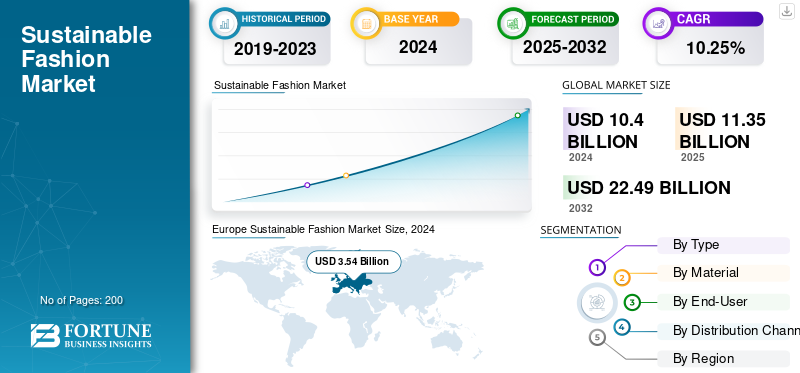
The global sustainable fashion market size was valued at USD 11.36 billion in 2025. The market is projected to grow from USD 12.44 billion in 2026 to USD 27.96 billion by 2034, growing at a CAGR of 10.65% during the forecast period. Europe dominated the global sustainable fashion market with a market share of 34.21% in 2025.
The ethical fashion market includes a wide range of products such as sneakers, clothing, bags, and statement jewelry. These products are developed using ethical practices and earth-friendly materials. Growing consciousness regarding environmental protection and the damaging impacts of fast fashion triggers the adoption of sustainable fashion products across countries. Furthermore, innovations in new sustainable materials such as plant-based leather are expected to boost global market expansion in the coming years. The market encompasses several major players such as Puma, Adidas, Nike, Levi Strauss & Co., and Burberry.
Download Free sample to learn more about this report.
SUSTAINABLE FASHION MARKET KEY TAKEAWAYS
 Global Market Size & Forecast
- 2025 Market Size: USD 11.36 billion
- 2026 Market Size: USD 12.44 billion
- 2034 Forecast Market Size: USD 27.96 billion
- CAGR: 10.65% from 2026-2034
 Market Share
- Europe dominated the global sustainable fashion market with a market share of 34.21% in 2025.
- The recycled materials segment captured the largest share of the market in 2024. In 2026, the segment is anticipated to dominate with a 53.46% share.
- The women segment held the dominating position in 2026 with 50.08% market share.
 Key Regional Highlights
North America
The North America market was valued at USD 3.19 Billion in 2025, capturing 28.12% of global revenue, and is estimated to reach USD 3.49 Billion in 2026.
Europe
In 2025, Europe held 34.21% of the global market, reaching a valuation of USD 3.89 Billion, and is projected to grow to USD 4.27 Billion in 2026.
Asia Pacific
The market in Asia Pacific reached USD 2.44 Billion in 2025, representing 21.52% of total market revenue, and is projected to reach USD 2.7 Billion in 2026.
U.S.
In 2025, the U.S. market is estimated to reach USD 2.03 billion.
Japan
Japan, is projected to record a growth rate of 11.15%, the highest among all regions, and reach a valuation of USD 2.44 billion by 2025.
Read More

MARKET DYNAMICS
MARKET DRIVERS
Rising Awareness Regarding Environmental Impact to Drive Market Growth
The fast fashion industry consumes a significant amount of resources, including energy and water, which hampers the environment. For instance, as per the United Nations Alliance for Sustainable Fashion, a United Nations initiative emphasizing promoting sustainability, the textile and clothing industry worldwide utilizes approximately 215 trillion liters of water annually. Such damages boost demand for ethical fashion products, which utilize fewer resources. The younger generations are especially more informed about these environmental damages related to conventional fashion products through documentaries and social media. In this respect, rising awareness regarding the fashion market’s environmental impact drives global sustainable fashion industry growth.
MARKET RESTRAINTS
High Prices of Sustainable Products to Impede Product Sales
Sustainable fashion products involve higher raw materials, ethical manufacturing, and certification costs. These factors increase the overall price of the final product by at least 30% hampering sales among lower-income consumers. In addition, numerous buyers across countries prefer fast fashion owing to its widespread accessibility, trend-based styles, and affordability. Moreover, low product awareness in developing countries, notably across Asia and Africa, where individuals typically prioritize price over sustainability, negatively impacts the global sustainable fashion market forecast.
MARKET OPPORTUNITIES
Development of New Sustainable Materials to Provide Growth Opportunities
Innovation in technology has led to the development of new sustainable materials, including recycled polyester, plant-based fibers, lab-grown leather, and regenerative wool. Fashion product manufacturers seek these materials to develop sustainable items and eliminate the use of traditional materials, including conventional cotton and nylon. The strategy enables them to appeal to environmentally conscious end-users worldwide. As a result, advancements in technology will lead to the production of innovative, eco-friendly materials, providing growth opportunities to industry participants in the coming years.
SUSTAINABLE FASHION MARKET TREND
Rising Sustainable Luxury Trends to Boost Product Sales
In recent years, the trend of sustainable luxury has been growing rapidly globally, which has favored the sales of sustainable fashion products among high-income individuals. High-end consumers seek fashion products that are environmentally responsible and emphasize ethical sourcing due to their uniqueness and quality. Furthermore, the slow fashion movement and eco-friendly apparel market trends are gaining popularity among younger demographics. These trends emphasize high-quality and sustainable production, supporting global sustainable fashion market growth.
Download Free sample to learn more about this report.
Segmentation Analysis
By Type
High Consumption Volume & Product Awareness to Trigger Apparel Sales
On the basis of the type, the market is classified into apparel, footwear, accessories, and jewelry.
The apparel segment accounted for the largest global sustainable fashion market share in 2024. The product has high consumption volume and is purchased more frequently compared to its counterparts. In addition, social media influencers and brands typically target sustainable apparel, which fuels their awareness, favoring segmental growth. The footwear segment held the second-largest market share in 2024.
To know how our report can help streamline your business, Speak to Analyst
By Material
Affordability & Wide Availability to Boost Recycled Materials Demand
In terms of material, the market is categorized into organic/natural materials, recycled materials, and certified responsible materials.
The recycled materials segment captured the largest share of the market in 2024. In 2026, the segment is anticipated to dominate with a 53.46% share. The segment includes materials such as recycled cotton and polyester. These materials have higher production capacity and are available at reasonable prices compared to other materials. Moreover, they are suitable for various fashion products, including active wear, casual wear, shoes, bags, and hats. The organic/natural materials segment held the second-largest market share in 2024.
By End User
High Fashion Consciousness to Increase Product Demand Among Women
Based on end user, the market is segmented into women, men, and kids/children.
The women segment held the dominating position in 2026 with 50.08% market share. High fashion consciousness among women leads to them exploring a wider range of products, including sustainable dresses, shoes, bags, and jewelry, which in turn escalates sales. In addition, several female influencers endorse sustainable fashion items on social media, and women tend to engage more on these platforms, accelerating product demand. The men segment is set to flourish with a growth rate of 10.18% over the forecast period.
By Distribution Channel
Advantages of Personal Evaluation & Quality Assurance to Escalate Offline Sales
Based on the distribution channel, the market is segmented into online and offline.
The offline segment held the dominating position in 2026 with 63.18% market share. The products include sustainable materials, which can vary in comfort and durability. Thus, end users prefer to personally evaluate products in physical stores to ensure their quality. Moreover, these products are available at high prices, thus consumers tend to try and check them in offline stores before making premium purchases. The online segment is set to flourish with a growth rate of 10.91% over the forecast period.
Sustainable Fashion Market Regional Outlook
By region, the market is divided into North America, Europe, Asia Pacific, South America, and Middle East & Africa.
Europe
Europe Sustainable Fashion Market Size, 2025 (USD Billion)
To get more information on the regional analysis of this market, Download Free sample
In 2025, Europe held 34.21% of the global market, reaching a valuation of USD 3.89 Billion, and is projected to grow to USD 4.27 Billion in 2026. Strong eco-consciousness throughout European Countries triggers the adoption of various eco-friendly fashion products. Stringent sustainability regulations in the region, such as the EU Green Deal and Extended Producer Responsibility (EPR), are also increasing the availability and demand for sustainable items. Backed by these factors, countries including Germany are expected to record the valuation of USD 0.71 billion, and the U.K will record USD 0.62 billion in 2025.
Asia Pacific
The market in Asia Pacific reached USD 2.44 Billion in 2025, representing 21.52% of total market revenue, and is projected to reach USD 2.7 Billion in 2026. Other regions, including North America and the Asia Pacific, are expected to experience notable growth in the coming years. During the forecast period, the Asia Pacific region, comprising countries such as China, India, and Japan, is projected to record a growth rate of 11.15%, the highest among all regions, and reach a valuation of USD 2.44 billion by 2025. The rising income level in Asian countries, resulting in higher spending power, boosts sales of premium, ethical fashion products. In addition, adoption of eco-friendly fashion trends is increasingly through platforms such as YouTube and Instagram. In the region, China is estimated to reach USD 0.69 billion, while India is projected to record USD 0.51 billion in 2025.
North America
The North America market was valued at USD 3.19 Billion in 2025, capturing 28.12% of global revenue, and is estimated to reach USD 3.49 Billion in 2026. The market in North America is estimated to reach USD 3.19 billion in 2025 and secure the position of the second-largest region in the market. Numerous consumers in the region are interested in a healthy lifestyle involving eco-friendly products. Moreover, the millennial and Gen Z populations are inclined toward ethical fashion options. In 2025, the U.S. market is estimated to reach USD 2.03 billion, backed by the presence of numerous high-end consumers who prefer sustainable luxury fashion brands. Furthermore, multiple brands, including Nike, Levi Strauss & Co., Eileen Fisher, and PVH Corp, prioritize providing ethical fashion products in the country.
South America and Middle East & Africa
Over the forecast period, the South America and Middle East & Africa regions would witness a moderate growth in this market. Governments in these regions prioritize the development of circular economies and invest in recycling initiatives that favor sustainable production. In addition, growing inclination toward conscious consumption will fuel ethical clothing demand across South America in the near term. The South America market in 2025 is set to reach a valuation of USD 1.02 billion. In 2025, the Middle East & Africa market stood at USD 0.81 Billion, representing 7.15% of global demand, and is projected to grow to USD 0.87 Billion in 2026. Fashion brands such as Levi's and Stella McCartney use sustainable textiles and recycled materials in apparel offered in the country to improve brand image.
COMPETITIVE LANDSCAPE
Key Industry Players:
Investing in Social Media Marketing & Providing Promotional Discounts to Boost Growth
The global ethical fashion market includes numerous manufacturers using various strategies such as product innovation, social media promotions, green supply chain in fashion, and multi-channel sales to accelerate growth. Fashion brands can provide sustainability workshops in their flagship stores to increase knowledge regarding eco-friendly items. Furthermore, establishing a partnership with digital content creators helps brands promote products, especially among youth. Additionally, several key players prioritize offering discounts and promotional offers to appeal to environmentally conscious end-users with limited budgets. Investment in circular fashion innovations can also assist manufacturers in developing new product categories. Research on sustainable clothing consumer behavior further helps understand their choices.
LIST OF KEY SUSTAINABLE FASHION COMPANIES PROFILED:
- Puma (Germany)
- Adidas (Germany)
- Nike (U.S.)
- Levi Strauss & Co. (U.S.)
- Burberry (U.K)
- Ralph Lauren (U.K)
- Kering SA (France)
- Eileen Fisher (U.S)
- Stella McCartney (U.K)
- PVH Corp (U.S)
KEY INDUSTRY DEVELOPMENTS:
- November 2025: Hyosung TNC, a South Korean-based textile company, partnered with Lenzing Group, an Austrian-based sustainable fiber company, to introduce a sustainable yoga-inspired fabric product line.
- May 2025: Borealis, an Austria-based polyolefin solutions company, introduced a renewable ethylene vinyl acetate (polymer) material for footwear midsoles.
- November 2024: Cosset Clothing, an India-based sustainable clothing company, unveiled its new sustainable knitwear product line. The collection includes trousers, cardigans, and sweaters developed using organic woolen and cotton.
- September 2020: ASOS, a U.K.-based fashion retailer, unveiled its new circular collection, including accessories and apparel in trendy styles. It features recycled materials and zero zero-waste design.
REPORT COVERAGE
Request for Customization to gain extensive market insights.
The global market report provides an in-depth study of the market size & forecast by all the market segments. The global Sustainable Fashion market analysis also includes details on the market dynamics expected to drive the market in the forecast period. It offers information on the global Sustainable Fashion market trends, technological advancements, new product launches, key industry developments, and details on partnerships, mergers & acquisitions. The market research report further encompasses a detailed competitive landscape with information on the market share and profiles of key operating players.
Report Scope & Segmentation
| ATTRIBUTE | DETAILS |
| Study Period | 2021-2034 |
| Base Year | 2025 |
| Estimated Year | 2026 |
| Forecast Period | 2026-2034 |
| Historical Period | 2021-2024 |
| Growth Rate | CAGR of 10.65% from 2026-2034 |
| Unit | Value (USD Billion) |
| By Type |
|
| By Material |
|
| By End User |
|
| By Distribution Channel |
|
| By Region |
|
Frequently Asked Questions
Fortune Business Insights says that the global market value stood at USD 11.36 billion in 2025 and is projected to reach USD 27.96 billion by 2034.
In 2025, the market value stood at USD 3.89 billion.
The market is expected to exhibit a CAGR of 10.65% during the forecast period of 2026-2034.
The apparel segment led the market by type.
Rising awareness regarding environmental impact to drive market growth
Puma, Adidas, Nike, Levi Strauss & Co., and Burberry are some of the prominent players in the market.
Europe dominated the market in 2025.
Rising sustainable luxury trends to boost product sales



- 2021-2034
- 2025
- 2021-2024
- 200
-
(Offer valid till 30th Sep 2026)
Get 30-60 hrs Free Customization
Expand Regional and Country Coverage, Segments Analysis, Company Profiles, Competitive Benchmarking, and End-user Insights.
















Related Reports
-
US +1 833 909 2966 ( Toll Free )
-
Get In Touch With Us