High Barrier Packaging Films Market Size, Share & Industry Analysis, By Material (Polyethylene (PE), Polypropylene (PP), Ethylene Vinyl Alcohol (EVOH), Polyethylene Terephthalate (PET), and Others), By Packaging Type (Bags & Pouches, Lids, Trays, and Others), By End-use Industry (Food & Beverages, Healthcare, Consumer Goods, and Others), and Regional Forecast, 2026-2034
 Download Free Sample
(Offer valid till 30th Sep 2026)

KEY MARKET INSIGHTS
 Listen to Audio Version
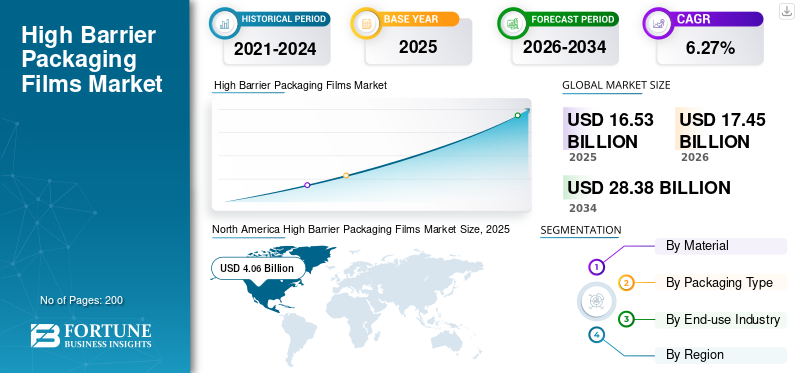
The global high barrier packaging films market size was valued at USD 16.53 billion in 2025 and is projected to grow from USD 17.45 billion in 2026 to USD 28.38 billion by 2034, exhibiting a CAGR of 6.27% during the forecast period. North America dominated the global high barrier packaging films market with a market share of 24.56% in 2025.
High barrier packaging films represent sophisticated flexible packaging solutions engineered to offer robust product protection against oxygen, moisture, light, aromas, and contaminants. The rising demand for convenient, packaged, and ready-to-eat foods is driving the need for high-barrier films that inhibit spoilage and maintain freshness, thereby boosting the global market growth.
Furthermore, many key industry players, such as Amcor Plc, Sealed Air, and Constantia Flexibles, operating in the market, are focusing on developing various innovative products and conducting R&D activities.
Download Free sample to learn more about this report.
High Barrier Packaging Films Market Takeaways
 Market Size & Forecast
- 2025 Market Size: USD 16.53 billion
- 2026 Market Size: USD 17.45 billion
- 2034 Forecast Market Size: USD 28.38 billion
- CAGR: 6.27% from 2026–2034
 Market Share
- North America dominated the high barrier packaging films market with a 24.56% share in 2025.
- The polypropylene (PP) segment is projected to grow at a CAGR of 6.17% during the forecast period.
- The lids segment is expected to expand at a CAGR of 6.38% through 2034.
 Key Regional Highlights
North America
North America led the market with a value of USD 4.06 billion in 2025.
Europe
Europe reached USD 3.32 billion in 2025 and is projected to grow at a CAGR of 5.86% during the forecast period.
Asia Pacific
Asia Pacific was the second-largest regional market, valued at USD 5.16 billion in 2025.
U.S.
The market was valued at USD 3.26 billion in 2025, accounting for approximately 19.72% of global sales.
Japan
The market was valued at USD 0.98 billion in 2025, representing roughly 5.93% of global revenue.
Read More

HIGH BARRIER PACKAGING FILMS MARKET TRENDS
Focus on Sustainable Branding and Consumer Engagement is a Prominent Trend Observed in the Market
The growing emphasis on sustainable branding and consumer interaction is a significant trend shaping the global market. Brand owners are increasingly recognizing packaging not merely as a protective layer but as a strategic communication medium that embodies environmental responsibility and brand values. Simultaneously, enhanced consumer engagement is being fostered through improved aesthetics, high-clarity films, and cutting-edge printing technologies that facilitate clean labeling and sustainability messaging. The collaboration of sustainability-driven design and interactive communication is enhancing brand differentiation, fostering consumer trust, and promoting the broader adoption of innovative, high-barrier packaging film solutions within the food, beverage, and pharmaceutical sectors.
Download Free sample to learn more about this report.
MARKET DYNAMICS
MARKET DRIVERS
Rising Demand for Enhanced Protection and Extended Shelf Life is Propelling Market Growth
The increasing demand for improved protection and extended shelf life is a significant factor driving the global market, particularly in the food, beverage, and pharmaceutical sectors. High barrier films are effective in preventing the entry of oxygen, moisture, light, and contaminants, thereby aiding in the preservation of product freshness, flavor, nutritional value, and efficacy for extended periods. This capability is becoming increasingly vital as supply chains become longer and more complex, with products frequently transported across multiple regions or stored for extended periods. Moreover, the rising consumer inclination toward packaged, ready-to-eat meals and convenience foods has heightened the necessity for packaging solutions that reduce spoilage and food waste while ensuring safety and quality. Henceforth, the growing demand for enhanced protection and extended shelf life is driving the global high barrier packaging films market growth.
MARKET RESTRAINTS
Complexity in Recycling and Environmental Impact Restricts Market Growth
The challenges associated with recycling high barrier packaging films pose a considerable limitation to market expansion, primarily due to their multilayer films and multi-material compositions. These films typically incorporate polymers such as PET, PE, PP, polyamide, EVOH, aluminum coatings, or metallized layers to provide enhanced barrier properties. Although they are effective in offering protection, the diverse structures make them challenging to separate during the recycling process, thereby restricting their suitability for standard mechanical recycling systems. Consequently, high-barrier films often end up in landfills or are subjected to incineration, which raises environmental concerns and draws regulatory attention, especially in areas with stringent waste management and circular economy policies, such as Europe.
MARKET OPPORTUNITIES
Advanced Digital and Smart Packaging Technologies Provide Potential Growth Opportunities
Advanced digital and intelligent packaging technologies are emerging as a significant opportunity for the global high-barrier packaging films industry, enabling manufacturers to enhance performance, efficiency, and value throughout the packaging lifecycle. The incorporation of digital tools, such as IoT-enabled sensors, AI-driven quality inspection systems, and real-time process monitoring, enables producers to maintain tighter control over film thickness, barrier uniformity, and defect detection, leading to enhanced consistency and reduced material waste. Simultaneously, smart packaging features such as freshness indicators, oxygen and moisture sensors, QR codes, and traceability solutions are being increasingly integrated into high-barrier films, particularly for food and pharmaceutical applications. Thus, the implementation of advanced digital and smart packaging technologies will offer growth opportunities.
MARKET CHALLENGES
Regulatory Complexity Across Regions Poses a Critical Challenge to Market Growth
The intricate regulatory landscape across various regions presents a considerable challenge for the global market. Manufacturers are required to adhere to diverse food safety, environmental, and raw materials regulations that vary by geography. Packaging films used in the food and pharmaceutical sectors must meet stringent standards regarding chemical composition, migration limits, and contact safety, which vary across regions such as North America, Europe, and Asia Pacific. Managing these specific regional requirements elevates compliance costs and extends the timelines for product development and approval.
Segmentation Analysis
By Material
Polyethylene (PE) Segment to Lead Market Due to Its Versatility, Processability, and Compatibility
Based on the material, the market is divided into polyethylene (PE), polypropylene (PP), ethylene vinyl alcohol (EVOH), polyethylene terephthalate (PET), and others.
The polyethylene (PE) segment is expected to account for the largest market in the coming years. The polyethylene (PE) segment leads the global market due to its remarkable versatility, affordability, and compatibility with contemporary high-barrier film technologies. PE offers outstanding sealability, flexibility, and mechanical strength, making it suitable for various packaging formats, including pouches, sachets, wraps, and lidding films. Its capacity to function reliably across a range of thicknesses and applications enables manufacturers to customize barrier structures to meet diverse end-use needs, especially in the food and pharmaceutical packaging sectors.
The polypropylene (PP) segment is expected to rise at a CAGR of 6.17% over the forecast period.
By Packaging Type
Convenience, Material Efficiency, and Shelf-Life Performance Enhanced Bags & Pouches Segment Growth
Based on packaging type, the market is segmented into bags & pouches, lids, trays, and others.
In 2025, bags & pouches dominated the global market, primarily due to their strong compatibility with contemporary packaging needs, including convenience, reduced weight, and extending shelf life. Bags and pouches provide an effective format for utilizing high-barrier films that safeguard products against oxygen, moisture, light, and contaminants, making them particularly ideal for applications in food, beverages, and pharmaceuticals. Their adaptable design facilitates enhanced barrier performance while reducing material consumption in comparison to rigid packaging options.
The lids segment is projected to grow at a CAGR of 6.38% over the forecast period.
By End-use Industry
To know how our report can help streamline your business, Speak to Analyst
Volume Demand and Shelf-Life Criticality Pushes Segmental Growth
Based on the end-use industry, the market is segmented into food & beverages, healthcare, consumer goods, and others.
The food and beverages segment is expected to hold a dominant market share over the forecast period, primarily due to its substantial consumption volumes and the essential need to maintain product freshness, safety, and quality. Food and beverage items are particularly vulnerable to oxygen, moisture, light, and microbial contamination, making high barrier films crucial for preserving their taste, texture, nutritional value, and longer shelf life. As packaged, processed, and ready-to-eat foods increasingly gain traction globally, the demand for sophisticated barrier packaging solutions has consistently risen.
The healthcare segment is projected to grow at a CAGR of 6.24% over the forecast period.
High Barrier Packaging Films Market Regional Outlook
By geography, the market is categorized into Europe, North America, Asia Pacific, Latin America, and the Middle East & Africa.
North America
North America High Barrier Packaging Films Market Size, 2025 (USD Billion)
To get more information on the regional analysis of this market, Download Free sample
North America held the dominant high barrier packaging films market share in 2024, valued at USD 3.84 billion, and maintained its leading position in 2025, with a value of USD 4.06 billion. In North America, the market is predominantly influenced by robust demand from the food, beverage, and pharmaceutical sectors, where factors such as prolonged shelf life, product safety, and adherence to regulations are of utmost importance. The established packaged food market in this region, along with the prevalent consumption of ready-to-eat and frozen foods, requires sophisticated barrier solutions to inhibit the entry of oxygen and moisture.
U.S High Barrier Packaging Films Market
Based on North America’s strong contribution and the U.S. dominance within the region, the U.S. market was valued at USD 3.26 billion in 2025, accounting for roughly 19.72% of global sales. In the U.S., the market growth is significantly influenced by the high demand for convenience, frozen, and ready-to-eat foods, in addition to a robust pharmaceutical and healthcare industry. Brand owners focus on packaging solutions that enhance shelf life, minimize food waste, and adhere to strict FDA regulations.
Europe
Europe is projected to record a growth rate of 5.86% in the coming years, which is the third highest among all regions, and reached a valuation of USD 3.32 billion in 2025. The growth of the market in Europe is clearly propelled by regulations that emphasize sustainability and initiatives related to the circular economy. Stringent EU regulations concerning the reduction of plastic waste, recyclability, and extended producer responsibility (EPR) are compelling manufacturers to adopt recyclable, mono-material, and downgauged high barrier films.
U.K High Barrier Packaging Films Market
The U.K. market in 2025 was valued at USD 0.60 billion, representing approximately 3.63% of global revenues.
Germany High Barrier Packaging Films Market
Germany’s market was valued at USD 0.70 billion in 2025, equivalent to around 4.26% of global high barrier packaging films sales.
Asia Pacific
Asia Pacific was valued at USD 5.16 billion in 2025 and secured the position of the second-largest region in the market. In the region, India and China were valued at USD 1.40 billion and USD 1.66 billion, respectively, in 2025. In the Asia Pacific region, the market is propelled by swift urbanization, increasing disposable incomes, and the rising consumption of packaged and convenience foods. The expanding middle-class populations and the penetration of modern retail in countries such as China and India are boosting the demand for packaged products that are longer-lasting, hygienic, and visually attractive.
Japan High Barrier Packaging Films Market
The Japanese market in 2025 was valued at USD 0.98 billion, accounting for roughly 5.93% of global revenues. The market for high barrier packaging films in Japan is propelled by the nation's focus on product quality, freshness, and the reduction of food waste. Stringent food safety standards, along with consumer demands for high-quality packaging, foster a robust demand for advanced barrier films that offer exceptional protection against oxygen and moisture.
China High Barrier Packaging Films Market
China’s market is projected to be one of the largest worldwide, with 2025 revenues valued at USD 1.66 billion, representing roughly 10.05% of global sales.
India High Barrier Packaging Films Market
The Indian market in 2025 was valued at USD 1.40 billion, accounting for roughly 8.43% of global high revenues.
Latin America and Middle East & Africa
The Latin America and Middle East & Africa regions are expected to witness moderate growth in this market space during the forecast period. The Latin America market is set to reach a valuation of USD 2.32 billion in 2025. In Latin America, the market is propelled by the necessity to enhance food preservation and minimize losses throughout fragmented and extensive supply chains.
In the Middle East & Africa, South Africa is set to reach a value of USD 0.48 billion in 2025.
Saudi Arabia High Barrier Packaging Films Market
The Saudi Arabian market is projected to reach approximately USD 0.67 billion by 2025, accounting for roughly 4.08% of global revenues.
COMPETITIVE LANDSCAPE
Key Industry Players
Focus on Expanding Product Launch and Acquisitions by Key Players to Propel Market Progress
The global market holds a semi-consolidated market structure, constituting prominent players such as Amcor Plc, Sealed Air, and Constantia Flexibles. The significant market share of these companies is due to numerous strategic activities, including collaboration among operating entities to advance research activities.
- For instance, in August 2025, Mondi broadened its selection of high-performance barrier papers with the introduction of FunctionalBarrier Paper Ultimate, a paper-based solution designed to satisfy the most stringent packaging needs. Designed for high barrier applications, this solution is ideal for packaging instant coffee sticks and pod overwraps, tea sachets, dried food seasonings, muesli or cereal bars, and bouillon cubes, among other products, while providing extended shelf life and convenience.
Other notable players in the global market include Glenroy, Inc., Winpak Ltd., and Mondi. These companies are expected to prioritize new product launches and collaborations to increase their global market share during the forecast period.
LIST OF KEY HIGH BARRIER PACKAGING FILM COMPANIES PROFILED
- Amcor Plc (Switzerland)
- Sealed Air (U.S.)
- Constantia Flexibles (Austria)
- Glenroy, Inc. (U.S.)
- Winpak Ltd. (Canada)
- Mondi (U.K.)
- Toray Plastics, Inc. (U.S.)
- Schur Flexibles GmbH (Austria)
- Huhtamaki Oyj (Finland)
- ProAmpac (U.S.)
- Flair Flexible Packaging Corporation (Canada)
- Oliver Healthcare Packaging (U.S.)
- C-P Flexible Packaging (U.S.)
- Cosmo Films (India)
- Bagla Group (India)
KEY INDUSTRY DEVELOPMENTS
- December 2025: Cosmo Films broadened its flexible packaging offerings with a new selection of films based on BOPP, CPP, and BOPET, specifically designed for pet food packaging. This launch features a new TR-BOPP film that is highly resistant to heat, as well as enhanced barrier and lidding films, reinforcing the company’s dedication to providing next-generation, food-safe packaging.
- November 2025: TOPPAN Inc., along with its subsidiary based in India, TOPPAN Speciality Films Private Limited (TSF), installed a hybrid manufacturing line that is capable of producing both biaxially-oriented polypropylene (BOPP) film and biaxially-oriented polyethylene (BOPE) on a single machine. With a robust history in the production of BOPP films, TSF is now initiating the film production of BOPE on this new line to meet the growing and diversifying demand.
- July 2025: Dai Nippon Printing Co., Ltd. (DNP) introduced Vacuum Metalized High Barrier PP Film, which is appropriate for the base material of mono-material packaging. This innovative film possesses excellent barrier properties against oxygen and water vapor, in addition to a strong lightproof characteristic. Utilizing this product in mono-material packaging demonstrates nearly double the barrier performance when compared to DNP’s traditional mono-material packaging.
- March 2025: KM Packaging is delighted to announce the introduction of K-Nature Paper HBe, a high-barrier paper packaging solution aimed at simplifying the recycling process for end consumers. With a material composition of over 85% paper, complemented by a robust PE coating and an EVOH barrier, Paper HBe serves as an excellent alternative for numerous products that presently utilize flexible plastic packaging.
- August 2023: Amcor declared the introduction of curbside-recyclable AmFiber Performance Paper packaging in North America, which is included in the company’s AmFiber portfolio. This AmFiber Performance Paper is a high-barrier laminated paper that can be recycled in the majority of paper recycling streams, achieving the How2Recycle prequalification status of "widely recyclable."
REPORT COVERAGE
Request for Customization to gain extensive market insights.
Report Scope & Segmentation
|
ATTRIBUTE |
DETAILS |
|
Study Period |
2021-2034 |
|
Base Year |
2025 |
|
Estimated Year |
2026 |
|
Forecast Period |
2026-2034 |
|
Historical Period |
2021-2024 |
|
Growth Rate |
CAGR of 6.27% from 2026-2034 |
|
Unit |
Value (USD Billion) |
|
Segmentation |
By Material, Packaging Type, End-use Industry, and Region |
|
By Material |
· Polyethylene (PE) · Polypropylene (PP) · Ethylene Vinyl Alcohol (EVOH) · Polyethylene Terephthalate (PET) · Others |
|
By Packaging Type |
· Bags & Pouches · Lids · Trays · Others |
|
By End-use Industry |
· Food & Beverages · Healthcare · Consumer Goods · Others |
|
By Region |
· North America (By Material, Packaging Type, End-use Industry, and Country) o U.S. o Canada · Europe (By Material, Packaging Type, End-use Industry, and Country/Sub-region) o Germany o U.K. o France o Italy o Spain o Russia o Poland o Romania o Rest of Europe · Asia Pacific (By Material, Packaging Type, End-use Industry, and Country/Sub-region) o China o Japan o India o Australia o Southeast Asia o Rest of Asia Pacific · Latin America (By Material, Packaging Type, End-use Industry, and Country/Sub-region) o Brazil o Mexico o Argentina o Rest of Latin America · Middle East & Africa (By Material, Packaging Type, End-use Industry, and Country/Sub-region) o Saudi Arabia o UAE o Oman o South Africa o Rest of Middle East & Africa |
Frequently Asked Questions
According to Fortune Business Insights, the global market value stood at USD 16.53 billion in 2025 and is projected to reach USD 28.38 billion by 2034.
In 2025, the market value in North America stood at USD 4.06 billion.
The market is expected to exhibit a CAGR of 6.27% during the forecast period of 2026-2034.
By material, the polyethylene (PE) segment is expected to lead the market.
Growing demand for enhanced protection and extended shelf life is driving the market growth.
Amcor Plc, Sealed Air, and Constantia Flexibles are the major players in the global market.
North America dominated the market in 2025.



- 2021-2034
- 2025
- 2021-2024
- 200
-
(Offer valid till 30th Sep 2026)
Get 30-60 hrs Free Customization
Expand Regional and Country Coverage, Segments Analysis, Company Profiles, Competitive Benchmarking, and End-user Insights.






-
US +1 833 909 2966 ( Toll Free )
-
Get In Touch With Us