High-Power Microwave Counter-Drone Market Size, Share & Industry Analysis, By End User (Defense & Military Authorities, Homeland Security & Border Agencies, and Critical Infrastructure Operators), By Offering (Complete HPM Counter-Drone Systems, HPM Emitters/RF Source Modules, Antenna, and Others), By Technology (Solid-State HPM Systems, RF Directed-Energy Weapon Systems, Pulsed HPM Systems, and Others), By Platform (Fixed-Site/Base-Defense Systems, Vehicle-Mounted Systems, Containerized/Expeditionary Systems, Naval/Shipboard Systems, and Others) and Regional Forecast, 2026-2034
 Download Free Sample
High-Power Microwave Counter-Drone Market Size and Future Outlook
 Listen to Audio Version
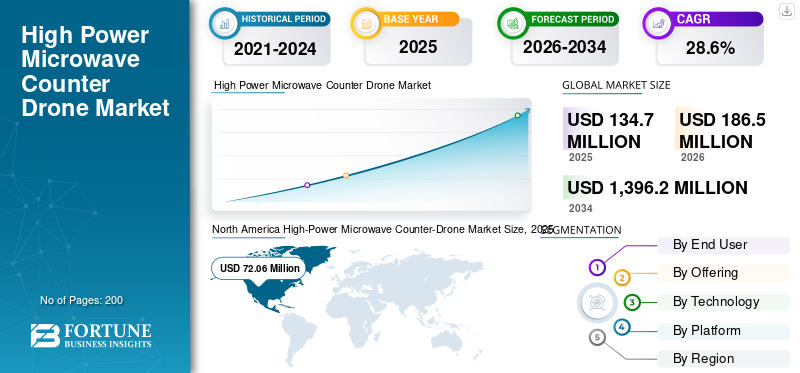
The global high-power microwave counter-drone market size was valued at USD 134.7 million in 2025. The market is projected to grow from USD 186.5 million in 2026 to USD 1,396.2 million by 2034, exhibiting a CAGR of 28.6% during the forecast period. North America dominated the high-power microwave counter-drone market with a market share of 53.49% in 2025.
The High-Power Microwave (HPM) counter-drone market is an emerging and strategically critical segment within the broader counter-unmanned aerial systems (C-UAS) industry. HPM systems use directed energy to disable or destroy drone electronics across a wide operational area, offering a non-kinetic, cost-effective alternative to traditional interception methods. Growing adoption by military, governmental, and critical infrastructure operators is fueling investment in HPM technologies. These systems are increasingly valued for their ability to neutralize swarm threats, deliver a low cost-per-shot advantage over missile-based interceptors, and support both fixed-site and mobile deployment scenarios.
Key players in the market include Epirus, Raytheon/RTX, Lockheed Martin, Leidos, BAE Systems, General Dynamics Land Systems, Thales, QinetiQ, Teledyne e2v, and HORIBA MIRA. These companies compete through advances in directed energy output, system portability, beam-steering precision, multi-target engagement capability, and platform integration, offering solutions tailored for military bases, forward operating positions, critical national infrastructure protection, and mobile force-protection applications.
Download Free sample to learn more about this report.
High Power Microwave Counter Drone Market KEY TAKEAWAYS
 Global Market Size & Forecast
- 2025 Market Size: USD 134.7 million
- 2026 Market Size: USD 186.5 million
- 2034 Forecast Market Size: USD 1,396.2 million
- CAGR: 28.6% from 2026–2034
 Market Share
- North America dominated the high-power microwave counter-drone market with a 53.49% share in 2025.
- The homeland security & border agencies segment is projected to grow at the fastest CAGR of 29.7%.
- The power & thermal management systems segment is expected to grow at a CAGR of 28.3% during the forecast period.
 Key Regional Highlights
North America
North America USD 72.06 million in 2025, driven by strong defense investments and military modernization programs.
Asia Pacific
Asia Pacific Expected to grow at a CAGR of 27.8%, supported by rising investments in counter-drone technologies.
Europe
Europe USD 42.4 million by 2026, driven by increasing NATO-led counter-UAS investments and defense modernization.
U.S.
U.S. USD 93.2 million by 2026, supported by Pentagon-funded directed-energy programs and counter-drone initiatives.
Japan
Japan USD 7.5 million by 2026, driven by increasing defense spending and demand for critical infrastructure protection.
Read More

HIGH-POWER MICROWAVE COUNTER-DRONE MARKET TRENDS
Advances in Gallium Nitride Semiconductor Technology to Boost Market Growth
The HPM counter-drone market is witnessing a decisive shift from bulky, legacy tube-based systems toward compact, solid-state directed energy platforms. Advances in gallium nitride (GaN) semiconductor technology are enabling the development of more efficient, reliable, and field-maintainable HPM solutions. Simultaneously, software-defined system architectures are becoming increasingly standard, allowing operators to update waveforms, targeting parameters, and engagement protocols in real-time. Integration with AI-driven threat classification and multi-sensor fusion systems is also accelerating across the market. These capabilities enable HPM platforms to autonomously detect, track, and engage hostile drones with minimal operator intervention, reflecting the broader defense industry trend toward autonomous and adaptive electronic warfare solutions.
MARKET DYNAMICS
MARKET DRIVERS
Download Free sample to learn more about this report.
Rapid Proliferation of Military-Grade Unmanned Aerial Systems to Amplify Product Demand
The rapid proliferation of commercially available and military-grade unmanned aerial systems as offensive weapons has fundamentally altered threat landscapes for defense forces worldwide. Drone attacks targeting military convoys, forward bases, naval vessels, and energy infrastructure have demonstrated critical vulnerabilities in existing air defense layers. HPM systems address these concerns by delivering speed-of-light engagement, zero propellant cost per shot, and the capacity to neutralize entire drone formations within a single activation. These operational advantages are compelling defense ministries to accelerate HPM counter-drone procurement programs, with urgency reinforced by documented adversarial use of drone swarms in active conflict theaters.
MARKET RESTRAINTS
Technological Complexity Associated with Directed Energy Systems to Limit Industry Expansion
Despite strong demand signals, the high-power microwave counter-drone market growth faces notable restraints related to the technological complexity and infrastructure requirements associated with directed energy systems. HPM platforms require substantial onboard or dedicated power generation capacity, posing logistical challenges in forward-deployed and mobile military settings. High research, development, and qualification costs contribute to elevated unit prices that constrain adoption by smaller defense budgets and allied nations. Regulatory frameworks governing electromagnetic emissions also complicate deployment in urban and civilian-adjacent environments. Additionally, extended procurement timelines can delay operational timelines, slowing near-term market expansion despite rising strategic demand.
MARKET OPPORTUNITIES
Expanding Demand for Protecting Military Airfields to Boost Industry’s Development
A significant market opportunity lies in the growing need to counter coordinated drone swarm attacks, which conventional point-defense systems cannot economically address. HPM technology's inherent ability to engage multiple targets simultaneously across a wide electromagnetic footprint positions it as the highly preferred solution for high-density threat environments. Additional growth opportunities exist in protecting energy installations, military airfields, naval assets, and large public venues. Allied nations seeking sovereign C-UAS capabilities are also creating export-driven demand. As procurement frameworks mature and allied militaries standardize HPM integration within layered air defense architectures, the addressable market is poised to expand substantially.
MARKET CHALLENGES
Complex Electromagnetic Spectrum Management to Deter Market Growth
A persistent challenge confronting the high-power microwave counter-drone market is the accelerating pace of adversarial adaptation. Drone manufacturers are actively developing hardened electronics, shielding materials, and frequency-agile architectures specifically designed to resist HPM effects, creating a continuous technological arms race. Simultaneously, electromagnetic spectrum management remains a major operational challenge. HPM systems must be carefully coordinated to avoid interference with friendly communications networks, radar systems, navigation assets, and other mission-critical electronic infrastructure. System operators must also be rigorously trained to manage collateral electromagnetic effects in complex environments. Addressing these evolving technical and operational challenges requires sustained research investment, complicating program planning and cost predictability for defense procurers.
Segmentation Analysis
By End User
Rising Adoption of Layered Non-Kinetic Air Defense Systems to Boost Defense and Military Segment Growth
Based on end user, the market is segmented into defense & military authorities, homeland security & border agencies, and critical infrastructure operators.
The defense & military authorities segment is anticipated to account for the largest high-power microwave counter-drone market share over the forecast period. Demand for the defense and military segment is rising as armed forces globally are prioritizing layered non-kinetic air defense to counter growing drone swarm threats targeting forward bases and strategic installations. HPM systems offer decisive engagement speed and cost advantages over missile-based intercepts, making them central to next-generation force protection doctrines as defense budgets expand.
The homeland security & border agencies segment is anticipated to rise with a CAGR of 29.7% over the forecast period.
By Offering
Growing Preference for Fully Integrated Counter-Drone Encouraged HPM Counter-Drone Systems Segment Growth
Based on offering, the market is segmented into complete HPM counter-drone systems, HPM emitters/RF source modules, power & thermal management systems, antenna, beam control & RF hardware, and others.
In 2025, the complete HPM counter-drone systems segment dominated the global market, as end-users require fully integrated platforms that combine detection, tracking, and defeat functions without complex multi-vendor assembly. Procurement agencies favor ready-to-deploy solutions that reduce integration risk and shorten fielding timelines, accelerating adoption of all-in-one HPM system packages across military and government customers.
The power & thermal management systems segment is projected to grow at a CAGR of 28.3% over the forecast period.
To know how our report can help streamline your business, Speak to Analyst
By Technology
Solid-State HPM Systems Segment to Dominate Due to Increasing Adoption of GaN-based Architectures
Based on technology, the market is segmented into solid-state HPM systems, RF directed-energy weapon systems, pulsed HPM systems, long-pulse/continuous HPM systems, and hybrid HPM-based counter-UAS systems.
The solid-state HPM systems segment is anticipated to account for a dominant market share over the forecast period. Demand for solid-state HPM systems is rising as GaN-based architectures deliver higher efficiency, greater reliability, and lower maintenance burden than legacy tube-based equivalents. Their compact form factor also enables integration into vehicle and man-portable integration, expanding deployment flexibility across mobile and expeditionary operations where logistics constraints make traditional high-power systems impractical.
The hybrid HPM-based counter-UAS systems segment is projected to grow at a CAGR of 31.8% over the forecast period.
By Platform
Fixed-Site and Base-Defense Systems Segment Led due to Increasing Need to Protect Critical Military Infrastructure
Based on platform, the market is segmented into fixed-site/base-defense systems, vehicle-mounted systems, containerized/expeditionary systems, naval/shipboard systems, autonomous/robotic HPM platforms, and airborne HPM payloads.
The fixed-site/base-defense systems segment dominated the market. Demand for fixed-site and base-defense HPM systems is rising as permanent installations such as air bases, naval facilities, and command centers require continuous, automated protection against recurring drone intrusions. Fixed platforms can support higher power output and extended coverage radii, making them ideal for sustained area-denial missions without the operational crew fatigue constraints.
The autonomous/robotic HPM platforms segment is projected to grow at a CAGR of 32.4% during the forecast period.
High-Power Microwave Counter-Drone Market Regional Outlook
By geography, the market is categorized into North America, Europe, Asia Pacific, and the Rest of the World.
North America
North America High-Power Microwave Counter-Drone Market Size, 2025 (USD Million)
To get more information on the regional analysis of this market, Download Free sample
North America held the dominant share in 2024, valued at USD 50.53 million, and also maintained its leading share in 2025, with USD 72.06 million. North America leads HPM counter-drone adoption driven by large U.S. Department of Defense procurement investments, active military modernization programs, and a mature defense industrial base developing next-generation directed energy systems.
U.S. High-Power Microwave Counter-Drone Market
Based on North America’s strong contribution and the U.S. dominance within the region, the U.S. market is expected to reach around USD 93.2 million by 2026, accounting for roughly 28.6% of the forecast period. Growth in the region is driven by Pentagon-funded directed-energy programs, active fielding initiatives led by companies such as Epirus and Raytheon, and urgent operational requirements emerging from counter-drone lessons learned in active conflict environments and base protection mandates operations.
Europe
Europe is estimated to reach USD 42.4 million by 2026 and secure the position of the second-largest region in the market. Europe's HPM market is expanding as NATO member states increase C-UAS investments in response to near-peer drone threats observed in regional conflict theaters, with the U.K., France, and Germany leading national procurement and collaborative research efforts.
U.K. High-Power Microwave Counter-Drone Market
The U.K. market growth in 2026 is estimated at around USD 11.8 Million, representing roughly 29.6% CAGR of the forecast period. The U.K. drives HPM adoption through its Directed Energy Weapons program, with QinetiQ, Teledyne e2v, and HORIBA MIRA contributing to sovereign capability development aligned with evolving NATO counter-drone doctrine and defense procurement priorities.
Germany High-Power Microwave Counter-Drone Market
Germany’s market is projected to reach approximately USD 8.9 million by 2026. Germany's significantly increased defense budget and NATO commitments are driving procurement of advanced C-UAS solutions, with HPM technology gaining attention as a complement to kinetic systems for protecting military bases and critical national infrastructure.
Asia Pacific
Asia Pacific is projected to record a growth rate of 27.8% during the forecast period, which is the third-highest among all regions. The region is expected to reach a valuation of USD 30.6 million by 2026. Asia Pacific's market is growing rapidly as nations including China, India, Japan, and South Korea prioritize counter-drone capabilities amid territorial disputes, border security pressures, and competitive military technology development programs across the region.
China High-Power Microwave Counter-Drone Market
China’s market is projected to be one of the largest in Asia Pacific, with market revenues estimated at around USD 12.9 million by 2026. China is rapidly developing indigenous HPM counter-drone capabilities under its military-civil fusion strategy, driven by contested maritime territorial environments, Taiwan Strait security dynamics, and a broader push to lead directed energy weapons technology globally.
Japan High-Power Microwave Counter-Drone Market
The Japanese market is estimated to reach around USD 7.5 million by 2026, accounting for roughly 28.8% of the CAGR during the forecast period. Demand for the product in Japan is rising as its revised national security strategy authorizes increased defense spending, with counter-drone protection of island territories, naval installations, and critical infrastructure becoming a high-priority capability acquisition focus.
India High-Power Microwave Counter-Drone Market
The Indian market is estimated to reach around USD 4.4 million by 2026. Growth in India's market is expanding due to persistent drone incursion threats along northern border regions, government-backed indigenization defense manufacturing initiatives under Atmanirbhar Bharat, and increasing defense budget allocations prioritizing electronic warfare and counter-UAS technology development.
Rest of the World
The rest of the world includes the Middle East & Africa and Latin America. These regions are expected to witness moderate growth in this market during the forecast period. The Middle East & Africa and Latin America markets are set to reach a valuation of USD 10.4 million and USD 3.1 million, respectively, by 2026. Markets in the Middle East, Latin America, and Africa are witnessing growing interest in HPM counter-drone systems as governments seek to protect critical energy assets, military installations, and border zones from increasing weaponized drone incidents.
COMPETITIVE LANDSCAPE
Key Industry Players
Key Players Focus on Solid-State HPM Architectures to Gain Competitive Edge
The high-power microwave counter-drone market is being strengthened by key players that are shifting counter-UAS competition from conventional jamming and missile-based interception toward scalable directed-energy systems capable of defeating multiple drones at once. Companies such as Epirus, RTX/Raytheon, Lockheed Martin, Leidos, BAE Systems, General Dynamics Land Systems, and Thales are focusing on solid-state HPM architectures, RF directed-energy weapons, mobile counter-swarm platforms, power and thermal optimization, sensor-to-effector integration, and low-cost electronic defeat mechanisms. Epirus is positioning its Leonidas and IFPC-HPM systems around counter-swarm protection for military bases and critical assets, supported by U.S. Army-funded development and delivery activity. RTX/Raytheon is advancing CHIMERA for extended-range air-base defense, while AFRL’s THOR program continues to validate HPM as a non-kinetic solution for disabling multiple drones. In Europe, Thales-led RF-DEW/RapidDestroyer trials highlight growing demand for radio-frequency weapons that can engage drone swarms at a much lower cost per shot than traditional interceptors. These strategies are accelerating market growth by moving HPM systems from demonstration-stage technologies toward deployable, layered counter-drone architectures.
LIST OF KEY HIGH-POWER MICROWAVE COUNTER-DRONE COMPANIES PROFILED
- Epirus (U.S.)
- Raytheon/RTX (U.S.)
- Lockheed Martin (U.S.)
- Leidos (U.S.)
- BAE Systems, Inc. (U.S.)
- General Dynamics Land Systems (U.S.)
- Thales (France)
- QinetiQ (U.K.)
- Teledyne e2v (U.K.)
- HORIBA MIRA (U.K.)
KEY INDUSTRY DEVELOPMENTS
- January 2026: Japan's Acquisition, Technology & Logistics Agency (ATLA) is continuing the prototyping phase of an HPM device designed to pair with high-power lasers for swarms, with tests scheduled for 2026-2027.
- July 2025: Epirus received a USD 43.6 million contract from the U.S. Army's Rapid Capabilities and Critical Technologies Office (RCCTO) to deliver two advanced Gen II Leonidas HPM systems for test events and potential fielding, with options for more. This follows earlier contracts worth over USD 66 million for Gen I prototypes, which have already been deployed to the Middle East and Pacific for evaluations.
- May 2025: India's Defence Research and Development Organisation (DRDO) successfully tested "Bhargavastra," a high-power microwave weapon system. It is slated for user trials in late 2026 for a national procurement project aimed at securing borders, involving partnerships with Adani Defence and Tata Advanced Systems.
REPORT COVERAGE
This research offers a detailed analysis of emerging trends and rapidly adopted technologies in the industry across key regions. The report outlines key drivers of market growth and challenges to expansion, delivering a detailed overview of the maritime industry landscape. The study highlights recent advancements to boost industry insights and support stakeholders in making well-informed decisions.
Request for Customization to gain extensive market insights.
Report Scope & Segmentation
| ATTRIBUTE | DETAILS |
| Study Period | 2021-2034 |
| Base Year | 2025 |
| Estimated Year | 2026 |
| Forecast Period | 2026-2034 |
| Historical Period | 2021-2024 |
| Growth Rate | CAGR of 28.6% from 2026 to 2034 |
| Unit | Value (USD Million) |
| Segmentation | By End User, By Offering, By Technology, By Platform, and Region |
| By End User |
|
| By Offering |
|
| By Technology |
|
| By Platform |
|
| By Region |
|
Frequently Asked Questions
According to Fortune Business Insights, the global market value stood at USD 134.7 million in 2025 and is projected to reach USD 1,396.2 million by 2034.
In 2025, the market value stood at USD 72.06 million.
The market is expected to exhibit a CAGR of 28.6% during the forecast period.
By platform, the fixed-site/base-defense systems segment dominated the market.
Rapid proliferation of military-grade unmanned aerial systems is a key factor driving market growth.
Epirus, Raytheon/RTX, Lockheed Martin, Leidos, BAE Systems, Inc., and General Dynamics Land Systems are a few major players in the global market.
North America dominated the market.



- 2021-2034
- 2025
- 2021-2024
- 200
Get 30-60 hrs Free Customization
Expand Regional and Country Coverage, Segments Analysis, Company Profiles, Competitive Benchmarking, and End-user Insights.




















Related Reports
-
US +1 833 909 2966 ( Toll Free )
-
Get In Touch With Us