Home Furnishing Market Size, Share, and Industry Analysis By Product Type (Home Textile, Floor Covering, and Furniture), By Price Point (Luxury, Premium, Mid Range, and Mass), By Distribution Channel (Supermarkets and Hypermarkets, Specialty Stores, E-commerce, and Others), and Regional Forecast, 2026-2034
 Download Free Sample
(Offer valid till 15th Oct 2026)

Home Furnishing Market Size
 Listen to Audio Version
The global home furnishing market size was valued at USD 777.62 billion in 2025 and is projected to grow from USD 803.32 billion in 2026 to USD 1,021.20 billion by 2034, exhibiting a CAGR of 3.02% during the forecast period. North America dominated the global home furnishing market with a market share of 40.24% in 2025.
Home furniture and decor items, including curtains, floor coverings, seating products, and decorative items, enhance the aesthetics of living spaces. The increasing emphasis on aesthetics and home renovations is driving demand for such products. In addition, the evolving consumer lifestyle and their preference for sustainably made home goods are favoring the demand for home furnishings. Additionally, the growing number of furnishing product platforms offering custom-made home decorative items is accelerating global product demand.
Leading players operating in the worldwide market include Inter IKEA Systems B.V., Ashley Furniture Industries, Inc., Mohawk Industries, Inc., Tarkett S.A., and Interface, Inc. These players maintain a robust portfolio of home furniture and furnishing items at retail outlets to reach a worldwide audience.
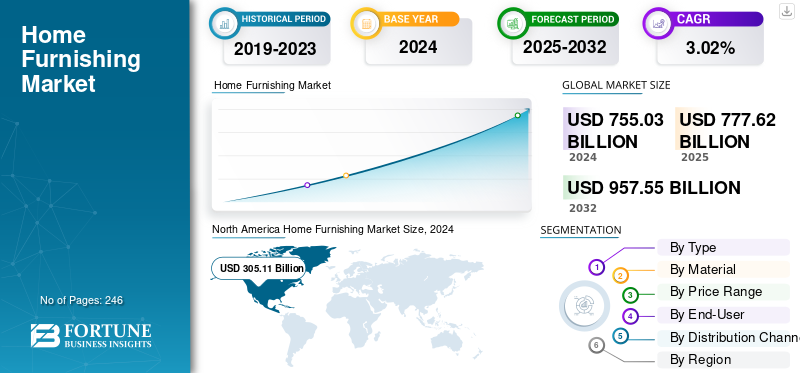
Download Free sample to learn more about this report.
Home Furnishing Market Key Takeaways
 Market Size & Forecast
- 2025 Market Size: USD 777.62 Billion
- 2026 Market Size: USD 803.32 Billion
- 2034 Forecast Market Size: USD 1,021.20 Billion
- CAGR: 3.02% from 2026–2034
 Market Share
- North America dominated the home furnishing market with a 40.24% share in 2025.
- The furniture segment is projected to account for a 60.66% share in 2026.
- The residential segment is projected to hold a 68.73% share in 2026.
 Key Regional Highlights
Asia Pacific
Asia Pacific accounted for USD 252.26 billion in 2025 and is expected to reach USD 263.17 billion in 2026.
North America
North America generated USD 312.91 billion in 2025 and is projected to reach USD 321.89 billion in 2026.
Europe
Europe reached USD 163.84 billion in 2025 and is projected to grow to USD 168.06 billion in 2026.
U.S.
The home furnishing market is projected to reach USD 285.29 billion in 2026.
Japan
Japan's home furnishing market is projected to reach USD 37.92 billion in 2026
Read More

MARKET DYNAMICS
MARKET DRIVERS:
Rising Home Construction and Increasing Demand for Compact-sized Home Goods to Drive Market Growth
The evolving real estate industry, rising number of new home constructions, and the growing number of families moving to apartments or small housing facilities increases the demand for modern home furniture items. Additionally, the evolving trend of home decoration and renovation increases the product replacement rate, driving growth in the global home furnishing products market. According to the Office for National Statistics (ONS), as of 2023, there were 28.4 million households in the U.K., 6% more than in 2013. Besides, governmental financial assistance in building housing and commercial infrastructure facilities is augmenting the demand for these products in these settings.
MARKET RESTRAINTS:
Volatility in Raw Material Prices to Restrain Market Growth
Volatility in the prices of various raw materials, including engineered wood, metal, textiles, glass, and others, is significantly impacting the business profitability of manufacturing companies, negatively affecting home furnishing market growth. In addition, trade restrictions and supply chain disruptions, including container shortages, transport delays, and labor constraints, are severely impacting the operations of supply chains across many countries. Additionally, the need for high R&D investments to develop eco-friendly products presents challenges to the key market players’ portfolio expansion activities.
MARKET OPPORTUNITIES:
Rising Popularity of Multi-functional, Modular, and Space-Saving Furnishings to Augment Market Growth
Foldable chairs and portable desks of lightweight designs are increasingly popular among households and official settings. Growing urbanization and rising demand for single-person household facilities are creating new opportunities for furnishing businesses that produce multi-functional, space-saving, and modular furnishings. Additionally, advancements in the development of furnishings with smart designs and lightweight construction are driving global market growth.
HOME FURNISHING MARKET TRENDS:
Increasing Demand for Personalized and Customized Home Furnishings to Augment Market Growth
Consumers seek furnishing items of customized and personalized designs that reflect their individual preferences, tastes, and space requirements. The product revenues across many countries is driven by rising demand for home furnishing items with personalized designs In addition, consistent efforts by manufacturers to conduct on-demand production of items for 3D visualization technologies are creating new industry growth prospects.
- For instance, in September 2025, Thrōn launched a crowdfunding campaign to promote its collection of 3D-printed sculptural furniture, made from plant-based resins and recycled material blends.
Download Free sample to learn more about this report.
MARKET CHALLENGES:
Significant Competition from Mass-Market Industry Manufacturers to Challenge Key Players’ Business Revenue Growth
Significant competition from upholstery shops and manufacturers producing mass-produced items with competitive pricing is posing challenges to key manufacturers in their international business expansion activities. Furthermore, an increasing number of direct-to-consumer (DTC) brands offering products at discounted prices is significantly impacting the key players’ product revenue growth.
Segmentation Analysis
By Type
Significant Furniture Demand among Households Led Furniture Segment to Hold Leading Market Share
By type, the market is segmented into furniture, home textiles, floor coverings, and others.
The Furniture segment is slated to hold a leading global market share of 60.66% in 2026. Its major share is attributed to its significant demand among household and commercial spaces. The most common furniture items these settings purchase are seating products, storage products, tables, beds, and modular units. In addition, the increasing demand for furniture items with space-saving and multifunctional designs is driving growth in the furniture segment.
Others segment, comprising various products including home décor accessories, lighting fixtures, wall art, decorative storage, and lifestyle furnishings, is projected to grow at the fastest rate of 4.10% during the forecast period. Broadening consumers' needs for a diverse range of home furnishing items is mainly driving the other segmental growth. In addition, the increasing demand for eco-friendly, handcrafted area rugs, curtains, and other textile furnishings is favoring segmental revenue growth.
To know how our report can help streamline your business, Speak to Analyst
By Material
High Demand for Wooden Furnishings Due to Its Aesthetic Outlook Led Wood Segment to Hold a Dominant Market Share
By material, the market is segmented into wood, metal, plastic, and others.
The Wood segment is projected to hold a leading global market share of 54.93% in 2026. Wooden items add aesthetic appeal and a decorative touch to living spaces. The segment’s leading share is attributed to the significant consumer demand for engineered wood-based furniture and furnishing items, compared to products made from counterpart materials. In addition, the growing manufacturing industry's emphasis on implementing sustainability and eco-friendly measures, including the use of certified, responsibly sourced timber and recycled wood for furniture production, is creating new segmental growth opportunities.
Its fastest growth is attributed to the lightweight construction and affordability of plastic-based home products, compared to those made from other materials. In addition, advancements in the development of plastic furniture using 3D printing and injection molding technologies are creating new segmental growth opportunities.
By Price Range
Significant Demand for Mass-Produced Affordable Products Led Mass-Market Segment to Hold Leading Market Share
Based on price range, the market is segmented into mass-market, mid-range, and luxury.
The Mass Market segment is projected to hold a leading global market share of 52.86% in 2026. Significant consumer demand for mass-produced, affordable products, combined with consistent partnerships between mass-market manufacturers and online retailers such as Amazon.com, Walmart, and others, is generating considerable product revenues from the mass-market segment. Furthermore, rapid urbanization and the rental lifestyle trend are propelling the demand for affordable products, driving future segmental revenues.
The Mass Market segment is projected to hold a leading global market share of 52.86% in 2026. Its fastest growth is attributed to rising consumer preferences for premium, design-oriented interiors, which require aesthetically designed furnishing items. In addition, the growing number of luxury brands emphasizing craftsmanship and the use of luxury materials, including metal alloys, solid wood, marble, and others, is further favoring the growth of the luxury segment.
By End-User
High Demand for Furnishing Items Among Households Led Dominance of Residential Segment
Based on end-user, the market is segmented into residential, hospitality, office, educational institutions, and others.
The Residential segment is projected to hold a leading global market share of 68.73% in 2026, as households are the primary users of home furniture and furnishing items for their daily seating and comfort requirements. Additionally, the growth of residential housing facilities is driving segmental revenue growth.
Hospitality settings, including hotels, restaurants, cafes, bars, and salons, essentially establish modern and stylish furnishing items that enhance the facility's visitors' experience of their hospitality service. The segment’s fastest growth is attributed to the significant demand for luxury furniture and home fixtures in hospitality settings. In addition, the rising number of international travelers preferring luxury hotel facilities where high-end products are used is driving segmental revenue growth.
By Distribution Channel
Product Expertise and Provision of Personalized Shopping Experience Led Specialty Stores Segment to Dominate Market
Based on distribution channel, the market is segmented into hypermarkets & supermarkets, specialty stores, online channels, and others.
The specialty stores segment is projected to hold a leading global market share of 33.48% by 2024. The specialty stores segment is slated to hold a leading global market share due to the consistent provision of expert advice, hands-on product trials, and technical assistance by specialty sporting goods stores to their visitors. In addition, the regular provision of customized, design-based, branded skating goods by these shops is favoring product sales from these settings.
The online channels segment is projected to grow at the fastest rate of 4.37% from 2025 to 2032. The rising adoption of online shopping for home care goods among households is primarily driving the growth of the online channels segment. In addition, the increasing number of brands adopting and delivering 3D visualization tools, virtual showrooms, and Augmented Reality applications that track users' purchasing behavior is positively contributing to the segment’s revenue growth.
Home Furnishing Market Regional Outlook
By region, the market is categorized into North America, Europe, Asia Pacific, South America, and the Middle East & Africa.
North America
North America Home Furnishing Market Size, 2025 (USD Billion)
To get more information on the regional analysis of this market, Download Free sample
North America contributed approximately USD 312.91 Billion to the global market in 2025, accounting for 40.24% share, and is expected to reach USD 321.89 Billion in 2026. High consumer spending on home decoration & renovation and significant demand for luxury housing facilities requiring the installation of luxury-priced home fixture goods in the U.S. and Canada resulted in the leading global market position of the region. In addition, the increasing number of consumers seeking sustainable and tech-integrated furnishings is favoring product revenues across Canada and the U.S. The U.S. market is projected to reach USD 285.29 Billion in 2026.
Asia Pacific
The Asia Pacific region captured 32.44% of the global market in 2025, generating USD 252.26 Billion in revenue, and is projected to reach USD 263.17 Billion in 2026. The rising demand for modern, space-saving, and affordable furniture solutions among households in China, India, and Southeast Asia is driving market growth in the region. Additionally, the increasing number of online platforms and specialty retailers expanding their retail footprint is favoring product sales in the region. The China market is projected to reach USD 118.06 Billion in 2026, the India market is projected to reach USD 45.95 Billion in 2026, and the Japan market is projected to reach USD 37.92 Billion in 2026.
Europe
In 2025, the Europe market stood at USD 163.84 Billion, representing 21.22% of global demand, and is projected to grow to USD 168.06 Billion in 2026. High aesthetic standards and robust consumer demand for products of quality craftsmanship characterize the European market. The rising demand for home goods with minimalist designs and durable construction in the U.K., Germany, France, and Italy is accelerating market growth. The UK market is projected to reach USD 30.25 Billion in 2026 and the Germany market is projected to reach USD 32.99 Billion in 2026.
South America
South America contributed 4.44% to the global market in 2025, with a valuation of USD 34.56 Billion, and is projected to reach USD 35.65 Billion in 2026. Increasing urbanization and the growing number of middle-income households in Brazil, Argentina, and Colombia are mainly driving the South American market growth.
Middle East & Africa
In 2025, Middle East & Africa generated USD 14.04 Billion, contributing 1.81% to global market revenue, and is projected to grow to USD 14.56 Billion in 2026. The expansion of hospitality and corporate infrastructure facilities, along with the rising number of international travelers seeking luxury hospitality services, is driving product demand across the region.
COMPETITIVE LANDSCAPE
Key Industry Players:
Production Capacity Building and Modernizing Product Portfolio to Help Key Players Maintain Competitive Market Position
The global market is competitive with leading players including IKEA Systems B.V., Ashley Furniture Industries, Inc., Mohawk Industries, Inc., Tarkett S.A., and Interface, Inc. These players focus on building the production capacity of home products to strengthen their market coverage. In addition, they invest in modernizing the design, sustainability, and operational efficiencies of the home fixture items to meet consumer needs. These business efforts collectively help key players maintain their global market position.
LIST OF KEY HOME FURNISHING COMPANIES PROFILED:
- IKEA Systems B.V. (Netherlands)
- Ashley Furniture Industries, Inc. (U.S.)
- Mohawk Industries, Inc. (U.S.)
- Tarkett S.A. (France)
- Interface, Inc. (U.S.)
- Welspun Living Ltd. (India)
- Häfele Group (Germany)
- Friul Intagli Industries S.p.A. (Italy)
- Bulthaup GmbH & Co. KG (Germany)
- Julius Blum GmbH (Austria)
KEY INDUSTRY DEVELOPMENTS:
- September 2025: Stanley Lifestyles, an Indian furniture manufacturer, established an exclusive agreement with Singer (Sri Lanka) PLC to distribute its Sofas & More-branded products in Sri Lanka.
- October 2025: Ingka Group, the largest franchisee of the IKEA Group, acquired Locus, an AI-based heavy logistics technology company in the U.S. The acquisition was aimed at enhancing the Ingka Group’s capability for home-delivery plans.
- June 2025: Amart, an Australian furniture retailer, acquired Freedom Furniture to expand its retail footprint to up to 120 stores located across Australia and New Zealand.
- March 2024: Ashley Home, Inc. signed an agreement to acquire Resident Home Inc., a leading digital retailer and wholesaler of mattresses
- and bedding accessories. The acquisition has significantly provided opportunities for Resident Home Inc. to expand its home fixture assortment and global footprint. The acquisition helped Ashley Home, Inc. improve sourcing and operational efficiencies.
- April 2023: The European Union (EU) approved the merger of XXXLutz and home24 to collectively strengthen their portfolio of household articles, lighting products, and furniture across Europe.
REPORT COVERAGE
The global home furnishing market analysis provides an in-depth study of market insights, size, and forecast by all the market segments included in the report. In addition, the report outlooks market dynamics and market trends expected to drive the market in the forecast period. It offers information on the technological advancements, new product launches, key industry developments, and details on partnerships, mergers & acquisitions. The home furnishing market research report also encompasses a detailed competitive landscape with information on the market share and profiles of key operating players.
Request for Customization to gain extensive market insights.
Report Scope & Segmentation
| ATTRIBUTE | DETAILS |
| Study Period | 2021-2034 |
| Base Year | 2025 |
| Forecast Period | 2026-2034 |
| Historical Period | 2021-2024 |
| Growth Rate | CAGR of 3.02% from 2026-2034 |
| Unit | Value (USD Billion) |
| Segmentation | By Type, Material, Price Range, End-User, Distribution Channel, and Region |
| By Type |
|
| By Material |
|
| By Price Range |
|
| By End-User |
|
| By Distribution Channel |
|
| By Region |
|
Frequently Asked Questions
Fortune Business Insights says that the global market value stood at USD 777.62 billion in 2025 and is projected to reach USD 1,021.20 billion by 2034.
In 2025, the market value stood at USD 312.91 billion.
At a CAGR of 3.02%, the global market is projected to grow during the forecast period.
By type, the furniture segment exhibited a leading global market share throughout the forecast period.
The rising home construction and increasing demand for compact-sized home goods are set to drive the global market.
IKEA Systems B.V., Ashley Furniture Industries, Inc., Mohawk Industries, Inc., Tarkett S.A., and Interface, Inc., among others, are the prominent players in the market.
North America dominated the market in 2025.
The rising popularity of multi-functional, modular, and space-saving furnishings is expected to favor the adoption rate of this product.



- 2021-2034
- 2025
- 2021-2024
- 246
-
(Offer valid till 15th Oct 2026)
Get 30-60 hrs Free Customization
Expand Regional and Country Coverage, Segments Analysis, Company Profiles, Competitive Benchmarking, and End-user Insights.



















Related Reports
-
US +1 833 909 2966 ( Toll Free )
-
Get In Touch With Us