Hose Market Size, Share & Industry Analysis, By Material Type (Rubber, PVC, Silicone, Teflon), By Application (Oil & Gas, Automotive, Construction & Infrastructure, Pharmaceuticals, Food & Beverages, Mining, Residential), By Region and Regional Forecast, 2026-2034
 Download Free Sample
Hose Market Overview
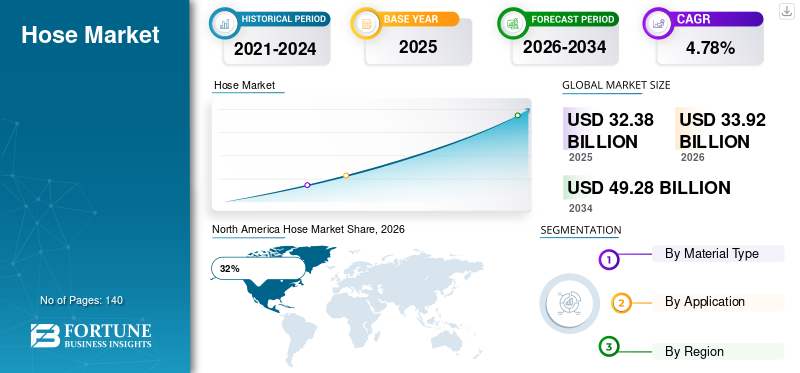
The global hose market size was valued at USD 32.38 billion in 2025. The market is projected to grow from USD 33.92 billion in 2026 to USD 49.28 billion by 2034, exhibiting a CAGR of 4.78% during the forecast period.

The global hose market is experiencing steady expansion due to increasing industrial automation, rising infrastructure activities, and the growing use of fluid transfer systems across multiple sectors. Hose products are essential for transferring liquids, gases, chemicals, steam, and abrasive materials in industrial and commercial environments. Demand for durable, pressure-resistant, and temperature-tolerant hose systems continues to rise in sectors such as manufacturing, automotive, pharmaceuticals, mining, and food processing. The hose market Report highlights growing preference for lightweight, flexible, and corrosion-resistant hose materials that improve operational efficiency and reduce maintenance requirements. Technological advancements in reinforced hose construction and smart monitoring solutions are also shaping the hose market Analysis globally.
The USA hose market remains highly developed due to strong industrial manufacturing capabilities and large-scale investments in oil & gas, automotive production, and infrastructure modernization. Industrial facilities across the country increasingly rely on hydraulic and pneumatic hose systems for automated operations and fluid management. The expansion of electric vehicle manufacturing and energy projects has accelerated demand for advanced hose assemblies capable of handling extreme pressure and chemical exposure. Hose Industry Analysis in the United States also indicates rising adoption of food-grade and pharmaceutical-grade hose systems due to strict safety standards and hygiene regulations. Replacement demand from aging industrial equipment further supports the hose market growth across the country.
Download Free sample to learn more about this report.
Hose Market Key Takeaways
 Global Market Size & Forecast
- 2025 Market Size: USD 32.38 Billion
- 2026 Market Size: USD 33.92 Billion
- 2034 Forecast Market Size: USD 49.28 Billion
- CAGR: 4.78% from 2026-2034
 Market Share
- Asia-Pacific dominated with a 34% regional market share in 2025.
- Rubber hoses held the largest material type share at approximately 38%.
- Oil & gas accounted for the largest application share at approximately 26%.
 Key Regional Highlights
Asia-Pacific
Asia-Pacific held the largest regional share at 34%, supported by industrialization and infrastructure development.
North America
North America accounted for 32% of the market, driven by demand from oil & gas and automotive industries.
Europe
Europe represented 27% of the market, supported by advanced industrial and manufacturing activities.
U.S.
Demand is supported by strong oil & gas, automotive, and construction activities.
Japan
Japan accounted for 16% of the Asia-Pacific market, supported by automotive and industrial applications.
Read More

Hose Market Latest Trends
The hose market is witnessing major transformation due to the increasing focus on efficiency, durability, and sustainability. One of the most notable hose market trends is the growing use of lightweight thermoplastic and hybrid hoses that offer flexibility without compromising pressure resistance. Manufacturers are integrating advanced reinforcement technologies using braided steel, synthetic fibers, and multilayer polymer coatings to improve lifespan and operational safety. Smart hose technologies equipped with sensors for pressure monitoring and leak detection are also becoming increasingly popular in industrial operations. These innovations help reduce downtime and improve predictive maintenance strategies across manufacturing and processing industries.
Download Free sample to learn more about this report.
Another important trend in the Hose Industry Report is the increasing demand for customized hose solutions tailored for industry-specific applications. Food processing companies are seeking antimicrobial and contamination-resistant hoses, while chemical industries require corrosion-resistant materials capable of handling aggressive fluids. The automotive sector is rapidly adopting high-temperature hoses for electric vehicles and battery cooling systems. Construction and mining operations continue to demand abrasion-resistant hydraulic hoses for heavy-duty machinery. Sustainability initiatives are also influencing the market, with manufacturers focusing on recyclable materials and energy-efficient production methods. The hose market forecast indicates continued innovation in hose materials and connectivity solutions to support evolving industrial requirements.
Hose Market Dynamics
DRIVER
Rising Industrial Automation and Infrastructure Development
Industrial automation across manufacturing, construction, mining, and energy sectors is significantly driving the hose market. Automated production facilities require high-performance hose systems for hydraulic and pneumatic operations, fluid transfer, cooling systems, and material handling. Industries are increasingly investing in machinery that depends on reliable hose assemblies capable of operating under high pressure and extreme environmental conditions. Infrastructure development projects such as highways, bridges, airports, and smart city initiatives are also increasing the use of industrial equipment requiring durable hydraulic hoses.
The expansion of oil & gas exploration, renewable energy projects, and heavy equipment manufacturing has further accelerated market demand. hose market research report findings indicate growing preference for reinforced hoses that improve operational safety and minimize leakage risks. Construction equipment manufacturers continue integrating advanced hydraulic systems into machinery, creating long-term demand for specialized hoses. Rapid urbanization in emerging economies and increasing industrial output globally are expected to strengthen hose market Opportunities in the coming years.
RESTRAINT
Volatility in Raw Material Prices
Fluctuating prices of raw materials such as synthetic rubber, PVC compounds, silicone, fluoropolymers, and steel reinforcement materials remain a major restraint for the hose market. Manufacturing costs often increase unpredictably due to changes in crude oil prices and global supply chain disruptions. Hose manufacturers face challenges in maintaining stable profit margins while meeting customer demands for cost-effective products. Small and medium-sized manufacturers are particularly affected by sudden material cost increases, limiting their production flexibility and competitiveness.
Environmental regulations related to chemical processing and polymer manufacturing also increase compliance expenses for hose producers. Rising transportation costs and import-export restrictions in several regions further complicate supply chain management. The hose market Outlook indicates that manufacturers must continuously optimize sourcing strategies and production efficiency to manage pricing pressures. Competition from low-cost local suppliers in developing economies additionally creates pricing challenges for established global brands, particularly in standard industrial hose segments.
OPPORTUNITY
Growing Demand for Specialized And High-Performance Hoses
The increasing requirement for specialized hoses in pharmaceuticals, food processing, electric vehicles, and chemical industries presents major growth opportunities for the market. Industries operating in sensitive environments are demanding contamination-resistant, chemically stable, and temperature-tolerant hose systems that comply with strict regulatory standards. Pharmaceutical and biotechnology facilities are particularly investing in sterile hose systems capable of maintaining hygienic processing conditions. Similarly, the expansion of electric vehicle manufacturing is increasing demand for cooling and fluid transfer hoses designed for advanced battery systems.
The hose market Insights show substantial opportunities in smart hose technologies featuring real-time monitoring capabilities. Industrial operators are seeking predictive maintenance solutions that improve equipment efficiency and reduce unexpected downtime. Demand for lightweight and energy-efficient hose systems is also creating opportunities for advanced thermoplastic materials. Emerging economies investing in industrialization, energy infrastructure, and water management projects are expected to provide long-term business expansion possibilities for hose manufacturers and component suppliers.
CHALLENGE
Intense Competition and Product Standardization Issues
The hose market faces strong competition from regional and international manufacturers offering similar industrial products across various price ranges. Maintaining product differentiation remains difficult in standard industrial hose categories where pricing pressure is high. Manufacturers must constantly invest in innovation, testing, and certification to maintain competitiveness. Product standardization requirements across industries and regions also create operational complexity for global suppliers.
Industrial customers increasingly expect customized solutions with improved durability, flexibility, and resistance to chemicals, abrasion, and temperature fluctuations. Meeting these expectations while controlling production costs remains a major challenge. The Hose Industry Analysis also highlights challenges associated with counterfeit and low-quality hose products entering the market, especially in developing regions. Such products may compromise industrial safety and reduce customer trust. Manufacturers are therefore focusing on quality certifications, advanced material technologies, and long-term partnerships with industrial equipment suppliers to strengthen their market position.
Hose Market Segmentation
By Material Type
Rubber hoses continue to dominate the hose market due to their superior flexibility, pressure resistance, and durability across industrial applications. This segment accounts for nearly 38% market share because rubber hoses are extensively used in hydraulic systems, fuel transfer, chemical handling, mining operations, and heavy machinery. Industries prefer rubber hoses for applications involving extreme temperatures, abrasive materials, and demanding working environments. Reinforced rubber hoses with braided steel and textile layers are increasingly utilized in construction equipment, agricultural machinery, and industrial automation systems.
The hose market Analysis indicates growing demand for synthetic rubber compounds such as EPDM and nitrile rubber because they provide enhanced chemical resistance and longer service life. Oil & gas operations heavily rely on rubber hoses for fluid transfer and drilling applications. Automotive manufacturers also use rubber hoses extensively in cooling systems, fuel lines, and brake systems. Technological improvements in rubber processing have enabled manufacturers to produce lightweight yet highly durable hoses suitable for high-pressure industrial environments. Replacement demand from aging industrial infrastructure continues supporting growth in this segment.
PVC hoses represent approximately 24% market share owing to their affordability, lightweight construction, and versatility in low-pressure applications. These hoses are widely used in residential water transfer, irrigation systems, construction sites, and food-grade applications. PVC hoses offer excellent resistance to moisture, corrosion, and weather conditions, making them suitable for outdoor usage. The hose market research report highlights increasing adoption of reinforced PVC hoses in agricultural operations and industrial fluid handling systems where flexibility and cost efficiency are critical.
Manufacturers are focusing on producing phthalate-free and environmentally safer PVC compounds to comply with evolving regulatory standards. Transparent PVC hoses are increasingly preferred in food processing and laboratory applications because they allow easy monitoring of fluid movement. Construction and infrastructure projects continue driving demand for PVC suction and discharge hoses used for water management and dewatering activities. Rising urbanization and agricultural modernization in developing economies are expected to further strengthen demand for PVC hose products in commercial and residential sectors.
Silicone hoses hold around 18% market share due to their excellent thermal stability, flexibility, and resistance to extreme temperatures. These hoses are commonly used in automotive turbocharger systems, medical equipment, food processing plants, and pharmaceutical manufacturing. Silicone materials provide superior hygiene characteristics and low contamination risk, making them highly suitable for sterile and high-purity environments. hose market trends indicate increasing adoption of silicone hoses in electric vehicles where advanced cooling systems require temperature-resistant fluid transfer solutions.
The pharmaceutical and biotechnology industries continue investing in silicone hose systems capable of meeting strict sanitation requirements. Medical device manufacturers also use silicone hoses for fluid transfer and respiratory applications because of their biocompatibility and chemical stability. Manufacturers are developing multilayer silicone hoses with reinforced fabrics to improve pressure handling capabilities. Growing demand for premium automotive performance systems and advanced healthcare equipment is expected to support expansion of the silicone hose segment in global markets.
Teflon hoses account for nearly 20% market share because of their exceptional chemical resistance and high-temperature performance. Industries handling aggressive chemicals, solvents, steam, and corrosive fluids extensively rely on Teflon hose systems for operational safety and reliability. Chemical processing plants, semiconductor manufacturing facilities, and pharmaceutical production units increasingly use Teflon hoses due to their non-reactive properties and long operational lifespan. The hose market Outlook highlights growing demand for PTFE-lined hoses in high-purity industrial applications.
Teflon hoses are also gaining popularity in aerospace and automotive industries where lightweight, heat-resistant, and chemically stable materials are essential. Manufacturers are producing braided stainless-steel reinforced Teflon hoses for high-pressure operations in industrial environments. Food and beverage processing industries utilize Teflon hoses because they resist contamination and simplify cleaning processes. Rising investments in advanced manufacturing and specialty chemical industries are expected to create strong long-term opportunities for Teflon hose manufacturers globally.
To know how our report can help streamline your business, Speak to Analyst
By Application
The oil & gas sector contributes approximately 26% market share in the hose market due to extensive usage in drilling, fluid transfer, refining, and offshore operations. Industrial hoses used in this sector must withstand extreme pressure, temperature variations, and exposure to corrosive chemicals. Hydraulic hoses are critical for drilling rigs, pumping systems, and heavy machinery used in upstream and downstream activities. The hose market Report indicates increasing demand for reinforced composite hoses designed for safe transfer of petroleum products and industrial gases.
Energy companies are investing in durable hose systems to improve operational safety and minimize leakage risks. Offshore exploration activities continue supporting demand for flexible hoses capable of handling harsh marine environments. The expansion of liquefied natural gas infrastructure and pipeline maintenance projects is also contributing to market growth. Manufacturers are focusing on advanced abrasion-resistant and flame-retardant hose technologies to meet industry regulations and improve equipment reliability in oil & gas operations.
The automotive industry represents nearly 19% market share because hoses are essential for fuel systems, cooling systems, braking systems, air conditioning, and power steering applications. The transition toward electric vehicles is creating additional demand for advanced thermal management hose systems used in battery cooling applications. Automotive manufacturers increasingly require lightweight and heat-resistant hoses to improve fuel efficiency and vehicle performance. The hose market forecast highlights rising investments in silicone and thermoplastic hoses for modern automotive engineering.
Replacement demand from vehicle maintenance and aftermarket services also supports growth in this segment. Commercial vehicle manufacturers rely heavily on durable hydraulic and pneumatic hose systems for heavy-duty transportation applications. Advanced engine technologies and emission control regulations are encouraging adoption of high-performance hose materials resistant to chemicals and temperature fluctuations. Increasing vehicle production across Asia-Pacific and North America continues strengthening demand for automotive hose solutions globally.
Construction and infrastructure applications account for around 17% market share due to rising global investments in urban development and public infrastructure projects. Hydraulic hoses are widely used in excavators, cranes, loaders, concrete pumps, and road construction machinery. These hoses must handle high-pressure operations and harsh environmental conditions. The Hose Industry Report indicates strong demand for abrasion-resistant hose systems capable of improving operational reliability in construction equipment.
Infrastructure modernization projects involving highways, airports, rail networks, and water management systems are increasing the use of industrial hose assemblies. Contractors increasingly prefer flexible and lightweight hose solutions that reduce maintenance downtime and improve equipment efficiency. Mining and tunneling projects also contribute significantly to demand for heavy-duty hydraulic hoses. Rapid industrialization in emerging economies continues creating long-term growth opportunities for hose manufacturers serving construction and infrastructure sectors.
The pharmaceutical industry holds nearly 9% market share in the hose market because of strict hygiene and contamination control requirements. Pharmaceutical manufacturing facilities utilize specialized silicone and Teflon hoses for sterile fluid transfer, chemical processing, and biotechnology applications. These hoses must comply with rigorous safety standards and maintain purity during production processes. The hose market Insights show increasing investment in cleanroom-compatible hose systems designed for advanced pharmaceutical operations.
Biotechnology expansion and rising healthcare production capacities are driving demand for flexible, chemically resistant, and easy-to-clean hose systems. Manufacturers are focusing on producing antimicrobial and sterilizable hoses suitable for sensitive processing environments. The growth of vaccine production and biopharmaceutical manufacturing has further increased demand for high-purity hose assemblies. Regulatory compliance requirements continue encouraging pharmaceutical companies to upgrade fluid transfer systems using premium-grade hose materials.
Food and beverage applications contribute nearly 11% market share because hygienic fluid transfer systems are essential for processing, packaging, and sanitation operations. Food-grade hoses are used for milk processing, beverage transfer, brewing, edible oil handling, and cleaning applications. These hoses must comply with strict safety standards and resist bacterial contamination. The hose market research report highlights increasing adoption of transparent and odor-free hose materials in food production facilities.
Manufacturers are developing flexible hose systems capable of handling high temperatures, steam cleaning, and aggressive cleaning chemicals. Beverage processing facilities increasingly utilize silicone and Teflon hoses due to their durability and contamination resistance. Growing consumer demand for packaged food and beverages is encouraging production expansion globally, thereby supporting hose market growth. Automation in food processing plants is also increasing the need for efficient fluid handling systems.
Mining applications account for approximately 10% market share due to heavy reliance on hydraulic equipment and abrasive material transfer systems. Mining operations require durable hoses capable of handling high-pressure fluids, slurry transport, dust suppression, and compressed air systems. hose market growth in this segment is strongly supported by rising mineral extraction activities and investments in advanced mining machinery.
Mining environments expose hose systems to extreme abrasion, temperature fluctuations, and harsh operating conditions. Manufacturers are therefore focusing on reinforced rubber and composite hoses with enhanced durability. Hydraulic excavators, drilling equipment, and ore processing systems extensively depend on reliable hose assemblies for continuous operations. Expansion of rare earth mineral extraction and infrastructure-related mining activities continues creating growth opportunities for industrial hose suppliers worldwide.
The residential segment holds nearly 8% market share because hoses are widely used for gardening, water supply, cleaning, and household maintenance applications. PVC and lightweight rubber hoses remain highly popular in residential environments due to affordability and ease of handling. Urbanization and rising home improvement activities continue increasing demand for residential hose products globally. The hose market Outlook indicates growing interest in kink-resistant and eco-friendly garden hose solutions.
Manufacturers are introducing compact, expandable, and weather-resistant hose products designed for consumer convenience. Increasing awareness regarding water conservation is encouraging adoption of efficient irrigation and watering systems in residential landscapes. Smart home gardening solutions integrated with automated watering systems are also contributing to product innovation in this segment. E-commerce expansion has further improved accessibility to residential hose products across global markets.
Hose Market Regional Outlook
North America
North America Hose Market Share, 2025 (%)
To get more information on the regional analysis of this market, Download Free sample
North America accounts for nearly 32% market share in the global hose market due to strong industrial manufacturing, oil & gas operations, and advanced infrastructure development. The region has a mature industrial ecosystem with extensive demand for hydraulic, pneumatic, and chemical transfer hoses across automotive, mining, food processing, and energy sectors. Industrial automation and modernization initiatives continue driving replacement demand for high-performance hose systems. The United States remains the dominant contributor due to its large manufacturing base and ongoing investments in energy infrastructure.
Canada also supports regional growth through mining activities and oil sands operations requiring durable industrial hose systems. hose market trends in North America show increasing adoption of smart hose technologies equipped with pressure monitoring and predictive maintenance capabilities. Environmental regulations are encouraging industries to adopt safer and more efficient hose materials with reduced leakage risks. The expansion of electric vehicle manufacturing and renewable energy projects is expected to create additional demand for advanced hose assemblies throughout the region.
Europe
Europe represents around 27% market share because of its advanced automotive sector, industrial automation capabilities, and strong regulatory focus on product quality and safety. Countries across the region increasingly invest in sustainable manufacturing technologies and energy-efficient industrial systems, supporting demand for specialized hoses. Food processing, pharmaceuticals, and chemical manufacturing industries contribute significantly to regional hose consumption. European manufacturers are also leading innovation in lightweight thermoplastic and recyclable hose materials.
Industrial modernization and automation projects across Western and Central Europe continue supporting long-term market demand. Hose Industry Analysis indicates rising use of high-purity hose systems in pharmaceutical and biotechnology applications throughout the region. Automotive production facilities are increasingly adopting advanced cooling and fluid transfer hose technologies for electric vehicles. Infrastructure renovation projects and renewable energy investments further contribute to regional market expansion.
Germany Hose Market
Germany holds nearly 29% share within the European hose market because of its strong industrial engineering, automotive manufacturing, and machinery production sectors. The country’s advanced manufacturing ecosystem creates substantial demand for hydraulic and pneumatic hose systems used in automation and precision engineering. German automotive manufacturers are investing heavily in electric vehicle production, increasing the requirement for advanced cooling hoses and thermal management systems.
Industrial machinery exports also contribute to demand for high-performance hose assemblies designed for heavy-duty applications. hose market research report findings indicate increasing preference for environmentally sustainable hose materials that align with Germany’s industrial sustainability objectives. Pharmaceutical and chemical manufacturing facilities further support market demand through adoption of contamination-resistant and chemically stable hose systems. Technological innovation and strict quality standards continue strengthening Germany’s position in the European hose industry.
United Kingdom Hose Market
The United Kingdom accounts for nearly 18% share within the European hose market due to strong aerospace, pharmaceutical, food processing, and construction industries. Industrial facilities across the country increasingly utilize advanced hose systems for fluid handling, automation, and chemical transfer applications. Infrastructure modernization projects and energy sector investments continue driving demand for hydraulic and industrial hoses.
The hose market Outlook in the United Kingdom is influenced by growing adoption of smart manufacturing technologies and predictive maintenance solutions. Food and beverage industries are investing in hygienic hose systems compliant with strict safety regulations. Pharmaceutical production expansion and biotechnology research activities are also contributing to demand for specialized silicone and Teflon hoses. Increasing focus on renewable energy infrastructure and industrial efficiency improvements is expected to create additional growth opportunities for hose manufacturers operating in the UK market.
Asia-Pacific
Asia-Pacific dominates industrial expansion and holds approximately 34% market share due to rapid urbanization, manufacturing growth, and infrastructure investments across major economies. China, Japan, India, and Southeast Asian countries are significantly increasing industrial output, creating strong demand for hydraulic and industrial hose systems. Construction equipment manufacturing, automotive production, mining activities, and agricultural modernization continue supporting regional market growth.
The hose market forecast for Asia-Pacific indicates rising investments in industrial automation and smart manufacturing technologies. Expanding oil & gas operations and water management projects are also contributing to demand for specialized hose products. Regional manufacturers are increasingly focusing on cost-effective production and export expansion. Rapid industrialization and government-supported infrastructure projects are expected to maintain Asia-Pacific’s leadership position in the global hose market over the coming years.
Japan Hose Market
Japan accounts for nearly 16% share within the Asia-Pacific hose market because of its advanced automotive, robotics, and electronics manufacturing industries. High demand for precision-engineered hose systems exists in industrial automation and semiconductor manufacturing facilities. Japanese automotive manufacturers increasingly utilize lightweight and heat-resistant hose technologies for hybrid and electric vehicles.
The hose market Analysis in Japan highlights strong adoption of premium silicone and fluoropolymer hoses capable of handling high-performance industrial applications. Pharmaceutical and biotechnology sectors also contribute to demand for sterile fluid transfer systems. Manufacturers in Japan prioritize innovation, durability, and energy efficiency, leading to development of technologically advanced hose products. Aging industrial infrastructure replacement and continued investment in robotics and factory automation are expected to sustain market demand.
China Hose Market
China represents nearly 41% share within the Asia-Pacific hose market because of its massive industrial manufacturing base and large-scale infrastructure development activities. Construction machinery, automotive production, mining operations, and energy projects generate substantial demand for industrial hose systems. Domestic manufacturing expansion and export-oriented industrial production continue driving market growth.
The Hose Industry Report highlights increasing investment in advanced hydraulic systems and automation equipment across Chinese industries. Rapid urbanization and transportation infrastructure projects are supporting demand for construction and water management hoses. China’s growing electric vehicle manufacturing sector is also creating opportunities for advanced cooling and battery fluid transfer hose technologies. Government initiatives supporting industrial modernization and renewable energy expansion are expected to strengthen long-term demand for high-performance hose systems.
Rest of World
The Rest of World region holds nearly 7% market share in the global hose market due to expanding industrial activities in Latin America, the Middle East, and Africa. Oil & gas exploration, mining operations, and infrastructure projects remain primary growth drivers in these regions. Countries in the Middle East continue investing heavily in energy infrastructure and industrial diversification, increasing demand for chemical-resistant and high-pressure hose systems.
Mining expansion in Africa and agricultural modernization in Latin America are also contributing to market growth. The hose market Insights indicate rising demand for affordable and durable hose solutions suitable for harsh environmental conditions. Water management projects and industrial development initiatives are expected to create additional opportunities for hose manufacturers in emerging economies. Increasing industrial automation and equipment modernization will likely strengthen market penetration across these regions in the coming years.
List of Top Hose Companies
- Parker Hannifin Corp
- Gates Corporation
- Continental AG
- Eaton Corporation
- Trelleborg Group
- Danfoss
- Semperit AG Holding
- Tesa
- THE YOKOHAMA RUBBER CO., LTD.
- Sumitomo Riko Company Limited
Top two companies with the highest market share
- Parker Hannifin Corp – 14%
- Continental AG – 11%
Investment Analysis and Opportunities
The hose market continues attracting investments due to expanding industrial automation, infrastructure modernization, and growing energy sector activities. Manufacturers are investing heavily in advanced material technologies to develop lightweight, flexible, and chemically resistant hose systems suitable for demanding industrial environments. Investments in smart hose monitoring technologies are increasing as industries seek predictive maintenance solutions that reduce operational downtime and improve safety. The hose market research report indicates rising merger and acquisition activities among major industrial component manufacturers aiming to strengthen global distribution networks and expand product portfolios.
Emerging economies offer substantial investment opportunities because of rapid industrialization, mining expansion, and water infrastructure projects. Automotive electrification is also encouraging investments in advanced thermal management hose technologies. Pharmaceutical and food processing industries present profitable opportunities for manufacturers specializing in hygienic and contamination-resistant hose systems. Investors are increasingly focusing on sustainable manufacturing processes and recyclable hose materials to align with environmental regulations and industrial sustainability goals. Expansion of renewable energy projects and industrial automation facilities is expected to create long-term business opportunities across global hose markets.
New Product Development
Innovation in the hose market is focused on improving durability, flexibility, safety, and operational efficiency. Manufacturers are introducing multilayer reinforced hoses with enhanced resistance to chemicals, abrasion, and extreme temperatures. Smart hose systems integrated with sensors for leak detection, temperature monitoring, and pressure tracking are becoming increasingly popular in industrial applications. The hose market trends indicate rising development of lightweight thermoplastic hoses that reduce equipment weight while maintaining high-pressure performance capabilities.
Automotive manufacturers are collaborating with hose producers to develop advanced cooling hose systems for electric vehicles and battery technologies. Food and pharmaceutical industries are driving innovation in antimicrobial and contamination-resistant hose materials. New fluoropolymer and silicone hose designs are improving operational reliability in high-purity manufacturing environments. Manufacturers are also focusing on environmentally sustainable products using recyclable materials and energy-efficient production methods. Rapid advancements in industrial automation continue encouraging the development of customized hose assemblies designed for specialized machinery and robotic systems.
Five Recent Developments (2023-2025)
- Parker Hannifin Corp expanded its industrial hose manufacturing capacity to support growing hydraulic equipment demand.
- Continental AG introduced advanced thermoplastic industrial hoses designed for lightweight high-pressure applications.
- Gates Corporation launched new smart hose monitoring solutions for predictive maintenance in industrial automation systems.
- Danfoss invested in hydraulic hose technologies optimized for renewable energy and heavy construction equipment.
- THE YOKOHAMA RUBBER CO., LTD. developed high-temperature resistant hose products for electric vehicle cooling systems.
Report Coverage of Hose Market
The hose market Report provides comprehensive analysis of industrial hose demand across multiple sectors including oil & gas, automotive, construction, pharmaceuticals, food processing, mining, and residential applications. The report evaluates market dynamics, technological advancements, product innovation trends, and competitive developments influencing industry expansion. Detailed segmentation analysis based on hose type and application offers insights into changing customer requirements and material adoption trends across industrial environments.
Request for Customization to gain extensive market insights.
The hose market Analysis also covers regional performance across North America, Europe, Asia-Pacific, and Rest of World markets, highlighting industrial growth patterns and infrastructure investments. Competitive profiling of major manufacturers provides insights into strategic initiatives, product development activities, and market positioning. The report further examines supply chain trends, raw material challenges, and emerging opportunities linked to automation, electric vehicles, and sustainable manufacturing technologies. hose market forecast assessments help businesses identify investment opportunities, operational trends, and future demand potential across global industrial sectors.
Frequently Asked Questions
Fortune Business Insights says that the global market value stood at USD 32.38 billion in 2025 and is projected to reach USD 49.28 billion by 2034.
The market is expected to exhibit a CAGR of 4.78% during the forecast period of 2026-2034.
Rubber hoses were the leading material type segment, accounting for nearly 38% of the market, due to their flexibility, pressure resistance, and durability across industrial applications.
Key players include Parker Hannifin Corp, Gates Corporation, Continental AG, Eaton Corporation, Trelleborg Group, and Danfoss.
Major trends include rising adoption of lightweight thermoplastic and hybrid hoses and increasing use of smart hoses with sensors for leak detection and pressure monitoring. Asia-Pacific leads regionally with approximately 34% market share.



- 2021-2034
- 2025
- 2021-2024
- 140
-

(Offer valid till 31st Oct 2026)
Get 30-60 hrs Free Customization
Expand Regional and Country Coverage, Segments Analysis, Company Profiles, Competitive Benchmarking, and End-user Insights.














-
US +1 833 909 2966 ( Toll Free )
-
Get In Touch With Us