Hot Rolled Coil (HRC) Steel Market Size, Share & Industry Analysis, By Grade (Low Carbon Steel, Medium Carbon Steel, and High Carbon Steel), By Application (Automotive & Transportation, Construction, Mechanical Equipment, Energy, and Others), and Regional Forecast, 2026-2034
 Download Free Sample
Hot Rolled Coil (HRC) Steel Market Size and Future Outlook
 Listen to Audio Version
The global hot rolled coil (HRC) steel market size was valued at USD 214.59 billion in 2025 and is projected to grow from USD 221.91 billion in 2026 to USD 291.40 billion by 2034, exhibiting a CAGR of 3.5% during the forecast period. Asia Pacific dominated the hot rolled coil (HRC) steel market with a market share of 63.05% in 2025.
Hot Rolled Coil (HRC) Steel is a type of steel that is rolled at high temperatures, making it easier to shape and form. It is widely utilized in construction, automotive, shipbuilding, and industrial machinery due to its strength, formability, and cost-effectiveness. The market is experiencing growth due to rapid urbanization, infrastructure development, and demand for durable building materials. Increased operations in the automotive and manufacturing sectors are further fueling steel demand. Rising transportation and energy infrastructure investments are fostering market growth.
Major manufacturers operating in the market include Tata Steel, ArcelorMittal, POSCO, JFE Steel Corporation, and NIPPON STEEL CORPORATION.
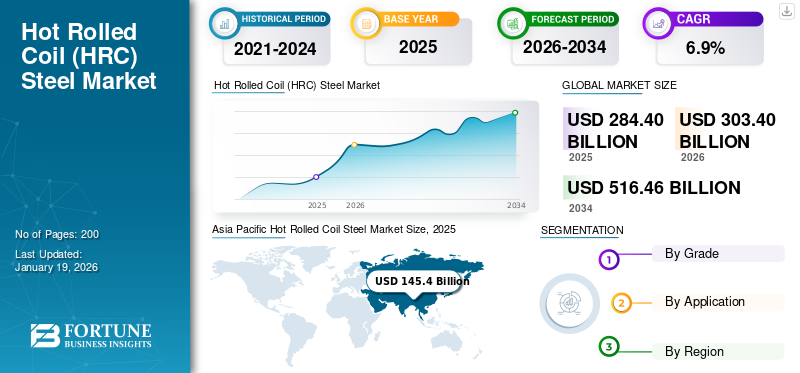
Download Free sample to learn more about this report.
Hot Rolled Coil (HRC) Steel Market Takeaways
 Global Market Size & Forecast
- 2025 Market Size: USD 214.59 billion
- 2026 Market Size: USD 221.91 billion
- 2034 Forecast Market Size: USD 291.40 billion
- CAGR: 3.5% from 2026–2034
 Market Share
- Asia Pacific dominated the hot rolled coil (HRC) steel market with a market share of 63.05% in 2025.
- The low carbon steel segment held a dominant global hot rolled coil (HRC) steel market share in 2025.
- The construction segment held a dominant global market share in 2025.
 Key Regional Highlights
North America
North America was valued at USD 17.78 billion in 2025 and is expected to register a CAGR of 3.3% in the coming years.
Europe
Europe reached USD 34.38 billion in 2025 and is projected to grow at a CAGR of 2.8% in the coming years.
Asia Pacific
Asia Pacific remained the largest regional market in 2025, valued at USD 135.31 billion, and is projected to reach USD 140.18 billion in 2026, registering a CAGR of 3.7% during the forecast period.
U.S.
The U.S. market is projected to generate market revenue worth USD 16.47 billion in 2026, accounting for roughly 7% of global revenues.
Japan
Japan continues to support regional demand through its advanced automotive, heavy machinery, and industrial manufacturing sectors, contributing to the Asia Pacific market growth.
Read More

HOT ROLLED COIL (HRC) STEEL MARKET TRENDS
Rising Focus on Steel Recycling and Circular Economy is a Key Market Trend
The HRC steel market increasingly emphasizes recycling and circular economy practices to promote sustainability. Manufacturers are increasingly utilizing scrap steel from the construction and automotive sectors to reduce dependency on raw materials and lower environmental impact. This trend supports compliance with environmental regulations, enhances resource efficiency, and helps stabilize production costs. With growing environmental consciousness, the integration of green steel production is becoming a key trend shaping the market's future.
MARKET DYNAMICS
MARKET DRIVERS
Download Free sample to learn more about this report.
Rising Infrastructure Projects and Industrial Growth to Boost Market Expansion
The growing focus on infrastructure development and rapid industrialization drives the demand for HRC steel, especially in emerging economies. With increasing investments in transportation, housing, railways, construction, and infrastructure sectors, the need for strong and versatile materials such as HRC steel is rising steadily. Its strength, flexibility, and weldability make it a preferred choice across construction, automotive, and heavy machinery sectors. Moreover, initiatives promoting domestic manufacturing are improving production efficiency and quality. These factors together are expected to drive the global hot rolled coil (HRC) steel market growth in the coming years.
MARKET RESTRAINTS
Changes in Raw Material Prices to Hamper Market Growth
The changing prices of key raw materials such as iron ore, coal, and scrap metal significantly affect the HRC steel manufacturers' production costs and profit margins. Increasing raw material costs lead to higher overall production expenses, which makes it difficult for companies to maintain competitive pricing. On the other hand, sudden drops in raw material prices can disrupt market stability. Companies often adopt cost-control measures and explore alternative sourcing options to manage these challenges. However, shifting raw material prices remain a key restraint, limiting consistent market expansion.
MARKET OPPORTUNITIES
Expanding Automotive and Construction Sectors to Create Growth Opportunities
The continuous expansion of the automotive and construction industries is expected to create significant growth opportunities for the market. The product is widely used in manufacturing structural parts in the automotive industry due to its excellent strength, flexibility, and affordability. Similarly, increasing investments in infrastructure, such as railways, bridges, and commercial buildings, is fueling the need for strong building materials. Additionally, rapid urbanization and government-led infrastructure initiatives across various regions are further increasing the use of HRC steel. These factors position products as important materials in industrial development and contribute to consistent HRC steel market growth.
- According to the Observatory of Economic Complexity (OEC), the global trade in steel-based rail and construction materials reached USD 639 billion in 2023, indicating strong infrastructure activity that drives the demand for hot rolled coil steel.
MARKET CHALLENGES
Strict Environmental Regulations and Rise of Alternative Materials Challenge Market Growth
The production of HRC steel involves energy-intensive processes that contribute significantly to carbon emissions, making it a target for increasingly strict environmental regulations. As a result, manufacturers face growing pressure to comply, often requiring heavy investments in cleaner and more energy-efficient continuous hot rolling technology. In addition, the availability and advancement of alternative materials are intensifying competition. These challenges push steel manufacturers to enhance efficiency, reduce emissions, and innovate to remain competitive.
Segmentation Analysis
By Grade
Low Carbon Steel Segment Led Market Due to Its Excellent Weldability, Malleability, and Cost-Effectiveness
Based on grade, the market is segmented into low carbon steel, medium carbon steel, and high carbon steel.
The low carbon steel segment held a dominant global hot rolled coil (HRC) steel market share in 2025, primarily due to its excellent weldability, malleability, and cost-effectiveness. It is widely used in construction, automotive body panels, pipelines, and industrial metal fabrication. Rapid infrastructure development and rising demand for lightweight vehicle components are driving the use of low-carbon steel. Its ease of manufacturing and adaptability to various applications make it a preferred choice for mass-market production. Additionally, supportive government initiatives and industrial expansion are further boosting segment growth.
The medium carbon steel segment holds a significant market share, driven by its optimal combination of strength and durability. It is widely used in manufacturing structural components, machinery parts, and railway applications. Growing investments in industrial steel coils-based machinery and transportation infrastructure fuel the demand for medium-carbon steel. Its versatility across multiple end-use sectors is anticipated to drive the demand for this grade at a CAGR of 3.3% over the forecast period.
The high carbon steel segment is gaining attention due to its superior hardness, strength, and resistance to wear. These characteristics make it perfect for high-performance applications such as cutting tools, industrial blades, springs, and high-strength components. Although it holds a smaller share of the market, its importance is steadily increasing. The growing demand from specialized industries is expected to support consistent growth of this segment at a CAGR of 3.1% in the coming years.
By Application
To know how our report can help streamline your business, Speak to Analyst
Construction Segment Dominated Market Due to Large-Scale Infrastructure Development
Based on the application, the market is segmented into automotive & transportation, construction, mechanical equipment, energy, and others.
The construction segment held a dominant global market share in 2025. This is primarily due to ongoing infrastructure development, rising urbanization, and increased demand for residential and commercial buildings. The product is widely used in structural frameworks, bridges, and pipelines due to its strength, formability, and cost-effectiveness. Government expenditure in public infrastructure and smart city projects continues to fuel growth in this segment.
The automotive & transportation segment also holds a significant position in the market. Hot-rolled coil steel is primarily used in manufacturing chassis, frames, structural parts and underbody components due to its durability and ease of processing. The growing production of vehicles and increasing demand for cost-effective and strong materials support its continued use in the automotive industry. The shift toward electric vehicles is expected to enhance the demand further at a CAGR of 3.8% during the forecast period.
In the mechanical equipment segment, hot rolled coil steel is used in heavy machinery, industrial tools, and agricultural equipment. Its high strength and ability to perform under tough conditions make it suitable for such applications. The ongoing expansion of industrial manufacturing, particularly in developing regions, is anticipated to drive the segment’s growth at a CAGR of 3.7% during the forecast period.
Hot Rolled Coil (HRC) Steel Market Regional Outlook
By geography, the market is categorized into Asia Pacific, North America, Europe, Latin America, and the Middle East & Africa.
Asia Pacific
Asia Pacific Hot Rolled Coil (HRC) Steel Market Size, 2025 (USD Billion)
To get more information on the regional analysis of this market, Download Free sample
Asia Pacific remained the largest regional market in 2025, valued at USD 135.31 billion, and is projected to reach USD 140.18 billion in 2026, registering a CAGR of 3.7% during the forecast period. The region continues to dominate global demand due to its large steel coil manufacturing base, deep industrial ecosystem, and concentration of high-consumption economies such as China and India. Its leadership is also supported by strong downstream demand across a wide range of application industries, which sustains large-scale consumption and reinforces its central position in the global market. With both mature production hubs and expanding domestic demand centers, Asia Pacific is expected to remain the key revenue-generating region in the overall market structure.
China Hot Rolled Coil (HRC) Steel Market
China is anticipated to create market revenue worth USD 84.10 billion in 2026, representing nearly 38% of global demand. The country continues to serve as the single largest market globally, supported by its extensive industrial base, strong domestic consumption, and large-scale manufacturing activity. Its dominant position makes China the primary anchor of demand within Asia Pacific.
India Hot Rolled Coil (HRC) Steel Market
India is expected to reach USD 22.89 billion in 2026, contributing around 10% of global demand. Growth in the country is being supported by expanding industrial output, rising domestic consumption, and a steadily strengthening downstream market base. India remains one of the most important contributors to Asia Pacific after China, adding considerable weight to regional demand.
North America
North America was valued at USD 17.78 billion in 2025 and is expected to register a CAGR of 3.3% in the coming years. The region reflects a relatively mature market environment, where demand is supported by established industrial operations, replacement-driven consumption, and stable downstream application sectors. While its growth pace is more moderate than that of Asia Pacific, North America continues to represent a significant share of the global market due to its strong consumption base and developed supply chain network. The region’s outlook remains supported by consistent demand fundamentals rather than sharp cyclical expansion.
U.S. Hot Rolled Coil (HRC) Steel Market
The U.S. market is projected to generate market revenue worth USD 16.47 billion in 2026, accounting for roughly 7% of global revenues. As the dominant country within North America, the U.S. underpins most of the region’s consumption profile. A large industrial base, high domestic demand, and an established market structure support its scale.
Europe
Europe reached USD 34.38 billion in 2025 and is projected to grow at a CAGR of 2.8% in the coming years. The regional market is characterized by stable yet comparatively slower expansion, reflecting its mature industrial profile and established demand base. Consumption across Europe is largely supported by longstanding manufacturing activity and diversified end-use industries rather than rapid capacity-driven growth. Although the region is not expanding as quickly as Asia Pacific, it remains an important contributor to global revenues due to the presence of several well-established country markets and a strong industrial foundation across the continent.
Germany Hot Rolled Coil (HRC) Steel Market
Germany is estimated to account for USD 8.35 billion in 2026, representing about 4% of global demand. Its market position is supported by a strong manufacturing ecosystem and its role as one of the core industrial economies in Europe. Germany, therefore, remains a major pillar of regional demand.
U.K. Hot Rolled Coil (HRC) Steel Market
The U.K. market is set to reach USD 4.20 billion in 2026, contributing close to 2% of global revenues. Although smaller than Germany, the country continues to hold a meaningful place in the European market landscape. Demand is sustained by consistent domestic consumption and its participation in the broader regional industrial network.
Latin America
Latin America accounted for USD 13.49 billion in 2025 and is expected to reach USD 13.93 billion in 2026, growing at a CAGR of 3.3%. The region represents a smaller but steadily progressing market within the global industry. Demand is primarily supported by industrial activity in key economies, improving consumption patterns, and gradual expansion in downstream sectors. While its absolute market size remains below that of North America and Europe, Latin America continues to present stable incremental opportunities, particularly through its leading domestic markets that sustain most of the region’s overall demand.
Brazil Hot Rolled Coil (HRC) Steel Market
Brazil is estimated to generate market revenue worth USD 6.17 billion in 2026, accounting for nearly 3% of global demand. The country remains the largest market in Latin America and forms the backbone of regional consumption. Its position is supported by domestic industrial activity and a comparatively broader end-use base than other countries in the region.
Middle East & Africa
The Middle East & Africa market stood at USD 13.64 billion in 2025 and is projected to rise to USD 14.10 billion in 2026, registering a CAGR of 3.4%. The region remains comparatively moderate in size, but its demand base is gradually strengthening due to ongoing industrialization, improving market penetration, and expansion across selected application sectors. Growth in the region is being shaped by a combination of developing domestic industries and gradually rising consumption across key economies.
COMPETITIVE LANDSCAPE
Key Industry Players
Continuous R&D Investments by Leading Companies to Introduce New Products to Maintain Their Market Dominance
The global HRC steel market is highly competitive, with key players focusing on technological advancements, mergers & acquisitions, and capacity expansion to increase their market presence. Key global companies include Tata Steel, ArcelorMittal, POSCO, JFE Steel Corporation, and NIPPON STEEL CORPORATION. These companies compete based on purity levels, cost-effective processing techniques, supply chain integration, and regional dominance while investing in sustainable extraction technologies to address environmental concerns. While global leaders dominate in developed markets, regional players are expanding aggressively in emerging economies, intensifying competition in the industry.
LIST OF KEY HOT ROLLED COIL (HRC) STEEL COMPANIES PROFILED
- Tata Steel (India)
- ArcelorMittal (Luxembourg)
- POSCO (South Korea)
- Hyundai Steel (South Korea)
- JSW Steel (India)
- United States Steel Corporation (U.S.)
- Nippon Steel Corporation (Japan)
- thyssenkrupp Steel Europe (Germany)
- JFE Steel Corporation (Japan)
- Nucor Corporation (U.S.)
KEY INDUSTRY DEVELOPMENTS
- August 2025: Steel Dynamics announced a definitive agreement to acquire the remaining 55% equity interest in New Process Steel, moving to full ownership of a large metals solutions and distribution platform.
- June 2025: S. Steel and Nippon Steel announced that they finalized their partnership (June 18th, 2025), positioning it as a long-term step to strengthen U. S. Steel’s capabilities and investment capacity across its steel platform, including flat-rolled production that influences HRC supply.
- June 2025: ArcelorMittal completed the acquisition of Nippon Steel’s stake in AM/NS Calvert (renamed ArcelorMittal Calvert), taking full control of a site disclosed as having 5.3 million tons per year flat rolled steel capacity and a hot strip mill; the company also stated the new 1.5 million-ton low-CO₂ steelmaking facility was commissioned with the first heat completed that month, supporting downstream flat-rolled output.
- June 2025: Nippon Steel’s acquisition of U.S. Steel secures over 100,000 jobs and commits multi-billion-dollar investments, including hot strip mill upgrades. This strengthens U.S. hot-rolled coil capacity, enhances product quality, reduces import reliance, and sharpens competitiveness in automotive, energy, and infrastructure markets.
- September 2024: Nippon Steel’s commitment of USD 1 billion to replace/upgrade U.S. Steel’s Mon Valley hot strip mill represents a major capacity and efficiency enhancement in North America’s hot-rolled coil market, reinforcing supply security and competitiveness against rising regional demand.
REPORT COVERAGE
The hot rolled coil (HRC) steel market analysis provides market size & forecast by all the segments included in the report. It includes details on the market dynamics and trends expected to drive the market in the forecast period. It offers information on the prevalence of malocclusion in key regions/countries, key industry developments, new product launches, details on partnerships, and mergers & acquisitions. The report covers a detailed competitive landscape with information on the market share and profiles of key players.
Request for Customization to gain extensive market insights.
Report Scope & Segmentation
| ATTRIBUTE | DETAILS |
| Study Period | 2021-2034 |
| Base Year | 2025 |
| Estimated Year | 2026 |
| Forecast Period | 2026-2034 |
| Historical Period | 2021-2024 |
| Growth Rate | CAGR of 3.5% from 2026 to 2034 |
| Unit | Value (USD Billion) and Volume (Million Ton) |
| Segmentation | By Grade, Application, and Region |
| By Grade |
|
| By Application |
|
| By Region |
|
Frequently Asked Questions
Fortune Business Insights says that the global market value stood at USD 214.59 billion in 2025 and is projected to reach USD 291.40 billion by 2034.
In 2025, the market value in Asia Pacific stood at USD 135.31 billion.
The market is expected to exhibit a CAGR of 3.5% during the forecast period.
Rising infrastructure projects and industrial growth are boosting market expansion.
Tata Steel, ArcelorMittal, POSCO, JFE Steel Corporation, and NIPPON STEEL CORPORATION are the top players in the market.
Asia Pacific dominated the market in 2025.
Rising demand from the automotive and construction sectors and increased investments in industrial manufacturing across developing economies are expected to favor the product adoption.



- 2021-2034
- 2025
- 2021-2024
- 200
Get 30-60 hrs Free Customization
Expand Regional and Country Coverage, Segments Analysis, Company Profiles, Competitive Benchmarking, and End-user Insights.


















Related Reports
-
US +1 833 909 2966 ( Toll Free )
-
Get In Touch With Us