 Download Free Sample



Get a Quote
Receive a tailored pricing based on your needs.
- Choose license type
- Multiple user options
- Custom scope & coverage
- Fast turnaround
"Electrifying your pathway to success through in-depth market research"
 Listen to Audio Version
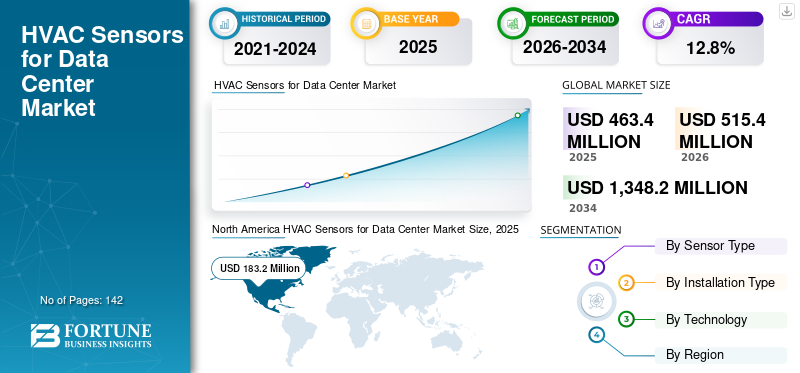
The global HVAC sensors for data center market size was valued at USD 463.4 million in 2025. The market is projected to grow from USD 515.4 million in 2026 to USD 1,348.2 million by 2034, exhibiting a CAGR of 12.8% during the forecast period. North America dominated the HVAC sensors for the data center market with a market share of 39.53% in 2025.
The global market comprises revenue generated from sensors used in heating, ventilation, and air conditioning systems deployed across data center facilities. These sensors are designed to monitor, measure, and support the control of critical environmental and cooling parameters, including temperature, humidity, pressure, airflow, smoke, gas, occupancy, and flow conditions. HVAC sensors in data centers play a vital role in maintaining stable thermal conditions, improving cooling efficiency, supporting uptime requirements, reducing energy consumption, and enabling integration with building management systems, data center infrastructure management platforms, and automation systems.
Automation Components, Inc., Honeywell International Inc., Johnson Controls International PLC, Schneider Electric SE, PLC Group, Inc., Sensirion AG, Siemens AG, TE Connectivity, Trafag AG, and Vaisala Oyj are the top players in the market.
Download Free sample to learn more about this report.
 Global Market Size & Forecast
 Market Share
 Key Regional Highlights
North America
North America led the global market, supported by a strong concentration of hyperscale, cloud, AI, and colocation data centers.
Asia Pacific
Asia Pacific held the second-largest market share due to rapid data center expansion across major economies.
Europe
Europe maintained a significant market share, driven by mature colocation infrastructure and increasing cloud adoption.
U.S.
U.S. The market was valued at approximately USD 155.0 million in 2025, supported by large-scale data center hubs and advanced cooling infrastructure.
Japan
Japan The market was valued at approximately USD 15.6 million in 2025, driven by continued investments in advanced data center facilities.
Read More

Increasing Adoption of AI-Driven Predictive Cooling and Environmental Monitoring Fuels Market Growth
AI-driven cooling optimization is becoming a key trend as data centers require smarter control strategies to manage high-density workloads and changing thermal conditions. AI-enabled platforms use real-time sensor data from cooling technologies, ducts, racks, cooling units, containment zones, and CRAC systems to optimize airflow, prevent hot spots, and improve data center temperature management. These platforms also support predictive maintenance by identifying cooling inefficiencies and early system degradation. This trend is strengthening the role of precision cooling sensors in modern data center operations.
Download Free sample to learn more about this report.
Rising Construction of Hyperscale and AI-Driven Data Centers Fuels Market Growth
The rapid expansion of hyperscale and AI-driven data centers is increasing demand for HVAC control sensors and precision cooling sensors across mission critical facilities. Rising data center temperature levels, higher rack density, and growing cooling requirements of data centers are creating the need for real-time data center environmental monitoring. These sensors help monitor temperature and humidity, detect hot spots, and support efficient cooling strategies across racks, ducts, cooling units, and Computer Room Air Conditioners (CRAC). Their integration with control systems and Data Center Infrastructure Management (DCIM) platforms helps optimize cooling systems, strengthen cooling technologies, and reduce energy consumption.
High Deployment Cost and Integration Complexity May Limit Market Adoption
High deployment costs and integration complexity may limit the adoption of advanced HVAC sensors across small and mid-sized data centers. Retrofitting older facilities with precision cooling sensors, control systems, and DCIM-integrated monitoring platforms can be challenging due to legacy cooling systems, limited wiring flexibility, and compatibility issues with existing cooling units. In addition, sensor calibration, cybersecurity requirements, and maintenance of IoT-enabled HVAC sensors can raise operational costs. These factors may slow product adoption, particularly in facilities with limited budgets or older data center operations.
Growing Adoption of Intelligent and Wireless Monitoring Creates Market Opportunities
The rising adoption of IoT-enabled HVAC sensors, wireless monitoring, and intelligent control strategies is creating strong opportunities for market players. Data center operators are using connected sensors to monitor temperature and humidity, airflow, pressure, and other environmental conditions across mission critical infrastructure. These solutions support remote data center environmental monitoring and improve the performance of cooling systems, cooling units, and CRAC systems. By enabling real-time visibility, automated alerts, and integration with DCIM platforms, intelligent HVAC monitoring helps improve cooling strategies, reduce energy consumption, and enhance operational reliability, further supporting HVAC sensors for data center market growth.
Temperature Sensors Led Due to Critical Thermal Control Requirements
Based on sensor type, the market is divided into temperature sensors, humidity sensors, pressure sensors, smoke & gas sensors, occupancy & motion sensors, and others.
Temperature sensors held the largest HVAC sensors for data center market share in 2025 at 33.9% as thermal control is the core operating requirement. They are deployed across racks, ducts, CRAC/CRAH units, containment zones, and chilled-water systems to prevent hot spots, protect servers, and maintain uptime. Their high deployment density and mandatory monitoring role support market leadership.
Pressure sensors are expected to grow at the highest CAGR of 15.1% during the forecast period as AI workloads, higher rack densities, and airflow optimization increase the need for differential pressure monitoring. They support containment control, filter monitoring, air-balancing, and cooling efficiency across high-power data halls. Their adoption is rising globally as the need for advanced HVAC control and liquid-cooling integration grows.
To know how our report can help streamline your business, Speak to Analyst
Duct-Mounted Sensors Dominated Owing to Continuous Air-Side Monitoring Needs
Based on installation type, the market is segmented into duct-mounted sensors, wall-mounted sensors, and outdoor sensors.
Duct-mounted sensors held the highest share of 44.5% in 2025 as data center HVAC systems rely heavily on continuous air-side monitoring across ducts, air handlers, CRAC/CRAH units, and return-air pathways. These sensors measure temperature, humidity, airflow, and pressure conditions, helping operators maintain stable cooling performance, improve energy efficiency, and protect mission-critical IT equipment.
Outdoor sensors are projected to grow at the highest CAGR of 14.0% during the forecast period as data centers increasingly adopt climate-responsive cooling, economizer systems, and outdoor air monitoring to reduce energy consumption. These sensors support external temperature, humidity, air quality, and weather-based HVAC control, helping operators optimize cooling strategies across large facilities and high-density environments.
Wired Sensors Held the Largest Share Due to High Reliability and Secure Connectivity
Based on technology, the market is bifurcated into wired sensors and wireless sensors.
Wired sensors held the largest share in 2025 as data centers prioritize reliability, low-latency connectivity, cybersecurity, and uninterrupted integration with BMS, BAS, EMS, and DCIM platforms. These sensors are widely used across CRAC/CRAH units, ducts, chilled-water systems, and containment zones, making them the preferred option for mission-critical HVAC monitoring.
Wireless sensors are expected to record the maximum CAGR of 14.2% during the forecast period due to growing use in retrofits, edge data centers, flexible monitoring points, and hard-to-wire locations. They reduce installation complexity and enable rapid deployment of temperature, humidity, pressure, and environmental monitoring systems, especially in expanding facilities seeking scalable, cost-efficient HVAC visibility.
By region, the market is categorized into North America, South America, Asia Pacific, Europe, and the Middle East & Africa.
North America HVAC Sensors for Data Center Market Size, 2025 (USD Million)
To get more information on the regional analysis of this market, Download Free sample
North America holds a leading position in the global market due to its strong base of hyperscale, colocation, cloud, and AI data center facilities. Major U.S. data center hubs, such as Northern Virginia, Texas, Phoenix, Atlanta, Chicago, and Dallas, host large-scale facilities that require continuous monitoring of temperature, humidity, pressure, airflow, and cooling systems.
The U.S. market was approximated at around USD 155.0 million in 2025, accounting for roughly 33.5% of global sales.
Asia Pacific holds the second-largest share in the global market due to rapid data center expansion across China, India, Japan, South Korea, ASEAN, and Oceania. The region has a strong mix of hyperscale, colocation, cloud, telecom, and enterprise data center investments, significantly increasing the need for temperature, humidity, pressure, airflow, and flow monitoring systems across critical facilities.
The Japanese market was valued at around USD 15.6 million in 2025, accounting for roughly 3.4% of global revenues.
China’s market is projected to be one of the largest globally, with revenues of around USD 37.6 million in 2025, accounting for roughly 8.1% of global sales.
The Indian market was valued at around USD 21.0 million in 2025, accounting for roughly 4.5% of global revenues.
Europe holds a significant share of the global market due to its mature colocation base, strong cloud adoption, and presence of major data center hubs such as Frankfurt, London, Amsterdam, Paris, and Dublin. Facilities across these hubs require continuous monitoring of temperature, humidity, pressure, airflow, and cooling systems to maintain uptime, manage energy use, and support BMS/DCIM integration across mission-critical data center environments. HVAC sensors are widely deployed across CRAC/CRAH units, ducts, containment zones, chilled-water systems, and facility automation platforms.
The U.K. market was valued at approximately USD 22.7 million in 2025, accounting for roughly 4.9% of global revenues.
Germany’s market reached approximately USD 25.6 million in 2025, equivalent to around 5.5% of global sales.
The Middle East & Africa region is projected to record the highest CAGR in the global market. The growth is driven by rapid data center expansion across the GCC, supported by AI, cloud, sovereign data, and national digital transformation programs. Countries such as Saudi Arabia, the UAE, Qatar, and Oman are investing heavily in hyperscale and colocation facilities, significantly increasing demand for temperature, humidity, pressure, airflow, and flow sensors across HVAC and cooling systems.
The GCC market reached approximately USD 15.3 million in 2025, accounting for roughly 3.3% of global revenues.
South America is expected to grow at the lowest rate in the global market due to its smaller data center base and limited hyperscale penetration compared with North America, Europe, and the Asia Pacific. Demand for HVAC sensors remains concentrated in a few countries, such as Brazil, Chile, and Colombia, which limits the broad-based adoption of advanced temperature, humidity, pressure, airflow, and flow monitoring systems across the wider region.
The Brazil market was valued at around USD 11.8 million in 2025, accounting for roughly 2.5% of global revenues.
Key Players Launch New Solutions to Strengthen Market Positioning
Key players, such as Automation Components, Inc., Honeywell International Inc., and Johnson Controls International PLC, are introducing new solutions to strengthen their market positions. Such a position is achieved by leveraging technological advancements, addressing evolving cooling and monitoring needs in data centers, and staying competitive in the HVAC sensors landscape. They are also focusing on portfolio expansion, strategic collaborations, acquisitions, and partnerships to enhance their sensor offerings. These initiatives are helping companies sustain and increase their share in the HVAC sensors for the data center market.
The global HVAC sensors for data center market analysis offers a detailed assessment of market size and forecasts across all segments included in the study. It examines the key market dynamics and emerging trends expected to shape global market growth during the forecast period. The report also covers technological advancements, major industry developments, partnerships, mergers, and acquisitions. Furthermore, it provides a comprehensive competitive landscape, market share analysis, and profiles of leading companies operating in the market.
Request for Customization to gain extensive market insights.
| ATTRIBUTE | DETAILS |
| Study Period | 2021-2034 |
| Base Year | 2025 |
| Estimated Year | 2026 |
| Forecast Period | 2026-2034 |
| Historical Period | 2021-2024 |
| Growth Rate | CAGR of 12.8% from 2026-2034 |
| Unit | Value (USD Million) |
| Segmentation | By Sensor Type, By Installation Type, By Technology, and By Region |
| By Sensor Type |
|
| By Installation Type |
|
| By Technology |
|
| By Region |
|
Fortune Business Insights says that the global market value stood at USD 463.4 million in 2025 and is projected to reach USD 1,348.2 million by 2034.
In 2025, the market value stood at USD 183.2 million.
The market is expected to grow at a CAGR of 12.8% over the forecast period.
By sensor type, the temperature sensors led the market in 2025.
The market is driven by the expansion of data centers, rising demand for energy-efficient cooling, increasing HVAC automation, and the need to ensure reliable uptime.
Automation Components, Inc., Honeywell International Inc., and Johnson Controls International PLC are some of the top players in the market.
North America held the largest market share in 2025.
Product adoption is driven by energy-efficient cooling, real-time monitoring, automation, predictive maintenance, and protection of critical infrastructure.

Get 30-60 hrs Free Customization
Expand Regional and Country Coverage, Segments Analysis, Company Profiles, Competitive Benchmarking, and End-user Insights.




















Related Reports
Get In Touch With Us
US +1 833 909 2966 ( Toll Free )
Receive a tailored pricing based on your needs.
Discuss your questions with our industry experts.
Have questions? Get quick answers before you purchase.

