Hydrogel Face Masks Market Size, Share & Industry Analysis, By Product Type (Hydrating & Moisturizing Hydrogel Masks, Anti-Aging Hydrogel Masks, Brightening Hydrogel Masks, and Others), By Ingredient Type (Hyaluronic Acid, Collagen, Vitamin C, and Others), By Skin Type (Dry Skin, Sensitive Skin, Oily Skin, and Others), By End User (Household/Individual Consumers, Salons & Spas, Dermatology & Cosmetic Clinics, and Others), By Distribution Channel (Specialty Beauty Stores, Online/E-Commerce, Hypermarkets/Supermarkets, and Others), and Regional Forecast, 2026-2034
 Download Free Sample
(Offer valid till 30th Sep 2026)

Hydrogel Face Masks Market Material and Future Outlook
 Listen to Audio Version
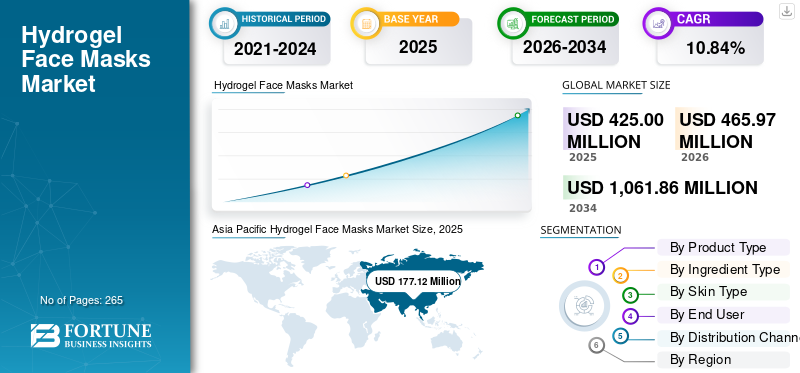
The global hydrogel face masks market size was valued at USD 425.00 million in 2025. The market is projected to grow from USD 465.97 million in 2026 to USD 1,061.86 million by 2034, exhibiting a CAGR of 10.84% over the forecast period. Asia Pacific dominated the hydrogel face masks market with a market share of 41.67% in 2025.
The global market is experiencing exponential growth as consumers increasingly favor them for intensive skin hydration, soothing properties, and a spa-like experience in their home skincare regimen. Hydrogel face masks, which contain active ingredients such as hyaluronic acid, collagen, niacinamide, and botanical extracts, exhibit better adhesion and greater serum absorption than sheet face masks. The growing trend of Korean beauty as well as high-end skincare regimens further drives the acceptance of this segment worldwide. For instance, L'Oreal's skincare unit in the Asia Pacific region has continued to grow, driven by the performance of facial skincare products, while Shiseido noted that younger customers are demanding functional, hydration-based skincare.
The major players in the global market are L'Oréal, Shiseido, Amorepacific, Unilever, and Johnson & Johnson. These companies have been implementing several growth strategies in terms of product development such as skin care research and development, collagen and peptide product innovation, sustainable packaging, partnership with celebrities and dermatologists, and distribution via e-commerce and Korean beauty. The companies are implementing various strategies, such as premiumization, advanced technology-based skin care, LED face masks, and long-lasting hydrogel products.
Download Free sample to learn more about this report.
HYDROGEL FACE MASKS MARKET KEY TAKEAWAYS
 Global Market Size & Forecast
- 2025 Market Size: USD 425.00 Million
- 2026 Market Size: USD 465.97 Million
- 2034 Forecast Market Size: USD 1,061.86 Million
- CAGR: 10.84% from 2026–2034
 Market Share
- Asia Pacific dominated the hydrogel face masks market with a market share of 41.67% in 2025.
- The anti-aging hydrogel masks segment is anticipated to rise at the second-fastest CAGR of 10.96% over the forecast period.
- The collagen segment is anticipated to rise at the second-fastest CAGR of 10.99% over the forecast period.
 Key Regional Highlights
North America
North America accounted for the second-highest regional market share, reaching USD 105.80 million in 2025.
Europe
Europe held 21.70% of the global hydrogel face masks market in 2025, with a market value of USD 92.23 million.
Asia Pacific
Asia Pacific dominated the hydrogel face masks market with a 41.67% market share in 2025.
U.S.
The U.S. hydrogel face masks market reached USD 71.08 million in 2025, accounting for 16.72% of global market sales.
Japan
The Japan hydrogel face masks market was valued at USD 25.15 million in 2025, representing 5.92% of global market revenues.
Read More

HYDROGEL FACE MASKS MARKET TRENDS
Rising Demand for Clean Beauty and Skin-Barrier Repair Solutions to Accelerate Product Innovation
The increased consumer awareness of skin sensitivity, chemical exposure, and the importance of maintaining healthy skin is driving the demand for clean-label, dermatologist-recommended skincare products. Therefore, manufacturers of hydrogel face masks are introducing natural extracts, probiotics, ceramides, and non-scented formulas in their product lines. This development is also fueled by trends in skincare on social media and a growing inclination toward “skinimalism,” a skincare approach focused on hydration and repairing the skin barrier. Hence, brands are introducing innovative hydrogel masks that offer soothing, anti-inflammatory, and deeply hydrating effects.
MARKET DYNAMICS
MARKET DRIVERS
Download Free sample to learn more about this report.
Increasing Consumer Spending on Premium Skincare Products to Fuel Product Demand
Rising disposable incomes and growing willingness among consumers to invest in premium personal care products are significantly driving the hydrogel face masks market growth. Consumers are increasingly seeking spa-like skincare treatments at home, particularly products offering deep hydration, anti-aging, and instant skin rejuvenation benefits. This growing beauty consciousness, especially among millennials and Gen Z consumers, is encouraging brands to introduce high-performance hydrogel masks enriched with collagen, hyaluronic acid, and botanical actives. As a result, premium skincare brands are expanding their product portfolios and strengthening their online retail presence, accelerating global market penetration and contributing to sustained market expansion.
MARKET RESTRAINTS
High Product Costs and Availability of Low-Cost Alternatives May Limit Market Penetration
The cost of hydrogel masks has been much higher than that of sheet masks and other skin-care products. There have been several challenges to their acceptance due to their high costs. The premium hydrogel masks utilize advanced manufacturing processes, feature serum-filled components, and employ complex manufacturing techniques, which explains the high cost associated with them. Hence, most people tend to opt for various skincare products such as cream, clay, and cotton sheet masks.
MARKET OPPORTUNITIES
Expansion of Men’s Grooming and Personalized Skincare to Create New Revenue Opportunities
The growing use of skincare and grooming products among men offers significant opportunities for growth in the industry. The rising awareness among men about skin hydration, anti-aging, anti-acne, and skincare regimens has driven the demand for more targeted face skincare products. There have been innovations in the form of gender-neutral hydrogel masks as well as products tailored for men with components such as charcoal, caffeine, and vitamin C. Moreover, advancements in skin analysis using artificial intelligence and the rise of personalized beauty products have prompted companies to develop hydrogel masks for various skin concerns.
MARKET CHALLENGES
Intense Market Competition and Product Differentiation Challenges to Limit Brand Loyalty
Rising concerns over plastic waste management and the use of non-biodegradable cosmetic packaging have now emerged as a potential threat to the hydrogel face mask industry. Hydrogel face masks generally have a single-use application and consist of synthetic polymers along with multi-layered packaging that results in environmental contamination. Consumers are becoming increasingly aware of their ecological footprint and are more inclined to purchase environmentally friendly skin care products. The growing environmental concerns could limit consumer acceptance of traditional hydrogel masks, posing a significant limitation on their future growth prospects.
Segmentation Analysis
By Product Type
Rising Demand for Deep Hydration and Skin Barrier Repair to Drive Hydrating & Moisturizing Hydrogel Masks Segment Dominance
By product type, the market is segmented into hydrating & moisturizing hydrogel masks, anti-aging hydrogel masks, brightening hydrogel masks, and others.
The hydrating & moisturizing hydrogel masks segment held a dominant market share in 2025, driven by the growing consumer preferences for skin hydration, radiance, and skincare maintenance. Pollution, varying weather conditions, and the occurrence of dryness and sensitivity in consumers have boosted the demand for skin care products that help hydrate the skin. In light of the above scenario, consumer preferences for hydrogels containing hyaluronic acid, aloe vera, collagen, and ceramides to deliver intensive hydration have been boosted. Another factor that has influenced the popularity of such products includes the emergence of Korean skin care routines and home spa treatments.
The anti-aging hydrogel masks segment is anticipated to rise at the second-fastest CAGR of 10.96% over the forecast period.
To know how our report can help streamline your business, Speak to Analyst
By Ingredient Type
Strong Consumer Preference for Intensive Hydration Solutions to Boost Hyaluronic Acid Segment Growth
Based on ingredient type, the market is divided into hyaluronic acid, collagen, vitamin C, and others.
The hyaluronic acid segment holds the largest share due to its widespread use in premium skincare formulations and superior moisture-retention properties. The rise in customer demand for skin hydration, dryness prevention, premature aging prevention, and skin barrier protection has driven strong sales growth for hyaluronic acid products. In turn, various skin care companies have increasingly used the substance in hydrogel masks to hydrate the skin and improve plumpness and elasticity. Moreover, the growing prevalence of dermatologist-recommended skin care routines and Korean skin care trends has further propelled the product consumption.
The collagen segment is anticipated to rise at the second-fastest CAGR of 10.99% over the forecast period.
By End User
Surging Adoption of At-Home Skincare Routines to Drive Household/Individual Consumers Segment Growth
By end user, the market is segmented into household/individual consumers, salons & spas, dermatology & cosmetic clinics, and others.
The household/individual consumers segment accounted for the highest hydrogel face masks market share in 2025. There has been a shift amongst consumers toward affordable, spa-like skincare solutions at the convenience of home, which has considerably amplified the demand for single-use hydrogel masks among daily skincare users. Consequently, brands are widening their product accessibility through beauty retailers, e-commerce platforms, and social-media-driven marketing campaigns targeting solo consumers. Moreover, K-beauty trends, personalized beauty routines, and the growing influence of skincare influencers have further strengthened consumer adoption, enabling the household segment to maintain global market dominance.
The dermatology & cosmetic clinics segment is anticipated to rise at the second-fastest CAGR of 10.40% over the forecast period.
By Skin Type
Soaring Concerns about Weakened Skin Barriers and Dullness to Boost Dry Skin Segment Growth
Based on skin type, the market is divided into dry skin, sensitive skin, oily skin, and other categories.
The dry skin segment holds the largest share due to rising consumer concerns about dullness, dehydration, and weakened skin barriers, driven by a drastic shift in lifestyles, harsh climatic conditions, and rising pollution levels. Dry skin consumers are increasingly inclined toward hydrogel masks for their ability to provide lasting hydration and improved serum penetration. Consequently, there has been an increase in the production of products containing hyaluronic acid, ceramides, collagen, and herbal extracts to retain moisture and repair the skin. Additionally, the growing focus on preventive skin care and anti-aging treatments is driving consumers with dry skin to adopt hydrogel masks.
The sensitive skin segment is anticipated to rise at the second-fastest CAGR of 10.82% over the forecast period.
By Distribution Channel
Online/E-Commerce Segment Dominated the Market Driven by More Personalized Shopping Experience
Based on distribution channel, the market is segmented into specialty beauty stores, online/e-commerce, hypermarkets/supermarkets, and others.
The online/e-commerce segment accounted for the largest share of the market in 2025 due to a rising shift toward personalized and convenient shopping experiences. Swift growth in influencer-driven digital marketing, the rising number of e-commerce platforms, and direct-to-consumer (D2C) penetration have greatly improved consumer access to international and premium skincare products. Consequently, consumers are buying hydrogel face masks from online platforms owing to subscription options, wider product availability, affordable pricing, offers & discounts, and the convenience of doorstep delivery.
The specialty stores segment is projected to grow at the second-fastest CAGR of 10.68% during the forecast period.
Hydrogel Face Masks Market Regional Outlook
By geography, the market is categorized into Europe, North America, Asia Pacific, South America, and the Middle East & Africa.
Asia Pacific
Asia Pacific Hydrogel Face Masks Market Size, 2025 (USD Million)
To get more information on the regional analysis of this market, Download Free sample
Asia Pacific dominated the global market in 2025, reaching USD 177.12 million, and is anticipated to grow at a CAGR of 12.40% over the analysis period. The rising consumer spending power, growing awareness and knowledge of skin care and personal wellbeing, coupled with rapid e-commerce expansion in countries such as China, India, Japan, and South Korea, drive regional market growth.
Japan Hydrogel Face Masks Market
The Japanese market was valued at USD 25.15 million in 2025, accounting for roughly 5.92% of global market revenues. The growing preference for technologically advanced beauty products, the rise of high-performance anti-aging skincare, and the country’s deeply established skincare culture focused on hydration and skin health support market growth.
China Hydrogel Face Masks Market
The China market was valued at USD 52.57 million in revenues in 2025, representing roughly 12.37% of global market sales.
India Hydrogel Face Masks Market
The India market was valued at USD 35.00 million in 2025, accounting for roughly 8.24% of global market revenues.
North America
The North America market has emerged as a key region. It is projected to grow at a CAGR of 10.42% over the forecast period, with the second-highest market share among regions, reaching a valuation of USD 105.80 million in 2025. The region’s growth is supplemented by high consumer spending on anti-aging and hydration-focused beauty products and premium skincare solutions. Along with that, increased awareness of clean beauty, greater emphasis on self-care practices, and dermatologist-recommended skincare are further boosting product adoption across the region.
U.S. Hydrogel Face Masks Market
Given North America’s strong contribution and the U.S.'s dominance in the region, the U.S. market reached USD 71.08 million in 2025, accounting for roughly 16.72% of global market sales. The strong influence of social media beauty trends, the surge in consumer spending on high-end skincare products, and the rising demand for clean-label anti-aging and hydration-focused facial treatments are augmenting the growth of the U.S. market.
Europe
Europe held the third-largest share in 2025, valued at USD 92.23 million and accounting for 21.70% of the global market. The Europe market growth is led by strong demand for dermatologically tested, clean-label skincare products, supported by stringent cosmetic guidelines that foster consumer trust. In addition, the strong presence of luxury beauty brands and the expanding adoption of vegan skincare products are driving the product adoption.
U.K. Hydrogel Face Masks Market
The U.K. market reached USD 17.64 million in 2025, representing roughly 4.15% of global market revenues.
Germany Hydrogel Face Masks Market
The Germany market reached USD 15.90 million in 2025, equivalent to around 3.74% of global market sales.
South America and the Middle East & Africa
South America and the Middle East & Africa regions are expected to witness moderate growth during the forecast period. The South America market reached USD 27.83 million in 2025. The growing influence of social media beauty trends across countries such as Brazil and Argentina, increasing demand for affordable premium skincare products, and rising beauty consciousness are boosting the market growth in South America. In the Middle East & Africa, the UAE market reached USD 12.14 million in 2025.
South Africa Hydrogel Face Masks Market
The South African market reached a value of USD 3.79 million in 2025, representing roughly 0.89% of the global market revenues.
COMPETITIVE LANDSCAPE
Key Industry Players
Companies’ Development of Multi-Purpose Masks to Bolster their Industry Positions
The global hydrogel face mask industry is highly competitive due to the presence of international beauty brands, Korean beauty brands, and upcoming clean beauty ventures that compete through constant innovations and high-end positioning. Companies in the global market are emphasizing the development of multi-purpose hydrogel masks enriched with active ingredients such as hyaluronic acid, collagen, peptides, and botanical extracts to cater to changing customer requirements. These businesses are also adopting various growth strategies, including celebrity endorsements, influencer-driven digital marketing, sustainable packaging initiatives, and online distribution channels, to improve their brand image and reach customers.
LIST OF KEY HYDROGEL FACE MASKS COMPANIES PROFILED
- L'Oréal S.A. (France)
- Unilever (U.K.)
- Shiseido Company, Limited (Japan)
- Amorepacific Corporation (South Korea)
- Johnson & Johnson (U.S.)
- Estée Lauder Companies (U.S.)
- LG Household & Health Care (South Korea)
- The Face Shop (South Korea)
- TONYMOLY (South Korea)
- KOSÉ Corporation (Japan)
KEY INDUSTRY DEVELOPMENTS
- June 2025: L'Oréal acquired a majority stake in skincare brand Medik8 to strengthen its science-backed dermo-cosmetics portfolio and accelerate global skincare expansion initiatives.
- December 2024: COSRX launched the “Advanced Snail Mucin Glass Glow Hydrogel Mask” in the U.S., U.K., and Asian markets to strengthen its premium K-beauty skincare portfolio and capitalize on the growing demand for hydration-focused facial masks.
- December 2024: Medipeel expanded its export-focused skincare brand MDP+ in the U.S. market with new hydrogel mask launches and strengthened TikTok Shop distribution to enhance North American market penetration.
- October 2024: Reliance Retail partnered with 9Skin to expand 9Skin’s offline presence across India through Tira stores, alongside the launch of the exclusive “Skinderella” Hydrogel Mask.
- September 2024: Epionce introduced the “Intense Recharge Mask,” targeting anti-aging and barrier-repair skincare needs with advanced, botanical-based formulations.
REPORT COVERAGE
The global hydrogel face masks market includes a comprehensive study of the market and forecast for all segments covered in the report. This qualitative and quantitative report includes details on market segmentation, dynamics, and trends expected to drive the market over the forecast period, along with a study of the different market segments. It provides information on key aspects, including a technologically advanced product portfolio, the regulatory environment, and new launches. Additionally, it details partnerships, mergers, acquisitions, key industry developments, and their distribution by key regions. The global market research report also provides a detailed competitive landscape, including market share and profiles of key players.
Request for Customization to gain extensive market insights.
Report Scope & Segmentation
| ATTRIBUTE | DETAILS |
| Study Period | 2021-2034 |
| Base Year | 2025 |
| Estimated Year | 2026 |
| Forecast Period | 2026-2034 |
| Historical Period | 2021-2024 |
| Growth Rate | CAGR of 10.84% from 2026-2034 |
| Unit | Value (USD Million) |
| Segmentation | By Product Type, Ingredient Type, Skin Type, End User, Distribution Channel, and Region |
| By Product Type |
|
| By Ingredient Type |
|
| By Skin Type |
|
| By End User |
|
| By Distribution Channel |
|
| By Region |
|
Frequently Asked Questions
According to Fortune Business Insights, the global market value stood at USD 425.00 million in 2025 and is projected to reach USD 1,061.86 million by 2034.
In 2025, the North America market value stood at USD 105.80 million.
The market is expected to grow at a CAGR of 10.84% over the forecast period.
By product type, the hydrating & moisturizing hydrogel masks segment led the market in 2025.
The rising consumer demand for premium skincare products offering deep hydration, anti-aging benefits, and spa-like at-home facial treatments and expanding e-commerce beauty retail are key factors driving the market.
L'Oréal, Shiseido, Amorepacific, Unilever, and Johnson & Johnson are the major players in the global market.
Asia Pacific dominates the market.



- 2021-2034
- 2025
- 2021-2024
- 265
-
(Offer valid till 30th Sep 2026)
Get 30-60 hrs Free Customization
Expand Regional and Country Coverage, Segments Analysis, Company Profiles, Competitive Benchmarking, and End-user Insights.












Related Reports
-
US +1 833 909 2966 ( Toll Free )
-
Get In Touch With Us