Immunotherapy Drugs Market Size, Share & Industry Analysis, By Type (Immune Checkpoint Inhibitor, Monoclonal Antibodies (mAbs), CAR-T Cell Therapies, Cancer Vaccines, and Others), By Indication (Oncology, Autoimmune Diseases, Infectious Diseases, and Others), By Route of Administration (Intravenous and Subcutaneous), By Distribution Channel (Hospital Pharmacies, Retail Pharmacies & Drug Stores, and Online Pharmacies), and Regional Forecast, 2026-2034
 Download Free Sample
Immunotherapy Drugs Market Size and Future Outlook
 Listen to Audio Version
The global immunotherapy drugs market size was valued at USD 343.98 billion in 2025 and is projected to grow from USD 394.36 billion in 2026 to USD 1,220.02 billion by 2034, exhibiting a CAGR of 15.16% during the forecast period. North America dominated the global immunotherapy drugs market with a market share of 47.54% in 2025.
Immunotherapy drugs are a class of medications designed to stimulate, enhance, or restore the body’s immune system to recognize and destroy diseases. This marketspace is witnessing a strong growth, which is driven by rising incidence of oncology indications, advances in oncology research, increasing number of regulatory approvals for novel immunotherapies and increased healthcare expenditure. Additionally, growing focus on combination regimens pairing immunotherapies with targeted therapies by pharmaceutical and biopharmaceutical companies further supports the market growth.
Additionally, the market is led by several key players, with Merck & Co., Bristol-Myers Squibb Company, F. Hoffmann-La Roche Ltd, AstraZeneca, and Novartis AG, and others occupying the dominating positions. Rapidly expanding clinical pipeline and strengthening product offerings through collaborations further enhance the position of these companies in the global market.
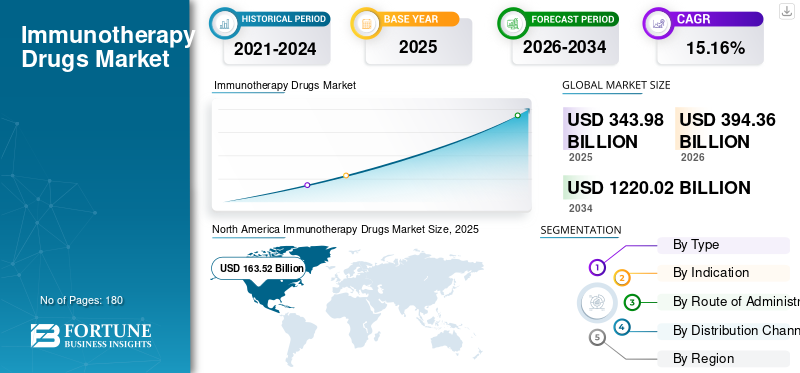
Download Free sample to learn more about this report.
Immunotherapy Drugs Market Takeaways
 Market Size & Forecast
- 2025 Market Size: USD 343.98 billion
- 2026 Market Size: USD 394.36 billion
- 2034 Forecast Market Size: USD 1,220.02 billion
- CAGR: 15.16% from 2026–2034
 Market Share
- North America dominated the immunotherapy drugs market with a 47.54% share in 2025.
- The oncology segment is anticipated to account for 87.2% of the market in 2026.
- CAR-T cell therapies are projected to grow at the fastest CAGR of 34.08% during the forecast period.
 Key Regional Highlights
North America
North America remained the leading regional market, generating USD 163.52 billion in revenue in 2025.
Europe
Europe is projected to record the second-highest regional growth rate of 14.46% and reach USD 89.10 billion by 2026.
Asia Pacific
Asia Pacific is expected to reach USD 71.30 billion by 2026.
U.S.
The immunotherapy drugs market is projected to reach USD 171.04 billion by 2026.
Japan
The market is expected to witness steady growth, supported by increasing demand for innovative immunotherapies and expanding oncology treatment programs.
Read More

MARKET DYNAMICS
MARKET DRIVERS:
Rapid Growth in Cell Therapies Including CAR-T and Emerging Allogeneic Platforms to Boost Market Growth
The fast expansion of cell therapies, such as CAR-T and new allogeneic platforms, is one of the main factors propelling the growth of the global market for immunotherapy drugs. The market demand for autologous CAR-T therapies has increased due to their growing clinical success in treating hematological malignancies. Furthermore, the market has grown more quickly due to the growing emphasis on next-generation allogeneic "off-the-shelf" cell therapies to address the main drawbacks of autologous models. Additionally, growing investments in the production of cell therapy and cutting-edge gene-editing technologies are driving market expansion. Additionally, the market expansion has been bolstered by a supportive regulatory framework that offers quicker approvals and review pathways.
- For example, in June 2025, Allogene Therapeutics declared results from its phase 1 clinical trial for its innovative products that targets CD70. The products has demonstrated positive results in offering clinical benefit in patients.
MARKET RESTRAINTS:
High Cost of Novel Immunotherapies to Hamper Market Growth
The high cost of these treatments is one of the main factors impeding the growth of the global market. This restricts patient access, which hinders the expansion of the market as a whole. Many patients, especially in low- and middle-income nations, cannot afford advanced treatments like checkpoint inhibitors and CAR T cell therapies due to their relatively high treatment costs. Drug development expenses are also raised by strict regulations and inadequate reimbursement practices. Because of these, the market's expansion is somewhat impeded.
- For instance, according to an article published by Peace Medical Tourism in the cost of CAR-T cell therapy in India ranges between USD 50,000 to USD 85,000.
MARKET OPPORTUNITIES:
Growth in Immunotherapy–Targeted Therapy Combinations to Offer Lucrative Growth Opportunities
A significant market opportunity is presented by the expansion of immunotherapy–targeted therapy combinations. This is motivated by the expansion of eligibility for both hematologic and solid cancers, as well as the capacity of combination regimens to overcome resistance mechanisms and produce better response rates. Additionally, more and more first-line settings are approving these combinations, which significantly increases the pool of possible patients. Additionally, in order to provide efficient treatment options for a variety of disease indications, the operating players have been concentrating on combination therapies in recent years.
- For instance, in July 2021, the U.S. FDA approved Merck’s Keytruda in combination with Eisai’s Lenvima for advanced endometrial carcinoma.
MARKET CHALLENGES:
Safety Concerns Associated with Immunotherapy Pose a Significant Challenge for Market Growth
Safety concerns associated with immunotherapy is one of the major challenges faced by this marketspace. This is due to the fact that these therapies may trigger severe and unpredictable immune-related adverse events (irAEs). Cytokine release syndrome (CRS), neurotoxicity, autoimmune reactions, myocarditis, and severe colitis are some of the life-threatening toxicities caused by the immunotherapies. In addition, safety risks also delay regulatory approvals further slowing market expansion.
For example, in April 2024, the U.S. FDA has issued updated safety warnings for CAR-T therapies after identifying rare cases of secondary T-cell malignancies in treated patients.
IMMUNOTHERAPY DRUGS MARKET TRENDS:
Increasing Approvals for Solid Tumors is a Significant Global Immunotherapy Drugs Market Trend
Increasing regulatory approvals of cancer immunotherapies for solid tumors has emerged as a major market trend. Bispecific antibodies, checkpoint inhibitors, and cell-based have shown improved clinical outcomes in solid tumors such as lung, breast, gastrointestinal, cervical, and melanoma, leading to broader regulatory approvals across the world. Furthermore, operating companies are also rapidly advancing solid-tumor indications into earlier treatment lines, significantly expanding the addressable patient population and market growth.
For instance, in October 2023, the U.S. FDA approved nivolumab (Opdivo) as an adjuvant treatment for resected Stage IIB/C melanoma following data from the CheckMate-76K trial that showed a 58% reduction in recurrence risk.
Download Free sample to learn more about this report.
Segmentation Analysis
By Type
Increasing Investments for Innovative mAbs to Drive Segmental Growth
Based on the type, the market is classified into monoclonal antibodies (mAbs), CAR-T cell therapies, cancer vaccines, and others.
To know how our report can help streamline your business, Speak to Analyst
The monoclonal antibodies (mAbs) segment held the largest global immunotherapy drugs market share in 2025. This can be attributed to the factors such as increasing investment for the development of innovative mAbs, expanding clinical pipeline of products and rising prevalence of chronic diseases in turn boosting the demand of the products. Additionally, new product launches by key players and increasing number of product approvals further supported the segment growth.
- For instance, in April 2025, Johnson & Johnson received the U.S. FDA approval for IMAAVY (nipocalimab-aahu), a human FcRn-blocking monoclonal antibody to treat generalized myasthenia gravis.
On the other hand, the CAR-T cell therapies segment is the fastest-growing segment with 34.08% CAGR during the forecast period.
By Indication
High Number of Approved Products to Lead Growth of Segment
In terms of indication, the market is divided into oncology, autoimmune diseases, infectious diseases, and others.
In 2025, the oncology segment dominated the market with largest market share. In 2026, the segment is anticipated to dominate with an 87.2% share. The segment dominated the market owing to the rising burden of caner across the globe, strong clinical effectiveness of immunotherapies, and widespread adoption for oncology indications. Additionally, large patient pool, expanding approvals across early-stage cancers, and growing use of combination regimens with targeted therapies further supplements the segment growth.
For instance, in December 2023, Merck & Co., Inc., collaborated with Moderna, Inc., to begin the cancer vaccine and KEYTRUDA combination trial for non-small cell lung cancer treatment (NSCLC).
The autoimmune diseases segment is expected to grow at a CAGR of 13.02% over the forecast period.
By Route of Administration
High Usage of Intravenous Drugs to Drive Growth of Segment
In terms of route of administration, the market is categorized into intravenous and subcutaneous.
The intravenous segment held the leading share of the market in 2025. In 2026, the segment is anticipated to lead with an 85.4% share. This dominance is supported by key factors such as heavy reliance on infusion centers, limited availability of subcutaneous formulations, and high number of products that are administered intravenously.
For instance, Nivolumab (Opdivo), Atezolizumab (Tecentriq), Pembrolizumab (Keytruda), and others are some of the leading immunotherapy drugs that administered intravenously.
The subcutaneous segment is anticipated to grow at the fastest CAGR of 19.54% over the forecast period.
By Distribution Channel
Increasing Patient Population in Hospitals to Drive Segmental Growth
In terms of distribution channel, the market is categorized into hospital pharmacies, retail pharmacies & drug stores, and online pharmacies.
The hospital pharmacies segment accounted for the largest share of the global immunotherapy drugs market in 2025 and is projected to maintain its dominance in 2026 with an estimated 80.1% share. This dominance is primarily driven by the increasing number of patient admissions in hospitals due to requirement of in-patient monitoring and the fact that majority of the immunotherapies are IV-administered and require infusion centers.
The online pharmacies segment is expected to grow at a CAGR of 21.10% over the forecast period.
Immunotherapy Drugs Market Regional Outlook
By geography, the market is divided into Europe, Asia Pacific, North America, Middle East & Africa, and Latin America.
North America Immunotherapy Drugs Market Size, 2025 (USD billion)
To get more information on the regional analysis of this market, Download Free sample
NORTH AMERICA
North America held the leading position with highest share in 2024 with a revenue generation of USD 142.82 billion and further captured dominating position in 2025 as well, with USD 163.52 billion. Prominent factors including increasing clinical trial activity, high healthcare spending, and continuously increasing number of approved products in the region have supported the regional market growth. In 2026, the market in the U.S. is expected to reach USD 171.04 billion. The rising burden of chronic diseases, coupled with active involvement of research community in innovative therapeutics development has supplemented the U.S. market growth.
For example, AstraZeneca has invested USD 50 million in July 2025. This investment is aimed at manufacturing and research & development presence in the U.S.
EUROPE
Regions including Europe and the Asia Pacific, would witness considerable growth in the near future. Over the projected years, the European region would witness a growth rate of 14.46%, and be the second highest among all regions. The region is projected to reach a revenue generation of USD 89.10 billion by 2026. The market growth can be attributed to factors such as increasing adoption of innovative immunotherapies, supportive regulatory & reimbursement framework, and developed oncology related healthcare in major European countries. Supported by these dynamics, nations including U.K. would generate a revenue of USD 18.24 billion, Germany to record USD 19.92 billion, and France to record USD 14.32 billion in 2026.
ASIA PACIFIC
Followed by Europe, the Asia Pacific market is projected to touch the valuation of USD 71.30 billion in 2026. The region is anticipated to capture the third-largest position in the overall market. In Asia Pacific, India and China are both projected to be valued at USD 12.69 and USD 21.43 billion each in 2026. The regional market growth is propelled by expanding clinical development, rising cancer burden, and growing access programs in Japan, China, and South Korea.
LATIN AMERICA and MIDDLE EAST & AFRICA
Over the projected period, the Middle East Africa and Latin America regions are likely to witness a relatively slower growth. The Latin America market in 2026 is set to reach a valuation of USD 26.57 billion. Increasing adoption of immunotherapy drugs, active involvement in clinical trials, and gradually increasing commercial access are some of the factors boosting the regional market growth. In the Middle East & Africa, the GCC is set to reach a value of USD 7.42 billion by 2026. Increasing engagement in clinical research collaborations among operating players in the region is one factors driving the regional market growth.
COMPETITIVE LANDSCAPE
Key Industry Players:
Technological Advancements and Strategic Initiatives Strengthen Leadership of Major Immunotherapy Players
The global immunotherapy drugs market shows a semi consolidated framework, with few companies capturing the leading market share in 2025. Entities such as Merck & Co., Bristol-Myers Squibb Company, F. Hoffmann-La Roche Ltd, AstraZeneca, and Novartis AG are some of the leading market entities. Continuous clinical innovation, expanding biologics manufacturing capabilities, and large-scale global distribution networks are some of the factors supporting their market leadership. Additionally, strategic collaborations and partnerships and increasing investments also supports their leading position.
- For example, in April 2025, Merck & Co. Inc., invested USD 1 billion in a new Delaware, U.S. plant to expand domestic production of biologic drugs and Keytruda.
Apart from this, other prominent players, including Gilead Sciences, Inc. (Kite Pharma), Johnson & Johnson (Janssen), Amgen Inc., Pfizer Inc., and Regeneron, continue to strengthen their market presence through advancements in CAR-T therapy, bispecific T-cell engagers, targeted mAbs, and immune-modulating platforms.
LIST OF KEY IMMUNOTHERAPY DRUGS COMPANIES PROFILED:
- Merck & Co., Inc. (U.S.)
- Bristol-Myers Squibb Company (U.S.)
- F. Hoffmann-La Roche Ltd (Switzerland)
- AstraZeneca (U.S.)
- Pfizer Inc. (U.S.)
- Novartis AG (Switzerland)
- Gilead Sciences, Inc. (U.S.)
- Johnson & Johnson (U.S.)
- Amgen Inc. (U.S.)
- Regeneron Pharmaceuticals, Inc. (U.S.)
KEY INDUSTRY DEVELOPMENTS:
- October 2025: The researchers from UCLA developed a one-product-fits-all immunotherapy for breast cancer.
- September 2025: The U.S. FDA approved Merck’s KEYTRUDA QLEX (pembrolizumab and berahyaluronidase alfa-pmph) injection for subcutaneous use to treat most solid tumor indications.
- April 2025: Gilead Sciences, Inc. announced positive results from the Phase 3 ASCENT-04/KEYNOTE-D19 study. This study demonstrated that combining Trodelvy (sacituzumab govitecan-hziy) with Keytruda significantly improved progression-free survival.
- August 2024: GI Innovation signed a clinical trial collaboration and supply agreement with MSD for the evaluation of combination of GI-102 and MSD’s anti-PD-1 therapy, KEYTRUDA (pembrolizumab) in patients with immunotherapy-resistant liver cancer, melanoma, and renal cell carcinoma.
- July 2021: The U.S. FDA approved Merck’s KEYTRUDA (pembrolizumab) to treat patients with high-risk early-stage triple-negative breast cancer in combination with chemotherapy.
REPORT COVERAGE
The global immunotherapy drugs market analysis provides a comprehensive study of market size & forecast by all the market segments included in the report. It includes details on the market dynamics and market trends expected to drive the market during the forecast period. It also provides overviews of technological advancements, product development, pipeline analysis, key industry developments, mergers & acquisitions, and strategic insights into market growth. The market forecast report also encompasses a detailed competitive landscape with information on market share and profiles of key operating players.
Request for Customization to gain extensive market insights.
Report Scope & Segmentation
| Global Immunotherapy Drugs Market Scope | |
| Study Period | 2021-2034 |
| Base Year | 2025 |
| Forecast Period | 2026-2034 |
| Historical Period | 2021-2024 |
| Growth Rate | CAGR of 15.16% from 2026-2034 |
| Unit | Value (USD Billion) |
| By Type |
|
| By Indication |
|
| By Route of Administration |
|
| By Distribution Channel |
|
| By Region |
|
Frequently Asked Questions
Fortune Business Insights says that the global market value stood at USD 343.98 billion in 2025 and is projected to reach USD 1,220.02 billion by 2034.
In 2025, the market value stood at USD 163.52 billion.
The market is expected to exhibit a CAGR of 15.16% during the forecast period of 2026-2034.
The oncology segment is expected to lead the market in terms of indication.
Rapid growth in cell therapies including CAR-T and emerging allogeneic platforms is anticipated to drive market growth.
Bristol Myers Squibb Company, Merck & Co., Novartis AG, and Pfizer Inc. are some of the prominent players in the market.
North America dominated the market in 2025.



- 2021-2034
- 2025
- 2021-2024
- 180
Get 30-60 hrs Free Customization
Expand Regional and Country Coverage, Segments Analysis, Company Profiles, Competitive Benchmarking, and End-user Insights.













.webp)






-
US +1 833 909 2966 ( Toll Free )
-
Get In Touch With Us