Pressure Ulcer Prevention Market Size, Share & Industry Analysis, By Product Type (Static Support Surfaces {Foam Mattresses, Gel Overlays, Alternating Pressure Pads, and Others}, Dynamic Support Surfaces {Alternating-air Mattresses, Low air-loss Mattresses, Air-fluidized or High-air-loss Mattresses, and Others}, Dressings, Positioners & Protectors, and Creams & Others), By End-user (Hospitals & Ambulatory Surgery Centers, Clinics, Long Term Care & Urgent Care Centers, Homecare Settings, and Others), and Regional Forecast, 2026-2034
 Download Free Sample
(Offer valid till 15th Aug 2026)
Pressure Ulcer Prevention Market Size and Future Outlook
 Listen to Audio Version
The pressure ulcer prevention market size was valued at USD 1.20 billion in 2025. The market is projected to grow from USD 1.26 billion in 2026 to USD 1.80 billion by 2034, exhibiting a CAGR of 4.6% during the forecast period. North America dominated the pressure ulcer prevention market with a market share of 45.83% in 2025.
Pressure ulcer prevention refers to clinical practices, products, and care protocols designed to reduce sustained pressure, shear, friction, and moisture on vulnerable skin and tissues. It includes risk assessment, repositioning, support surfaces, protective dressings, skin care, nutrition, and patient monitoring to prevent pressure injuries in immobile or hospitalized patients. The aging population is more prone to chronic disorders such as COPD, diabetes, and renal failure. This results in long-term hospitalization, which can cause pressure injuries among the geriatric population. As a result, the surge in the aging population is anticipated to drive the market growth during the forecast period.
Baxter, Arjo, Stryker, Medline Inc., and Mölnlycke AB accounted for the largest market share in 2025 due to their broad range of product offerings, strong brand reputation, and established partnerships with hospitals and other healthcare facilities.
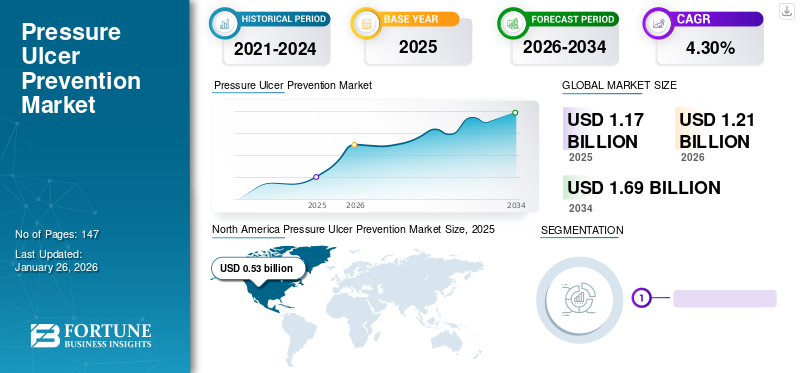
Download Free sample to learn more about this report.
PRESSURE ULCER PREVENTION MARKET KEY TAKEAWAYS
 Global Market Size & Forecast
- 2025 Market Size: USD 1.20 billion
- 2026 Market Size: USD 1.26 billion
- 2034 Forecast Market Size: USD 1.80 billion
- CAGR: 4.30% from 2026–2034
 Market Share
- The static support surfaces segment is projected to grow at a CAGR of 3.3% during the forecast period.
- The long term care & urgent care centers segment is anticipated to grow at a CAGR of 5.1% over the forecast period.
- The hospitals & ambulatory surgery centers accounted for the largest market share in 2025.
 Key Regional Highlights
North America
North America accounted for the largest market share in 2024, with a value of USD 0.52 billion, and reached a value of USD 0.55 billion in 2025.
Europe
Europe is projected to record a CAGR of 3.7% during the forecast period, the second-highest globally, reaching USD 0.33 billion by 2026.
Asia Pacific
By 2026, the Asia Pacific market is projected to reach approximately USD 0.26 billion, making it the third-largest market worldwide.
U.S.
In 2026, the U.S. is anticipated to reach USD 0.51 billion, accounting for approximately 40.7% of the global market.
Japan
The Japan market is projected to generate approximately USD 0.08 billion in revenue by 2026, representing nearly 6.6% of the global market.
Read More

PRESSURE ULCER PREVENTION MARKET TRENDS
Growing Utilization of Silicone Foam Dressings for Preventive Protection to Emerge as a Key Trend
Currently, silicone foam dressings are increasingly being used as part of proactive pressure ulcer prevention bundles rather than only for wound management after skin breakdown. Hospitals and long-term care facilities are applying multi-layer silicone foam dressings to high-risk areas such as the sacrum, heels, elbows, and medical device pressure points to reduce pressure, shear, friction, and moisture-related skin damage.
Their cushioning, conformability, atraumatic removal, and ability to stay in place make them suitable for ICUs, operating rooms, emergency departments, orthopedic wards, and elderly care settings where patients are often immobile or have fragile skin.
- For instance, as of June 2026, Mölnlycke’s Mepilex Border Sacrum and Mepilex Heel, along with Smith+Nephew’s ALLEVYN LIFE foam dressings, are positioned to support pressure injury prevention protocols, supported by growing clinical evidence in high-risk patients.
MARKET DYNAMICS
MARKET DRIVERS
Download Free sample to learn more about this report.
Growing Burden of Pressure Injuries Amid Aging, Immobile, ICU, and Long-term Care Patients to Fuel Market Expansion
Pressure injuries arise when prolonged pressure, shear, friction, or moisture restricts blood flow to the skin and underlying tissues. This makes elderly, immobile, critically ill, neurologically impaired, or poorly nourished patients highly vulnerable to such condition. As a result, the expanding geriatric population and rising number of patients requiring long-term, rehabilitative, and home-based care are increasing the demand for preventive solutions.
This is also supporting the adoption of pressure redistribution mattresses, dynamic support surfaces, seat cushions, heel protectors, positioning devices, prophylactic foam dressings, and skin barrier products. Moreover, prevention is being increasingly preferred over treatment, as pressure injuries cause pain, infection, delayed recovery, longer hospital stays, and higher care costs.
- For instance, the Agency for Healthcare Research and Quality (AHRQ) estimates that more than 2.5 million people in the U.S. develop pressure ulcers each year. At the same time, NPIAP emphasizes regular repositioning for at-risk patients.
Thus, rising pressure injury burden among aging and immobile patients is expected to drive pressure ulcer prevention market growth.
|
Rank |
Market Driver |
Overall Impact Rank |
CAGR Contribution (2026-2034) |
Impact: 2026-2028 |
Impact: 2029-2031 |
Impact: 2032-2034 |
|
1 |
Rising Burden of Pressure Injuries Among Aging, Immobile, ICU, and Long-term Care Patients |
High |
+2.15% |
High |
High |
High |
|
2 |
Growing Hospital Focus on HAPI Reduction, Patient Safety, Quality Reporting, and Value-based Care |
High |
+1.75% |
High |
High |
Medium |
|
3 |
Increasing Adoption of Advanced Support Surfaces, Preventive Dressings, and Positioning Products |
Medium-High |
+1.35% |
Medium |
High |
High |
|
4 |
Growing Demand for Smart, Sensor-based and Digitally Enabled Prevention Solutions |
Medium |
+0.95% |
Medium |
Medium |
High |
|
5 |
Expansion of Post-acute, Rehabilitation, Homecare, and Long-term Care Prevention Programs |
Medium-Low |
+0.65% |
Medium |
Medium |
Low |
|
6 |
Others (Growing awareness among caregivers, wider availability of affordable foam surfaces and positioners in emerging markets, procurement standardization, product bundling by wound-care companies, and wider use of clinical education programs) |
Low |
+0.25% |
Low |
Low |
Low |
|
Total Positive Growth Contribution |
+7.10% |
MARKET RESTRAINTS
High Costs Associated with Pressure Ulcer Prevention to Hamper Market Growth
Despite the intense need for prevention and care for pressure ulcers, one of the major factors that potentially hampers the market growth is high cost associated with these products. The high prices of pressure ulcer prevention products, such as alternating air pads, air-fluidized mattresses, and specialized beds & support surfaces, are hampering product adoption amongst the population. According to NCBI estimates published in a cohort study of 1000 patients for 52 weeks, in April 2021, the cost of one wearable sensor was around USD 39,580.
In terms of emerging regions such as Asia Pacific, Latin America, and the Middle East & Africa, the high cost of these devices is limiting the adoption rate. This is influencing a greater preference toward more economical products in healthcare settings. Therefore, the high cost of products for pressure ulcer treatment, such as negative pressure wound therapies and prevention products, will lead to their lesser adoption amongst the patient population, limiting the market growth.
|
Rank |
Market Restraint |
Overall Impact Rank |
Negative CAGR Contribution (2026-2034) |
Impact: 2026-2028 |
Impact: 2029-2031 |
Impact: 2032-2034 |
|
1 |
High Cost of Advanced Pressure Ulcer Prevention Products and Digital Systems |
High |
-1.10% |
High |
High |
Medium |
|
2 |
Inconsistent Reimbursement, Prior Authorization, and Documentation Requirements |
Medium |
-0.65% |
Medium |
Medium |
Low |
|
3 |
Implementation Barriers Related to Staff Workload, Training, and Protocol Adherence |
Medium |
-0.55% |
High |
Medium |
Medium |
|
4 |
Others (Low awareness in smaller facilities, weak standardization in product evaluation, fragmented purchasing decisions, limited clinical evidence for some lower-cost products, and supply-chain or tender-related price pressure) |
Low |
-0.20% |
Low |
Low |
Low |
|
Total Negative Growth Impact |
-2.50% |
MARKET OPPORTUNITIES
Growing Shift Toward Smart Pressure Injury Prevention Solutions to Create Strong Market Opportunities
Traditional pressure ulcer prevention relies on manual repositioning, skin checks, and caregiver documentation, which can be inconsistent due to staff workload, shortages, and limited real-time visibility. Smart prevention technologies address these gaps through wearable sensors, pressure mapping systems, connected support surfaces, and digital platforms that monitor patient mobility, pressure exposure, turn frequency, and protocol adherence.
These solutions help caregivers identify high-risk patients earlier, reduce missed repositioning events, and improve workflow efficiency in hospitals, ICUs, long-term care facilities, and rehabilitation centers. They also support quality reporting by generating actionable data and reducing dependence on manual documentation.
- For instance, in June 2026, Smith+Nephew launched its next-generation LEAF Patient Monitoring System in the U.S., using wearable sensors to provide real-time turn status updates.
Thus, rising adoption of sensor-based and smart monitoring platforms is expected to create strong market opportunities in the upcoming years.
MARKET CHALLENGES
Inconsistent Reimbursement for Preventive Support Surfaces and Accessories to Hamper Market Development
Although pressure ulcer prevention is clinically important, reimbursement remains inconsistent across countries, payers, care settings, product types, and patient eligibility criteria. In several markets, coverage is more clearly defined for treatment of existing pressure injuries than for early prevention among high-risk patients.
This is expected to create uncertainty for hospitals, long-term care providers, suppliers, and homecare users when purchasing pressure redistribution mattresses, powered overlays, heel protectors, cushions, positioning aids, prophylactic dressings, and related accessories. This is expected to pose a major challenge for the market’s expansion.
- For instance, as of June 2026, U.S. Medicare covers Group 2 pressure-reducing support surfaces only when specific medical-necessity criteria are met, such as non-healing stage 2 ulcers, large or multiple stage 3/4 ulcers, or recent flap/skin graft surgery. If criteria are unmet, claims may be denied, limiting timely access to preventive products.
Segmentation Analysis
By Product Type
Cost Effectiveness of Dynamic Support Surfaces Leads to Segment’s Dominance
Based on product type, the market is segmented into static support surfaces, dynamic support surfaces, dressings, positioners & protectors, and creams & others. The static support surfaces are subdivided into foam mattresses, gel overlays, alternating pressure pads, and others. The dynamic support surfaces segment is further sub-segmented into alternating-air mattresses, low-air-loss mattresses, air-fluidized or high-air-loss mattresses, and others.
To know how our report can help streamline your business, Speak to Analyst
The dynamic support surfaces segment held a largest pressure ulcer prevention market share in 2025. The segment’s dominance is primarily attributed to the effectiveness of dynamic support surfaces. Also, these devices are available at a comparatively lower price, leading to a high patient adoption rate. Also, increasing strategic initiatives such as partnerships and acquisitions by key players are favoring the segment's growth.
- For instance, in August 2023, Coloplast A/S completed the acquisition of Kerecis. The acquisition created a broader wound & tissue repair platform by combining advanced wound dressings and biologics.
Additionally, the static support surfaces segment is projected to grow at a CAGR of 3.3% during the forecast period.
By End-user
Higher Patient Concentration in Hospitals & Ambulatory Surgery Centers to Fuel the Segment’s Growth
In terms of end-user, the market is segmented into hospitals & ambulatory surgery centers, clinics, long term care & urgent care centers, homecare settings, and others.
The hospitals & ambulatory surgery centers accounted for the largest market share in 2025. The segment is witnessing growth due to the large presence of immobilized, post-surgical, ICU, and elderly patients across hospitals and ASCs. These facilities require structured prevention measures, including pressure redistribution mattresses, operating room positioners, heel offloading devices, prophylactic dressings, and repositioning aids. Growth is further supported by increasing patient-safety priorities and stronger purchasing capabilities compared with smaller care settings, encouraging key players to introduce advanced and innovative products.
- For instance, in December 2024, Agiliti Health, Inc. launched its Adapt Line therapeutic hospital support surfaces to reduce pressure injury risk from prolonged bed rest.
Additionally, the long term care & urgent care centers segment is anticipated to grow at a CAGR of 5.1% over the forecast period.
Pressure Ulcer Prevention Market Regional Outlook
In terms of geography, the market is segmented into North America, Europe, Asia Pacific, Latin America, and Middle East & Africa.
North America
North America Pressure Ulcer Prevention Market Size, 2025 (USD Billion)
To get more information on the regional analysis of this market, Download Free sample
North America accounted for the largest market share in 2024, with a value of USD 0.52 billion, and reached a value of USD 0.55 billion in 2025. The region’s growth is attributed to the increasing burden of chronic diseases and technological advancements for the prevention of pressure ulcers. Moreover, the high awareness of hospital-acquired pressure injuries, mature patient-safety programs, and wider availability of advanced prevention products such as therapeutic support surfaces, prophylactic dressings, heel protectors, and positioning aids are also expected to fuel the region’s growth.
U.S. Pressure Ulcer Prevention Market
In 2026, the U.S. is anticipated to reach USD 0.51 billion, accounting for approximately 40.7% of the global market.
Europe
Europe is projected to record a CAGR of 3.7% during the forecast period, the second-highest globally, reaching USD 0.33 billion by 2026. The growth of this region is attributed to the rising initiatives by various organizations to increase awareness regarding pressure ulcers in Europe. The Direct Health Group (DHG) supported the ‘Stop The Pressure’ campaign held on 17th November 2022. The European Pressure Ulcer Advisory Panel (EPUAP) coordinated the campaign to increase national awareness and enhance pressure ulcer prevention education.
U.K. Pressure Ulcer Prevention Market
The U.K. market is projected to reach USD 0.06 billion by 2026, representing approximately 5.1% of the global revenues.
Germany Pressure Ulcer Prevention Market
The Germany market is expected to reach USD 0.08 billion by 2026, accounting for approximately 6.0% of the global revenue.
Asia Pacific
By 2026, the Asia Pacific market is projected to reach approximately USD 0.26 billion, making it the third-largest market worldwide. The region’s growth is due to rapid population aging, rising hospital admissions, expansion of private hospitals, and increasing adoption of international pressure injury prevention practices.
Japan Pressure Ulcer Prevention Market
The Japan market is projected to generate approximately USD 0.08 billion in revenue by 2026, representing nearly 6.6% of the global market.
China Pressure Ulcer Prevention Market
The China market is anticipated to reach around USD 0.08 billion by 2026, accounting for nearly 6.3% of the global revenues.
India Pressure Ulcer Prevention Market
The India market is expected to reach approximately USD 0.02 billion by 2026, accounting for 1.7% of the global market revenue.
Latin America and Middle East & Africa
Both Latin America and the Middle East & Africa are anticipated to witness moderate growth, with the Latin America market estimated to reach approximately USD 0.06 billion by 2026. The growth of these regions is due to increasing awareness of pressure ulcer prevention and increasing investments in healthcare infrastructure in emerging countries.
GCC Pressure Ulcer Prevention Market
By 2026, the GCC market is estimated to reach approximately USD 0.02 billion, representing around 1.5% of the global revenues.
COMPETITIVE LANDSCAPE
Key Industry Players
Strong Market Presence and Product Portfolio of Key Companies Aids Them to Gain Top Position
In 2025, Baxter, Arjo, Stryker, Medline Inc., and Mölnlycke AB held the largest market share. This dominance is attributed to a strong product portfolio and a robust presence of these companies in the international market. Also, active strategic acquisitions have been some of the prominent driving factors for the dominance of market players.
- For instance, in May 2026, Mölnlycke AB and Zhende Medical formed a joint venture in China to expand access to advanced wound care solutions, including pressure ulcer prevention products, in the country.
On the other hand, other prominent players, such as Agiliti Health, Inc, Smith+Nephew, and others, are focused on strengthening their market position through new product launches, facility expansions, and increasing investments.
LIST OF KEY PRESSURE ULCER PREVENTION COMPANIES PROFILED
- Agiliti Health, Inc. (U.S.)
- Arjo (Sweden)
- Savaria (Canada)
- Medline Inc. (U.S.)
- Coloplast A/S. (Denmark)
- Smith+Nephew (U.K.)
- Stryker (U.S.)
- Mölnlycke AB (Sweden)
- Baxter (U.S.)
- Invacare Corporation (U.S.)
- Cardinal Health (U.S.)
KEY INDUSTRY DEVELOPMENTS
- April 2026: Agiliti Health, Inc. introduced Capillaire, a low-profile alternating air pressure overlay for OR tables and stretchers.
- May 2026: Savaria introduced the new PressureGuard APM-i, an advanced therapeutic support surface with SmartImmerse technology.
- June 2025: Agiliti Health, Inc. introduced the NP Line of stretcher support surfaces, including NP Adjust ST, NP Trio ST, and NP Duo ST. This expanded the company’s pressure ulcer prevention portfolio into emergency and perioperative departments.
- June 2025: Stryker launched the APAISER X1, an advanced ICU air mattress customized for India, at ANEiCON 2025 in Kochi, India. It integrates with SmartMedic to enhance patient comfort, reduce pressure injuries, and improve caregiver efficiency in critical care.
- January 2024: Medline Inc. launched OptiView Transparent Dressing with HydroCore technology. This broadened the company’s pressure ulcer prevention portfolio.
- June 2023: Baxter launched the Hillrom Progressa+ ICU Bed in the U.S., with global expansion planned afterward.
- June 2022: Medline Inc. launched a new version of Optifoam Gentle EX foam dressing, which aids in preventing pressure injury.
REPORT COVERAGE
The report provides a comprehensive analysis of the global pressure ulcer prevention market, covering market size, current market dynamics, and forecast growth from 2026 to 2034. It evaluates key growth drivers, restraints, opportunities, and emerging trends influencing the adoption of pressure ulcer prevention products across healthcare settings. In addition, the report assesses competitive positioning, company market share, product portfolios, recent developments, strategic initiatives, and key innovations introduced by major players.
Request for Customization to gain extensive market insights.
Report Scope & Segmentation
| ATTRIBUTE | DETAILS |
| Study Period | 2021-2034 |
| Base Year | 2024 |
| Estimated Year | 2026 |
| Forecast Period | 2026-2034 |
| Historical Period | 2021-2024 |
| Growth Rate | CAGR of 4.6% from 2026-2034 |
| Unit | Value (USD Billion) |
| Segmentation | By Product Type, End-user, and Region |
| By Product Type |
|
| By End-user |
|
| By Region |
Frequently Asked Questions
Fortune Business Insights says that the global market is projected to grow from USD 1.26 billion in 2026 to USD 1.80 billion by 2034.
The market is expected to grow at a CAGR of 4.6% during 2026-2034.
The North America market stood at USD 0.55 billion in 2025.
The dynamic support surfaces is the leading product type segment in the market.
North America held the maximum share of the global market in 2025.
The growing occurance of pressure injuries among aging, immobile, ICU, and long-term care patients drives global market growth.
Baxter, Arjo, Stryker, Medline Inc., and Mölnlycke AB are significant market players.



- 2021-2034
- 2025
- 2021-2024
- 147
-
(Offer valid till 15th Aug 2026)
Get 30-60 hrs Free Customization
Expand Regional and Country Coverage, Segments Analysis, Company Profiles, Competitive Benchmarking, and End-user Insights.













.webp)






Related Reports
-
US +1 833 909 2966 ( Toll Free )
-
Get In Touch With Us