Industrial Control Systems Market Size, Share & Industry Analysis, By System Type (Distributed Control System (DCS), Supervisory Control and Data Acquisition (SCADA), Programmable Logic Controller (PLC), and Safety Instrumented System (SIS)), By Component (Hardware, Software, and Services), By Application (Process Control, Discrete Control, Safety & Critical Control, and Monitoring & Supervisory Control), By End-Use Industry (Oil & Gas, Power Generation & Utilities, Chemicals & Petrochemicals, Water & Wastewater, Pharmaceuticals & Biotechnology, and Others), and Regional Forecast, 2026-2034
 Download Free Sample
Industrial Control Systems Market Size and Future Outlook
 Listen to Audio Version
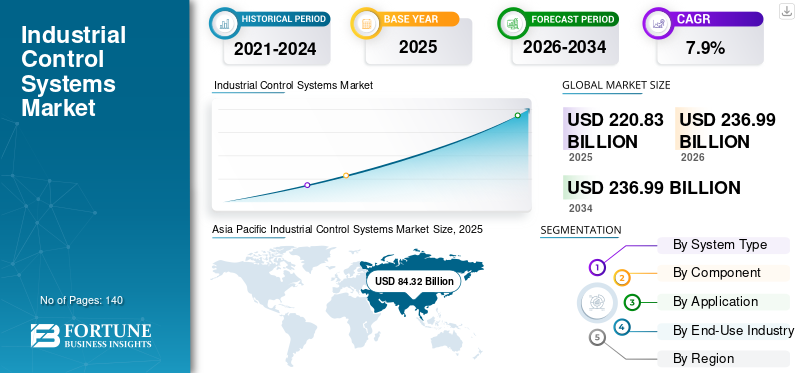
The global industrial control systems market size was valued at USD 220.83 billion in 2025 and is projected to grow from USD 236.99 billion in 2026 to USD 436.46 billion by 2034, exhibiting a CAGR of 7.9% during the forecast period. Asia Pacific dominated the industrial control systems market with a market share of 38.18% in 2025.
Industrial control systems (ICS) comprise integrated hardware and software architectures designed to monitor, control, and automate industrial processes with high precision, reliability, and real-time responsiveness across process and discrete manufacturing environments. These systems, including distributed control systems (DCS), supervisory control and data acquisition (SCADA), programmable logic controllers (PLC), and safety instrumented systems (SIS), form the backbone of modern industrial operations. As industries increase investment in digitalized, interconnected production ecosystems, the market is witnessing strong growth. Rising demand for operational efficiency and process optimization, along with the need to ensure system reliability and safety across key regions, including Asia Pacific and North America, is driving market expansion.
ICSs are widely deployed across oil and gas facilities, power generation plants, chemical processing units, water and wastewater infrastructure, and advanced manufacturing facilities to enable continuous monitoring, precise control, and seamless coordination of complex industrial workflows. They play a critical role in enhancing process stability, reducing downtime, improving asset utilization, enhancing the supply chain, enabling AI-driven operations, and ensuring compliance with stringent safety and regulatory standards. Current market trends indicate a growing shift toward hybrid control architectures, where traditional centralized systems are increasingly integrated with edge-enabled controllers and open communication protocols to improve system flexibility and interoperability.
- For instance, in April 2026, Siemens AG introduced enhancements to its industrial control portfolio by integrating edge computing capabilities within PLC and SCADA platforms, enabling real-time analytics and improved decision-making at the control level in manufacturing environments.
Siemens AG, ABB Ltd., Schneider Electric SE, Rockwell Automation Inc., Emerson Electric Co., and Honeywell International Inc. are among the key players with significant market share. Their competitive positioning is reinforced by strong expertise in control system engineering, deep integration capabilities across industrial software and hardware layers, extensive global service networks, and continuous advancements in open automation architectures, cybersecurity integration, and software-defined control platforms to support the evolving landscape of industrial digitalization.
Download Free sample to learn more about this report.
Industrial Control Systems Market KEY TAKEAWAYS
 Global Market Size & Forecast
- 2025 Market Size: USD 220.83 billion
- 2026 Market Size: USD 236.99 billion
- 2034 Forecast Market Size: USD 436.46 billion
- CAGR: 7.9% from 2026-2034
 Market Share
- Asia Pacific dominated the global market with a 38.18% share in 2025.
- Programmable Logic Controller (PLC) held the largest system type share in 2025.
- Hardware held the largest component share in 2025.
 Key Regional Highlights
Asia Pacific
Dominated the market with USD 84.32 billion in 2025, supported by rapid industrialization.
North America
Accounted for USD 48.43 billion in 2025, supported by investments in industrial automation.
Europe
Europe is driven by industrial automation, energy efficiency, regulatory compliance, and increasing demand.
U.S.
The market is projected to reach approximately USD 40.48 billion in 2026.
Japan
The market is estimated at approximately USD 11.49 billion in 2026, accounting for roughly 4.9% of global sales.
Read More

INDUSTRIAL CONTROL SYSTEMS MARKET TRENDS
Shift toward Open, Hybrid, and Software-Defined Control Architectures is Reshaping Market
The need for operational flexibility, system interoperability, and real-time decision-making across complex industrial environments increasingly drives demand for industrial control systems. As industries such as oil and gas, power generation, chemicals, and advanced manufacturing accelerate their digital transformation initiatives, organizations are moving away from rigid, proprietary control systems toward open and hybrid architectures that enable seamless integration across multiple platforms and vendors. This shift is driving the adoption of next-generation PLCs, distributed control systems, and SCADA platforms that support open communication standards and modular configurations, enabling industries to modernize legacy infrastructure without complete system overhauls.
Moving beyond traditional centralized control frameworks, there is a growing emphasis on distributed, edge-enabled control systems that process data closer to the source, reducing latency and improving responsiveness in critical operations. The increasing deployment of edge-integrated PLCs and software-defined control platforms is enabling real-time analytics, predictive maintenance, and dynamic process optimization directly at the control layer. Additionally, the adoption of open process automation standards, such as O-PAS, is gaining traction, particularly in the process industries, as it enables multi-vendor interoperability and reduces dependence on single-system providers. The growing importance of industrial cybersecurity, driven by expanding attack surfaces and regulatory requirements such as IEC 62443, is further influencing system design, with embedded security features becoming a core component of modern ICS architectures.
- For instance, in February 2024, Schneider Electric announced advancements to its EcoStruxure Automation Expert platform, an open, software-defined automation system based on IEC 61499 standards, aimed at enabling vendor-agnostic industrial control architectures and improving flexibility across process and hybrid industries.
MARKET DYNAMICS
MARKET DRIVERS
Download Free sample to learn more about this report.
Expansion of Industrial Digitalization and Real-Time Process Optimization Fuels Market Growth
The industrial control systems market growth is increasingly being driven by the rapid expansion of industrial digitalization and the growing need for real-time process optimization across complex production environments. In contrast to traditional automation setups, modern industrial operations require continuous monitoring, predictive control, and dynamic adjustment of processes to maintain efficiency, quality, and safety. Industries such as oil and gas, power generation, chemicals, and advanced manufacturing are facing increasing pressure to optimize asset performance, reduce unplanned downtime, and improve energy efficiency, which is accelerating the adoption of advanced control systems. This shift is driving demand for integrated PLC, DCS, and SCADA platforms capable of processing large volumes of operational data and enabling real-time decision-making at the control level.
- For instance, in March 2025, Rockwell Automation announced the expansion of its FactoryTalk® Analytics portfolio, introducing enhanced real-time data and control integration capabilities designed to improve operational visibility and decision-making across manufacturing environments.
MARKET RESTRAINTS
Legacy System Integration Complexity and Cybersecurity Risks Limiting System Modernization
Market growth is significantly constrained by the complexity associated with integrating modern control technologies with legacy industrial infrastructure. A large portion of industrial facilities continues to operate on decades-old control systems that lack the capability to support modern connectivity, interoperability, or data-driven applications. Integrating advanced PLCs, DCS platforms, and SCADA systems into these environments requires extensive system redesign, custom interfaces, and careful migration planning to avoid operational disruptions. This increases implementation time, project costs, and technical risks, particularly in critical industries such as oil and gas, power generation, and chemicals, where downtime can result in substantial financial losses.
The increasing connectivity of industrial control systems has significantly expanded the attack surface for cyber threats, making cybersecurity a major concern for operators. Many legacy systems lack built-in security features, making them vulnerable to unauthorized access, malware, and ransomware attacks. Ensuring compliance with industrial cybersecurity standards such as IEC 62443 requires additional investments in network segmentation, monitoring tools, and secure communication protocols, further increasing the cost and complexity of system upgrades.
MARKET OPPORTUNITIES
Adoption of Software-Defined Automation and Open Process Architectures Creating New Growth Avenues
An emerging market opportunity lies in the growing adoption of software-defined automation and open process control architectures across industrial environments. As industries increasingly shift toward flexible, modular, and vendor-agnostic automation systems, the demand for control platforms that decouple hardware from software is rising significantly. Modern industrial environments require scalable and interoperable solutions that enable seamless integration of multi-vendor components, allowing operators to upgrade or expand systems without full infrastructure replacement. This is creating strong opportunities for next-generation DCS, PLC, and SCADA platforms designed with open standards and service-oriented architectures.
- For instance, in February 2025, Schneider Electric announced advancements to its EcoStruxure Automation Expert platform, emphasizing software-defined automation and interoperability based on open standards to enable flexible and scalable industrial control architectures.
MARKET CHALLENGES
Complexity in Managing Convergence of IT and OT Systems is a Key Market Challenge
A key challenge in the market is the increasing complexity of the convergence of Information Technology (IT) and Operational Technology (OT) systems in industrial environments. Modern industrial operations require seamless integration between control platforms, enterprise systems, cloud infrastructure, and data analytics tools. This convergence introduces significant challenges related to system compatibility, data synchronization, and network architecture design, particularly when integrating legacy control systems with modern digital platforms. The need to maintain deterministic control performance while enabling data exchange with higher-level systems adds further complexity, as latency, bandwidth limitations, and system interoperability must be carefully managed.
Segmentation Analysis
By System Type
Programmable Logic Controller (PLC) Led Market as It Offers High-Speed Control
By system type, the market is segmented into Distributed Control System (DCS), Supervisory Control and Data Acquisition (SCADA), Programmable Logic Controller (PLC), and Safety Instrumented System (SIS).
Programmable Logic Controller (PLC) held the largest market share in 2025, as it represents the most widely adopted and flexible control systems across both discrete and hybrid industrial environments. PLCs offer high-speed control, a modular architecture, and ease of integration, enabling industries to efficiently manage machine-level automation, production lines, and material-handling operations with precision and reliability. Their ability to support real-time control, scalability, and compatibility with a wide range of industrial communication protocols makes them particularly suitable for manufacturing-driven sectors such as automotive, electronics, food and beverage, and packaging, where operational flexibility and rapid system reconfiguration are critical.
- For instance, in March 2025, Siemens AG announced advancements to its SIMATIC S7-1500 PLC series, focusing on enhanced edge integration, improved processing performance, and expanded connectivity features to support real-time industrial automation and digitalization initiatives.
Safety Instrumented System (SIS) represents a significant segment, accounting for approximately 7.9% of the market share, driven by the growing need for functional safety and regulatory compliance across high-risk industries such as oil and gas, chemicals, and power generation. The increasing adoption of safety standards such as IEC 61508 and IEC 61511 is driving demand for SIS solutions that ensure safe shutdowns and minimize operational risks in hazardous environments.
To know how our report can help streamline your business, Speak to Analyst
By Component
Hardware Segment Led as It Represents the Core Foundation of Industrial Control Infrastructure across Automation Environments
By component, the market is segmented into hardware, software, and services.
Hardware held the largest industrial control systems market share in 2025, as it represents the foundational layer of industrial control systems, comprising controllers such as PLCs and DCS systems, remote terminal units, I/O modules, and industrial networking equipment. These components are essential for executing real-time control functions, enabling deterministic operations, and ensuring system reliability across industrial environments. Hardware systems are widely deployed across process and discrete industries, including oil and gas, power generation, manufacturing, and water and wastewater, where continuous operation and high system availability are critical.
Software is the fastest-growing segment and is projected to expand at a CAGR of approximately 9.0% in the coming years, driven by the increasing demand for data-driven decision-making, advanced process optimization, and industrial digitalization. The growing integration of control systems with analytics platforms, digital twins, and industrial cybersecurity solutions is accelerating the adoption of software layers within ICS architectures. Modern systems increasingly rely on software for monitoring, visualization, predictive maintenance, and system optimization, enabling industries to improve operational efficiency and reduce downtime.
By Application
Process Control Segment Led as It Represents the Most Critical and Widely Deployed Application across Continuous Industrial Operations
By application, the market is segmented into process control, discrete control, safety & critical control, and monitoring & supervisory control.
Process control held the largest market share in 2025, as it is the most critical application of industrial control systems in continuous, large-scale industrial operations. These systems are extensively deployed in industries such as oil and gas, chemicals, power generation, and water and wastewater, where maintaining precise control over variables such as temperature, pressure, flow, and chemical composition is essential for ensuring operational stability, product quality, and safety. Process industries require uninterrupted and highly reliable control systems capable of managing complex, interdependent processes in real time.
Discrete control is the fastest-growing segment and is projected to expand at a CAGR of approximately 8.8% in the coming years, driven by the rapid expansion of manufacturing automation across industries such as automotive, electronics, food and beverage, and consumer goods. Discrete manufacturing environments require high-speed, flexible, and reconfigurable control systems to manage individual production units, assembly lines, and material handling operations.
By End-Use Industry
Power Generation & Utilities Segment Led as It Signifies the Most Critical Infrastructure for Continuous Monitoring and Grid Stability
By end-use industry, the market is segmented into oil & gas, power generation & utilities, chemicals & petrochemicals, water & wastewater, pharmaceuticals & biotechnology, food & beverage, metals & mining, pulp & paper, and discrete manufacturing (automotive, electronics, machinery).
The power generation & utilities segment held the largest market share in 2025, as it represents one of the most critical infrastructure sectors requiring continuous monitoring, real-time control, and high system reliability. Industrial control systems are extensively deployed across power plants, transmission networks, and distribution systems to ensure grid stability, load balancing, and efficient energy management. The increasing integration of renewable energy sources, along with the modernization of aging grid infrastructure, is driving demand for advanced SCADA systems, DCS platforms, and energy management solutions capable of handling complex and distributed power networks.
The pharmaceuticals & biotechnology segment is the fastest-growing, projected to expand at a CAGR of approximately 9.3% over the coming years, driven by the increasing need for precision manufacturing, regulatory compliance, and process validation. Pharmaceutical production requires highly controlled, traceable processes, making industrial control systems essential for maintaining product quality, batch consistency, and compliance with regulatory standards such as those of the FDA and GMP.
Industrial Control Systems Market Regional Outlook
By geography, the market is categorized into Europe, North America, Asia Pacific, South America, and the Middle East & Africa.
Asia Pacific
Asia Pacific Industrial Control Systems Market Size, 2025 (USD Billion)
To get more information on the regional analysis of this market, Download Free sample
Asia Pacific dominates the market, driven by rapid industrialization, strong manufacturing expansion, and large-scale adoption of automation and digital control technologies across key economies, including China, India, Japan, South Korea, and Southeast Asian countries. Asia Pacific remains a significant growth market, generating global revenue of USD 84.32 billion in 2025. The region’s growth is primarily supported by its position as a global manufacturing hub, particularly in industries such as electronics & semiconductor, automotive, chemicals, and energy infrastructure.
China Industrial Control Systems Market
China’s market is projected to remain the dominant one in the Asia Pacific region, with 2026 revenues estimated at around USD 38.13 billion, representing roughly 16.1% of global sales.
Japan Industrial Control Systems Market
The Japanese market in 2026 is estimated at around USD 11.49 billion, accounting for roughly 4.9% of the global sales.
India Industrial Control Systems Market
The Indian market in 2026 is estimated at around USD 12.04 billion, accounting for roughly 5.1% of global sales.
North America
The North America market accounted for USD 48.43 billion in 2025, supported by increasing investments in industrial automation, grid modernization, and the growing integration of digital control systems across critical infrastructure sectors in the U.S., Canada, and Mexico. Regional demand is closely linked to the need for operational efficiency, system reliability, and enhanced cybersecurity across industries such as oil & gas, power generation, chemicals, and advanced manufacturing. Industrial operators are increasingly upgrading legacy control systems with modern PLC, DCS, and SCADA platforms to enable real-time monitoring, predictive maintenance, and improved process optimization, particularly in high-value and safety-critical applications.
U.S. Industrial Control Systems Market
The U.S. is expected to dominate the market with an estimated revenue of about USD 40.48 billion in 2026, driven by its highly developed industrial automation ecosystem, strong presence of leading control system providers, and continuous investments in energy infrastructure and advanced manufacturing. U.S.-based industries are actively focusing on modernizing legacy control environments by integrating edge-enabled controllers, industrial cybersecurity frameworks, and data-driven automation solutions. The increasing adoption of industrial control systems is particularly evident in sectors such as power utilities, oil & gas, pharmaceuticals, and discrete manufacturing, where real-time control, regulatory compliance, and operational resilience are critical.
Europe
The European market is driven by a strong focus on industrial automation, energy efficiency, and regulatory compliance, along with increasing demand for advanced control systems across key economies such as Germany, the U.K., France, Italy, and the Netherlands. Demand for industrial control systems is closely linked to the region’s well-established process industries, including chemicals, power generation, pharmaceuticals, and water management, where precise control and continuous monitoring are essential. Industrial operators and system integrators are prioritizing control solutions that offer interoperability, cybersecurity, and compliance with stringent standards such as IEC 62443 and functional safety regulations.
U.K. Industrial Control Systems Market
The U.K. market in 2026 is estimated at around USD 7.75 billion, representing roughly 3.3% of global sales.
Germany Industrial Control Systems Market
Germany’s market is projected to reach approximately USD 10.95 billion in 2026, equivalent to around 4.6% of global sales.
Middle East & Africa
The Middle East & Africa market is driven by increasing investments in industrial automation, expansion of energy infrastructure, and a growing focus on economic diversification across GCC countries, South Africa, Israel, and North Africa. Demand for industrial control systems is closely linked to the region’s strong presence in oil & gas, power generation, and water management sectors, where real-time monitoring, process reliability, and safety are critical. Governments across the region are investing in modernizing industrial infrastructure and reducing dependence on oil revenues by developing advanced manufacturing and industrial ecosystems, which are accelerating the adoption of control systems such as DCS, SCADA, and PLC platforms.
GCC Industrial Control Systems Market
The GCC market is projected to reach around USD 7.74 billion in 2026, representing roughly 3.3% of the global sales.
South America
The South America market is driven by increasing investments in industrial automation, modernization of energy and mining infrastructure, and the growing need to improve operational efficiency across key economies such as Brazil, Argentina, and Chile. Demand for industrial control systems is closely linked to the region’s strong presence in process-driven industries, particularly oil & gas, mining, power generation, and food processing, where continuous monitoring, system reliability, and operational safety are critical. Countries across the region are gradually transitioning from manual and semi-automated operations toward integrated control environments, driving the adoption of PLC, DCS, and SCADA systems to enhance productivity and reduce operational risks.
Brazil Industrial Control Systems Market
The Brazil market is projected to reach around USD 8.26 billion in 2026, representing roughly 3.5% of the global sales.
COMPETITIVE LANDSCAPE
Key Industry Players
Competitive Advantage Driven by Integrated Control Platforms, Industrial Software Capabilities, and System-Level Engineering Expertise
The industrial control systems market is moderately consolidated, with competitive positioning driven by advanced control system engineering capabilities, integration of hardware and software platforms, and the ability to deliver scalable and high-reliability automation solutions across diverse industrial environments. Leading players such as Siemens AG, ABB Ltd., Schneider Electric SE, Rockwell Automation Inc., Emerson Electric Co., and Honeywell International Inc. maintain strong market positions by offering comprehensive control system portfolios, including PLCs, DCS, SCADA platforms, and safety systems, designed to enhance operational efficiency, ensure process reliability, and support critical infrastructure operations.
Competitive differentiation is increasingly shaped by the ability to develop integrated automation ecosystems that combine control hardware, industrial software, and data-driven applications. As industrial operators focus on improving system flexibility, reducing downtime, and enabling real-time decision-making, market players are investing in next-generation solutions such as software-defined automation, edge-enabled control systems, and cybersecurity-integrated platforms.
- For instance, in April 2025, Rockwell Automation announced enhancements to its Logix control platform, focusing on improved data integration, edge connectivity, and real-time control capabilities to support advanced manufacturing and industrial digitalization initiatives.
LIST OF KEY INDUSTRIAL CONTROL SYSTEM COMPANIES PROFILED
- Siemens AG (Germany)
- ABB Ltd. (Switzerland)
- Schneider Electric SE (France)
- Rockwell Automation, Inc. (U.S.)
- Honeywell International Inc. (U.S.)
- Emerson Electric Co. (U.S.)
- Yokogawa Electric Corporation (Japan)
- Mitsubishi Electric Corporation (Japan)
- Omron Corporation (Japan)
- General Electric Company (U.S.)
KEY INDUSTRY DEVELOPMENTS
- June 2025: Rockwell Automation Inc. launched advancements in its ControlLogix PLC platform, aimed at improving high-speed control performance, edge integration, and seamless connectivity with industrial IoT and analytics solutions.
- April 2025: Siemens AG announced enhancements to its SIMATIC PCS 7 distributed control system, focusing on improved process optimization, integrated cybersecurity, and enhanced interoperability to support digital transformation in the process industries.
- March 2025: Schneider Electric SE expanded its EcoStruxure Automation Expert platform, introducing advanced software-defined automation capabilities to enable vendor-agnostic control architectures and improve system scalability across industrial environments.
- February 2025: Emerson Electric Co. introduced updates to its DeltaV distributed control system, emphasizing edge connectivity, real-time data integration, and advanced process control capabilities to optimize operations in energy and chemical sectors.
- January 2025: Honeywell International Inc. announced upgrades to its Experion® SCADA platform, focusing on enhanced remote monitoring, cybersecurity integration, and improved data visualization for utilities and infrastructure applications.
REPORT COVERAGE
The global industrial control systems market analysis includes a comprehensive study of market size & forecast across all market segments covered in the report. It includes details on the market dynamics and market trends expected to drive the market over the forecast period. It provides information on key aspects, including technological advancements, the regulatory environment, and product launches. Additionally, it details partnerships, mergers & acquisitions, and key industry developments and prevalence by key regions. The global market research report also provides a detailed competitive landscape, including market share and profiles of key players.
Request for Customization to gain extensive market insights.
Report Scope & Segmentation
| ATTRIBUTE | DETAILS |
| Study Period | 2021-2034 |
| Base Year | 2025 |
| Estimated Year | 2026 |
| Forecast Period | 2026-2034 |
| Historical Period | 2021-2024 |
| Growth Rate | CAGR of 7.9% from 2026 to 2034 |
| Unit | Value (USD Billion) |
| Segmentation | By System Type, Component, Application, End-Use Industry, and Region |
| By System Type |
|
| By Component |
|
| By Application |
|
| By End-Use Industry |
|
| By Region |
|
Frequently Asked Questions
According to Fortune Business Insights, the global market value stood at USD 220.83 billion in 2025 and is projected to reach USD 436.46 billion by 2034.
In 2025, the Asia Pacifics market value stood at USD 84.32 billion.
The market is expected to exhibit a CAGR of 7.9% during the forecast period (2026-2034).
By end-use industry, the power generation & utilities segment led the market.
Rising industrial digitalization, legacy system modernization, cybersecurity demand, real-time control needs, and infrastructure expansion drive growth.
Siemens, ABB, Schneider Electric, Rockwell Automation, Honeywell, Emerson, Yokogawa, Mitsubishi Electric, and Omron are the top players in the market.
Asia Pacific held the largest market share in 2025.


- 2021-2034
- 2025
- 2021-2024
- 140
Get 30-60 hrs Free Customization
Expand Regional and Country Coverage, Segments Analysis, Company Profiles, Competitive Benchmarking, and End-user Insights.















Related Reports
-
US +1 833 909 2966 ( Toll Free )
-
Get In Touch With Us