Industrial Hydraulic Equipment Market Size, Share & Industry Analysis, By Component (Pumps, Motors, Cylinders, Transmission, and Others), By Application (General Construction, Industrial Manufacturing, Oil and Gas, Material Handling, Energy and Power, and Others), and Regional Forecast, 2026-2034
 Download Free Sample
KEY MARKET INSIGHTS
 Listen to Audio Version
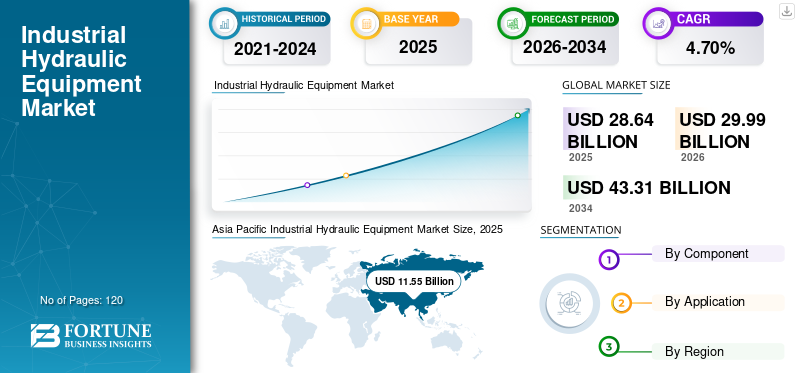
The global industrial hydraulic equipment market size was estimated at USD 28.64 billion in 2025 and is projected to reach USD 29.99 billion in 2026 to USD 43.31 billion by 2034, growing at a CAGR of 4.70% from 2026 to 2034. Asia Pacific dominated the industrial hydraulic equipment market with a market share of 40.31% in 2025.
Hydraulic equipment utilizes fluid power to generate, control, and transmit power, making it a crucial technology used across multiple industries to handle tasks involving heavy loads. This equipment ensures operational safety and provides better reliability to facility operators. The current era of automation and integration of Industry 4.0 has proved to be a stepping stone in transforming operational standards and increasing procurement of industrial hydraulic equipment. However, rival technologies such as electric and pneumatic have emerged as a considerable threat, which might curtail market growth over the forecast period.
Download Free sample to learn more about this report.
Industrial Hydraulic Equipment Market Key Takeaways
 Global Market Size & Forecast
- 2025 Market Size: USD 28.64 billion
- 2026 Market Size: USD 29.99 billion
- 2034 Forecast Market Size: USD 43.31 billion
- CAGR: 4.70% from 2026 to 2034
 Market Share
- Asia Pacific dominated the industrial hydraulic equipment market with a market share of 40.31% in 2025.
- The general construction segment is expected to contribute 15.00% globally in 2026.
- The cylinder category emerged as a prominent segment due to its critical functionality and increasing replacement demand.
 Key Regional Highlights
Asia Pacific
The region generated USD 11.55 billion in 2025 and is projected to reach USD 12.09 billion in 2026, supported by strong manufacturing bases and expanding industrial investments.
North America
The region is expected to witness significant growth, driven by its well-established construction and manufacturing industries along with the presence of leading hydraulic equipment manufacturers.
Europe
Rising demand for automation, software-integrated industrial equipment, and green machinery is expected to support steady market growth across the region.
U.S.
The U.S. contributes to regional growth through its established construction and manufacturing industry and the presence of numerous tier-1 or global players.
Japan
The country's advanced manufacturing ecosystem and strong hydraulic equipment production capabilities contribute to market growth and technological innovation.
Read More

Industrial Hydraulic Equipment Market Trends
Increasing Proliferation of Industry 4.0 and Adoption of Automation to Provide New Growth Prospects
Industry 4.0 technologies enable the implementation of predictive maintenance strategies, utilizing sensors and Internet of Thing (IoT) devices to monitor the condition of industrial hydraulic equipment in real-time, and detect potential issues before failures occur. This scheduling of maintenance activities, when needed, reduces downtime and extends the lifespan of equipment. Automation generates a wealth of data from hydraulic systems. Analyzing this data provides insights into equipment performance, energy consumption, and other critical parameters. These insights support informed decision-making for process optimization, resource allocation, and overall system improvement. Industry 4.0 technologies enable greater customization and flexibility in manufacturing processes. Hydraulic systems can be easily reconfigured and adapted to different production requirements, allowing for more agile and responsive manufacturing operations.
Download Free sample to learn more about this report.
Industrial Hydraulic Equipment Market Growth Factors
Substantial Investments in Research and Development Initiatives by Tier 1 Companies is Augmenting Product Sales
Manufacturers are leveraging their R&D infrastructure to introduce technologically advanced and modernized products for their customers. The efforts to offer novel products are gaining traction from customers in various application industries. Moreover, these companies are extensively using organic market strategies to propel their business in a positive direction. Companies such as Parker Hannifin and Danfoss are making noteworthy investments in the development of cutting-edge hydraulic technology through their R&D division. For instance, KYB Corporation has launched advanced hydraulic cylinders with reinforced chromium plating to increase durability and provide exceptional wear resistance, thereby increasing operational life.
RESTRAINING FACTORS
Increasing Adoption of Electromechanical Actuation is Hindering Hydraulic Technology
Over the recent past, the demand for industrial hydraulic equipment has faced significant challenges from technologies that offer greater reliability and superior operations efficacy. With the increasing trend of electrical machinery and electrically driven hydraulic motors in the construction and industrial manufacturing division, the trend has propelled the prominence of electromechanical actuation. In addition, pneumatic technology has also proved its numerous benefits over hydraulic technology, restricting opportunities for industrial hydraulic equipment in the market. The benefits of pneumatic cylinders, including leakage-free operations and elimination of possible contamination in the event of a leak, are cited as decisive factors restricting the application of hydraulic technology.
Industrial Hydraulic Equipment Market Segmentation Analysis
By Component Analysis
Critical Functionality of Superior Cylinders to Propel the Cylinder Segment Growth
In terms of component, the market is divided into pumps, motors, cylinders, transmission, and others.
The cylinders segment is expected to hold the highest market share compared to the rest of the components and is also expected to experience a surge in its share owing to the superior rate of growth in the market over the period of market forecast.
The importance and criticality functionality of superior cylinders in the operational hydraulic units emerged as a prominent factor contributing to the impressive performance of the cylinder category in the global industrial hydraulic equipment market growth. Moreover, operators of hydraulic equipment show a preference for repairing and replacing cylinders, resulting in an increased adoption of new cylinders as a retrofit in existing hydraulic equipment.
Additionally, the pumps and motors segment collectively commands a significant share of the global market, despite its high initial procurement cost. The introduction of more powerful and efficient products further drives the procurement of innovative products by customers.
By Application Analysis
To know how our report can help streamline your business, Speak to Analyst
Automated Operations for Heavy Liftings is Spurring Hydraulics Application in Construction
By application, the market is categorized across general construction, industrial manufacturing, oil and gas, material handling, energy and power, and others.
In terms of market share, the general construction segment is estimated to have a dominant performance during the period of market forecast and is also expected to have a swift pace of growth, outpacing its peers throughout the forecast period, contributing 15.00% globally in 2026. Hydraulic systems offer precise control over movements and forces, a valuable feature in construction applications that require accuracy, such as excavating foundations, positioning heavy materials, or manipulating construction elements.
The ability to provide unprecedented precision and reliability in the construction sector is the critical factor propelling market development. Hydraulic systems provide high power density, enabling the efficient transmission of substantial force through relatively compact components. This is particularly advantageous in manufacturing processes that require significant force for tasks such as pressing, punching, or forming. Moreover, hydraulic equipment finds applications in warehouses and distribution centers, including products such as forklifts, platform cranes and automated storage and retrieval systems, enhancing the efficient handling and movement of goods.
The increasing use of hydraulic equipment for good transport has contributed to the material handling segment gaining a noteworthy growth in industrial hydraulic equipment market share.
REGIONAL ANALYSIS
On the basis of region, the global market for industrial hydraulic equipment is divided into North America, Europe, Asia Pacific, Latin America, and the Middle East & Africa.
Asia Pacific Industrial Hydraulic Equipment Market Size, 2025 (USD Billion)
To get more information on the regional analysis of this market, Download Free sample
Asia Pacific
Asia Pacific dominated the market with a valuation of USD 11.55 billion in 2025 and USD 12.09 billion in 2026. Asia Pacific is anticipated to witness superior market growth over the forecast period, outpacing its global counterparts. The presence of dominant manufacturers in the region and established manufacturing bases in China and Japan is supporting the growth prospects of the market. Moreover, efforts by developing economies to increase their manufacturing base and establish manufacturing clusters for economic growth make Asia Pacific one of the most lucrative regions for investments and market development.
China
In terms of market share, China is expected to emerge as a dominant country in the global market for industrial hydraulic equipment over the forecast period. Most of the manufacturers operating in the global market still have an established and properly functioning manufacturing base in China. The favorable policies implemented by the government, along with numerous subsidiaries and benefits offered to manufacturers, have lured them to set up their manufacturing hubs in the country. China is ranked as one of the top countries in the ease of doing business index, attracting manufacturers across the globe and earning its reputation as the global industrial manufacturing hub. The factors stated above are expected to drive China's market and will help the country maintain its dominating share in the region.
To know how our report can help streamline your business, Speak to Analyst
North America
North America is estimated to have a substantial share of the global market and is anticipated to record a significant growth rate during the projected period. The presence of an established and well-developed construction and manufacturing industry in the region is a key driver for regional growth. Moreover, the presence of numerous tier-1 or global players is another factor behind the decent market share and noticeable market growth.
Europe
Europe will also hold a sizable market share with decent market growth owing to the increasing demand for automation and software-integrated products and equipment in construction and industrial manufacturing. Mandates for green and emission-free equipment will further boost the application of hydraulic technology.
Middle East & Africa and Latin America
The Middle East & Africa and Latin America are anticipated to possess a minimal market share and will also register sluggish market growth. Heavy dependence on import based sales is the main reason restricting growth of industrial hydraulic equipment in these regions.
List of Key Companies in Industrial Hydraulic Equipment Market
Increasing Competition Amongst the Manufacturers is Expected to Provide Substantial Surge
The industrial hydraulic equipment market consists of a moderate fragmentation with an increasing presence of emerging players across various geographies. Moreover, the established players in the global market are also dedicated to maintaining their customer base in the existing market and also making concerted efforts to expand their global footprint introducing products more effectively outside their local markets. Notably, in the current competition landscape, key players based in Japan and China hold a dominant position globally, taking initiatives to boost sales in North America and Europe.
Kawasaki Heavy Industries, Nabtesco, Nachi-Fujikoshi, Bosch Rexroth are few prominent manufacturers who have managed to gather a loyal customer base for their hydraulic equipment across the globe. Although there are numerous manufacturers based in diverse regions such as North America, Europe, and Asia Pacific, a majority of them have their manufacturing facilities located in China. These companies effectively engage in cross-border trade or export activities to provide a seamless and hassle-free supply of their equipment to multiple geographic locations.
List of Key Companies Profiled:
- Moog, Inc. (U.S.)
- Nachi-Fujikoshi (Japan)
- Nabtesco Corporation (Japan)
- Hitachi Construction Machinery Co., Ltd. (Japan)
- Hydac (Germany)
- Eaton Corporation Plc (Ireland)
- Kawasaki (Japan)
- Daikin (Japan)
- Linde Hydraulics (Germany)
- HAWE (Germany)
- Danfoss (Denmark)
KEY INDUSTRY DEVELOPMENTS:
- October 2023: Hitachi Construction Machinery agreed to and signed a memorandum Concerning Collaboration, which would be helpful in establishing mobile energy storage systems at construction sites. The initiatives helped advance the utilization of zero emission equipment across Europe.
- March 2023: Tata Hitachi, established as a joint venture between Tata and Hitachi Construction to operate in India, launched its latest product, ZX670H Hydraulic Mining Excavator. The new product would provide high durability and unmatched safety and comfort.
- March 2023: Moog Motion Control Technology developed a suspension system for extreme applications using digital hydraulic solutions, which developed a high-performance test rig.
- March 2023: Donaldson Company announced the launch of its Alpha-Web hydraulic media technology. The product assisted in maintaining the cleanliness of hydraulic fluids.
- February 2023: HydraForce, a leading manufacturer of hydraulic valves and manifolds unveiled HF Impulse 2.0, which is the latest hydraulic manifold circuit design tool. The product would provide ease in controlling hydraulic equipment using the mentioned configuration software.
REPORT COVERAGE
Request for Customization to gain extensive market insights.
The report provides a detailed analysis of the market and focuses on key aspects such as leading companies, product/service types, and leading applications of the product. Besides, the report offers insights into the market trends and highlights key industry developments. In addition to the factors above, the report encompasses several factors that contributed to the growth of the market in recent years.
Report Scope & Segmentation
|
ATTRIBUTE |
DETAILS |
|
Study Period |
2021-2034 |
|
Base Year |
2025 |
|
Estimated Year |
2026 |
|
Forecast Period |
2026-2034 |
|
Historical Period |
2021-2024 |
|
Growth Rate |
CAGR of 4.7% from 2026 to 2034 |
|
Unit |
Value (USD Billion) |
|
Segmentation |
By Component
By Application
By Region
|
Frequently Asked Questions
The market is projected to reach USD 43.31 billion by 2034.
In 2025, the market was valued at USD 28.64 billion.
The market is projected to grow at a CAGR of 4.7% during the forecast period.
The cylinders segment is expected to lead the market.
Substantial investments in research and development initiatives by Tier 1 companies is the key factor driving market growth.
Moog, Inc., Nachi-Fujikoshi, Hitachi Construction Machinery Co., Ltd., Hydac, Eaton Corporation Plc, and Kawasaki are the top players in the market.
Asia Pacific is expected to hold the highest market share.
By application, the general construction is expected to grow with a remarkable CAGR during the forecast period.


- 2021-2034
- 2025
- 2021-2024
- 120
Get 30-60 hrs Free Customization
Expand Regional and Country Coverage, Segments Analysis, Company Profiles, Competitive Benchmarking, and End-user Insights.














Related Reports
-
US +1 833 909 2966 ( Toll Free )
-
Get In Touch With Us