Hydraulic Cylinder Market Size, Share & Industry Analysis, By Function (Single Acting Hydraulic Cylinder and Double Acting Hydraulic Cylinder), By Product Type (Welded Cylinder, Tie Rod Cylinder, and Others (Telescopic, Mill-type, Custom, etc.)), By Application (Industrial Equipment and Mobile Equipment), By End-use Industry (Construction & Mining, Agriculture & Forestry, Aerospace & Defense, Material Handling, Industrial Machinery, Marine, and Others (Special-purpose Machinery & High-End Applications)), and Regional Forecast, 2026 - 2034
 Download Free Sample
(Offer valid till 30th Sep 2026)

Hydraulic Cylinder Market Size and Future Outlook
 Listen to Audio Version
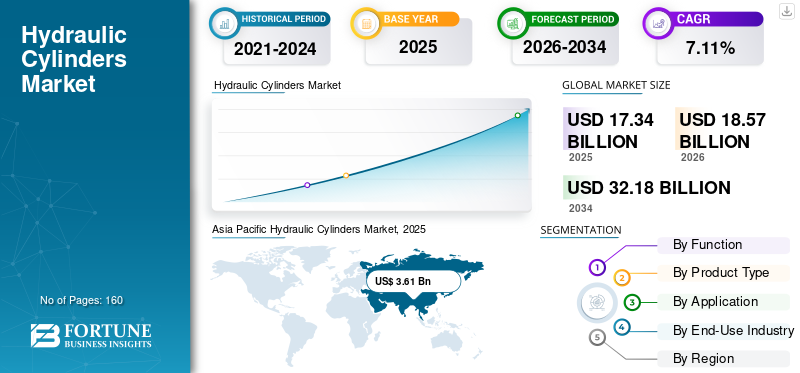
The global hydraulic cylinder market size was valued at USD 17.34 billion in 2025. The market is projected to grow from USD 18.11 billion in 2026 to USD 27.19 billion by 2034, exhibiting a CAGR of 5.2% during the forecast period. Asia Pacific dominated the hydraulic cylinder market with a market share of 38.40% in 2025.
Hydraulic cylinders are mechanical actuators that convert hydraulic pressure into linear force and motion across mobile and industrial equipment. These systems are designed to support lifting, pushing, pulling, steering, clamping, and positioning operations under demanding load conditions. The market includes single acting and double acting cylinders, along with welded, tie rod, telescopic, mill-type, and customized cylinder configurations developed for different operating requirements. These products integrate cylinder barrels, pistons, piston rods, seals, end caps, mounting components, and hydraulic connections to deliver controlled and reliable movement across heavy duty applications. Increasing focus on equipment productivity, operational reliability, and automation is shaping the development of modern hydraulic cylinder systems. Market growth is also supported by the expansion of construction equipment fleets, increasing mechanization in agriculture, and rising deployment of material handling machinery across warehouses and industrial facilities. Demand is further influenced by replacement requirements in aging equipment and the need for customized cylinders capable of operating under high pressure, extreme temperatures, and corrosive environments.
Hydraulic cylinder supports a wide range of applications across construction & mining, agriculture & forestry, aerospace & defense, material handling, industrial machinery, marine, and special-purpose equipment. These components are widely used in excavators, loaders, cranes, agricultural machinery, forklifts, presses, production equipment, steering systems, lifting platforms, and marine machinery. Manufacturers are increasingly focusing on improving load-handling capability, durability, corrosion resistance, sealing performance, and compatibility with connected hydraulic systems. The growing use of sensors, condition-monitoring systems, and electronically controlled hydraulics is also supporting the development of smarter cylinder solutions for predictive maintenance and improved equipment uptime. However, factors such as raw material price volatility, seal wear, maintenance requirements, hydraulic fluid leakage, and competition from electric actuators continue to influence adoption across certain applications.
The major companies include Caterpillar Inc, Bosch Rexroth AG, Parker Hannifin Corporation, Eaton Corporation plc, and Norrhydro Oy. These players are engaged in developing high performance hydraulic cylinder designed for heavy duty mobile machinery, industrial equipment, and specialized applications. Additionally, key players are focusing on expanding their market footprint through strategic collaborations, acquisitions, mergers, product development, and partnerships.
Download Free sample to learn more about this report.
Hydraulic Cylinder Market Trends
Increasing Preference for Standardized and Configurable Cylinder Platforms Among OEMs
The market is witnessing growing demand for standardized and configurable cylinder platforms that allow original equipment manufacturers to reduce engineering complexity and use repeatable cylinder designs across multiple machine models. These platforms enable users to select parameters such as bore diameter, stroke length, rod size, mounting arrangement, pressure rating, sealing system, and connection type according to specific operating requirements.
Standardized cylinder architectures are particularly relevant across construction machinery, agricultural equipment, industrial machines, material handling systems, and commercial vehicles, where manufacturers require consistent fitment and faster component selection. The growing availability of digital configurators and downloadable CAD models is also helping engineering teams evaluate dimensions, motion constraints, and mounting options before procurement. This trend is expected to support demand for catalog-based and modular hydraulic cylinder that simplify sourcing, reduce dependence on fully customized designs, and accelerate equipment development cycles.
- For instance, in February 2025, Parker Hannifin expanded its PHConnect platform with new CAD, quotation, and pricing functionality, enabling distributors and OEM engineers to configure cylinder products, access technical drawings, and streamline product selection and procurement through a standardized digital workflow.
MARKET DYNAMICS
MARKET DRIVERS
Download Free sample to learn more about this report.
Rising Construction, Mining, and Material Handling Equipment Production is Driving Market Demand
Growing production and deployment of construction machinery, mining equipment, cranes, forklifts and other material handling systems is directly driving hydraulic cylinder market growth across mobile equipment applications. These machines rely on hydraulic actuation for lifting, steering, digging, tilting, stabilizing, pushing, pulling, and load-control operations. As a result, higher equipment volumes translate into stronger demand for welded cylinders, telescopic cylinders, steering cylinders, lift cylinders, boom cylinders, bucket cylinders, and other heavy duty configurations.
Demand is particularly strong across infrastructure development, road construction, quarrying, mining, warehousing, and industrial logistics, where equipment such as excavators, loaders, dozers, dump trucks, cranes, and forklifts require multiple hydraulic cylinders per machine. Expansion of these sectors is therefore supporting both original equipment demand and replacement requirements for cylinders operating under high loads, repetitive duty cycles, and harsh environmental conditions.
- For instance, in April 2025, Komatsu reported that sales in its construction, mining, and utility equipment business increased during FY2024, supported by higher mining-equipment sales, while cumulative deployment of its autonomous mining haul trucks reached 862 units, reinforcing demand for hydraulic cylinder used in excavators, loaders, haulage equipment, and other heavy duty mobile machinery.
|
Rank |
Market Drivers |
Overall Impact Rank |
CAGR Contribution (2026-2034) |
Impact 2026-2028 |
Impact 2029-2031 |
Impact 2032-2034 |
|
1 |
Rising construction, mining, and material handling equipment production is driving hydraulic cylinder demand |
High |
+2.6% |
High |
High |
High |
|
2 |
Increasing mechanization of agriculture and forestry operations through tractors, harvesters, loaders, and timber-handling machinery |
High |
+1.8% |
Medium-High |
High |
High |
|
3 |
Growing use of hydraulic cylinder in industrial machinery, metal-forming equipment, presses, and automated production systems |
Medium-High |
+1.5% |
Medium |
Medium-High |
High |
|
4 |
Increasing adoption of sensor-integrated, electronically controlled, and energy-efficient hydraulic cylinder systems |
Medium |
+1.2% |
Medium |
Medium-High |
High |
|
5 |
Rising demand for customized and heavy duty cylinders across aerospace, defense, marine, lifting, and special-purpose machinery |
Medium-Low |
+1.1% |
Medium |
Medium |
Medium-High |
|
6 |
Others (expansion of port equipment, waste-handling machinery, utility vehicles, renewable-energy equipment, and localized cylinder production, etc.) |
Low |
+0.8% |
Low |
Medium-Low |
Medium |
|
Total Positive Growth Contribution |
+9.0% |
MARKET RESTRAINTS
Steel Price Volatility and Cyclical Equipment Demand are Limiting Margin Stability
Hydraulic cylinder manufacturing is highly dependent on steel-intensive and precision-engineered components, including cylinder barrels, piston rods, tubes, pistons and end caps. Fluctuations in steel prices, alloy costs, machining expenses, heat treatment, surface finishing, coatings, seals, and logistics can directly increase production costs. These pressures are particularly significant for manufacturers supplying customized cylinders under fixed-price, long-term, or project-based contracts, where cost increases cannot always be transferred immediately to customers.
When infrastructure spending, mining activity, housing construction, or capital investment slows, OEMs may reduce equipment output and delay cylinder procurement. This creates order volatility, inventory pressure, and uneven capacity utilization for suppliers serving mobile and heavy duty equipment markets. As a result, raw material volatility and cyclical equipment demand can constrain profitability and reduce revenue visibility across the market.
|
Rank |
Market Restraints |
Overall Impact Rank |
Negative CAGR Contribution (2026-2034) |
Impact 2026-2028 |
Impact 2029-2031 |
Impact 2032-2034 |
|
1 |
Steel price volatility and cyclical equipment demand are limiting margin stability |
High |
-1.6% |
High |
High |
Medium-High |
|
2 |
Increasing substitution of hydraulic actuation by electric and electromechanical actuators in selected precision and light-duty applications |
Medium-High |
-1.0% |
Medium |
Medium-High |
High |
|
3 |
Hydraulic leakage risks, maintenance requirements, and efficiency losses increasing lifecycle costs for equipment operators |
Medium |
-0.7% |
Medium |
Medium |
Low |
|
4 |
Others (supply-chain disruptions, seal failures, skilled engineering requirements, environmental compliance costs, and pricing pressure, etc.) |
Low |
-0.5% |
Low |
Low |
Low |
|
Total Negative Growth Impact |
-3.8% |
MARKET OPPORTUNITIES
Growing Demand for Smart, Sensor-Integrated, and Energy-Efficient Hydraulic Cylinder Creating Significant Growth Opportunities
The increasing demand for precise motion control, lower fuel consumption, improved equipment productivity, and automation-ready machinery is creating strong opportunities for smart hydraulic cylinder manufacturers. OEMs across construction, mining, agriculture, material handling, marine, and industrial machinery are increasingly seeking advanced cylinders that combine mechanical actuation with position sensing, electronic controls, integrated valves, accumulators, and digital monitoring capabilities.
Smart hydraulic cylinder enables operators to monitor piston position, improve load control, reduce hydraulic energy losses, and optimize machine performance under changing operating conditions. The integration of sensors, multi-chamber designs, anti-rotation systems, and digital motion-control technologies is shifting demand from conventional cylinders toward higher-value intelligent cylinder assemblies. As mobile and industrial equipment manufacturers focus on energy efficiency, automation, and predictive maintenance, suppliers offering customized, sensor-enabled, and digitally integrated hydraulic cylinder are expected to benefit from growing premium sales opportunities.
- For instance, in April 2025, Parker Hannifin launched the SensoControl Converter Box for its Service Master Connect platform, enabling real-time integration and monitoring of multiple hydraulic sensor inputs such as pressure, flow, and fluid-condition data. The solution strengthens digital diagnostics and performance optimization across complex hydraulic systems, supporting the broader shift toward sensor-integrated and energy-efficient hydraulic actuation systems.
Segmentation Analysis
By Function
Double Acting Hydraulic Cylinder Segment Held Largest Share Due to Bidirectional Force Capability and Wider Heavy duty Equipment Adoption
Based on function, the market is divided into single acting hydraulic cylinder and double acting hydraulic cylinder.
Double acting hydraulic cylinder segment held the largest market share in 2025, driven by its ability to generate controlled force during both extension and retraction strokes. These cylinders are widely deployed across excavators, loaders, cranes, forklifts, agricultural machinery, industrial presses, material handling equipment, and marine systems that require precise bidirectional movement. Compared with single acting cylinders, double acting hydraulic cylinder offer greater motion control, faster cycle times, and improved suitability for repetitive lifting, steering, positioning, and load-handling operations.
- For instance, in June 2025, Norrhydro highlighted its development of customer-specific hydraulic cylinder for demanding mobile and industrial applications, including double-acting configurations engineered for repetitive lifting, positioning, steering, and load-control operations under high-pressure and heavy duty operating conditions.
Single acting hydraulic cylinder segment is expected to be the fastest growing segment, with a CAGR of 5.7% during the forecast period, driven by increasing demand for compact, cost-effective, and mechanically simple actuation systems across lifting platforms, agricultural attachments, dump equipment, clamping systems, and intermittent-duty industrial applications.
By Product Type
Welded Cylinder Segment Dominated Market Due to Compact Construction and Wider Use in Mobile Equipment
Based on product type, the market is divided into welded cylinder, tie rod cylinder, and others (telescopic, mill-type, custom, etc.).
Welded cylinder segment held the largest market share in 2025, driven by its compact design, high structural strength, strong pressure-handling capability, and extensive use across mobile equipment applications. These cylinders are widely deployed in excavators, loaders, agricultural machinery, cranes, forklifts, mining equipment, and material handling systems where installation space is limited and resistance to vibration, shock loads, and harsh operating conditions is essential. Compared with tie rod cylinders, welded cylinders offer fewer external components, greater mounting flexibility, and better suitability for customized bore, stroke, rod, and mounting configurations.
- For instance, in August 2025, Hydroline highlighted the use of friction welding in hydraulic cylinder manufacturing to create strong and precise joints between piston rods and other cylinder components, supporting reliable welded-cylinder production for demanding mobile machinery applications.
Others segment, including telescopic, mill-type, and custom cylinders, is expected to witness the second-highest growth rate, with a CAGR of 5.2% during the forecast period, driven by increasing demand for long-stroke, heavy-load, corrosion-resistant, and application-specific cylinder designs across dump trucks, steel mills, marine equipment, mining machinery, lifting systems, and special-purpose industrial applications.
To know how our report can help streamline your business, Speak to Analyst
By Application
Mobile Equipment Segment Led Market Due to Extensive Use Across Off-Highway and Material Handling Machinery
Based on application, the market is divided into industrial equipment and mobile equipment.
Mobile equipment segment held the largest hydraulic cylinder market share in 2025, driven by the extensive use of hydraulic cylinder across excavators, loaders, cranes, forklifts, agricultural machinery, forestry equipment, dump trucks, and mining machinery. These applications require compact, high-force actuators capable of performing lifting, steering, tilting, stabilizing, digging, and load-handling operations under variable and demanding operating conditions. Compared with industrial equipment, mobile machinery typically uses multiple hydraulic cylinder within a single machine and requires customized designs capable of withstanding vibration, impact loads, dust, moisture, and temperature fluctuations.
- For instance, in September 2025, Caterpillar introduced the Cat MH3295 material handler with an advanced electrohydraulic system, dedicated swing pump, and hydraulic pressure and flow control designed to support smooth, coordinated movement in port and large scrapyard applications.
Industrial equipment segment is expected to witness the second-highest growth rate, with a CAGR of 4.7% during the forecast period, driven by increasing demand across industrial presses, machine tools, injection molding equipment, steel processing machinery, factory automation systems, and heavy duty manufacturing operations requiring precise, continuous, and high-force linear actuation.
By End-use Industry
Construction & Mining Segment Holds Largest Share Due to High Cylinder Content Across Heavy Equipment
Based on end-use industry, the market is divided into construction & mining, agriculture & forestry, aerospace & defense, material handling, industrial machinery, marine, and others.
Construction & mining segment held the largest market share in 2025. Hydraulic cylinders are essential for boom movement, bucket control, steering, lifting, blade positioning, stabilization, and material loading operations. Compared with other end-use industries, construction and mining equipment generally operates under higher loads, longer duty cycles, and harsher environmental conditions, supporting demand for durable welded, telescopic, and customized cylinder designs.
- For instance, in February 2025, Volvo Construction Equipment introduced five new-generation hydraulic hybrid excavators ranging from 26 to 50 tons, incorporating advanced hydraulic systems for heavy duty digging and loading operations while delivering up to 20% better fuel efficiency.
Agriculture & Forestry segment is expected to be the fastest growing segment, with a CAGR of 5.4% during the forecast period, driven by increasing mechanization across farming and forestry operations and rising adoption of hydraulic cylinder in tractors, harvesters, loaders, balers, sprayers, log splitters, forestry cranes, and timber-handling equipment.
Hydraulic Cylinder Market Regional Outlook
By geography, the market is categorized into North America, Europe, Asia Pacific, South America, and the Middle East & Africa.
North America
Asia Pacific Hydraulic Cylinder Market Size, 2025 (USD Billion)
To get more information on the regional analysis of this market, Download Free sample
North America’s market accounted for USD 4.19 billion in revenue in 2025, supported by sustained investment in public infrastructure, highways, utilities, and institutional construction. The U.S. recorded USD 516.8 billion in public construction spending during 2025, including expenditure on highways, transportation, power, water supply, and sewage infrastructure. These projects require excavators, backhoe loaders, road machinery, cranes, aerial work platforms, compact equipment, and utility vehicles that depend on hydraulic cylinder for lifting, digging, steering, stabilization, positioning, and attachment control.
Demand is also supported by the introduction of advanced construction equipment designed specifically for North American operating requirements. New-generation machines increasingly use load-sensing hydraulic systems, variable-flow pumps, and multiple hydraulic actuators to deliver greater lifting force, attachment flexibility, and controlled machine movement.
U.S. Hydraulic Cylinder Market
The U.S. is expected to dominate the North America market with an estimated revenue of about USD 3.35 billion in 2026, representing roughly 18.5% of global sales. Growth is supported by increasing deployment across warehouse automation and material handling operations. Forklifts, lifting platforms, dock equipment, and specialized handling machinery use hydraulic cylinder for mast lifting, steering, tilting, clamping, and load positioning. Expansion of distribution centers, logistics facilities, and industrial warehouses is supporting demand for reliable cylinder systems capable of handling frequent duty cycles and high equipment utilization.
Europe
Europe’s market is expected to witness steady growth during the forecast period, supported by increasing demand for energy-efficient and electronically controlled hydraulic systems. European machinery manufacturers are integrating position sensors, digital controls, variable hydraulic architectures, and energy-saving cylinder designs into mobile and industrial equipment to reduce fuel consumption and improve motion accuracy. This trend is particularly visible across construction machinery, agricultural equipment, industrial automation, and specialized mobile systems. The region’s strong engineering base and focus on lower-emission machinery are encouraging the adoption of intelligent and high-efficiency hydraulic cylinder solutions.
U.K. Hydraulic Cylinder Market
The U.K. market is estimated at around USD 0.45 billion in 2026, representing roughly 2.5% of global revenues.
Germany Hydraulic Cylinder Market
Germany’s market is projected to reach USD 1.16 billion in 2026, equivalent to around 6.4% of global sales.
Asia Pacific
Asia Pacific will continue to lead the market, accounting for USD 6.66 billion in revenue in 2025. Regional growth is strongly supported by expanding production of construction, agricultural, and industrial machinery across China, India, Japan, and South Korea. The region serves as a major manufacturing base for excavators, loaders, tractors, forklifts, cranes, machine tools, and special-purpose equipment, creating substantial OEM demand for welded, tie rod, telescopic, and customized cylinders. Rising localization of hydraulic component supply chains is also enabling equipment manufacturers to source cylinders closer to assembly facilities, supporting higher production volumes and shorter delivery cycles.
China Hydraulic Cylinder Market
China’s market is projected to remain dominant in Asia Pacific, with 2026 revenues estimated at around USD 3.01 billion, representing roughly 16.6% of global sales.
Japan Hydraulic Cylinder Market
The Japanese market is estimated at around USD 1.27 billion in 2026, accounting for roughly 7.0% of global sales.
India Hydraulic Cylinder Market
The Indian market is estimated at around USD 1.23 billion in 2026, accounting for roughly 6.8% of global sales.
Middle East & Africa
The Middle East & Africa’s market accounted for USD 1.29 billion in revenue in 2025, supported by demand from oil and gas, mining, ports, and heavy industrial operations. Hydraulic cylinder are used in drilling equipment, offshore handling systems, lifting machinery, mining vehicles, bulk material equipment, and maintenance systems operating under high loads and harsh environmental conditions. These applications require cylinders with corrosion-resistant coatings, reinforced sealing systems, high pressure ratings, and customized mounting arrangements. Continued investment in energy and resource-based industries is expected to support demand for heavy duty hydraulic actuation systems across the region.
GCC Hydraulic Cylinder Market
The GCC market is projected to reach around USD 0.57 billion in 2026, representing roughly 3.1% of global sales.
South America
The South American market accounted for USD 1.15 billion in revenue in 2025, supported by extensive use of hydraulic equipment across mining and agricultural operations. Large-scale copper, iron ore, and other mineral extraction activities require excavators, haulage equipment, loaders, drilling machinery, and processing systems fitted with heavy duty hydraulic cylinder. Demand is further supported by operating conditions that accelerate wear and create recurring requirements for cylinder repair, reconditioning, and replacement. The region’s resource-intensive economy is therefore expected to sustain demand for robust welded and customized cylinder designs.
Brazil Hydraulic Cylinder Market
The Brazilian market is projected to reach around USD 0.86 billion in 2026, representing roughly 4.7% of global sales.
COMPETITIVE LANDSCAPE
Key Industry Players
Key Industry Players Focus on Smart Cylinder Technologies, Customized Designs, and Energy-Efficient Hydraulic Solutions to Strengthen Market Position
The global hydraulic cylinder market is competitive and continues to evolve as mobile and industrial equipment manufacturers demand more durable, compact, efficient, and application-specific actuation systems. Competition is determined by cylinder design capability, pressure-handling performance, sealing reliability, material quality, corrosion resistance, sensor integration, customization expertise, manufacturing scale, and the ability to supply consistent products across demanding operating environments. Companies are focusing on hydraulic cylinder solutions that improve load control, extend service life, reduce hydraulic losses, withstand harsh duty cycles, and support precise motion across construction & mining, agriculture & forestry, material handling, industrial machinery, marine, and aerospace & defense applications.
Several key players are developing advanced hydraulic cylinder portfolios, ranging from single acting and double acting cylinders, welded and tie rod cylinders, telescopic cylinders, mill-type cylinders, and customized assemblies to sensor-integrated, electronically controlled, and energy-efficient cylinder systems. Manufacturers are also strengthening capabilities in position sensing, surface coatings, sealing technologies, lightweight materials, digital engineering, and integrated hydraulic solutions. As the industry expands, partnerships with construction equipment manufacturers, agricultural machinery producers, material handling companies, industrial automation providers, mining equipment OEMs, and hydraulic system integrators are expected to remain important competitive strategies.
LIST OF KEY HYDRAULIC CYLINDER COMPANIES PROFILED IN REPORT
- Caterpillar Inc. (U.S.)
- Bosch Rexroth AG (Germany)
- Parker Hannifin Corporation (U.S.)
- Eaton Corporation plc (Ireland)
- Norrhydro Oy (Finland)
- KYB Corporation (Japan)
- HYDAC International GmbH (Germany)
- Enerpac Tool Group (U.S.)
- Hydroline Oy (Finland)
- Poclain Hydraulics (France)
KEY INDUSTRY DEVELOPMENTS
- July 2026: Enerpac Tool Group entered into a definitive agreement to acquire Specialized Fabrication Equipment Group for approximately USD 472 million, expanding its portfolio of industrial fabrication, pipe handling, and high-force equipment solutions.
- March 2026: Bosch Rexroth demonstrated its digitalized hydraulics technologies through a deep-drawing press at Hannover Messe 2026, integrating digital twins, energy monitoring, CO2 assessment, and circular-economy applications for industrial hydraulic systems.
- March 2026: Caterpillar launched the next-generation Cat 6040 hydraulic mining shovel featuring a five-circuit hydraulic architecture that supports simultaneous cylinder, travel, and swing movements while reducing fuel consumption by up to 15%.
- March 2026: Enerpac acquired the assets and technology of Hydra-Pac, adding diesel-powered split-flow pumps to its heavy-lifting portfolio for synchronized operation of multiple hydraulic cylinder.
- January 2026: Eaton introduced new mobile power solutions, including Allison wet kits and a pressure-compensated piston pump designed to provide consistent hydraulic performance for dump, utility, snow-removal, and construction equipment.
- April 2025: KYB reported the development of an IoT-enabled hydraulic oil-condition diagnostic system and a compact motor-driven hydraulic pump unit intended to improve equipment reliability, maintenance efficiency, and electrification readiness.
- March 2025: HYDAC introduced its EcoPack modular compact hydraulic power unit for electrified mobile machines, incorporating variable-speed demand-based flow control and delivering measured hydraulic energy savings of up to 80% in a tractor test application.
REPORT COVERAGE
The global hydraulic cylinder market analysis includes a comprehensive study of the market size & forecast by all the market segments included in the report. It includes details on the market activities and market patterns expected to drive the market over the forecast period. Additionally, it details product launches, partnerships, mergers & acquisitions, technology developments, and key industry developments. The global market research report also provides an in-depth competitive landscape with information on the market share and profiles of key operating players.
Request for Customization to gain extensive market insights.
Report Scope & Segmentation
| ATTRIBUTE | DETAILS |
| Study Period | 2021-2034 |
| Base Year | 2025 |
| Estimated Year | 2026 |
| Forecast Period | 2026-2034 |
| Historical Period | 2021-2024 |
| Growth Rate | CAGR of 5.2% from 2026 to 2034 |
| Unit | Value (USD Billion) |
| Segmentation | By Function, By Product Type, By Application, By End-use Industry, and By Region |
| By Function |
|
| By Product Type |
|
| By Application |
|
| By End-use Industry |
|
| By Region |
|
Frequently Asked Questions
The global market size was valued at USD 17.34 billion in 2025 and is projected to reach USD 27.19 billion by 2034.
In 2025, the market in Asia Pacific was valued at USD 6.66 billion.
The market is expected to exhibit a CAGR of 5.2% during the forecast period of 2026-2034.
By function, the double acting hydraulic cylinder segment led the market.
Rising production of construction, mining, agricultural, and material handling equipment is driving demand for hydraulic cylinder used in lifting, steering, digging, positioning, and load-handling applications.
Caterpillar Inc., Bosch Rexroth AG, Parker Hannifin Corporation, Eaton Corporation plc, and Norrhydro Oy are the key players considered in the market.
Asia Pacific held the largest market share in 2025.


- 2021-2034
- 2025
- 2021-2024
- 200
-
(Offer valid till 30th Sep 2026)
Get 30-60 hrs Free Customization
Expand Regional and Country Coverage, Segments Analysis, Company Profiles, Competitive Benchmarking, and End-user Insights.














Related Reports
-
US +1 833 909 2966 ( Toll Free )
-
Get In Touch With Us