Hydraulic Seals Market Size, Share & Industry Analysis, By Product Type (Rod Seals, Piston Seals, Wiper Seals, Buffer Seals, O-Rings and Backup Rings, Guide Rings and Wear Rings, and Others), By Material (Polyurethane, Nitrile Butadiene Rubber, Polytetrafluoroethylene, Fluorocarbon Elastomer, and Others), By Application (Hydraulic Cylinders, Hydraulic Pumps and Motors, Hydraulic Valves, and Others), By End-Use Industry (Construction, Agriculture, Mining, Manufacturing, Automotive and Transportation, Aerospace and Defense, Oil and Gas, Marine, and Others), and Regional Forecast, 2026 – 2034
 Download Free Sample
Hydraulic Seals Market Size and Future Outlook
 Listen to Audio Version
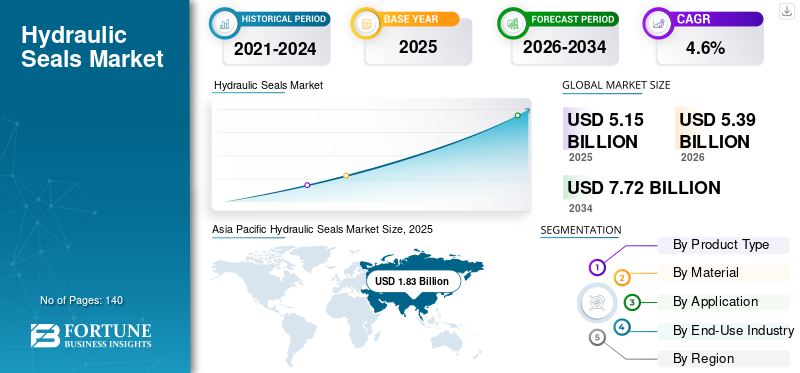
The global hydraulic seals market size was valued at USD 5.15 billion in 2025. The market is projected to grow from USD 5.39 billion in 2026 to USD 7.72 billion by 2034, exhibiting a CAGR of 4.6% during the forecast period. Asia Pacific dominated the hydraulic seals market with a market share of 35.53% in 2025.
The market comprises the manufacturing and commercial sale of industrial sealing solutions designed to prevent hydraulic-fluid leakage, maintain pressure, minimize contamination ingress, and support the efficient operation of hydraulic equipment. These seals create controlled barriers between moving and stationary components within hydraulic cylinders, pumps, motors, valves, actuators, and other fluid power systems. Hydraulic cylinder seals help reduce internal and external leakage, maintain equipment accuracy, limit friction and wear, protect critical hydraulic equipment components, improve energy efficiency, and extend machinery service life under varying pressure, temperature, speed, fluid, and operating conditions. Rising construction-equipment production, expansion of industrial manufacturing, agricultural mechanization, mining activity, material-handling demand, aging hydraulic machinery, and replacement of worn heavy machinery components are supporting global market growth. Increasing adoption of advanced polyurethane seals, low-friction PTFE materials, high-pressure seal profiles, temperature-resistant elastomers, multi-lip sealing designs, enhanced wiper seals, self-lubricating materials, and simulation-based seal engineering is enabling equipment manufacturers to improve pressure retention, strengthen leak prevention systems, reduce frictional losses, extend maintenance intervals, and enhance system reliability.
- For instance, in February 2025, Trelleborg Sealing Solutions announced the acquisition of Aero-Plastics Inc., strengthening its capabilities in high-performance polymer materials, precision molding, machining, and engineered sealing-related solutions for demanding aerospace applications.
Trelleborg AB, Parker-Hannifin Corporation, Freudenberg Sealing Technologies GmbH & Co. KG, SKF Group, NOK Corporation, Hallite Seals International Limited, and Kastaş Sealing Technologies A.Ş. are among the major companies operating in the market.
Download Free sample to learn more about this report.
HYDRAULIC SEALS MARKET TRENDS
Growing Adoption of Advanced Material Compounds and Low-Friction Seal Designs is Accelerating Market Expansion
Demand for hydraulic seals is increasingly influenced by the transition from conventional elastomer seals toward advanced, application-specific sealing materials and optimized profile designs. Hydraulic-equipment manufacturers are adopting high-performance polyurethane compounds, low-friction PTFE materials, fluorocarbon elastomers, composite seals, multi-lip profiles, and self-lubricating sealing solutions across cylinders, pumps, motors, valves, and actuators. Unlike standard sealing products, advanced hydraulic seals are engineered according to system pressure, operating temperature, fluid compatibility, surface speed, contamination exposure, and equipment duty cycle. This helps reduce internal and external leakage, lower frictional losses, improve pressure retention, minimize stick-slip behavior, and extend seal and equipment service life. The trend is particularly prominent in construction machinery, mining equipment, agricultural machinery, industrial presses, material-handling systems, and other applications operating under high pressure, abrasive conditions, and frequent load variations. Integration of finite element analysis, digital simulation, automated profile machining, advanced surface treatments, and predictive condition-monitoring technologies is also enabling early identification of seal wear, fluid leakage, pressure loss, and cylinder-performance deterioration.
For instance, in May 2026, Freudenberg Flow Technologies acquired Balmoral Comtec, strengthening its Connectors and Sealing Solutions business and expanding its engineered sealing capabilities across offshore oil & gas and renewable energy applications.
MARKET DYNAMICS
MARKET DRIVERS
Download Free sample to learn more about this report.
Rising Hydraulic Equipment Production and Expanding Installed Machinery Base is Driving Market Growth
The hydraulic seals market growth is increasingly being driven by sustained production of hydraulic equipment and the continued expansion of the global installed machinery base. Construction equipment, agricultural machinery, mining systems, industrial presses, material-handling equipment, automotive systems, marine machinery, and oil & gas equipment require reliable hydraulic seals to maintain pressure, prevent fluid leakage, reduce contamination ingress, and support efficient operation under varying loads and environmental conditions. Each newly produced hydraulic cylinder, pump, motor, valve, and actuator creates demand for rod seals, piston seals, wiper seals, buffer seals, O-rings, backup rings, guide rings, wear rings, and complete sealing kits through original equipment manufacturer channels. At the same time, the growing number and increasing average age of hydraulic machines in operation are supporting replacement demand for seals exposed to abrasion, pressure fluctuations, fluid contamination, temperature variation, misalignment, and repeated operating cycles. Construction, mining, and heavy industrial equipment generate particularly strong value demand owing to their high operating pressures, intensive duty cycles, harsh environments, and greater use of engineered sealing systems.
- For instance, in April 2025, Hallite Seals International introduced its Armorlene 505 material for demanding hydraulic sealing applications, offering enhanced wear resistance, extrusion resistance, and performance under high-pressure operating conditions.
MARKET RESTRAINTS
Extended Seal Life, OEM Pricing Pressure, and Low-Cost Product Competition is Restricting Market Growth
The growth of the market is constrained by improvements in hydraulic-seal durability, extended maintenance intervals, and the increasing adoption of advanced materials that reduce replacement frequency. High-performance polyurethane, PTFE, fluorocarbon elastomers, composite profiles, and improved surface treatments enable seals to operate for longer periods under high pressure, elevated temperature, and abrasive conditions. Although these technologies increase product value, they can reduce annual replacement volumes across mature equipment fleets. Market participants also face persistent pricing pressure from hydraulic-equipment manufacturers seeking lower component costs, localized sourcing, longer warranties, standardized dimensions, and reduced supplier numbers. The aftermarket is further affected by intense competition from low-cost and unbranded seals that may not consistently meet required dimensional tolerances, material specifications, or service-life expectations. In addition, fragmented demand across numerous seal sizes, profiles, materials, and equipment models increases inventory complexity and limits economies of scale.
|
Rank |
Market Restraints |
Overall Impact Rank |
Negative CAGR Contribution (2026–2034) |
Impact 2026–2028 |
Impact 2029–2031 |
Impact 2032–2034 |
|
1 |
Extended Seal Life, OEM Pricing Pressure, and Low-Cost Product Competition Restricting Market Growth |
High |
-0.85% |
Medium |
High |
High |
|
2 |
Extended maintenance intervals reducing replacement frequency |
Medium-High |
-0.650% |
High |
High |
Medium |
|
3 |
Fragmented seal specifications, material-compatibility requirements, and high inventory complexity |
Medium |
-0.35% |
High |
Medium |
Medium |
|
4 |
Others, including raw-material price volatility, hydraulic-equipment cyclicality, installation errors, fluid contamination, and supply-chain disruptions |
Low |
-0.150% |
Medium |
Low |
Low |
|
|
Total Negative Growth Impact |
|
-2.00% |
|
|
|
MARKET OPPORTUNITIES
Growing Demand for High-Performance Seals in Harsh Operating Environments is Creating Significant Market Opportunities
A major opportunity emerging within the market is the increasing requirement for high-performance hydraulic seals capable of operating under elevated pressure, extreme temperature, abrasive contamination, rapid reciprocating movement, and chemically aggressive hydraulic fluids. Construction equipment, mining machinery, agricultural systems, offshore equipment, industrial presses, and heavy material-handling machinery are increasingly designed for higher productivity, greater load capacity, and longer operating hours, raising the technical requirements placed on sealing components. Conventional elastomer seals may experience extrusion, abrasion, compression set, fluid degradation, and premature leakage under these demanding conditions. This is creating opportunities for manufacturers to develop advanced polyurethane compounds, PTFE-based sealing materials, fluorocarbon elastomers, reinforced composite profiles, multi-lip seals, and integrated sealing arrangements combining rod seals, piston seals, buffer seals, wipers, and guide elements.
- For instance, in September 2025, Hallite Seals completed the acquisition of Aston Seals, expanding its European manufacturing presence and strengthening its portfolio of hydraulic, pneumatic, and custom-engineered sealing solutions.
MARKET CHALLENGES
Fragmented Product Specifications and Application-Specific Engineering is Increasing Market Complexity
One of the major challenges affecting the market is the highly fragmented nature of hydraulic seal specifications across equipment types, operating conditions, and end-use industries. Hydraulic cylinders, pumps, motors, valves, actuators, presses, and mobile machinery require different seal diameters, profiles, tolerances, material formulations, pressure ratings, and fluid-compatibility characteristics. Even minor variations in rod finish, groove geometry, installation space, operating speed, temperature, or contamination exposure can significantly influence seal performance. Manufacturers must therefore maintain extensive product catalogs, specialized tooling, technical databases, and engineering support to serve a broad range of OEM and aftermarket requirements. This complexity increases development time, inventory requirements, production-changeover frequency, and the risk of supplying an unsuitable seal for a specific application.
Segmentation Analysis
By Product Type
Rod Seals Segment Led Market Owing to Critical Leakage-Control Function and Broad Hydraulic Cylinder Adoption
By product type, the market is segmented into rod seals, piston seals, wiper seals, buffer seals, O-rings and backup rings, guide rings and wear rings, and others.
Rod seals segment held the largest market share in 2025, driven by their critical role in preventing hydraulic fluid from escaping along the cylinder rod while maintaining system pressure during reciprocating movement. Their ability to withstand high pressure, repeated movement, side loading, temperature variation, and fluid exposure supports widespread adoption across both mobile and industrial hydraulic systems. Rod seals are also commonly integrated with buffer seals, wiper seals, guide rings, and backup elements to improve sealing reliability, reduce extrusion risk, protect rod surfaces, and extend cylinder service life.
- For instance, in July 2025, Kastaş Sealing Technologies introduced its KKB Guiding Tape, describing it as “a composite solution for demanding hydraulic applications” focused on reliability, durability, and precision in hydraulic systems.
Wiper seals segment is expected to register the highest CAGR of 5.1% during the forecast period, supported by growing demand for contamination-control solutions in hydraulic cylinders operating in dusty, muddy, abrasive, and moisture-intensive environments. These seals remove dirt, debris, water, and other contaminants from the retracting piston rod before they enter the hydraulic system.
To know how our report can help streamline your business, Speak to Analyst
By Material
Polyurethane Segment Led Market Owing to High Wear Resistance and Broad Hydraulic Equipment Adoption
By material, the market is segmented into polyurethane, nitrile butadiene rubber, polytetrafluoroethylene, fluorocarbon elastomer, and others.
The polyurethane segment held the largest hydraulic seals market share in 2025, driven by its extensive adoption in standard and heavy-duty hydraulic sealing applications requiring a balance of durability, flexibility, and cost efficiency. Polyurethane seals provide high abrasion resistance, excellent extrusion resistance, good load-bearing capability, and dimensional stability, making them suitable for dynamic sealing applications involving repeated movement and pressure fluctuations. The material is widely used in rod seals, piston seals, wiper seals, and buffer seals across mobile hydraulic equipment, industrial machinery, and fluid-power systems. Increasing preference for longer-lasting sealing materials that reduce maintenance frequency while maintaining competitive component costs is strengthening polyurethane adoption across OEM and aftermarket channels.
Polytetrafluoroethylene segment is expected to witness the highest growth, with a CAGR of 5.9% during the forecast period, driven by increasing demand for low-friction, chemically resistant, and temperature-stable sealing materials in advanced hydraulic systems. PTFE-based seals reduce stick-slip behavior, support higher surface speeds, and maintain reliable performance across wide temperature ranges and aggressive fluid environments.
By Application
Hydraulic Cylinders Segment Led Market Owing to Extensive Use Across Mobile and Industrial Equipment
By application, the market is segmented into hydraulic cylinders, hydraulic pumps and motors, hydraulic valves, and others.
The hydraulic cylinders segment held the largest market share in 2025, driven by their widespread deployment as primary actuators in mobile and industrial machinery. Hydraulic cylinders require multiple sealing elements, including rod seals, piston seals, wiper seals, buffer seals, guide rings, and wear rings, to maintain controlled linear movement and force transmission. Extensive usage across excavators, loaders, agricultural machinery, industrial presses, cranes, and material-handling equipment supports consistent demand for hydraulic sealing products. Growth is further supported by increasing adoption of high-performance cylinders designed for improved load capacity, compact designs, faster operation, and enhanced reliability in demanding working environments.
Hydraulic pumps and motors segment is expected to witness a significant CAGR of 4.4% during the forecast period, driven by growing demand for efficient fluid-power transmission across industrial machinery, mobile equipment, renewable energy systems, marine equipment, and material-handling applications.
By End-Use Industry
Construction Segment Led Market Owing to Extensive Hydraulic Equipment Deployment and High Seal Replacement Demand
By end-use industry, the market is segmented into construction, agriculture, mining, manufacturing, automotive and transportation, aerospace and defense, oil and gas, marine, and others.
The construction segment held the largest market share in 2025, driven by extensive hydraulic equipment deployment in excavators, loaders, cranes, bulldozers, compactors, and concrete machinery. Construction equipment operates under severe field conditions, including heavy loads, dust exposure, vibration, uneven surfaces, and extended operating cycles, creating continuous demand for reliable hydraulic sealing solutions. Infrastructure expansion, urban development, road construction, and equipment fleet modernization are increasing hydraulic machinery utilization and supporting replacement demand for sealing components.
Aerospace and defense segment is expected to witness the highest growth rate, with a CAGR of 5.3% during the forecast period, driven by increasing aircraft production, defense modernization, maintenance activity, and demand for high-performance hydraulic systems.
Hydraulic Seals Market Regional Outlook
By geography, the market is categorized into Europe, North America, Asia Pacific, South America, and the Middle East & Africa.
Asia Pacific
Asia Pacific Hydraulic Seals Market Size, 2025 (USD Billion)
To get more information on the regional analysis of this market, Download Free sample
Asia Pacific market will continue to dominate and accounted for USD 1.83 billion in 2025 globally, supported by large construction-equipment production, expanding industrial activity, agricultural mechanization, mining operations, and extensive hydraulic-component supply chains. China represents the largest regional market owing to strong production of excavators, loaders, cranes, industrial machinery, hydraulic cylinders, and agricultural equipment, along with a broad aftermarket network. Japan and South Korea remain important value-intensive markets, supported by advanced manufacturing, automotive production, robotics, aerospace activity, and demand for high-performance polyurethane and PTFE seals.
China Hydraulic Seals Market
China’s market is projected to remain the dominant in the Asia Pacific region, with 2026 revenues estimated at around USD 0.81 billion, representing roughly 15.0% of global sales.
Japan Hydraulic Seals Market
The Japanese market is estimated at around USD 0.27 billion in 2026, accounting for roughly 5.0% of the global sales.
India Hydraulic Seals Market
The Indian market is estimated at around USD 0.32 billion in 2026, accounting for roughly 5.9% of global sales.
North America
The North American market accounted for USD 1.23 billion in revenue in 2025, supported by strong demand from construction, mining, agriculture, industrial automation, aerospace, and oil & gas sectors. The region benefits from a mature fluid-power ecosystem, presence of leading hydraulic equipment manufacturers, advanced sealing-material suppliers, and established distribution channels across the U.S., Canada, and Mexico. The U.S. represents the largest regional contributor due to extensive construction activity, high adoption of mobile hydraulic machinery, large-scale manufacturing operations, and continued investment in automation and infrastructure projects.
U.S. Hydraulic Seals Market
The U.S. is expected to dominate the market with an estimated revenue of about USD 0.89 billion in 2026, supported by its advanced industrial base, strong presence of hydraulic-equipment manufacturers, and high adoption of automation and precision-engineered machinery. The country remains a major market for hydraulic sealing solutions across aerospace, defense, manufacturing, construction, agriculture, energy, and material-handling applications. Demand is further supported by investments in industrial modernization, infrastructure development, mining activities, and replacement of aging machinery fleets. The U.S. market also benefits from established sealing-material suppliers, application engineering capabilities, extensive distributor networks, and increasing adoption of advanced polyurethane, PTFE, and composite sealing technologies for high-performance hydraulic systems.
Europe
The Europe market is expected to witness steady growth during the forecast period, supported by industrial machinery production, construction-equipment demand, manufacturing automation, agricultural mechanization, aerospace activity, and replacement of aging hydraulic sealing components. Demand is closely linked to Germany’s industrial and machinery manufacturing base, the U.K.’s aerospace and mobile-equipment industries, France and Italy’s automotive and manufacturing sectors, Spain’s industrial equipment activity, and the advanced engineering capabilities of the Nordic and BENELUX markets. Europe remains a technology-intensive market for low-friction PTFE seals, advanced polyurethane compounds, fluorocarbon elastomers, composite sealing profiles, precision-machined seals, and contamination-control wipers.
U.K. Hydraulic Seals Market
The U.K. market is estimated at around USD 0.16 billion in 2026, representing roughly 3.0% of global sales.
Germany Hydraulic Seals Market
Germany’s market is projected to reach approximately USD 0.28 billion in 2026, equivalent to around 5.1% of global sales.
Middle East & Africa
The Middle East & Africa market is supported by infrastructure development, oil and gas activity, mining operations, construction-equipment deployment, industrial expansion, and growing use of hydraulic machinery. GCC countries remain key contributors due to strong demand for cranes, loaders, drilling equipment, material-handling systems, and heavy-duty mobile machinery. South Africa benefits from established mining, manufacturing, automotive, and aftermarket networks, while North Africa is supported by construction activity, industrial investment, and equipment modernization. Harsh operating conditions, including heat, dust, abrasive contamination, and intensive duty cycles, increase demand for durable rod seals, piston seals, wiper seals, buffer seals, O-rings, guide rings, and complete hydraulic sealing kits.
GCC Hydraulic Seals Market
The GCC market is projected to reach around USD 0.11 billion in 2026, representing roughly 2.1% of the global sales.
South America
South America’s market is supported by infrastructure development, mining activity, agricultural mechanization, construction-equipment deployment, manufacturing growth, and recurring replacement of worn sealing components. Demand is concentrated across excavators, loaders, tractors, mining machinery, industrial presses, material-handling equipment, and commercial vehicles operating under high temperatures, dust exposure, heavy loads, and demanding field conditions. Brazil leads the regional market due to its large construction, agriculture, mining, automotive, and industrial machinery base, established hydraulic-component ecosystem, and broad aftermarket network. Argentina and other regional economies contribute through equipment modernization, industrial investment, and replacement demand for rod seals, piston seals, wiper seals, buffer seals, O-rings, backup rings, guide rings, and complete hydraulic sealing kits.
Brazil Hydraulic Seals Market
The Brazilian market is projected to reach around USD 0.18 billion in 2026, representing roughly 3.3% of the global sales.
COMPETITIVE LANDSCAPE
Key Industry Players
Key Players to Focus on Product Breadth, Material Expertise, and OEM Relationships to Expand Market Share
The hydraulic seals market is moderately fragmented, with competitive positioning shaped by product portfolio breadth, material capabilities, hydraulic-equipment coverage, manufacturing capacity, regional presence, OEM relationships, aftermarket distribution, and sealing reliability. Leading companies, including Trelleborg AB, Parker-Hannifin Corporation, Freudenberg Sealing Technologies GmbH & Co. KG, SKF Group, and NOK Corporation, maintain strong positions through established portfolios of rod seals, piston seals, wiper seals, buffer seals, O-rings, backup rings, guide rings, wear rings, and customized hydraulic sealing systems.
Competitive differentiation is increasingly influenced by the ability to provide high-pressure, low-friction, wear-resistant, temperature-stable, and application-specific sealing solutions while meeting strict leakage, durability, dimensional, fluid-compatibility, and cost requirements. Companies are investing in advanced polyurethane compounds, reinforced PTFE materials, fluorocarbon elastomers, composite seal profiles, self-lubricating materials, finite element analysis, precision machining, and predictive leakage-monitoring technologies. Strong localized manufacturing, application engineering, rapid customization, supply-chain resilience, and aftermarket product availability also remain important competitive factors.
- For instance, in May 2026, Parker-Hannifin Corporation announced an agreement to acquire CIRCOR International’s aerospace business, expanding its motion-and-control portfolio across commercial aviation, defense, missile, and naval applications that require high-performance fluid-control and sealing technologies.
LIST OF KEY HYDRAULIC SEALS COMPANIES PROFILED IN REPORT
- Trelleborg AB (Sweden)
- Parker-Hannifin Corporation (U.S.)
- Freudenberg Sealing Technologies GmbH & Co. KG (Germany)
- SKF Group (Sweden)
- NOK Corporation (Japan)
- Hallite Seals International Limited (U.K.)
- Kastaş Sealing Technologies A.Ş. (Türkiye)
- James Walker Group Limited (U.K.)
- Hutchinson SA (France)
- W. Chesterton Company (U.S.)
KEY INDUSTRY DEVELOPMENTS
- April 2026: Trelleborg Sealing Solutions broke ground on an expanded manufacturing facility in Bengaluru, India, designed to increase production capacity by 30% and integrate manufacturing, R&D, testing, application engineering, and customer-support capabilities.
- February 2026: Parker-Hannifin Corporation announced the expansion of its engineered materials and motion-control capabilities through investments supporting advanced sealing, fluid-power, and aerospace applications.
- October 2025: Kastaş Sealing Technologies achieved AS9100 Aerospace Quality Management System certification, strengthening its quality, traceability, and risk-management capabilities for high-performance aerospace sealing applications.
- September 2025: Freudenberg Sealing Technologies expanded its advanced sealing-material and application-development activities for industrial, mobile machinery, and demanding fluid-power environments.
- July 2025: Hallite Seals International expanded its hydraulic sealing portfolio with engineered solutions designed for high-pressure cylinders, heavy-duty equipment, and contamination-intensive operating conditions.
REPORT COVERAGE
The global hydraulic seals market analysis includes a comprehensive assessment of market size and forecasts across all segments covered in the report. It provides detailed insights into the market dynamics, trends, opportunities, restraints, and challenges expected to influence growth during the forecast period. The study examines technology investments, partnerships, contracts, mergers and acquisitions, and key industry developments. The report also provides an in-depth competitive landscape, including market shares and profiles of major operating players.
Request for Customization to gain extensive market insights.
Report Scope & Segmentation
| ATTRIBUTE | DETAILS |
| Study Period | 2021-2034 |
| Base Year | 2025 |
| Estimated Year | 2026 |
| Forecast Period | 2026-2034 |
| Historical Period | 2021-2024 |
| Growth Rate | CAGR of 4.6% from 2026-2034 |
| Unit | Value (USD Billion) |
| Segmentation | By Product Type, Material, Application, End-Use Industry, and Region |
| By Product Type |
|
| By Material |
|
| By Application |
|
| By End-Use Industry |
|
| By Region |
|
Frequently Asked Questions
According to Fortune Business Insights, the global market value is expected to stand at USD 5.39 billion in 2026 and is projected to reach USD 7.72 billion by 2034.
In 2025, the Asia Pacific’s market value stood at USD 1.83 billion.
The market is expected to exhibit a CAGR of 4.6% during the forecast period (2026-2034).
By end-use industry, the construction segment led the market.
Rising hydraulic-equipment production, infrastructure development, industrial automation, agricultural mechanization, mining activity, and recurring seal replacement drives market growth.
Trelleborg AB, Parker-Hannifin Corporation, Freudenberg Sealing Technologies GmbH & Co. KG, SKF Group, and NOK Corporation are the top players in the market.
Asia Pacific held the largest market share in 2025.


- 2021-2034
- 2025
- 2021-2024
- 140
Get 30-60 hrs Free Customization
Expand Regional and Country Coverage, Segments Analysis, Company Profiles, Competitive Benchmarking, and End-user Insights.








-
US +1 833 909 2966 ( Toll Free )
-
Get In Touch With Us