3D Printing Medical Devices Market Size, Share & Industry Analysis By Product Type (Patient Specific Implants, Prosthetics & Orthotics, Dental Devices, Anatomical Models, Hearing Devices, Surgical Guides, and Others), By Technology (Vat Photopolymerization, Polymer Powder Bed Fusion, Metal Powder Bed Fusion, Material Jetting, and Others), By Material (Metal, Polymers, Photopolymers/Resins, Ceramics, and Others), By End User (Hospitals & ASCs, Orthotic & Prosthetic Clinics, Dental Labs & Clinics, and Others), and Regional Forecast, 2026-2034
 Download Free Sample
3D Printing Medical Devices Market Size and Future Outlook
 Listen to Audio Version
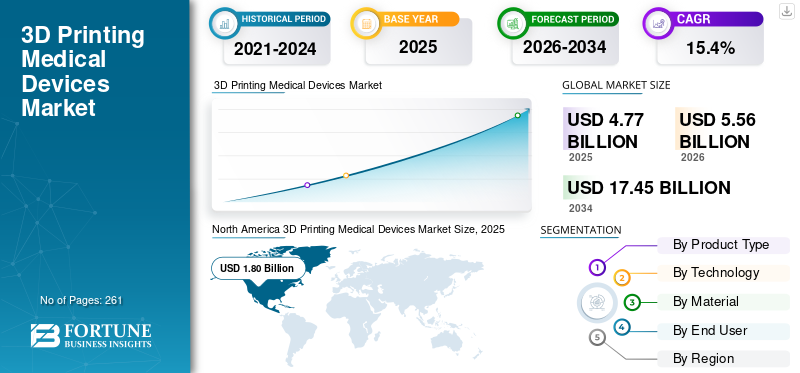
The global 3D printing medical devices market size was valued at USD 4.77 billion in 2025 and is projected to grow from USD 5.56 billion in 2026 to USD 17.45 billion by 2034, exhibiting a CAGR of 15.4% during the forecast period. North America dominated the 3D printing medical devices market with a market share of 37.73% in 2025.
3D printing medical devices are three-dimensional physical devices created layer-by-layer from a digital model. This technology is widely used to manufacture customized medical devices, patient-matched surgical instruments, anatomical models for preoperative planning, and external prosthetics. The increasing prevalence of chronic diseases, expansion of healthcare infrastructure, advancements in additive manufacturing technologies, and rising adoption of personalized healthcare are resulting in an increasing penetration of these products in the market. The growing adoption of 3D printing in dental applications is further boosting the demand for these devices, thereby fueling market growth.
- For instance, according to the 2025 data published by the National Cancer Institute (NCI), about 18.6 million people were affected by cancer in the U.S.
The rising integration of digital tools among the major companies, including Materialise and 3D Systems, Inc., is further contributing to the demand for these devices in the market.
Download Free sample to learn more about this report.
3D Printing Medical Devices Market Key Takeaways
 Global Market Size & Forecast
- 2025 Market Size: USD 4.77 billion
- 2026 Market Size: USD 5.56 billion
- 2034 Forecast Market Size: USD 17.45 billion
- CAGR: 15.4% from 2026–2034
 Market Share
- North America dominated the 3D printing medical devices market with a 37.73% share in 2025.
- The prosthetics & orthotics segment is expected to grow at a CAGR of 14.6% during the forecast period.
- The polymer powder bed fusion segment is projected to grow at a CAGR of 15.0% during the forecast period.
 Key Regional Highlights
North America
North America maintained its leading position, reaching USD 1.80 billion in 2025.
Europe
Europe is projected to reach USD 1.48 billion in 2026, growing at a 13.3% CAGR during the forecast period.
Asia Pacific
Asia Pacific is expected to reach USD 1.51 billion in 2026, ranking as the third-largest regional market.
U.S.
The market is projected to reach USD 1.83 billion in 2026, accounting for approximately 33.0% of global sales.
Japan
The market is estimated to reach USD 0.29 billion in 2026, representing around 5.2% of global revenue.
Read More

3D Printing Medical Devices Market Trends
Integration of AI and CAD/CAM Technologies to Bolster Industry Expansion
Healthcare professionals are increasingly shifting toward digital and image-based production solutions where patient data from CT, CBCT, MRI, or intraoral scans is converted into digital 3D models. These digital models are further refined using CAD software, optimized through artificial intelligence or automated design tools, and then created using 3D printing. 3D printing is gaining widespread importance in orthopedic implants, dental devices, cranio-maxillofacial implants, anatomical models, surgical guides, and prosthetics.
Additionally, artificial intelligence and automation also reduce manual design time, improve accuracy, and provide scalable customization. In dentistry, CAD/CAM systems enable dental laboratories and clinicians to design aligners, bridges, crowns, implant guides, and dental models from digital scans. Therefore, the growing incorporation of digital tools and artificial intelligence is augmenting the demand for these devices in the market.
- For instance, in June 2024, 3D Systems, Inc., announced its expanded focus and technology roadmap tailored to deliver a broad range of solutions. The portfolio includes solutions for alignment, protection, repair, and replacement of teeth.
Other Trends
- Development of Biocompatible 3D Printing Materials
Market Dynamics
Market Drivers
Download Free sample to learn more about this report.
Increasing Prevalence of Chronic Disorders to Fuel Market Growth
The increasing prevalence of chronic conditions, including cardiovascular disorders and musculoskeletal conditions, is resulting in a growing number of patient admissions, consequently driving the demand for the product in the market.
- For instance, according to 2022 data published by the World Health Organization (WHO), it was reported that about 1.71 billion people were living with musculoskeletal conditions in the U.S.
This, along with growing acquisitions and mergers among key companies, expansion of healthcare infrastructure, increasing demand for personalized solutions, and growing adoption of additive manufacturing in healthcare, is further driving the adoption of these devices in the market. The rising focus of key companies on R&D activities to introduce novel devices is anticipated to drive the adoption of these products, thereby supporting the global 3D printing medical devices market growth.
Market Restraints
High Cost of Medical-grade Printers and Post-Processing Equipment to Hamper Market Growth
The high cost of medical-grade 3D printers, certified materials, and post-processing equipment acts as a key restraint in the market. 3D printing medical devices supports sterilizable parts, biocompatible materials, reproducible accuracy, validated procedures, and regulatory documentation, which increases the overall ownership cost for dental laboratories, hospitals, orthopedic implant manufacturers, and contract manufacturers.
Additionally, implantable and customized devices require companies to invest in industrial-grade metal, qualified operators, dedicated facilities, quality management systems, validated software, and other resources, which further make the adoption challenging for small and mid-size healthcare settings, especially in emerging countries.
- For instance, according to 2025 data published by Matrix Technology Co., Ltd., a metal 3D printer can cost anywhere from less than USD 5,000.0 for a basic metal-filament setup to more than USD 1.0 million for a full industrial production system.
Market Opportunities
Expansion of Healthcare Facilities in Developing Countries to Spur Market Growth
There is an ongoing expansion of healthcare facilities in developing countries, including Brazil, Mexico, and others. The rising prevalence of chronic conditions, expansion of healthcare infrastructure, and growing number of dental labs and clinics are consequently increasing the adoption of 3D printing medical devices in healthcare facilities. The technology provides digital design and additive manufacturing to produce personalized medical devices closer to the point of care, which is further contributing to the growing demand and driving a growing focus among key companies on incorporating advancements into these devices.
- According to 2020 data published by the National Center for Biotechnology Information (NCBI), it was reported that there were about 3,943 dental laboratories in China.
Market Challenges
Limited Healthcare Access in Emerging Countries to Hinder Market Growth
There is a growing demand for 3D printing medical devices among the patient population. However, limited access to advanced technologies, limited healthcare expenditure, regulatory approval complexities, and inadequate reimbursement policies, particularly in developing nations, are resulting in limited access to clinical facilities, including dental labs and hospitals, among the patient population.
Moreover, a limited number of clinical facilities and shortages of skilled professionals are among the key factors limiting the adoption of these devices, especially in emerging nations, including China and Brazil.
- For instance, according to 2023 data published by The World Bank Group, approximately 4.5 billion people lack full access to essential health services worldwide.
Other Prominent Trends
- Quality Control and Manufacturing Standardization Issues
SEGMENTATION ANALYSIS
By Product Type
Increasing Prevalence of Chronic Conditions Boosted the Segment Growth
Based on product type, the market is classified into patient specific implants, prosthetics & orthotics, dental devices, anatomical models, hearing devices, surgical guides, and others.
In terms of revenue, the patient specific implants segment dominated the market in 2025, due to the increasing prevalence of chronic conditions among the patient population, resulting in a growing adoption of 3D printing devices globally. This, along with the rising focus of key companies on launching novel devices, is anticipated to contribute to the segment’s growth.
- For instance, in May 2026, Sir Ganga Ram Hospital used a patient-specific 3D-printed hip implant to restore mobility in a complex reconstruction case in India.
To know how our report can help streamline your business, Speak to Analyst
The prosthetics & orthotics segment is expected to grow at a CAGR of 14.6% over the forecast period.
By Technology
Vat Photopolymerization Segment Led the Market due to its Ability to Offer a Smooth Surface Finish
Based on technology, the market is segmented into vat photopolymerization, polymer powder bed fusion, metal powder bed fusion, material jetting, and others.
The vat photopolymerization segment dominated the global market in 2025, holding a share of 36.5% in 2025. The growth is due to the increasing advantages offered by this technique, including exceptional detail & resolution and smooth surface finish, resulting in rising demand for the product, thereby contributing to the segmental growth.
- For instance, according to 2024 statistics published by MDPI, vat photopolymerization (VP) is the most commonly used technological principle in dental practice and includes SLA, DLP, and LCD (or mSLA) technologies.
The polymer powder bed fusion segment is set to flourish with a growth rate of 15.0% during the forecast period.
By Material
Growing Prevalence of Dental Disorders Led to the Dominance of the Segment
Based on material, the market is segmented into metal, polymers, photopolymers/resins, ceramics, and others.
The photopolymers/resins segment dominated the global market in 2025, registering a share of 23.8% in 2025. The growth is attributed to the increasing prevalence of chronic conditions, including dental disorders, resulting in a growing adoption of 3D printing devices worldwide, thereby contributing to the segment’s growth. 3D-printed photopolymer resin materials are used across multiple dental specialties, including orthodontics, prosthodontics, pediatric dentistry, maxillofacial surgery, endodontics, periodontology, and conservative dentistry.
- For instance, according to the 2025 statistics published by the World Health Organization (WHO), 3.7 billion people were affected by oral diseases.
The segment of metal is set to flourish with a growth rate of 16.0% during the forecast period.
By End-user
Increasing Number of Patient Admissions Boosted Hospitals & ASCs Segment Growth
Based on end user, the market is fragmented into hospitals & ASCs, orthotic & prosthetic clinics, dental labs & clinics, and others.
The hospitals & ASCs segment dominated the market in 2025. The growing number of patient admissions in hospitals and the increasing number of hospitals and ambulatory surgical centers are some of the key factors contributing to the growth of the segment. Furthermore, the segment is set to hold a 37.8% share in 2026.
- For instance, according to 2025 data published by Statistisches Bundesamt, there were about 1,874 hospitals in Germany.
The orthotic & prosthetic clinics segment is projected to grow at a CAGR of 14.5% during the forecast period.
3D Printing Medical Devices Market Regional Outlook
Based on region, the market has been studied across North America, Europe, Asia Pacific, Latin America, and the Middle East & Africa.
North America
North America 3D Printing Medical Devices Market Size, 2025 (USD Billion)
To get more information on the regional analysis of this market, Download Free sample
The North America market held the dominant 3D printing medical devices market share in 2024, valued at USD 1.55 billion, and also maintained its leading share in 2025 with USD 1.80 billion. The rising prevalence of chronic disorders, advanced hospital infrastructure, and growing technological advancements in these devices are some of the key factors contributing to the growth of the region in the market.
- For instance, according to 2026 data published by the American Cancer Society (ACS), about 4,110 new cases of bone cancer are diagnosed in the U.S.
U.S. 3D Printing Medical Devices Market
Based on North America’s strong contribution and the U.S. dominance within the region, the U.S. market is expected to reach around USD 1.83 billion in 2026, accounting for roughly 33.0% of global sales.
Europe
Europe is projected to record a growth rate of 13.3% during the forecast period, which is the second-highest among all regions. The market is expected to reach a valuation of USD 1.48 billion in 2026. The rising prevalence of chronic conditions and R&D activities is likely to support market growth.
U.K. 3D Printing Medical Devices Market
The U.K. market is estimated to reach around USD 0.27 billion in 2026, representing roughly 4.8% of global revenues.
Germany 3D Printing Medical Devices Market
Germany’s market is projected to reach approximately USD 0.31 billion in 2026, equivalent to around 5.5% of global sales.
Asia Pacific
Asia Pacific is estimated to reach USD 1.51 billion in 2026 and secure the position of the third-largest region in the market. The growing adoption of 3D printing in healthcare and rising healthcare access are likely to support the growth of the market. In the region, India and China are both estimated to reach USD 0.20 billion and USD 0.46 billion, respectively, in 2026.
Japan 3D Printing Medical Devices Market
The Japanese market in 2026 is estimated to reach around USD 0.29 billion, accounting for roughly 5.2% of global revenues. Japan has historically reported a relatively high prevalence of chronic diseases, along with increasing innovations in 3D printing technologies.
China 3D Printing Medical Devices Market
China’s market is projected to be one of the largest worldwide, with 2026 revenues standing at around USD 0.46 billion, representing roughly 8.3% of global sales.
India 3D Printing Medical Devices Market
The Indian market is estimated to reach around USD 0.20 billion in 2026, accounting for roughly 3.6% of global revenues.
Latin America and Middle East & Africa
The Latin America and Middle East & Africa regions are expected to witness moderate growth in this market during the forecast period. The Latin American market is set to reach a valuation of USD 0.28 billion in 2026. The growth is due to improving digital fabrication technologies and the growing adoption of 3D printed medical devices in the region. The Middle East & Africa region is also expected to witness considerable growth due to rising R&D activities aimed at introducing novel devices, including cranial implants, thereby contributing to the growing demand for the 3D printing medical devices industry. In the Middle East & Africa, the GCC is set to reach USD 0.11 billion in 2026.
South Africa 3D Printing Medical Devices Market
The South African market is projected to reach around USD 0.04 billion in 2026, representing roughly 0.7% of global revenues.
Competitive Landscape
Key Industry Players
Key Players Focus on Launching Novel Platforms to Boost Their Market Position
A broad product portfolio, along with a strong focus on strategic initiatives worldwide, is one of the major factors contributing to the dominance of leading companies in the market. Materialise and 3D Systems, Inc., were among the major companies in the market in 2025. Moreover, the growing focus of key companies on launching innovative platforms and solutions is likely to strengthen companies’ market presence.
- For instance, in December 2024, Materialise, a global company in medical 3D printing and planning solutions, launched its fully integrated Materialise Mimics platform for enhanced efficiencies in advanced 3D planning and personalized device creation, providing accessible patient care for medical device companies and hospitals globally.
Other key players, including EOS GmbH and others, are also expanding their presence in the market, primarily due to their increasing emphasis on collaborations among other companies to strengthen their brand presence.
List of Key 3D Printing Medical Devices Companies Profiled
- 3D Systems, Inc. (U.S.)
- Materialise (Belgium)
- Stratasys (Israel)
- Stryker (U.S.)
- Johnson & Johnson Services, Inc. (U.S.)
- Medtronic (Ireland)
- Zimmer Biomet (U.S.)
- EOS GmbH (Germany)
- Smith+Nephew (U.K.)
- Renishaw plc (U.K.)
KEY INDUSTRY DEVELOPMENTS
- May 2026: Open Bionics fitted a full-length, 3D printed bionic arm for an above-elbow amputees in a patient in the U.K. This initiative helped the company strengthen its brand presence.
- May 2026: 3D Systems Inc. announced that ROE Dental Laboratory, one of the nation’s premier full-service dental labs, purchased additional NextDent 300 3D printers to expand its digital denture manufacturing capacity.
- March 2026: 3D Systems Inc. received full-scope certification under the European Union Medical Device Regulation (EU MDR) 2017/745.
- February 2026: Stratasys received CE marking as a Class IIa medical device for TrueDent resins, with an aim to strengthen its brand presence.
- March 2025: Materialise, a company in medical 3D printing and planning solutions, and the University of Michigan’s Michigan Medicine and University of Michigan Health, initiated a U.S. FDA pivotal clinical trial involving Materialise’s innovative, bioresorbable, 3D-printed tracheobronchial splint device.
- September 2025: Carbon, a company in 3D printing technology, launched FP3D, an innovative, flexible, removable partial denture (FRPD) resin enabling dental labs to produce 3D-printed flexible partial dentures.
- September 2024: Stryker, a global company in medical technologies, showcased its commitment to innovation across orthopaedic specialties with the introduction of the newest additions to the Triathlon Total Knee System, created using additive manufacturing, and the expanded Mako SmartRobotics portfolio at the American Academy of Orthopaedic Surgeons’ (AAOS) 2026 Annual Meeting.
REPORT COVERAGE
The report provides a detailed global 3D printing medical devices market analysis and focuses on key aspects such as leading companies and market segmentation, including product type, technology, material, and end user. Besides this, the global report offers insights into the market growth trends and highlights key industry developments. In addition to the aforementioned factors, the report encompasses several factors that have contributed to the growth and advancement of the market over recent years.
Request for Customization to gain extensive market insights.
Report Scope & Segmentation
| ATTRIBUTE | DETAILS |
| Study Period | 2021-2034 |
| Base Year | 2025 |
| Estimated Year | 2026 |
| Forecast Period | 2026-2034 |
| Historical Period | 2021-2024 |
| Growth Rate | CAGR of 15.4% from 2026 to 2034 |
| Unit | Value (USD Billion) |
| Segmentation | By Product Type, Technology, Material, End User, and Region |
| By Product Type |
|
| By Technology |
|
| By Material |
|
| By End User |
|
| By Region |
|
Frequently Asked Questions
Fortune Business Insights says that the global market size was valued at USD 4.77 billion in 2025 and is projected to reach USD 17.45 billion by 2034.
In 2025, the North America regional market value stood at USD 1.80 billion.
Growing at a CAGR of 15.4%, the market will exhibit steady growth over the forecast period.
By product type, the patient specific implants segment led the market.
Expansion of healthcare facilities in developing countries is the key factor driving the market.
Materialise and 3D Systems, Inc., are the major players in the global market.
North America dominated the market.
The growing prevalence of chronic conditions and the increasing number of patient admissions are some of the key factors expected to drive the adoption of these products.



- 2021-2034
- 2025
- 2021-2024
- 261
Get 30-60 hrs Free Customization
Expand Regional and Country Coverage, Segments Analysis, Company Profiles, Competitive Benchmarking, and End-user Insights.













.webp)






-
US +1 833 909 2966 ( Toll Free )
-
Get In Touch With Us