Antifreeze Proteins Market Size, Share & Industry Analysis, By Source (Recombinant / Synthetic AFPs, Fish-Derived AFPs, Microbial-Derived AFPs, Plant-Derived AFPs, and Insect-Derived AFPs), By Application (Medical & Biopharmaceutical, Food & Beverage, Research & Academic Use, Agriculture & Aquaculture, Cosmetics & Personal Care, and Industrial & Materials Science), By Form (Native Liquid AFPs, Dry AFP Powders, and Immobilized / Encapsulated AFP Systems), and Regional Forecast, 2026-2034
 Download Free Sample
(Offer valid till 30th Sep 2026)

Antifreeze Proteins Market Size and Future Outlook
 Listen to Audio Version
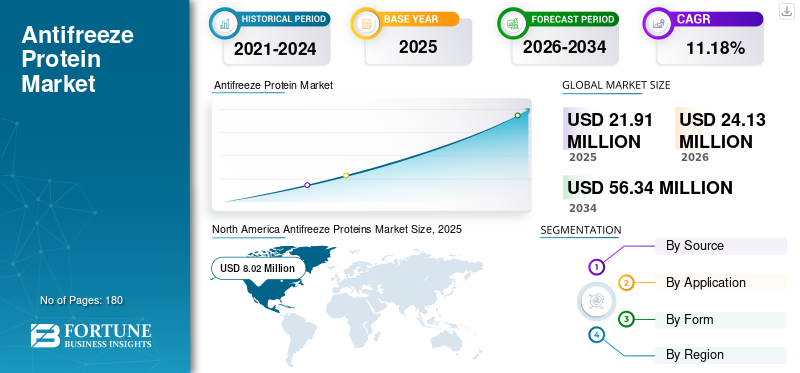
The antifreeze proteins market size was valued at USD 21.91 million in 2025. The market is projected to grow from USD 24.13 million in 2026 to USD 56.34 million by 2034, exhibiting a CAGR of 11.18% during the forecast period. North America dominated the antifreeze proteins market with a market share of 36.6% in 2025.
Antifreeze Proteins (AFPs) are specialized proteins that prevent or slow ice crystal formation and recrystallization during freezing and thawing conditions. They are naturally found in fish, insects, plants, and microorganisms. Such proteins are increasingly being produced through recombinant biotechnology and are used in cryopreservation, frozen foods, seafood storage, cell therapy storage, and research institutions. The market is growing rapidly due to rising demand for advanced cryopreservation in regenerative medicine, stem cell banking, fertility treatment, and biologics storage. Rising demand for frozen foods, seafood exports, and better cold-chain logistics is also driving demand for AFPs.
Companies such as NICHIREI CORPORATION, KANEKA CORPORATION and A/F Protein Inc. are some of the prominent players in the market. Merger and acquisition and partnership is the key strategy which is boosting sales and supporting the popularity of Antifreeze Proteins products.
Download Free sample to learn more about this report.
ANTIFREEZE PROTEIN MARKET KEY TAKEAWAYS
 Global Market Size & Forecast
- 2025 Market Size: USD 21.91 million
- 2026 Market Size: USD 24.13 million
- 2034 Forecast Market Size: USD 56.34 million
- CAGR: 11.18% from 2026-2034
 Market Share
- North America dominated the global market with a market share of 36.6% in 2025.
- Medical & biopharmaceutical accounted for the largest market share in 2025.
- Food & beverage makes up the second-largest share of the market and is expected to grow at a CAGR of 11.42% during the forecast period.
 Key Regional Highlights
North America
North America led the global antifreeze proteins market with a value of USD 8.02 million in 2025, driven by strong adoption in cryopreservation, frozen food applications, and advanced biotechnology research.
Europe
Europe reached USD 6.23 million in 2025, supported by increasing demand for premium frozen foods, biomedical applications, and clean-label product development.
Asia Pacific
Asia Pacific was valued at USD 5.09 million in 2025, with market growth supported by expanding frozen food production, seafood processing, aquaculture, and biomanufacturing activities.
U.S.
The U.S. antifreeze proteins market reached USD 6.77 million in 2025, benefiting from strong demand across biomedical cryopreservation, frozen food preservation, and cell therapy applications.
Japan
The Japan antifreeze proteins market was valued at USD 1.09 million in 2025, accounting for 4.96% of global market revenues.
Read More

ANTIFREEZE PROTEINS MARKET TRENDS
Scalable Recombinant Platforms and Blended Systems are Prominent Market Trends
The market is shifting toward recombinant, fermentation-based, and engineered AFP platforms. Suppliers are now focusing on ice recrystallization inhibition, thermal hysteresis activity, and are conducting research to assess AFPs performance across different formulations. Blended systems that mix AFPs with sugars, polyols, hydrocolloids, or cryoprotectants are in high demand as they help lower both dosage and cost. Suppliers are targeting seafood, cryopreservation, and premium frozen foods and therefore expanding the application across different food categories.
MARKET DYNAMICS
MARKET DRIVERS
Download Free sample to learn more about this report.
Increasing Demand to Improve Product Quality and Cell Viability Boosts Market Growth
Antifreeze proteins are becoming more popular as they address freeze-damage problems that regular stabilizers cannot. In frozen foods, these proteins help prevent ice crystals from growing, protecting the texture of ice cream, seafood, meat alternatives, and baked goods even when temperatures fluctuate. In medicine, antifreeze glycoproteins are useful as cell therapies, fertility samples, tissues, and organ transplantation research survive better through freezing and thawing. Aquaculture and seafood companies prefer AFPs for exporting fish to other countries further boosting the antifreeze proteins market growth.
MARKET RESTRAINTS
High Production Cost Slow Commercial Scale-Up and Restricts Market Growth
High production costs, limited large-scale supply, unclear regulations, and the need for specific validation is hindering market growth. These products differ from standard food stabilizers, as their performance depends on factors such as protein type, purity, dosage, temperature, and the overall formulation. Fish-based AFPs also have allergen labeling issues, with significant challenges in maintaining batch consistency. Recombinant AFPs provide better control, however they are expensive than other products. Availability of cheaper options such as hydrocolloids, cryoprotectants, and emulsifiers also impact market adoption.
MARKET OPPORTUNITIES
Cryopreservation and Premium Frozen Foods Create High-Value Opportunities for AFP Suppliers
Areas such as cell therapy logistics, stem cell banking, fertility preservation, organ transport research, premium seafood exports, and frozen desserts have greater commercialization potential than low-margin frozen foods creating opportunity for market growth. Fermentation-derived AFPs can lead to lower costs while maintaining activity and purity. Partnership with frozen food brands, seafood processors, and bio-preservation companies help suppliers increase capacity and boost market growth.
Segmentation Analysis
By Source
Consistent Performance and Scalable Fermentation Production Drives Recombinant / Synthetic AFPs Segment Dominance
The market is segmented, by source, into recombinant / synthetic AFPs, fish-derived AFPs, microbial-derived AFPs, plant-derived AFPs, and insect-derived AFPs.
The recombinant / synthetic AFPs segment held the largest antifreeze proteins market shares in 2025 as they provide consistent purity, reliable performance, and can be customized for large-scale applications of antifreeze proteins. This makes them suitable for biomedical cryopreservation, application of cells tissues and organs, fertility preservation, and producing high-quality food products.
The fish-derived AFPs holds the second-largest market share, and is expected to grow at a CAGR of 11.36% during the forecast period. Clinical studies have proved that it helps to control ice recrystallization. However, the growth of this segment is impacted by raw material availability, inconsistent batch yields, allergen risks, and concerns about sustainability. Therefore, fish-derived AFPs are still used in research, seafood-related products.
By Application
High Freeze-Sensitivity of Cells and Biologics Leads to Medical & Biopharmaceutical Applications Segment Dominance
Based on application, the market is segmented into medical & biopharmaceutical, food & beverage, research & academic use, agriculture & aquaculture, cosmetics & personal care, and industrial & materials science.
Medical & biopharmaceutical accounted for the largest market share in 2025. AFPs are suitable for areas such as cell therapy, stem cell banking, fertility preservation, tissue storage, and organ transport research. Manufacturers also invest in R&D, specialized cryopreservation methods, to improve recovery after thawing with standard cryoprotectants.
Food & beverage makes up the second-largest share of the market and is expected to grow at a CAGR of 11.42% during the forecast period. AFPs help reduce ice crystal growth, texture loss, drip loss, and freezer burn in frozen desserts, seafood, baked goods, meat products, and ready meals. However, adoption is slower in food manufacturing due to stricter cost limits, labeling issues, regulatory checks, and competition from less expensive hydrocolloids, sugars, emulsifiers, and stabilizer blends.
To know how our report can help streamline your business, Speak to Analyst
By Form
Extended Shelf Stability and Flexible Industrial Handling Drives the Dominance of Dry AFP Powders Segment
The market is segmented, by form, into native liquid AFPs, dry AFP powders, and immobilized / encapsulated AFP systems.
The dry AFP powders segment led the global market in 2025. Dry AFP powders or solid antifreeze protein are popular as they have longer shelf life, are easier to store and transport, and offer greater flexibility in usage as compared to liquid forms. Users in food, biopharma, and research can measure powders more accurately, mix them into dry blends, rehydrate them as needed, and rely less on cold storage during shipping. Powder forms also help facilitate the commercialization of recombinant and synthetic AFP-purified proteins, which can be dried, standardized, and delivered with set activity levels.
Native liquid AFPs segment is another major segment that is growing with a CAGR of 11.32% during the forecast period. Native liquid AFPs hold the second-largest share as they are useful in research, marine-derived extracts, and applications. However, liquid AFPs have limited shelf life, are expensive to handle, can become contaminated easily, and require advanced cold storage facilities.
Antifreeze Proteins Market Regional Outlook
By geography, the market is categorized into Europe, North America, Asia Pacific, South America, and the Middle East & Africa.
Asia Pacific
North America Antifreeze Proteins Market Size, 2025 (USD Million)
To get more information on the regional analysis of this market, Download Free sample
The Asia Pacific market was valued at USD 5.09 million in 2025. Asia Pacific uses a wide range of uses of antifreeze proteins as frozen food production, seafood processing, aquaculture, and bio-manufacturing. It is especially useful in situations where freeze-thaw cycles can damage the texture of fish, dumplings, meat, and biological samples. Manufacturers in the region focus on affordable antifreeze peptides, proteins produced through fermentation, and mixed cryoprotective systems rather than costly purified AFPs. More companies are likely to use these products once suppliers show that they stay stable during industrial freezing, thawing, salting, and processing.
India Antifreeze Proteins Market
The India market in 2025 was valued around USD 0.65 million, accounting for roughly 2.99% of global market revenues.
China Antifreeze Proteins Market
China’s market in 2025 was valued around USD 1.33 million, representing roughly 6.09% of global market share. China’s market for antifreeze proteins is growing due to high frozen food consumption, seafood processing, large-scale aquaculture, and better cold-chain infrastructure.
Japan Antifreeze Proteins Market
The Japan market in 2025 reached a valuation of around USD 1.09 million, accounting for roughly 4.96% of global market revenues.
North America
The market in North America reached a valuation of USD 8.02 million in 2025 and is the leading region in the world. In North America, antifreeze proteins are mainly used for cryopreservation, frozen desserts, seafood quality, and cell therapy logistics. The U.S. has the highest demand for antifreeze proteins. However, commercial use faces challenges such as high production costs, strict safety regulations, and the need to ensure safety of these formulations
U.S. Antifreeze Proteins Market
In 2025, the U.S. market reached USD 6.77 million. In the U.S., the main uses for antifreeze proteins are in biomedical cryopreservation, frozen desserts, seafood preservation, and cell therapy logistics. Recombinant and fermentation-based antifreeze proteins are more common in the U.S. as biopharma companies need traceability, purity, and consistent results. Food uses for antifreeze proteins are growing slowly, as ingredient costs and regulations remain major challenges. Partnerships among biotech companies, universities, frozen food brands, and cell therapy providers will likely shape how these proteins reach the market.
Europe
The European market reached a valuation of USD 6.23 million in 2025. In Europe, the market is driven by biomedical validation, the development of premium frozen foods, seafood preservation, and the demand for clean-label formulations. Germany, the UK, France, and the Nordic countries are key markets due to expertise in pharmaceutical cold chains, advanced food processing, and marine biotechnology research. Frozen bakery, dairy desserts, seafood, fertility clinics, and cell storage laboratories are the largest user of such products. As a result, companies gain a competitive edge through traceability, strong safety records, and thorough application testing, not just by offering low prices.
Germany Antifreeze Proteins Market
The market in Germany in 2025 reached around USD 1.57 million, representing roughly 7.16% of global market sales. In Germany, the market is influenced by advances in food engineering, pharmaceutical cold-chain research, frozen bakery products, dairy processing, and bio-preservation.
U.K. Antifreeze Proteins Market
The U.K. market reached approximately USD 1.11 million in 2025, equivalent to around 5.09% of global market sales.
South America and Middle East & Africa
Over the forecast period, South America is expected to experience significant growth in this market. The South America market in 2025 recorded USD 1.10 million. The market in South America is still in its early stages. Brazil and Chile are the key markets and Brazil is one of the major exporter of frozen meat and processed foods, while Chile’s is another prominent exporter of salmon and seafood products that make quality preservation essential. Local partnerships with processors and cold-chain operators is expected to create growth opportunity in this region. Middle East & Africa region reached a valuation of USD 1.47 million in 2025. The market is small with UAE and Saudi exhibiting string potential for growth. AFP is suitable for premium foodservice, airline catering, specialty seafood, and biomedical cold-chain needs. It is less relevant for mass retail. South Africa and some Gulf-connected trade hubs also create opportunity for limited use of AFP in the distribution of frozen meat and seafood.
UAE Antifreeze Proteins Market
UAE market is set to grow at a CAGR of 8.08% during the forecast period. The market is small and relies on imported frozen foods, seafood, high-end hospitality supply chains, and temperature-controlled logistics.
COMPETITIVE LANDSCAPE
Key Industry Players
Specialized Use Cases Attract Strategic Partnerships and Propels Market Competition
The antifreeze proteins market is fairly fragmented with some of the major market players operating, such as NICHIREI CORPORATION, KANEKA CORPORATION and A/F Protein Inc. The market competition is driven by expertise in specific applications. Ingredient developers, biotech companies, marine extract suppliers, and food technology firms compete based on purity, thermal hysteresis activity, stability, regulatory approval. Companies with fermentation, recombinant protein expression, or marine protein extraction skills are expanding their expertise in this area. Strategic partnerships with frozen food makers, cell therapy firms, aquaculture businesses, and research institutes also create opportunity for investments and expand their growth in untapped areas.
LIST OF KEY ANTIFREEZE PROTEINS COMPANIES PROFILED
- NICHIREI CORPORATION (Japan)
- KANEKA CORPORATION (Japan)
- A/F Protein Inc. (U.S.)
- MyBioSource (U.S.)
- PROTOKINETIX, INC. (U.S.)
- BioCrick BioTech (China)
- CUSABIO TECHNOLOGY LLC (China)
- ProSpec-Tany TechnoGene Ltd. (UAE)
- Sino Biological, Inc. (China)
- AquaBounty Technologies, Inc. (U.S.)
KEY INDUSTRY DEVELOPMENTS
- February 2026: CUSABIO expanded its recombinant AFP products availability, which includes recombinant Antarctomyces psychrotrophicus antifreeze protein for the market.
- April 2025: BioLife Solutions, Inc. a leading developer and supplier of bio-production products and services, acquired PanTHERA CryoSolutions, Inc., a developer of novel cryopreservation solutions based on proprietary Ice Recrystallization Inhibitor ("IRI") technology.
- February 2023: Sirona Biochem Corp. announced that it received trademark for its anti-aging and anti-wrinkle molecule, TFC-1326, as GlycoProteMim.
- December 2021: Kaneka Corporation launched edible Type I antifreeze proteins which are designed for food applications, such as rice and noodles.
- March 2021: BioLife Solutions, Inc. partnered with Casdin Capital to re-investment in iVexSol, a vector manufacturing company to develop next generation freeze media technology.
REPORT COVERAGE
The global antifreeze proteins market report provides an in-depth study of market size & forecast by all the market segments included in the report. The market analysis includes details on the market trends expected to drive the market during the forecast period. It offers information on the technological advancements, new product launches, key industry developments, and details on partnerships, mergers & acquisitions. The market forecast also encompasses detailed competitive landscape with information on the market segmentation, market share and profiles of key operating players.
Request for Customization to gain extensive market insights.
Report Scope & Segmentation
| ATTRIBUTE | DETAILS |
| Study Period | 2021-2034 |
| Base Year | 2025 |
| Estimated Year | 2026 |
| Forecast Period | 2026-2034 |
| Historical Period | 2021-2024 |
| Growth Rate | CAGR of 11.18% from 2026-2034 |
| Unit | Value (USD Million) |
| Segmentation | By Source, By Application, By Form, and Region |
| By Source |
|
| By Application |
|
| By Form |
|
| By Region |
|
Frequently Asked Questions
Fortune Business Insights says that the global market value stood at USD 21.91 million in 2025 and is projected to reach USD 56.34 million by 2034.
In 2025, the North America’s market value stood at USD 8.02 million.
The market is expected to exhibit a CAGR of 11.18% during the forecast period of 2026-2034.
By application, medical & biopharmaceutical segment led the global market.
Freeze-damage control improves product quality and cell viability, driving the market growth.
NICHIREI CORPORATION, KANEKA CORPORATION and A/F Protein Inc. are few top players in the market.
North America held the largest market share in 2025.
Scalable recombinant platforms and blended systems is a major market trend.



- 2021-2034
- 2025
- 2021-2024
- 180
-
(Offer valid till 30th Sep 2026)
Get 30-60 hrs Free Customization
Expand Regional and Country Coverage, Segments Analysis, Company Profiles, Competitive Benchmarking, and End-user Insights.




















-
US +1 833 909 2966 ( Toll Free )
-
Get In Touch With Us