Digital Signage Market Size, Share & Industry Analysis, By Component (Hardware, Software, Content, and Services), By Deployment (On-Premise, Cloud), By Location (Indoor, Outdoor), By Product Type (Video Walls, Digital Posters, Kiosks, Billboards, and Others), By Industry Vertical (Retail, Corporate, Hospitality, Transportation, Education, Healthcare, Sports and Entertainment, and Others) and Regional Forecast, 2026-2034
 Download Free Sample
Digital Signage Market Outlook 2026-2034
 Listen to Audio Version
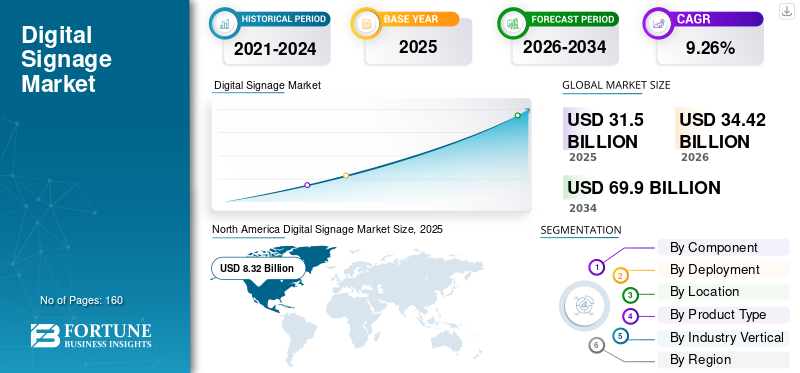
The global digital signage market size was valued at USD 31.50 billion in 2025 and is projected to grow from USD 34.42 billion in 2026 to USD 69.90 billion by 2034, exhibiting a CAGR of 9.26% during the forecast period. North America dominated the digital signage market with a market share of 42.06% in 2025.
A significant factor in the widespread growth of this technology was the decline in the prices of crucial hardware components such as LCD screens in digital signage. Developments in the electronic displays used in digital signage may offer new opportunities and advantages compared to traditional signage. For instance, digital technology provides dynamic multimedia presentations containing audio, video, and animated content.
Smart city development initiatives have given a comprehensive platform for the deployment of digital signage solutions. The developments in ground-breaking technologies such as facial recognition capabilities offered by AI and others have boosted the developments in digital signage. For instance, facial recognition cameras allow the displays to recognize a customer’s expressions and suggest services based on the data.
Interactive digital signage has brought a technological transformation in various industry verticals, including retail, financial services, smart city, transportation, and others. Advances in media players and the adoption of new screen technologies are among the growing digital signage market trends. For instance, Ebebek's mother and baby product retailer based in Turkey, and Phygital Mind, a retail specialist based in Istanbul, used large-format interactive kiosks intending to deliver a new concept for enhanced customer experience by fully integrating e-commerce with the assisted sale.
Download Free sample to learn more about this report.
Digital Signage Market Key Takeaways
 Market Size & Forecast
- 2025 Market Size: USD 31.50 billion
- 2026 Market Size: USD 34.42 billion
- 2034 Forecast Market Size: USD 69.90 billion
- CAGR: 9.26% from 2026-2034
 Market Share
- North America dominated the digital signage market with a 42.06% share in 2025.
- The indoor digital signage segment held the largest market share in 2025.
- The retail segment accounted for the largest market share in 2025.
 Key Regional Highlights
North America
North America led the market with USD 8.32 billion in 2025 due to strong adoption across retail, transportation, and corporate sectors.
Asia Pacific
Asia Pacific is expected to witness the fastest growth driven by smart city projects and rapid digitalization.
Europe
Europe is expanding steadily due to increasing investments in smart infrastructure and digital transformation.
U.S.
Strong demand for DOOH advertising and interactive display solutions continues to support market growth.
Japan
Advanced display technologies and smart city developments are driving digital signage adoption.
Read More

Key Market Dynamics
Digital Signage Market Trends
Several key drivers shape the Digital Signage market's growth trajectory. Rising demand for immersive customer experiences is the most influential factor. Retailers, hotels, restaurants, and entertainment venues are deploying digital displays to differentiate environments, engage customers, and automate real-time communication. The transition to omnichannel commerce elevates the role of digital displays as physical touchpoints that bridge online and in-store experiences.
The digital signage market is shifting from screen deployment toward software-defined network management, because enterprises increasingly need one operating layer for content, devices, permissions, analytics, and remote support. The commercial implication is clear: recurring software and managed-service revenue is becoming more strategically important as hardware replacement cycles lengthen.
Cloud architecture is becoming the preferred scaling mechanism. Centralized platforms allow organizations to manage geographically dispersed displays without maintaining equivalent local infrastructure, while hybrid models remain relevant where enterprises need local processing or tighter control over sensitive environments. Samsung's VXT platform illustrates this transition by combining cloud-based content management with remote device management and hybrid-cloud capabilities.
Retail media is also rewiring the economics of signage. Retailers increasingly treat in-store screens as addressable advertising inventory, connecting physical displays with audience data, campaign management, and broader media operations; Walmart's advertising business, for example, grew 44% in its latest reported quarter, demonstrating the broader strategic value retailers are assigning to advertising infrastructure.
Advancements in display technologies also accelerate adoption. LED and LCD screens now offer better brightness, higher resolutions, and greater energy efficiency. OLED and microLED innovations enable ultra-thin, flexible, and bezel-less designs for premium installations. Video walls with fine pixel pitch are increasingly used for command centers, corporate lobbies, and stadiums.
Download Free sample to learn more about this report.
Digital Signage Market Growth Drivers
“Increasing Demand for Enhanced Connectivity, Flexibility, and Affordability to Drive the Market “
Digital display helps to build a connection between the person or organization displaying the content and the person reading the content. Due to the improved flexibility of the hardware and software, the adoption of digital signage is gaining pace. Digital display hardware has become more affordable in recent years. Hence, organizations are making substantial investments in digital signage solutions. This factor is likely to drive the digital signage market.
The primary growth driver is the conversion of physical signage into centrally managed communications infrastructure, particularly for enterprises operating hundreds or thousands of customer-facing locations. Retailers, transportation operators, hospitality groups, healthcare networks, and corporate campuses gain value because one digital network can distribute localized messages, operational information, promotions, and wayfinding without replacing physical assets.
Cloud management strengthens this economics. Centralized platforms allow IT and marketing teams to control content, permissions, device health, and scheduling remotely, reducing the administrative burden associated with geographically dispersed installations. This becomes increasingly important as enterprises standardize technology across locations while maintaining local content requirements.
“Growing Infrastructure Development across Industries to Expand the Market Size”
Retailers today leverage digital signage to create an enhanced shopping experience, resulting in high sales. They make considerable investments in the infrastructure of retail stores to reap the benefits of digitization. Digital signage enables retailers to provide personalized offerings, theme-based digitally enhanced experience stores, and other advanced services.
In the banking and finance sector, digital signage solutions act as customer touchpoints by providing them with increased control and information on demand. For instance, large-scale video walls continuously display financial news, creating an immediate impact on customers. Digital signage can also reduce waiting times by keeping the customers informed. Thus, the benefits, as mentioned above, will drive the demand for digital signage solutions and elevate the digital signage market value in the process.
Market Restraints:
The principal restraint is deployment complexity, because enterprise digital signage is rarely a standalone hardware purchase. Large networks require displays, media players, connectivity, content management, installation, cybersecurity, monitoring, maintenance, and integration with existing enterprise systems. Each additional layer increases procurement complexity and extends implementation timelines.
Hardware commoditization creates another pressure point. Display specifications increasingly converge across suppliers, allowing buyers to compare products primarily through price, warranty, service coverage, and lifecycle economics. Vendors that depend heavily on hardware margins therefore face greater pressure as enterprises demand integrated solutions at controlled total cost.
Content operations also constrain adoption. A large screen estate requires continuous production, localization, scheduling, approval, and governance. The screen is easy to install; keeping thousands of endpoints commercially relevant is the harder operational problem. Cybersecurity is becoming more significant as displays connect to corporate networks and cloud platforms. Compromised endpoints can create reputational, operational, or data-security exposure, making authentication, access control, software updates, and remote monitoring essential procurement criteria.
Energy consumption and equipment replacement costs further influence investment decisions, particularly for large outdoor networks and continuously operated commercial environments. Organizations increasingly assess lifecycle economics rather than upfront hardware pricing. The market therefore faces a practical constraint: digital signage promises flexibility, but poorly governed deployments can create another distributed technology estate to manage.
Market Opportunities:
The largest opportunity is the convergence of digital signage with retail media, because physical screens can become measurable advertising inventory rather than remaining a pure communications expense. Retailers can connect in-store displays with campaign management, audience data, product information, and advertiser reporting, creating a new monetization layer around existing store infrastructure.
Cloud-managed signage represents another substantial opportunity. Enterprises with geographically distributed locations can centralize content, device monitoring, permissions, and software updates, reducing dependence on local technical teams. This model also creates recurring software and managed-service revenue for vendors.
Interactive kiosks provide a third growth pathway because they combine communication with transactions and operational workflows. Retailers, restaurants, airports, hospitals, and hotels can use kiosks for ordering, registration, navigation, check-in, and customer-service functions. The investment case becomes stronger when deployment reduces queue times or increases transaction capacity.
Artificial intelligence creates a further opportunity within the software layer. Automated content generation, audience analytics, contextual scheduling, and predictive device monitoring can improve network productivity when connected to measurable business objectives. Samsung's 2026 VXT AI Studio, for example, introduced AI-assisted conversion of static images into signage-ready video content.
Market Segmentation Analysis
By Component
“Digital Signage Hardware to Gain More Demand Across Organizations”
Based on component, the market is classified into hardware, content, software, and services.
Hardware
Increasing demand for digital signage hardware is expected to generate maximum revenue until 2026. The hardware segment comprises LCD/LED displays, media players, projector/projection screens, and other hardware.
Hardware remains the physical foundation of every digital signage deployment, covering commercial displays, media players, controllers, mounting systems, interactive screens, and related connectivity equipment. Buyers increasingly evaluate hardware on lifecycle economics rather than resolution alone, with brightness, operating hours, thermal performance, remote diagnostics, cybersecurity support, and warranty coverage influencing procurement decisions. Large enterprise deployments favor commercial-grade equipment because failure at scale creates operational costs that consumer displays cannot absorb. Retailers, transportation operators, and hospitality groups also require equipment designed for extended operating schedules and demanding environmental conditions.
The competitive structure is changing. Display manufacturers increasingly bundle management software, device monitoring, and content capabilities, while software providers integrate with multiple hardware ecosystems. This convergence shifts vendor selection toward interoperability and serviceability. Hardware still captures significant spending because every network requires physical endpoints. Yet recurring software and service layers increasingly determine account lifetime value.
For investors, the key distinction is between box revenue and infrastructure revenue. A vendor selling displays alone competes primarily on specification and price. A vendor controlling the broader operating environment can generate additional revenue through software, maintenance, analytics, and managed services.
Content
The digital signage content segment is expected to note an exponential CAGR in the coming years. Providing relevant content is an essential factor in delivering sustainable advertising effects. The digital signs adopt content based on the viewers’ reactions. Digital content includes contextual and interactive content. Hence, there is an increasing need for more creative content to grab the customer’s attention across various industries. Lack of interactive content or inadequate contextual content may restrict market growth in the future.
Content is frequently underestimated in digital signage economics because hardware purchases are more visible. In practice, content determines whether deployed screens remain commercially useful after installation. Enterprise buyers require content that can be adapted by location, audience, time, campaign, inventory position, and operational context. Retailers therefore need integration between merchandising systems and signage, while transportation operators require real-time service information and wayfinding updates.
Content production can become a bottleneck when screen networks expand faster than creative teams. AI-assisted content generation is addressing part of this constraint, but governance remains essential. Brand consistency, accessibility, legal compliance, localization, and approval workflows cannot be fully delegated to automated systems. The strongest suppliers increasingly provide templates, content libraries, scheduling tools, localization capabilities, and integration services alongside basic content management.
Software
Digital signage software solutions help to produce creative digital solutions. It also helps users to enhance overall customer experience and support business goals. For instance, Scala is a cloud-based digital signage software that offers content scheduling, media libraries, and other automatic player updates.
Software is becoming the control layer for distributed signage networks. Content management systems allow organizations to schedule campaigns, manage permissions, localize messages, monitor devices, and coordinate screen groups from centralized interfaces. Enterprise buyers increasingly require integration with customer relationship management, retail systems, advertising platforms, enterprise resource planning, and data sources. This changes software selection from a standalone purchase into an architecture decision.
Cloud deployment strengthens scalability because IT teams can manage large screen fleets without maintaining equivalent local infrastructure. Hybrid architectures remain relevant where organizations require local processing, resilience during connectivity interruptions, or tighter data control. The software segment also provides stronger recurring-revenue characteristics than hardware. Subscription licensing, device management, analytics, content services, and support can create predictable revenue streams after installation.
Services
Digital signage services include maintenance, planning, project services, and other technical implementation services. Maintenance services encompass content services, onsite service, warranty service, and others. Planning services include project planning, solution development, and others. System production, logistics services, and content creation are included in project services.
Services include installation, system integration, maintenance, monitoring, content production, consulting, cybersecurity support, and managed operations. They are particularly important for large deployments where customers lack internal expertise to manage thousands of endpoints. Enterprise buyers increasingly favor service providers that can assume responsibility across the deployment lifecycle. Installation quality affects reliability, while maintenance determines network availability and replacement costs.
Managed services create recurring revenue and strengthen customer retention because replacing an operating partner can disrupt content workflows, device monitoring, and service-level agreements. Service providers can also differentiate through vertical specialization. A transportation deployment requires different integration expertise from a hospital or retail network.
By Deployment
“Increasing Demand to Streamline the Content to Surge the Demand for Cloud-Based Digital Signage Software”
Based on deployment type, the market has been classified as cloud and on-premises.
Cloud
The advanced digital signage solution includes cloud-based digital signage software for content management. A cloud-based digital signage platform enables users to manage digital signage content, whereas the digital signage service provider maintains the server that hosts it.
Cloud-based digital signage software can be defined as a cloud-based content management system, dashboard, or interface. The dashboard enables the user to control the content on the digital signage display in real-time. Owing to these benefits, cloud-based digital signage software is expected to propel market growth.
Cloud deployment is gaining strategic importance because it simplifies network scaling and centralized administration. Enterprises can add locations without replicating local server infrastructure, while software updates and permissions can be managed centrally. Cloud platforms also support distributed operating models. Corporate marketing teams can establish brand standards while regional managers receive controlled permissions for local content.
The model creates additional opportunities for software vendors because recurring subscriptions can be linked to devices, users, locations, or functionality. Cybersecurity becomes a critical procurement criterion. Enterprises require strong authentication, encryption, access controls, audit trails, and software-update processes.
On-Premise
An on-premise digital signage solution can be referred to as a ‘do-it-yourself (DIY)’ solution. In an on-premise solution, the owner maintains the servers that host the digital signage content. The software that supports the on-premise solution may be a third-party solution or built in-house. There are several advantages of cloud-based solutions over on-premise solutions, including easier setup, less maintenance, remote access, and others.
On-premise deployment remains relevant for organizations requiring direct control over infrastructure, data, access policies, and network operations. Large enterprises with established information-technology environments can integrate signage servers with existing security and identity-management systems. The model provides greater control over infrastructure location and network dependencies. It can also suit environments where connectivity is restricted, or operational continuity requires local processing.
However, on-premise systems require customers to maintain servers, software infrastructure, backups, security updates, and technical personnel. These responsibilities increase total cost of ownership as networks expand. On-premise deployment therefore remains strongest where control requirements outweigh administrative convenience.
By Location
“Growing Digital Advertising to Spike the Demand for Outdoor Signage Solutions”
There are several types of digital signage solutions used in the market. Based on the location of deployment, the market has been segmented into indoor and outdoor digital signage solutions.
Indoor
Indoor signage represents a broad commercial opportunity across retail stores, corporate offices, hotels, hospitals, schools, airports, restaurants, and entertainment venues. Environmental requirements are generally less demanding than outdoor installations, allowing greater flexibility in display selection. Retail remains a particularly important application because indoor screens can influence customers near entrances, shelves, checkout areas, service counters, and promotional zones. Kiosks also combine communication with transactional functions.
Indoor deployments increasingly connect with enterprise systems. Inventory data, queue information, promotions, and customer-service workflows can trigger contextual content. The economics favor modular networks because organizations can expand from pilot locations to national or international estates without redesigning the entire architecture.
Outdoor
The outdoor digital signage market is expected to boom the market growth in coming years. Indoor digital signage solutions incorporate interactive kiosks that are deployed in subway stations, shopping malls, and airports. Outdoor signage requires higher brightness, weather resistance, thermal management, structural engineering, and stronger remote monitoring. These requirements increase upfront investment but also support higher-value applications.
In recent years, fast-food chains have applied digital signage solutions at their point-of-sale (POS) devices. Examples of outdoor digital signage solutions include LCD screens deployed in massive public areas such as Times Square in New York, Wall Street, and others. Also, stadiums and trade shows use outdoor digital signage solutions on a large scale to provide information to the masses.
Transportation hubs, roadside advertising, stadiums, shopping districts, and public infrastructure represent major deployment environments. Outdoor networks also intersect with digital out-of-home advertising, where screen inventory can become monetizable media infrastructure. Reliability is particularly important because physical access for maintenance can be costly. Remote diagnostics therefore have greater commercial value than in small indoor installations.
By Product Type
“Large Scale Deployment of Video Walls to Expand the Market Size”
Based on product type, the global digital signage market is segmented into video walls, kiosks, billboards, digital posters, and others.
Video walls are used in command centers, airports, corporate lobbies, and entertainment venues. They offer seamless visuals with thin bezels, high brightness, and long operational life. Fine-pitch LED video walls are replacing traditional LCD walls due to improved uniformity and flexibility. The video walls segment is expected to generate maximum revenue during the forecast period. Video walls are of two types: LCD video walls and LED video walls. There is a continuous trend of using LED video walls for advertising among organizations.
Apart from this, the emergence of OLED (Organic Light-emitting Diodes) would drive the demand for video walls in the coming years. Video walls are considered a crucial factor in enhancing the potential of the digital signage market. Advancements in video walls, such as the emergence of OLED, are likely to offer new market opportunities.
Kiosks are projected to witness an exponential growth rate during the forecast period. Interactive digital signage kiosks provide information related to wayfinding, broadcasting, or customer services. Digital signage kiosks are mostly deployed in retail stores, big shopping malls, corporate buildings, and other places.
To know how our report can help streamline your business, Speak to Analyst
Other products that play a significant role in implementing digital signage include billboards, digital menu boards, digital posters, and others.
By Industry Vertical
Retail
Retail is one of the most commercially important verticals because digital signage connects directly with merchandising, promotions, customer experience, and retail media. Stores can use displays to influence purchasing decisions while also creating advertising inventory for brands. Adoption increasingly requires integration with inventory, pricing, loyalty, and advertising systems.
The strategic opportunity is larger than visual merchandising. Retailers can build physical media networks that complement digital advertising channels.
Corporate
Corporate deployments focus on employee communication, reception areas, meeting spaces, dashboards, training, and internal announcements. Large enterprises benefit from centralized governance across offices and campuses.
Demand is strongest where organizations operate distributed workforces or multiple facilities. Integration with calendars, collaboration systems, emergency notifications, and corporate communications platforms increases utility.
Hospitality
Hotels, restaurants, resorts, and venues use signage for menus, promotions, wayfinding, event information, guest services, and brand communication. The sector values rapid content changes because offerings and operating conditions change frequently. Cloud management is therefore particularly useful across geographically dispersed properties.
Transportation
Airports, rail stations, metro systems, and bus networks depend on reliable information delivery. Digital signage supports schedules, gate information, disruption notices, navigation, advertising, and emergency communication. The operational requirement is reliability. Systems must remain available under demanding conditions and integrate with transportation-management data.
Education
Universities, schools, and training organizations use signage for announcements, navigation, event promotion, emergency information, and campus communications. Budget constraints influence purchasing decisions, making lifecycle cost and centralized management important. Large campuses benefit from standardized platforms that reduce local administration.
Healthcare
Hospitals and healthcare networks use digital signage for wayfinding, patient communication, queue information, education, and operational messaging. The environment creates higher requirements for reliability, accessibility, privacy, and content governance. Integration with scheduling and patient-flow systems can increase operational value.
Sports and Entertainment
Stadiums, arenas, cinemas, museums, and entertainment venues use large displays, video walls, kiosks, and outdoor screens to create immersive experiences and monetize audience attention.
The commercial model combines communication with sponsorship and advertising revenue. High-resolution displays and synchronized content therefore carry greater value than standard information screens.
Regional Analysis
North America Digital Signage Market Analysis
North America is forecasted to witness remarkable growth in the global digital signage market during the forecast period. The reduction of mass media such as broadcast and print has created a demand for digital signage solutions across the region. Moreover, the increased efficiency of promotions due to the adoption of digital signage has encouraged the adoption of digital signage solutions in North America. The U.S is the major contributor to the market growth in the region, aiding North America to lead the digital signage market share.
North America has an established digital signage ecosystem supported by sophisticated retail networks, advertising infrastructure, enterprise technology spending, and large-format display deployment. Demand is shifting toward cloud management, retail media, interactive kiosks, and analytics-enabled networks. Vendors compete increasingly on software integration, cybersecurity, remote monitoring, and lifecycle services, while hardware differentiation alone is becoming less decisive for enterprise procurement.
United States Digital Signage Market
The United States represents the region’s largest commercial opportunity, supported by extensive retail estates, airports, corporate campuses, restaurants, stadiums, and healthcare networks. Retail media is strengthening the business case as retailers monetize in-store screens alongside digital advertising channels. Enterprise buyers increasingly require centralized management, interoperability, analytics, and cybersecurity, creating opportunities for vendors that combine displays with software and managed services.
Asia-Pacific Digital Signage Market Analysis
Asia Pacific is projected to exhibit an exponential CAGR due to the adoption of digital signage solutions in India, China, and other developing countries. Growing commercial, housing, and corporate trends are likely to generate tremendous demand for digital signage in APAC. Asia Pacific is considered one of the potential markets for digital signage solutions owing to the low prices of deploying electronic signage systems.
Asia-Pacific represents a significant expansion environment because rapid urban development, retail modernization, transportation investment, hospitality growth, and smart-city programs are increasing demand for connected displays. Adoption varies across countries, creating opportunities for localized platforms and hardware configurations. Large-scale deployments favor centralized management and remote monitoring, while high-density commercial environments increasingly support interactive kiosks, video walls, digital posters, and advertising applications.
Japan Digital Signage Market
Japan has a technically advanced digital signage environment supported by sophisticated retail, transportation, hospitality, and public-information infrastructure. Buyers prioritize reliability, compact installation, visual quality, energy efficiency, and operational continuity. Transportation networks provide particularly important applications for passenger information and wayfinding. Vendors with strong hardware engineering, software integration, and long-term service capabilities are positioned well within Japan’s demanding enterprise procurement environment.
China Digital Signage Market
China represents a large-scale deployment opportunity supported by retail expansion, transportation infrastructure, smart-city investment, hospitality development, and extensive commercial property networks. Domestic technology ecosystems strengthen local hardware and software capabilities, increasing competitive intensity. Buyers increasingly seek integrated platforms combining displays, content management, analytics, and interactive functionality. Scale, local support, supply-chain responsiveness, and system integration remain important determinants of commercial positioning.
Europe Digital Signage Market Analysis
Europe is expected to hold a significant position in the global market. Continuous development in the manufacturing industry and high investments in digitization by business leaders such as Samsung Electronics, LG, and others will expand the market size in the region. UK, Germany, and Italy are expected to contribute a significant share in the digital signage market across the region.
Europe has a diversified digital signage ecosystem spanning retail, transportation, hospitality, corporate facilities, and public infrastructure. Procurement increasingly emphasizes energy efficiency, accessibility, cybersecurity, and lifecycle economics alongside visual performance. Cloud platforms are gaining traction across distributed deployments, while privacy requirements influence analytics implementation. Regional opportunities are strongest for vendors offering interoperable systems that can accommodate different languages, regulations, and operating environments.
Germany Digital Signage Market
Germany offers strong B2B demand across retail, transportation, manufacturing facilities, corporate campuses, and public infrastructure. Buyers place considerable emphasis on engineering quality, system reliability, energy efficiency, data protection, and long-term serviceability. Digital signage deployments increasingly integrate with enterprise information systems and building infrastructure. Vendors with strong local integration capabilities and dependable technical support are better positioned for complex multi-site procurement programs.
United Kingdom Digital Signage Market
The United Kingdom provides a strong commercial environment for digital signage across retail, hospitality, transportation, entertainment, and corporate communications. Retail media is increasing the strategic value of in-store displays, while cloud platforms simplify management across distributed estates. Buyers increasingly evaluate total cost of ownership, content governance, analytics, and cybersecurity. Vendors can differentiate through managed services, system integration, and measurable campaign performance.
Latin America Digital Signage Market Analysis
Latin America offers growing digital signage opportunities across retail, banking, transportation, hospitality, and entertainment. Adoption is increasingly linked to modernization of customer-facing environments and centralized communication across multi-location businesses. Budget discipline remains important, making lifecycle cost and remote management significant procurement factors. Vendors can strengthen positioning through regional integration partners, localized content platforms, financing flexibility, and service networks supporting distributed installations.
Middle East & Africa Digital Signage Market Analysis
The Middle East and Africa is expected to witness a moderate growth rate in the global market. For the last few years, organizations in the region have been putting efforts into digitizing the solutions and services offered across the region. Latin America is anticipated to have steady growth compared to other markets.
The Middle East and Africa present expanding opportunities through airports, hospitality developments, retail centers, stadiums, government facilities, and smart-city projects. Large destination developments support premium video walls and outdoor displays, while enterprise networks require centralized management. Procurement increasingly emphasizes environmental durability, remote monitoring, service availability, and energy efficiency, particularly for large outdoor deployments operating under demanding climatic conditions.
Digital Signage Industry Competitive Landscape
“Key Industry Players to Focus on Advancements in Digital Signage Hardware”
Key digital signage market leaders such as LG, Samsung, Sony, and other giants are observed to be more focused on providing digital signage hardware, including video walls, media players, projectors, and others.
The competitive landscape is separating into platform-led display manufacturers, specialist signage technology providers, and solution integrators, with the strongest positions increasingly built around control of the complete signage stack rather than display hardware alone. Samsung Electronics and LG Electronics occupy the strongest hardware-led positions, combining commercial displays with software, device management, LED technologies, and enterprise partnerships. Omdia reported Samsung and LG at 43.8% and 15.3% of global signage and information-display shipments in the first quarter of 2026, respectively, demonstrating the scale advantage of established display manufacturers.
Sony, Panasonic, Sharp, PPDS, Barco, Leyard, Unilumin, and Daktronics compete across professional displays, LED systems, video walls, and specialized visual environments. Their differentiation increasingly depends on image quality, reliability, installation flexibility, energy performance, and vertical-specific engineering rather than panel specifications alone.
The second competitive group consists of BrightSign, STRATACACHE, Broadsign, Appspace, Scala, Navori Labs, SpinetiX, and related software specialists. These companies compete closer to the control plane, where content orchestration, device management, analytics, advertising workflows, and multi-vendor interoperability determine customer value. Emerging competition is therefore moving upward in the technology stack. SignageOS, for example, is addressing hardware fragmentation through a platform designed to simplify multi-vendor device management and extend endpoint lifecycles.
Partnerships are becoming strategically important because enterprise deployments require interoperability across displays, content platforms, advertising systems, networks, sensors, and business applications. Samsung's 2026 ecosystem strategy illustrates this direction through VXT, AI Studio, Spatial Signage, and enterprise collaborations involving Cisco-certified wide-format display solutions.
The competitive model is changing. Hardware wins the installation; software and services defend the account. Vendors that control recurring content management, monitoring, analytics, and integration revenue can increase customer retention and lifetime value. For investors, the key distinction is between vendors selling endpoints and vendors operating the Signage Control Stack. The latter have greater opportunity to capture recurring enterprise spending and withstand hardware price compression.
LG Electronics offers a range of digital signage products, which include video walls, LG standard signage, ultra HD large displays, and other accessories. LG also provides indoor LED signage and outdoor LED signage. Similarly, other service providers offer various digital signage solutions.
List of Key Companies Profiled:
- Samsung Electronics
- Daktronics
- Exceptional 3D
- LG Electronics
- Panasonic Corporation
- Sony Corporation
- Leyard Optoelectronic Co., Ltd.
- Scala
- E Ink Holdings Inc.
- Deepsky Corporation Ltd.
- Omnivex Corporation
Digital Signage Industry Competitive Landscape
- March 2025: Samsung Electronics released an expanded version of its VXT digital signage platform, adding broader device compatibility, new applications, enhanced operational tools, and hybrid-cloud deployment. The strategic purpose was to strengthen centralized management for distributed B2B screen networks while reducing dependence on a single deployment architecture. Capabilities involved included cloud-native content management, remote screen administration, expanded integrations, ISO 27001 and ISO 27701 security certifications, and hybrid-cloud infrastructure.
- June 2025: BrightSign introduced new AI toolkits for its digital-signage players, extending edge intelligence into customized and interactive visual experiences. The strategic purpose was to move analytics and audience responsiveness closer to the display while reducing dependence on centralized processing. Capabilities involved included artificial-intelligence applications, media-player processing, interactive content, object recognition, and integration with BrightSign's operating system and content-management ecosystem.
- January 2026: BrightSign expanded its intelligent-signage platform with demonstrations of edge-based artificial intelligence at Integrated Systems Europe 2026. The strategic purpose was to enable signage systems to respond to real-time audience behavior while maintaining processing capabilities at the device level. Technologies involved included neural processing units, motion detection, object detection, gaze detection, audience measurement, BrightSignOS, bsn. Control, and connected content-management tools.
- February 2026: Samsung Electronics launched Spatial Signage globally, introducing glasses-free three-dimensional commercial displays alongside AI-assisted content creation through VXT. The strategic purpose was to increase the value of digital displays in retail, luxury, museums, entertainment, and other high-impact environments where visual differentiation supports customer engagement. Capabilities involved included patented 3D Plate technology, 4K resolution, dynamic high-dynamic-range processing, anti-glare displays, and VXT AI Studio for converting static images into signage-ready video.
- January 2026: STRATACACHE expanded its in-store retail-media deployment activity with digital-display and sensor technology for Iceland and The Food Warehouse, positioning physical store networks as measurable advertising infrastructure. The strategic purpose was to help retailers create additional media revenue while connecting shopper engagement with in-store digital experiences. Capabilities involved included advanced displays, sensors, content distribution, retail-media technology, audience measurement, and centralized digital-signage management.
Report Coverage,
The digital signage market report provides a thorough analysis of the market and focuses on key aspects such as leading companies, product/service types, and leading applications of digital signage. Besides, the report offers insights into market trends and highlights vital industry developments. In addition to the above-mentioned factors, the report encompasses several factors that have contributed to the growth of the market over recent years.
Request for Customization to gain extensive market insights.
Report Scope & Segmentation
|
ATTRIBUTE |
DETAILS |
|
Study Period |
2021-2034 |
|
Base Year |
2025 |
|
Forecast Period |
2026-2034 |
|
Historical Period |
2026-2034 |
|
Unit |
Value (USD billion) |
|
Segmentation |
By Component
|
|
By Deployment
|
|
|
By Location
|
|
|
By Product Type
|
|
|
By Industry Vertical
|
|
|
By Region
|
Frequently Asked Questions
As per Fortune Business Insights study, the global digital signage market is predicted to reach USD 69.9 billion by 2034, with a CAGR of 9.26% (2026 -2034).
As per our study, in 2025, global digital signage market value at USD 31.5 billion, and it is anticipated to reach USD 69.9 billion by 2034 at a CAGR of 9.26% during the forecast period (2026 -2034).
Globally, spending on digital signage solutions is increasing each year. Some of the regions, such as North America, generated a revenue of USD 8.32 billion in 2025 and is expected to generate a remarkable revenue share by 2034.
In the digital signage market, hardware and content are the leading component segments as there is a growing demand for hardware and content to leverage digital signage solutions.
The critical driving factor for the digital signage market is the increasing demand for enhanced connectivity, flexibility and affordability.
In the digital signage market, some of the key players are Samsung, LG Electronics, Sony, and others. These players are focusing on advancements in digital signage hardware.
North America is expected to hold the highest market share in the digital signage market. The reduction of mass media such as broadcast and print has created a demand for digital signage solutions across the region.
Asia Pacific is projected to witness a fast growth rate in the digital signage market. Growing commercial, housing, and corporate trends are likely to generate tremendous demand for digital signage in APAC.



- 2021-2034
- 2025
- 2021-2024
- 160
Get 30-60 hrs Free Customization
Expand Regional and Country Coverage, Segments Analysis, Company Profiles, Competitive Benchmarking, and End-user Insights.




















Related Reports
-
US +1 833 909 2966 ( Toll Free )
-
Get In Touch With Us