Castor Oil Derivatives Market Size, Share & Industry Analysis, By Product Type (Sebacic Acid, Ricinoleic Acid, Hydrogenated Castor Oil, 12-Hydroxy Stearic Acid, Dehydrated Castor Oil and Others), Application (Cosmetic & Pharmaceuticals, Plastic & Resins, Lubricants, Biodiesel, and Others) and Regional Forecast, 2026-2034
 Download Free Sample
Castor Oil Derivatives Market Size and Industry Overview
 Listen to Audio Version
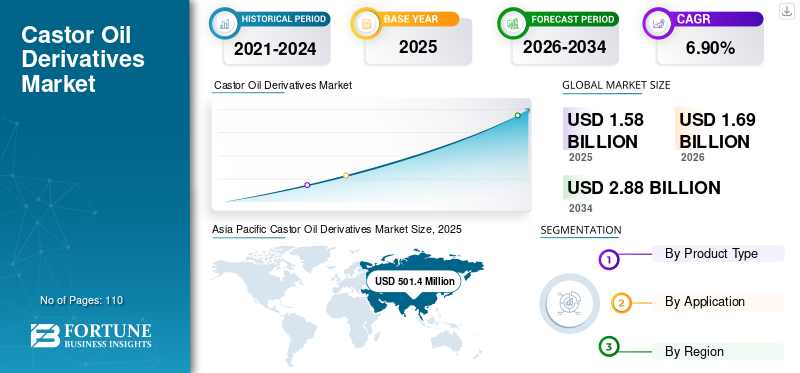
The global castor oil derivatives market size was valued at USD 1.58 billion in 2025. The market is projected to grow from USD 1.69 billion in 2026 to USD 2.88 billion by 2034, exhibiting a CAGR of 6.90% during the forecast period. Asia Pacific dominated the castor oil derivatives market with a market share of 48.43% in 2025.
Castor oil and its derivatives are multi-featured chemicals and widely used in the manufacturing of paints, lubricants, coatings, cosmetics, pharmaceuticals, and other products. Owing to their excellent chemical properties, these derivatives are gaining popularity. Leading ingredient manufacturing companies are launching castor oil-based ingredients to tap opportunities in the green chemicals market. For instance, in August 2020, BASF SE launched a Lamesoft Balance, a hydrogenated castor oil-based product to stabilize ingredients in hair and skin cleansing formulations. It helps in providing homogeneous rheology in cleansing formulations, which is often challenging to obtain. Such activities are fueling the castor oil derivatives market growth.
Download Free sample to learn more about this report.
Castor Oil Derivatives Market KEY TAKEAWAYS
 Market Size & Forecast
- 2019 Market Size: USD 1,035.4 Million
- 2027 Market Size: USD 1,429.7 Million
- Forecast Market Size:
- CAGR: 4.3% from 2020-2027
 Market Share
- Asia Pacific holds 48.43% market share.
- Sebacic Acid held the largest market share in 2019.
- Plastic & Resin held 36.5% market share in 2019.
 Key Regional Highlights
Asia Pacific
Asia Pacific holds 48.43% market share, driven by abundant castor seed availability.
Europe
Europe was the second-largest consumer in 2019, supported by increasing adoption of bio-based chemicals.
Asia Pacific
Asia Pacific is projected to register the fastest CAGR of 5.3%, supported by strong castor oil production.
U.S.
The U.S. market is projected to reach USD 155.1 million by 2027.
Japan
Japan is a key market within Asia Pacific, with demand supported by applications across cosmetics.
Read More

CASTOR OIL DERIVATIVES MARKET LATEST TRENDS
Increasing Adoption of Castor Oil Derivatives in Personal Care Products is a Key Trend
The cosmetics and perfumeries segment is one of the emerging applications of castor oil derivatives in the global market. Castor wax, castor oil esters, zinc ricinoleate, undecylenic acid are few of the key derivatives used in the manufacturing of hair care, skincare & lip care products, and perfumeries. These derivatives perform different roles during cosmetic manufacturing such as surfactants, emulsion stabilizers, skin conditioning agents, and others. With the increasing demand for natural cosmetics products globally, the adoption of natural ingredients is expected to increase in the future. In March 2020, Revlon launched a new collection of hair care products based on black castor oil, aloe vera, and vitamins under its ‘Creme of Nature’ brand.
Download Free sample to learn more about this report.
CASTOR OIL DERIVATIVES MARKET DRIVING FACTORS
Diverse Application of Castor Oil is Driving the Growth of Market
Because of the unique fatty acid structure, castor oil and its derivatives offer vast advantages as compared to other vegetable oils. Applications of oils derived from cotton, coconut, soy, corn, rapeseed are limited mostly to edible purposes. Castor oil derivatives are renewable, natural, and versatile in physicochemical properties. Thus, these products are preferred as a key raw material in multiple applications including lubricants, oleo-chemicals, medical, cosmetics, pharmaceuticals, bio-energy among others. Owing to the rising importance of green chemicals globally, the market is expected to indicate stable growth in the forthcoming years.
RESTRAINING FACTORS
Wavering Prices of Raw Materials to Restrain Growth
Castor oil is a prime feedstock for the production of its derivatives. The castor oil yield is highly dependent on conditions such as temperature, light, rainfall, soil characteristics, latitude, altitude among others. Depending on the yield, the price of castor oil is decided. The unstable prices affect downstream production and demand of castor oil derivatives, thus reducing profit margins. However, with the rapid adoption of modern agricultural practices backed by government policies will elevate the business of oils in the near future.
SEGMENTATION ANALYSIS
By Product Type Analysis
Sebacic Acid Segment Accounted for the Largest Revenue Share of the Global Castor Oil Derivatives Market
Sebacic acid is a bio-based and unique feedstock for the production of biopolymers. Owing to performance benefits such as durability, hydrophobicity, flexibility, and low melting points, it is widely adopted in the manufacturing of polyamides. Moreover, sebacic acid is adopted as an additive in lubricants, as a buffering agent in personal care products, as a corrosion inhibitor, and in the production of esters. Such diversity of sebacic acid among different applications is boosting the growth of the segment. Also, continuous advancement in bioplastics is propelling demand for sebacic acid as a key raw material.
By Application Analysis
To know how our report can help streamline your business, Speak to Analyst
Plastic & Resin Segment to Hold the Major Share of the Global Market
In 2025, the Plastic & Resin segment held the largest castor oil derivatives market share of 36.5% in the global market. These oil derivatives are extensively used in the manufacturing of plastic & resins, which are further used in paint, coating, inks, and other polymer applications. For instance, 12-hydroxy stearic acid is used as a feedstock to produce acrylic polymers. Moreover, the increase in the consumption of bioplastics globally is fueling demand for castor oil and its derivative in bioplastic production. According to the research study of Fortune Business Insights, the global bioplastics market is projected to register a CAGR of 16.2% during the forecast period.
REGIONAL ANALYSIS
Asia Pacific Castor Oil Derivatives Market Size, 2025 (USD Million)
To get more information on the regional analysis of this market, Download Free sample
Asia Pacific
Owing to the high presence of castor oil and its derivatives, Asia Pacific contributed a major share in the market in 2025. The region is also projected to register the fastest CAGR of 5.3% in terms of value. China is the global leader in the production and export of sebacic acid with a capacity of more than 210-kilo tons. Due to the abundance of castor seeds, India has become a producer & exporter of castor oil and castor oil derivatives such as 12-hydroxy stearic acid, castor wax, dehydrated castor oil, undecylenic acid among others. China, the USA, European Union are key export destinations for India. According to The Solvent Extractors Association of India, China holds around 40% of castor oil export from India followed by Europe 30-35%.
Europe
Europe was the second-largest consumer of castor oil derivatives in 2019. Increasing adoption and favorable government regulations regarding the use of bio-based chemicals is expected to drive the market growth in the near future. In 2019, the European Commission launched a ‘Green Deal’ to become a carbon-neutral region by 2050. This deal is backed by policy reforms and adopting green technologies across chemical industries operating in Europe. Therefore, both manufacturers and consumers are shifting preference for bio-based chemicals in Europe. Thus, such initiatives by the government are expected to propel the demand for this oil derivatives in Europe in the foreseeable future.
KEY INDUSTRY PLAYERS
Leading Players to Focus on Securing Sustainable Feedstock to Meet the Growing Demand
Securing feedstock for the production of castor oil derivatives is a key strategy followed by leading producers in the market. Jayant Agro Organics Limited, one of the leading producers and exporters of castor oil and its derivatives is taking the initiative to improve castor feedstock in India. In 2025, the company launched the ‘Pragati’ project in association with BASF and Arkema to develop more sustainable farming practices in India. Through this initiative, these companies are helping local Indian farmers to increase the yield of castor oil and supporting their economic growth each year.
LIST OF TOP CASTOR OIL DERIVATIVES COMPANIES PROFILED:
- Hengshui Jinghua Chemical Co., Ltd. (China)
- N.K. Proteins Pvt. Ltd. (India)
- Thai Castor Oil Industries Co. Ltd. (Thailand)
- Sebacic India Pvt. Ltd. (India)
- HOKOKU Co. Ltd. (Japan)
- Adani Wilmar Ltd. (India)
- Gokul Agri International Ltd. (India)
- RPK Agrotech (India)
- Arvalli Castor Derivatives Pvt Ltd. (India)
- Krishna Antioxidants Pvt. Ltd. (India)
KEY INDUSTRY DEVELOPMENTS:
- February 26, 2016: India based Shipra Agrichem invested around US$ 62.7 million to develop the first sebacic acid plant in Oman. The plant capacity is 30-kilo tons per year and the produced quantities are aimed to export to Europe, China, Japan, and the United States.
REPORT COVERAGE
Request for Customization to gain extensive market insights.
The castor oil derivatives market research report provides both qualitative & quantitative insights into the market. Quantitative insights include the global market sizing in terms of value (USD Million) and volume (Kilo Tons) across each segment, sub-segment, and region profiled in the scope of the study. Also, the report covers market share analysis and growth rates of the segment, sub-segments, and key counties across each region. Qualitative insight covers an elaborative analysis of market drivers, restraints, growth opportunities, key trends related to the market. The competitive landscape section covers detailed company profiling of the key players operating in the global market.
Report Scope & Segmentation
|
ATTRIBUTE |
DETAILS |
|
Study Period |
2021-2034 |
|
Base Year |
2025 |
|
Forecast Period |
2026-2034 |
|
Historical Period |
2021-2024 |
|
Unit |
Value (USD Million) & Volume (Kilo Tons) |
|
Segmentation |
Product Type, Application, and Geography |
|
By Product Type
|
|
|
By Application
|
|
|
By Geography
|
|
Frequently Asked Questions
According to Fortune Business Insights, the global castor oil derivatives market size was USD 1.69 billion in 2026, projected to reach USD 2.88 billion by 2034 at a CAGR of 6.90% during 2026–2034.
Registering a compounded annual growth rate of 6.90%, the market will exhibit steady growth in the forecast period (2026-2034).
Castor oil derivatives are widely used in cosmetics, pharmaceuticals, lubricants, paints, coatings, plastics, resins, and biofuels. Their versatility stems from unique chemical properties, making them suitable for use as emulsion stabilizers, surfactants, and conditioning agents.
The plastic & resin segment dominated the global market in 2025 with a 36.5% share. These derivatives are extensively used in producing bioplastics, coatings, and inks, with rising demand fueled by sustainable material consumption trends.
Asia Pacific held the largest market share of 48.43% in 2025 and is projected to register the fastest CAGR of 5.3%. India and China are major contributors due to abundant raw material availability and strong export capabilities.
Key products include sebacic acid, ricinoleic acid, hydrogenated castor oil, 12-hydroxy stearic acid, and dehydrated castor oil. Among them, sebacic acid holds the largest revenue share due to its use in biopolymers, lubricants, and personal care items.
The market is driven by increasing demand for bio-based and renewable chemicals across multiple sectors. The shift toward sustainable manufacturing and green chemistry is further boosting the adoption of castor oil derivatives globally.
Major companies include Jayant Agro Organics, N.K. Proteins, Thai Castor Oil Industries, Sebacic India Pvt. Ltd., BASF SE, and Adani Wilmar. These players are focused on sustainable sourcing and expanding production capacities to meet global demand.



- 2021-2034
- 2025
- 2021-2024
- 110
Get 30-60 hrs Free Customization
Expand Regional and Country Coverage, Segments Analysis, Company Profiles, Competitive Benchmarking, and End-user Insights.


















-
US +1 833 909 2966 ( Toll Free )
-
Get In Touch With Us