Dialysis Equipment Market Size, Share & Industry Analysis, By Type (Hemodialysis Machines (In-Center Hemodialysis Machines and Home Based Hemodialysis Machines) and Peritoneal Dialysis Equipment (Continuous Ambulatory Peritoneal Dialysis (CAPD) and Automated Peritoneal Dialysis (APD)), By End-user (Dialysis Centers and Hospitals and Home Healthcare), and Regional Forecast, 2026-2034
 Download Free Sample
Dialysis Equipment Market Size and Future Outlook
 Listen to Audio Version
The global dialysis equipment market size was valued at USD 5.86 billion in 2025. The market is projected to grow from USD 6.23 billion in 2026 to USD 10.28 billion by 2034, exhibiting a CAGR of 6.5% during the forecast period. North America dominated the global market with a market share of 33.45% in 2025.
Dialysis equipment refers to specialized medical machinery and supplies that replicate kidney function for patients with kidney failure. These systems filter toxins, waste products, and excess fluids from the blood when kidneys can no longer perform these tasks. The rising number of the aging population is resulting in the growing prevalence of chronic kidney diseases, further boosting the adoption rate of these products.
Fresenius Medical Care AG, Vantive, B. Braun SE, NIPRO, and WEIGAO GROUP held the largest market share in 2025. The growing equipment demand and the robust focus of key players on developing novel products are driving mergers and acquisitions.
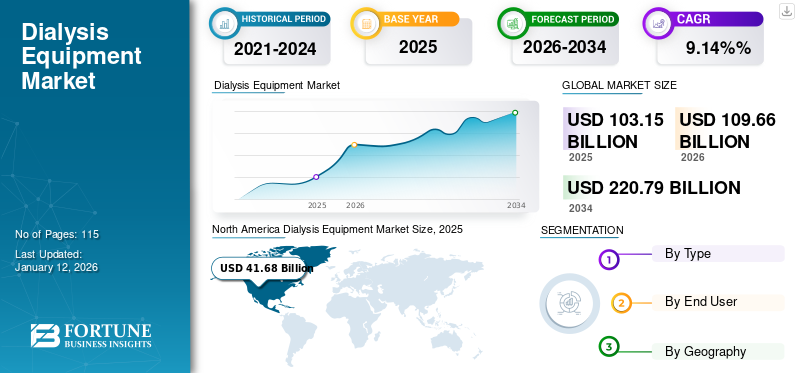
Download Free sample to learn more about this report.
DIALYSIS EQUIPMENT MARKET TRENDS
Substantial Shift from In-Center Dialysis to Home Dialysis is a Significant Market Trend
A significant shift from in-center dialysis to home dialysis is emerging as a prominent trend in the global market. Healthcare systems, payers, and providers are increasingly encouraging treatment models that improve convenience, support patient-centered care, and reduce dependence on facility-based dialysis capacity. This trend is strengthening the demand for home hemodialysis equipment, peritoneal dialysis cyclers, remote-monitoring tools, consumables, and related support services, making home-based therapy an increasingly important part of the dialysis care continuum. The trend is gaining momentum as home dialysis offers greater flexibility in treatment scheduling and can reduce the logistical burden associated with frequent travel to dialysis centers. It also aligns with broader care-delivery goals around decentralization, quality-of-life improvement, and more individualized therapy pathways. Moreover, this shift is contributing to the growing demand for home dialysis devices, installation services, patient training, digital support platforms, and recurring home-use consumables.
- For instance, according to data published by the U.S. Department of Health and Human Services (USDHHS), the percentage of incident dialysis patients performing home dialysis increased from 7.5% to 13.4% from 2011 to 2021.
The policy frameworks are increasingly designed to encourage home-based renal replacement therapy. In the U.S., CMS’s Kidney Care Choices model explicitly aims to incentivize home dialysis alongside better dialysis starts and greater transplant utilization. As reimbursement and value-based care structures evolve, home dialysis is becoming more commercially attractive for providers and more accessible for appropriately selected patients. Additionally, ongoing product innovation and digital enablement are also likely to contribute to the penetration rate of these procedures in the market. Home dialysis pathways are increasingly supported by remote monitoring, connected treatment platforms, and improved patient support models, which make at-home therapy more manageable for both patients and care teams. This strengthens confidence in home treatment adoption and helps expand the market beyond traditional in-center settings.
MARKET DYNAMICS
MARKET DRIVERS
Download Free sample to learn more about this report.
Mounting Prevalence of Chronic Kidney Conditions to Fuel the Demand for Advanced Products
The rising burden of chronic kidney disease is a major driver for global dialysis equipment market growth. There is an increase in the number of patients requiring renal replacement therapy, especially hemodialysis or peritoneal dialysis, as CKD progresses to advanced stages and kidney function declines among patients. This directly supports the demand for dialysis machines, dialyzers, bloodlines, concentrates, catheters, access products, and related consumables across hospital, clinic, and home-care settings.
- For instance, according to 2024 statistics published by Nature, it was reported that approximately 850 million people worldwide are estimated to have kidney disease, most of whom live in low-income and lower-middle-income countries (LICs and LMICs). Further, a large proportion of these individuals lack access to kidney disease diagnosis, prevention, or treatment.
The key risk factors for these diseases are highly prevalent and persistent, resulting in growing demand for dialysis equipment. Kidney disease is closely linked with diabetes and hypertension, two chronic conditions that continue to expand globally and drive progression toward end-stage kidney disease. CKD is often silent in early stages and is frequently diagnosed late, when patients are already closer to needing intensive intervention or kidney replacement therapy. Furthermore, the delayed diagnosis increases the likelihood of higher treatment intensity among patients, which strengthens the recurring demand for chronic dialysis infrastructure, monitoring products, and replacement consumables. The growing prevalence is further supported by the improving survival of patients receiving long-term renal care, among others.
Moreover, dialysis is not a one-time intervention but a recurring and high-frequency therapy. As more patients remain on treatment for longer periods, the market benefits from new patient additions as well as sustained utilization of machines, disposables, vascular access products, and clinic capacity. Therefore, the above-mentioned factors, along with rising research and development activities to launch technologically advanced dialysis systems, are further anticipated to support the growing adoption rate of these devices.
|
Rank |
Market Driver |
Overall Impact Rank |
Gross Growth Contribution (USD Billion, 2026-2034) |
Impact: 2026-2028 |
Impact: 2029-2031 |
Impact: 2032-2034 |
|
1 |
Rising ESRD/CKD burden driven by diabetes, hypertension, and aging population |
High |
1.35 |
High |
High |
High |
|
2 |
Expansion of dialysis infrastructure, center capacity, and treatment access in emerging markets |
High |
1.10 |
Medium |
High |
High |
|
3 |
Replacement and upgrade demand for aging installed base of dialysis machines |
High |
0.95 |
Medium |
High |
High |
|
4 |
Growing adoption of home dialysis equipment, including home HD and APD systems |
Medium |
0.85 |
Medium |
Medium |
High |
|
5 |
Technological advancements in compact, automated, digitally connected, and user-friendly systems |
Medium |
0.75 |
Medium |
Medium |
High |
|
6 |
Others (public-private partnerships, localization of manufacturing, product portfolio expansion, improved service support) |
Low |
0.70 |
Low |
Low |
Medium |
|
Total Gross Growth Contribution |
5.70 |
MARKET RESTRAINTS
Poor Reimbursement and Management Policies for Dialysis Treatment in Emerging Countries to Restrict Market Growth
Poor reimbursement structures and weak management policies remain a major restraint in the market, especially across developing countries. Dialysis is a high-frequency, resource-intensive therapy that depends on sustained financing, stable procurement, trained personnel, and effective referral systems. When reimbursement is inadequate or irregular, companies often face difficulty expanding capacity, maintaining infrastructure, and ensuring uninterrupted treatment delivery, which directly hampers market growth across equipment, consumables, and service segments. The dialysis demand does not translate into market expansion unless patients can consistently afford treatment or access publicly funded care. In many developing countries, kidney care remains heavily dependent on out-of-pocket spending and reimbursement coverage for kidney replacement therapy is still limited. Moreover, this reduces treatment initiation, lowers adherence to recommended treatment frequency, and delays the adoption of advanced dialysis technologies in cost-sensitive settings.
- For instance, according to 2023 data published by the International Society of Nephrology (ISN), in many countries where KRT is not publicly funded, the annual minimum wage is less than USD 2,000.0 while the annual cost of dialysis is more than USD 25,000.0.
Additionally, weak policy execution and fragmented care management are also limiting the adoption of dialysis procedures. The inadequate planning around dialysis-unit distribution, referral pathways, workforce availability, and consumables supply can reduce treatment access among the patient population, resulting in a reduced number of patients receiving treatment, thereby weakening adoption for machines, dialyzers, tubing sets, concentrates, access products, and related support services. This, along with the increasing prevalence of kidney disease among economically vulnerable populations already burdened by diabetes, hypertension, and other chronic conditions, is making long-term dialysis financially unsustainable for households. This restricts patient volumes and affects provider economics, discouraging new center setup, technology upgrades, and private-sector participation in underpenetrated markets.
|
Rank |
Market Restraint |
Overall Impact Rank |
Market Size Reduction (USD Billion, 2026-2034) |
Impact: 2026-2028 |
Impact: 2029-2031 |
Impact: 2032-2034 |
|
1 |
High capital cost of dialysis equipment, installation, and poor reimbursement burden for providers |
High |
0.75 |
High |
High |
Medium |
|
2 |
Infrastructure and operational limitations, including water treatment, maintenance, and trained staff gaps |
Medium |
0.45 |
Medium |
Medium |
High |
|
3 |
Preference for refurbished equipment and longer replacement cycles in cost-sensitive markets |
Medium |
0.30 |
Medium |
Medium |
Low |
|
4 |
Others (regulatory delays, tender volatility, import dependency, pricing pressure) |
Low |
0.15 |
Low |
Low |
Low |
|
Total Market Reduction |
1.65 |
MARKET OPPORTUNITIES
Improving Access and Expansion of Healthcare Infrastructure is an Emerging Opportunity
The expansion of dialysis capacity across emerging markets represents a significant opportunity for market players. Many low- and middle-income countries still face substantial under-penetration in dialysis infrastructure, despite a growing burden of chronic kidney disease and end-stage renal disease. There is an increasing demand for dialysis machines, dialyzers, blood tubing sets, concentrates, catheters, water-treatment systems, and other recurring consumables as governments, private providers, and public-private partnerships are expanding district-level dialysis services, setting up new treatment centers, and improving referral access. This opportunity is especially significant as dialysis markets in many emerging countries are still constrained by capacity availability rather than by underlying disease need. The healthcare infrastructure is expanding, resulting in growing actual treatment volumes, creating a multiplier effect across center construction, equipment installation, and long-term consumables utilization.
These factors, along with the installation of support systems including reverse osmosis water purification units, vascular access products, acute and chronic dialysis equipment, technical service support, and trained personnel, are contributing to the demand across both capital equipment and high-frequency consumables. These factors are improving the long-term revenue visibility of the dialysis market.
- For instance, according to 2025 data published by the Government of India, there are about 1,704 operational dialysis centers in India.
The opportunity is also supported by the fact that several emerging economies are actively introducing or scaling national dialysis-access initiatives. These programs improve affordability and broaden treatment availability through district hospitals and partnership-based delivery models, thereby making dialysis access more geographically and financially feasible.
MARKET CHALLENGES
Risk and Complications Associated with Dialysis Procedures to Slow Down Market Growth
The risks and complications associated with dialysis procedures remain a significant restraint for global market expansion. Although dialysis is a life-sustaining therapy, it is associated with multiple clinical complications, including infections, cardiovascular events, access-related issues, and treatment-related side effects. These risks can affect patient outcomes, reduce treatment adherence, and create hesitation among patients and caregivers when initiating long-term dialysis therapy. Dialysis requires repeated and prolonged exposure to extracorporeal circulation and vascular access, which increases the likelihood of complications over time. Hemodialysis patients are especially vulnerable to bloodstream infections due to catheter use, while peritoneal dialysis carries the risks of peritonitis, which can increase hospitalization rates and limit the optimal utilization of dialysis therapies.
Additionally, the burden of managing complications adds to the overall cost and complexity of care, further limiting the expansion of dialysis infrastructure and adoption of advanced treatment modalities. The challenge is further amplified by the high comorbidity burden among dialysis patients. Individuals requiring dialysis often have underlying conditions such as diabetes, hypertension, and cardiovascular disease, which increase the risk of adverse events during treatment. This makes dialysis care more complex and may limit eligibility for certain therapies or increase dependency on high-intensity clinical settings.
- According to data published by the Centers for Disease Control & Prevention (CDC), adults on dialysis depicted a likelihood of more than 100 times for a staph bloodstream infection compared to those not on dialysis in the U.S. during 2017 to 2020.
The availability of limited healthcare professionals in emerging countries is an additional factor hampering the growth of the market.
Segmentation Analysis
By Type
Hemodialysis Machines Segment Led the Market due to Availability of Large In-Center Treatment Networks
Based on type, the market is segmented into hemodialysis machines and peritoneal dialysis equipment. Hemodialysis machines are further segmented into in-center hemodialysis machines and home based hemodialysis machines. Additionally, peritoneal dialysis equipment is segmented into continuous ambulatory peritoneal dialysis (CAPD) and automated peritoneal dialysis (APD).
To know how our report can help streamline your business, Speak to Analyst
The hemodialysis machines segment dominated the global market in 2025. The segment growth is attributed to the presence of large in-center treatment networks, hospital-based infrastructure, trained personnel, and reimbursement pathways, resulting in the growing adoption of hemodialysis among patients. Additional factor supporting segmental expansion is an increasing number of patients undergoing renal replacement therapy with hemodialysis due to faster treatment initiation, broader provider familiarity, and stronger installed infrastructure across both developed and emerging markets.
Additionally, the peritoneal dialysis equipment segment is projected to grow at a CAGR of 7.5% during the forecast period.
By End-user
Dialysis Centers and Hospitals Segment Dominated Owing to Surging Dialysis Procedure Demand in these Settings
On the basis of end-user, the market is classified into dialysis centers and hospitals and home healthcare.
The dialysis centers and hospitals segment dominated the global dialysis equipment market share in 2025. The segment growth is attributed to the rising prevalence of chronic kidney disorders, which are increasing the demand for dialysis procedures in these healthcare settings. Moreover, a soaring number of hospitals and dialysis centers and improving healthcare access are some of the other factors contributing to the segment growth. Furthermore, the segment is set to hold a share of 90.2% in 2026.
In addition, the home healthcare segment is projected to grow at a CAGR of 10.2% during the forecast period.
Dialysis Equipment Market Regional Outlook
Based on geography, the market is classified into North America, Europe, Asia Pacific, Latin America, and the Middle East & Africa.
North America
North America Dialysis Equipment Market Size, 2025 (USD Billion)
To get more information on the regional analysis of this market, Download Free sample
North America held the largest share in 2024, with a value of USD 1.85 billion, and reached a value of USD 1.96 billion in 2025. North America accounted for the leading market share in 2025 and is expected to continue growing at a significant pace over the forecast period. The region’s strong position is supported by the high prevalence of chronic conditions, well-established healthcare infrastructure, and broad awareness regarding disease management. Additionally, the widespread adoption of dialysis procedures in homecare settings and the presence of major companies continue to support market expansion across the U.S. and Canada.
- According to 2026 data published by Centers for Disease Control & Prevention (CDC), about 37.0 million people have chronic kidney disease in the U.S.
U.S. Dialysis Equipment Market
In 2026, the U.S. market is projected to reach USD 19.2 billion, capturing 30.8% of the global revenue.
Europe
The Europe market is expected to depict a growth rate of 5.3% over the forecast period, the second-highest globally. The regional market is estimated to reach USD 1.54 billion by 2026. In Europe, which held a significant share in 2025, the market growth is being supported by the rising elderly population, increasing burden of chronic disorders, and strong access to healthcare services across European countries. The region is also benefiting from the availability of established companies and growing demand for efficient dialysis systems in both clinical and homecare settings, which is helping sustain steady adoption of dialysis products and services.
U.K. Dialysis Equipment Market
The U.K. market is projected to reach USD 0.18 billion by 2026, accounting for 2.9% of the global market revenue.
Germany Dialysis Equipment Market
The Germany market is anticipated to reach about USD 0.28 billion by 2026, representing roughly 4.4% of global revenue.
Asia Pacific
In 2026, the Asia Pacific market is predicted to touch a value of USD 1.81 billion, ranking as the third-largest globally. The regional market held a considerable market share in 2025 and is expected to register the fastest growth during the forecast period. This growth is largely driven by the region’s large patient pool, rising incidence of chronic kidney disease, improving healthcare infrastructure, and increasing access to kidney care in countries such as China, India, and Japan.
Japan Dialysis Equipment Market
The Japan market is projected to generate a value of approximately USD 0.39 billion by 2026, contributing nearly 6.3% to the global market.
China Dialysis Equipment Market
The China market is estimated to reach approximately USD 0.51 billion by 2026, contributing about 8.2% to global revenues.
India Dialysis Equipment Market
The India market is anticipated to contribute a valuation of approximately USD 0.19 billion by 2026, corresponding to about 3.0% of global revenues.
Latin America and Middle East & Africa
Latin America and the Middle East & Africa markets are anticipated to witness moderate growth, with Latin America expected to reach around USD 0.41 billion by 2026. This region is also expected to grow at a considerable rate during the forecast period. Furthermore, the market in these regions is supported by a stronger reimbursement, relatively better infrastructure, and broad availability of dialysis modalities. The product demand is driven by the rising CKD burden and sustained procurement of chronic dialysis devices and related technologies.
GCC Dialysis Equipment Market
By 2026, the GCC market is estimated to generate a valuation of approximately USD 0.12 billion, accounting for nearly 1.9% of global revenues.
COMPETITIVE LANDSCAPE
Key Industry Players
Robust Product Innovation to Strengthen the Market Positions of Prominent Players
The global dialysis equipment market is a semi-consolidated market with Fresenius Medical Care AG accounting for the highest share in the global market in 2025 with their wide range of products. The rising emphasis of the company toward receiving approvals for dialysis devices is contributing to its market share.
- In February 2024, Fresenius SE & Co. KGaA announced FDA 510(k) clearance for the 5008X hemodialysis system for U.S.-based clinical evaluations and user studies ahead of broader launch. This broadened the company’s product portfolio.
Moreover, Vantive, B. Braun SE, and NIPRO continue to hold strong positions by focusing on partnerships and the introduction of novel devices in the market.
LIST OF KEY DIALYSIS EQUIPMENT COMPANIES PROFILED
- Braun SE (Germany)
- Fresenius Medical Care AG (Germany)
- Mozarc Medical Holding LLC. (U.S.)
- NIPRO (Japan)
- Vantive (U.S.)
- WEIGAO GROUP (China)
- BAIN MEDICAL EQUIPMENT (GUANGZHOU) CO.,LTD (China)
- Outset Medical, Inc. (U.S.)
- Quanta Dialysis Technologies Inc. (U.K.)
KEY INDUSTRY DEVELOPMENTS
- March 2026: Asahi Kasei Medical Co., Ltd., announced the commencement of the sales of its hemodialysis machines "Asahi PS Dialyzer APS-MA NX" and "Asahi PS Dialyzer APS-UA NX" to medical institutions nationwide.
- November 2025: Vantive introduced HomeAdvantage, a digitally enabled home-therapy ecosystem. The solution combines PD therapies, supply ordering, technical support, and education powered by Vantive CONNECT.
- October 2025: DaVita Inc. launched two initiatives, MODEL and MEMOIRS, to generate the first-of-its-kind U.S. data on middle-molecule clearance using medium-cut-off dialyzers. The move aimed at reducing inflammation and improving outcomes for kidney failure patients.
- September 2025: Mozarc Medical partnered with DK Medical Technology (Suzhou) Co., Ltd. (DK Medtech) with an aim to strengthen PTA balloon technology in the U.S. AV access market.
- June 2025: Fresenius SE & Co. KGaA announced broader U.S. commercialization of the 5008X CAREsystem, with updated FDA clearance and the rollout of high-volume hemodiafiltration in the U.S. clinic network.
REPORT COVERAGE
The dialysis equipment market report provides an in-depth analysis of all market segments. Furthermore, the report highlights key drivers, trends, opportunities, restraints, and challenges across the market. It also provides insights into technological advancements, key industry developments, company market share analysis, and the profiles of leading companies.
Request for Customization to gain extensive market insights.
Report Scope & Segmentation
| ATTRIBUTE | DETAILS |
| Study Period | 2021-2034 |
| Base Year | 2025 |
| Estimated Year | 2026 |
| Forecast Period | 2026-2034 |
| Historical Period | 2021-2024 |
| Growth Rate | CAGR of 6.5% from 2026-2034 |
| Unit | Value (USD Billion) |
| Segmentation | By Type, End-user, and Region |
| By Type |
|
| By End-user |
|
| By Region |
|
Frequently Asked Questions
Fortune Business Insights says that the global market value stood at USD 5.86 billion in 2025 and is projected to reach USD 10.28 billion by 2034.
In 2025, the North America market value stood at USD 1.96 billion.
The market is expected to exhibit a CAGR of 6.5% during the forecast period of 2026-2034.
The hemodialysis machines segment led the market by type in 2025.
A key factor driving the market is the growing prevalence of chronic kidney conditions.
Fresenius Medical Care AG, Vantive, B. Braun SE, and NIPRO are the major players in the market.
North America dominated the market in 2025.



- 2021-2034
- 2025
- 2021-2024
- 115
Get 30-60 hrs Free Customization
Expand Regional and Country Coverage, Segments Analysis, Company Profiles, Competitive Benchmarking, and End-user Insights.













.webp)






Related Reports
-
US +1 833 909 2966 ( Toll Free )
-
Get In Touch With Us