Construction Equipment Market Size, Share & Industry Analysis, By Equipment Type (Earthmoving Equipment, Material Handling Equipment & Cranes, Concrete Equipment, Road Building Equipment, Civil Engineering Equipment, Crushing and Screening Equipment, and Other Equipment), By Propulsion Type (Internal Combustion Engine (ICE), Electric Construction Equipment, and CNG/LNG), By Power Output (<100 HP, 101-200 HP, 201-400 HP, and >401 HP), By Engine Capacity (Up to 250 HP, 250-500 HP, and More than 500 HP), By Application (Residential, Commercial, and Industrial), and Regional Forecast, 2026 – 2034
 Download Free Sample
 Construction Equipment Market Size and Future Outlook
 Listen to Audio Version
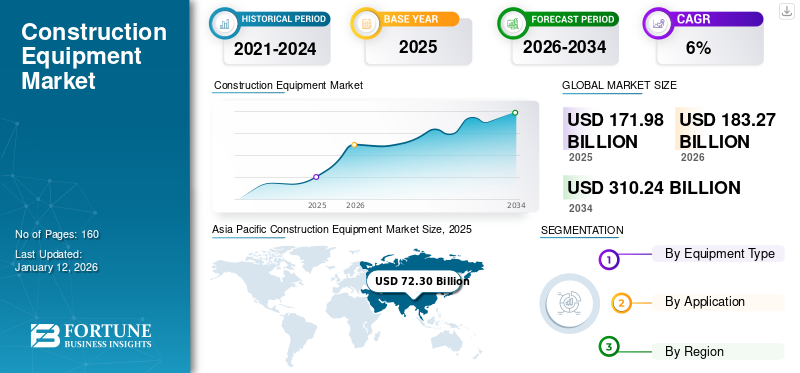
The global construction equipment market size was valued at USD 237.41 billion in 2025. The market is projected to grow from USD 252.87 billion in 2026 to USD 426.44 billion by 2034, exhibiting a CAGR of 6.8% during the forecast period. Asia Pacific dominated the construction equipment market with a market share of 42.97% in 2025.
Construction equipment comprises machinery, vehicles, attachments, and engineered systems used for earthmoving, material handling, road construction, concrete placement, lifting, excavation, demolition, and infrastructure development activities across residential, commercial, industrial, mining, and public infrastructure projects. The market includes excavators, loaders, bulldozers, motor graders, dump trucks, cranes, road rollers, pavers, concrete equipment, telehandlers, and compact construction machinery designed to improve productivity, reduce project timelines, and enhance operational efficiency. Growing investments in transportation infrastructure, rapid urbanization, renewable energy projects, mining activities, and smart city initiatives are driving demand for advanced construction equipment globally. The increasing adoption of telematics, machine control systems, autonomous operation technologies, predictive maintenance solutions, and fuel-efficient equipment is further improving fleet performance and asset utilization across construction sites. Rising equipment rental penetration and infrastructure modernization programs continue to support market expansion globally.
- For instance, in March 2025, Caterpillar Inc. expanded its next-generation connected equipment portfolio with enhanced machine automation and remote fleet monitoring capabilities, strengthening productivity optimization and equipment lifecycle management across large-scale construction projects.
Caterpillar Inc., Komatsu Ltd., Volvo Construction Equipment, Hitachi Construction Machinery Co., Ltd., Liebherr Group, Deere & Company, JCB Ltd., SANY Group, and XCMG Group, are among the major companies operating in the market.
Download Free sample to learn more about this report.
CONSTRUCTION EQUIPMENT MARKET KEY TAKEAWAYS
 Global Market Size & Forecast
- 2025 Market Size: USD 237.41 billion
- 2026 Market Size: USD 252.87 billion
- 2034 Forecast Market Size: USD 426.44 billion
- CAGR: 6.80% from 2026–2034
 Market Share
- Asia Pacific dominated the market with a 42.97% share in 2025.
- The Internal Combustion Engine (ICE) segment is expected to dominate the market in 2026.
- The Residential segment is expected to dominate the market in 2026.
 Key Regional Highlights
Asia Pacific
The market reached USD 102.02 billion in 2025.
North America
The market reached USD 47.66 billion in 2025.
Europe
The market is projected to witness steady growth by 2026.
U.S.
The market is projected to reach USD 40.12 billion by 2026.
Japan
The market is projected to reach USD 13.69 billion by 2026.
Read More

CONSTRUCTION EQUIPMENT MARKET TRENDS
Growing Adoption of Intelligent, Connected, and Autonomous Equipment to be a Significant Market Trend
Demand for construction equipment is increasingly being driven by the growing adoption of telematics-enabled machinery, machine control systems, autonomous operation technologies, and connected fleet management platforms across infrastructure, commercial, residential, mining, and industrial construction projects. As contractors and equipment owners focus on improving productivity, reducing fuel consumption, minimizing downtime, and addressing skilled labor shortages, manufacturers are integrating advanced sensors, GPS guidance systems, Artificial Intelligence (AI), machine learning, and real-time equipment monitoring capabilities into construction machinery. The market is witnessing rising deployment of semi-autonomous excavators, intelligent compaction systems, automated grading equipment, remote diagnostics solutions, and predictive maintenance platforms that improve operational efficiency, enhance jobsite safety, and optimize asset utilization. The transition from conventional machinery toward data-driven and digitally connected equipment fleets is enabling construction companies to improve project execution, reduce operating costs, and achieve greater visibility across equipment operations while supporting long-term infrastructure development initiatives globally.
- For instance, in January 2025, Komatsu Ltd. expanded its Smart Construction platform with enhanced digital jobsite management and machine guidance capabilities, strengthening the integration of connected equipment, automation technologies, and real-time project optimization solutions across construction operations.
MARKET DYNAMICS
MARKET DRIVERS
Download Free sample to learn more about this report.
Rising Global Infrastructure Investments and Urban Development Activities Driving Market Growth
The market is increasingly being driven by growing investments in transportation infrastructure, urban expansion, industrial development, energy projects, and public works modernization across developed and emerging economies. Governments and private sector developers are allocating substantial capital toward highways, rail networks, airports, ports, bridges, renewable energy facilities, and smart city projects, creating sustained demand for earthmoving, material handling, road construction, and concrete equipment. Construction equipment enables contractors to improve project execution speed, increase operational productivity, and manage large-scale construction activities efficiently while addressing labor shortages and rising project complexity. The growing deployment of advanced excavators, loaders, cranes, graders, and intelligent construction machinery is supporting faster infrastructure delivery, reduced project timelines, and enhanced jobsite efficiency. Additionally, increasing replacement demand for aging equipment fleets and expanding construction activities in residential and commercial sectors continue to strengthen construction equipment market growth globally.
- For instance, in March 2026, Komatsu introduced the new HM460-6 articulated dump truck, engineered for increased traction, power, and payload, strengthening its construction equipment portfolio for high-demand earthmoving and infrastructure applications.
MARKET RESTRAINTS
High Equipment Ownership Costs and Cyclical Construction Demand Limiting Market Expansion
The growth of the market is constrained by high equipment acquisition costs, maintenance expenses, fuel consumption, financing pressure, and uncertain construction spending cycles. Heavy equipment such as excavators, cranes, dump trucks, loaders, and road construction machinery requires substantial upfront investment, making fleet expansion difficult for small and mid-sized contractors. In addition, rising interest rates, volatile raw material prices, delayed infrastructure approvals, and fluctuations in residential, commercial, and mining activity can slow purchasing decisions. Equipment owners also face pressure from spare parts availability, operator shortages, emission compliance costs, and downtime-related losses. As a result, many contractors increasingly prefer rental or leasing models over direct purchase, which can moderate new equipment sales in price-sensitive markets.
MARKET OPPORTUNITIES
Expanding Equipment Rental Industry and Infrastructure Investments in Emerging Economies Creating Significant Market Opportunities
A major opportunity emerging within the market is the rapid expansion of equipment rental services and increasing infrastructure investments across emerging economies. Governments are allocating substantial budgets toward transportation networks, urban infrastructure, industrial corridors, renewable energy projects, airports, ports, and smart city developments, creating sustained demand for construction equipment without requiring contractors to make large capital investments. At the same time, the growing preference for equipment rental among small and medium-sized contractors is enabling broader access to advanced machinery while reducing ownership, maintenance, and fleet management costs. Rental providers are expanding their fleets with modern, fuel-efficient, and application-specific equipment to meet evolving customer requirements across residential, commercial, industrial, and infrastructure projects. This trend is creating significant opportunities for manufacturers to strengthen partnerships with rental companies, expand aftermarket services, and increase equipment sales across high-growth developing markets.
- For instance, in January 2026, Volvo Construction Equipment announced the global rollout of its new generation of articulated haulers featuring enhanced productivity, connectivity, and fuel-efficiency technologies, reinforcing the industry's transition toward intelligent and more sustainable heavy equipment solutions.
MARKET CHALLENGES
Supply Chain Disruptions, Skilled Labor Shortages, and Emission Compliance Requirements Affecting Market Growth
One of the major challenges affecting the market is the increasing complexity of managing equipment production, fleet operations, and project execution amid supply chain uncertainties, labor shortages, and evolving environmental regulations. Construction equipment manufacturers continue to face challenges related to component availability, semiconductor supply constraints, logistics disruptions, and raw material price volatility, which can impact production schedules and equipment delivery timelines. At the same time, contractors are experiencing difficulties in recruiting and retaining skilled equipment operators, maintenance technicians, and construction personnel, affecting equipment utilization and project productivity. The industry is also facing growing pressure to comply with stricter emission standards, safety regulations, and sustainability requirements, often requiring significant investments in advanced engine technologies, electrification initiatives, and fleet modernization programs. These factors collectively increase operational costs and create challenges for both equipment manufacturers and end users across global markets.
Segmentation Analysis
By Equipment Type
Earthmoving Equipment Segment Led Market Owing to Its Extensive Utilization Across Infrastructure, Mining, and Urban Construction Projects
By equipment type, the market is segmented into earthmoving equipment, material handling equipment & cranes, concrete equipment, road building equipment, civil engineering equipment, crushing & screening equipment, and other equipment.
Earthmoving equipment segment held the largest construction equipment market share in 2025, driven by its widespread deployment across residential construction, commercial developments, transportation infrastructure, mining operations, and utility projects. Excavators, loaders, bulldozers, backhoe loaders, and motor graders represent the backbone of construction activities, supporting excavation, site preparation, land development, material movement, and grading operations. Compared with other equipment categories, earthmoving machinery benefits from broad applicability across nearly every stage of the construction lifecycle, resulting in consistently high utilization rates and replacement demand. Growing investments in highways, railways, airports, industrial facilities, renewable energy projects, and urban infrastructure continue to support strong demand for earthmoving equipment globally. The increasing integration of telematics, machine control systems, and fuel-efficient technologies is further strengthening equipment productivity and fleet utilization.
- For instance, in February 2025, Hitachi Construction Machinery launched the ZX135US-7 medium excavator in North America, expanding its earthmoving equipment portfolio with enhanced fuel efficiency, operator comfort, and advanced telematics capabilities for infrastructure and construction applications.
Material handling equipment & cranes segment is expected to witness the highest growth rate, with a CAGR of 7.4% during the forecast period, driven by increasing investments in high-rise construction, industrial facilities, logistics infrastructure, renewable energy projects, and large-scale transportation developments. Growing demand for efficient lifting, material transportation, and heavy-load handling solutions is accelerating the adoption of advanced cranes, telehandlers, and material handling equipment across global construction sites.
To know how our report can help streamline your business, Speak to Analyst
By Propulsion Type
Internal Combustion Engine (ICE) Segment Led Market Owing to Its Dominance Across Heavy-Duty Construction and Infrastructure Applications
By propulsion type, the market is segmented into internal combustion engine (ICE), electric construction equipment, and CNG/LNG.
Internal Combustion Engine (ICE) segment held the largest market share in 2025, driven by its extensive deployment across earthmoving, mining, road construction, material handling, and heavy infrastructure projects. Diesel-powered excavators, loaders, bulldozers, dump trucks, motor graders, and cranes continue to dominate global equipment fleets due to their high power output, proven reliability, extended operating range, and suitability for demanding jobsite conditions. Compared with alternative propulsion technologies, ICE equipment benefits from established fueling infrastructure, lower upfront costs, wider equipment availability, and strong performance in remote construction and mining locations. The segment continues to benefit from ongoing infrastructure development, large-scale transportation projects, and equipment replacement demand across both developed and emerging economies.
Electric construction equipment segment is expected to witness the highest growth rate, with a CAGR of 12.0% during the forecast period, driven by increasing emission regulations, sustainability initiatives, and growing adoption of low-noise, zero-tailpipe-emission machinery across urban construction projects. Expanding investments in electric excavators, compact wheel loaders, mini construction equipment, and battery-powered material handling solutions are accelerating market growth.
By Power Output
101–200 HP Segment Led Market Owing to Its Extensive Utilization Across Core Construction and Infrastructure Applications
By power output, the market is segmented into <100 HP, 101–200 HP, 201–400 HP, and >401 HP.
101–200 HP segment held the largest market share in 2025, driven by its broad applicability across earthmoving, road construction, material handling, utility installation, and general construction activities. Equipment within this power range, including excavators, wheel loaders, backhoe loaders, compact dozers, and motor graders, offers an optimal balance between performance, fuel efficiency, versatility, and operating costs. Compared with lower- and higher-powered equipment categories, machinery in the 101–200 HP range is widely utilized across residential, commercial, industrial, and infrastructure projects, making it the preferred choice for contractors and rental fleet operators.
<100 HP segment is expected to witness the highest growth rate, with a CAGR of 7.3% during the forecast period, driven by increasing demand for compact construction equipment across urban development, residential construction, landscaping, utility maintenance, and municipal infrastructure projects.
By Engine Capacity
Up to 250 HP Segment Led Market Owing to Its Broad Deployment Across Mainstream Constructions
By engine capacity, the market is segmented into up to 250 HP, 250–500 HP, and more than 500 HP.
Up to 250 HP held the largest market share in 2025, driven by its extensive utilization across residential construction, commercial developments, municipal projects, utility installation, road maintenance, and general infrastructure activities. Equipment within this engine capacity range, including compact and mid-sized excavators, wheel loaders, backhoe loaders, skid steer loaders, and motor graders, offers a favorable balance of productivity, fuel efficiency, operating flexibility, and ownership costs. Compared with higher-capacity equipment, machines in this category are suitable for a wider range of applications and project sizes, resulting in higher fleet penetration among contractors, rental companies, and construction service providers.
250–500 HP is expected to witness a significant CAGR of 7.0% during the forecast period, driven by increasing investments in large-scale infrastructure, mining, industrial construction, quarrying, and energy development projects. Equipment within this capacity range delivers higher productivity, greater material handling capability, and improved operational efficiency for demanding applications.
By Application
Residential Segment Led Market Owing to Sustained Housing Construction and Urban Development Activities
By application, the market is segmented into residential, commercial, and industrial.
Residential segment held the largest market share in 2025, driven by increasing housing demand, urban expansion, population growth, and government-supported residential development initiatives across major economies. Construction equipment plays a critical role in site preparation, excavation, material handling, road access development, utility installation, and foundation construction for housing projects. Compared with commercial and industrial projects, residential construction generates a significantly higher volume of construction activities, particularly in rapidly urbanizing regions across Asia Pacific, North America, and the Middle East.
Industrial segment is expected to witness the highest growth rate, with a CAGR of 7.2% during the forecast period, driven by increasing investments in manufacturing facilities, warehouses, logistics hubs, semiconductor plants, data centers, renewable energy infrastructure, and industrial parks globally.
Construction Equipment Market Regional Outlook
By geography, the market is categorized into Europe, North America, Asia Pacific, South America, and the Middle East & Africa.
Asia Pacific
Asia Pacific Construction Equipment Market Size, 2025 (USD Billion)
To get more information on the regional analysis of this market, Download Free sample
Asia Pacific region dominates the market and accounted for USD 102.02 billion in 2025 globally. Within the region, China and India represent major markets due to their extensive construction activities, advanced equipment fleets, and strong infrastructure spending, while India and Southeast Asia are emerging as high-growth markets driven by smart city initiatives, industrial corridor developments, and rising government investments in roads, railways, airports, and logistics infrastructure. Demand for construction equipment continues to increase as contractors, infrastructure developers, and industrial companies seek to improve productivity, reduce project timelines, and support large-scale construction activities.
China Construction Equipment Market
China’s market is projected to remain the dominant in the Asia Pacific region, with 2026 revenues estimated at around USD 50.83 billion, representing roughly 20.1% of global sales.
Japan Construction Equipment Market
The Japanese market is estimated at around USD 13.69 billion in 2026, accounting for roughly 5.4% of the global sales.
India Construction Equipment Market
The market is estimated at around USD 17.26 billion in 2026, accounting for roughly 6.8% of global sales.
North America
The North American market accounted for USD 47.66 billion in revenue in 2025, supported by large-scale infrastructure investments, extensive residential construction activity, expanding industrial development projects, and ongoing replacement demand for aging equipment fleets across the U.S. and Canada. Regional demand is strongly influenced by highway modernization programs, transportation infrastructure upgrades, energy projects, warehouse construction, and increasing investments in manufacturing facilities. The region benefits from advanced construction practices, high equipment utilization rates, strong rental equipment penetration, and widespread adoption of telematics, automation, and machine control technologies.
U.S. Construction Equipment Market
The U.S. is expected to dominate the market with an estimated revenue of about USD 40.12 billion in 2026, driven by substantial investments in transportation infrastructure, industrial reshoring initiatives, residential construction projects, and energy sector development. Demand for construction equipment remains particularly strong across highway construction, bridge rehabilitation, airport expansion, utility infrastructure upgrades, manufacturing facility construction, and large-scale commercial developments. The country continues to experience growing adoption of connected machinery, intelligent machine control systems, autonomous construction technologies, and predictive maintenance solutions aimed at improving productivity and reducing operating costs.
Europe
The European market is expected to witness steady growth during the forecast period, driven by increasing investments in sustainable infrastructure, transportation modernization, urban redevelopment projects, and energy transition initiatives. Regional demand is closely associated with expanding railway networks, renewable energy developments, smart city projects, and replacement demand for low-emission construction equipment. Europe remains one of the most technologically advanced markets for construction equipment, with contractors and fleet operators increasingly adopting electric machinery, advanced telematics solutions, automated equipment systems, and fuel-efficient technologies. Germany, the U.K., France, Italy, and Spain countries remain key contributors, supported by strong infrastructure spending and stringent environmental regulations.
U.K. Construction Equipment Market
The U.K. market is estimated at around USD 10.74 billion in 2026, representing roughly 4.2% of global sales.
Germany Construction Equipment Market
Germany’s market is projected to reach approximately USD 22.23 billion in 2026, equivalent to around 8.8% of global sales.
Middle East & Africa
The Middle East & Africa market is driven by increasing investments in transportation infrastructure, urban development, industrial diversification programs, energy projects, and large-scale construction activities across GCC countries, South Africa, and other regional markets. Demand is closely linked to mega-project developments, smart city initiatives, airport expansions, rail network construction, mining operations, and renewable energy installations requiring advanced earthmoving, material handling, and road construction equipment. GCC countries lead regional demand due to substantial government infrastructure spending, economic diversification initiatives, and ongoing investments in commercial, residential, and industrial developments.
GCC Construction Equipment Market
The GCC market is projected to reach around USD 11.08 billion in 2026, representing roughly 4.4% of the global sales.
South America
The South America market is driven by increasing investments in transportation infrastructure, mining projects, urban development programs, energy facilities, and industrial construction activities across Brazil, Mexico, Argentina, Chile, Colombia, Peru, and other regional economies. Demand is mainly linked to highway construction, mining operations, renewable energy developments, residential housing projects, logistics infrastructure, and public works modernization initiatives requiring earthmoving, material handling, and road construction equipment.
Brazil Construction Equipment Market
The Brazil market is projected to reach around USD 5.53 billion in 2026, representing roughly 2.2% of the global sales.
COMPETITIVE LANDSCAPE
Key Industry Players
Market Participants to Focus on Product Innovation, Global Dealer Networks, and Advanced Equipment Technologies to Expand Market Share
The construction equipment market is moderately concentrated, with competitive positioning shaped by product portfolio breadth, manufacturing scale, technological innovation, dealer network strength, aftersales service capabilities, and global market presence. Leading companies including Caterpillar Inc., Komatsu Ltd., Volvo Construction Equipment, Hitachi Construction Machinery Co., Ltd., Liebherr Group, Deere & Company, JCB Ltd., SANY Group, XCMG Group, and CNH Industrial N.V. maintain strong market positions through diversified equipment portfolios spanning earthmoving machinery, material handling equipment, road construction machinery, concrete equipment, and mining equipment. These companies continue to strengthen their market presence through investments in automation, telematics, machine control systems, fleet connectivity solutions, fuel-efficient equipment, and low-emission technologies.
Competitive differentiation is increasingly influenced by the ability to deliver intelligent construction solutions, autonomous and semi-autonomous equipment, predictive maintenance capabilities, and integrated digital fleet management platforms. Manufacturers are investing in electrification technologies, connected machinery ecosystems, operator assistance systems, and equipment productivity solutions to improve asset utilization, reduce operating costs, and address evolving customer requirements across infrastructure, residential, commercial, industrial, and mining applications.
- For instance, in February 2026, Volvo Construction Equipment introduced a new generation of articulated haulers featuring enhanced connectivity, productivity improvements, and fuel-efficiency technologies, reinforcing the industry's focus on intelligent and performance-driven construction equipment solutions.
LIST OF KEY CONSTRUCTION EQUIPMENT COMPANIES PROFILED IN REPORT
- Caterpillar Inc. (U.S.)
- Komatsu Ltd. (Japan)
- Volvo Construction Equipment (Sweden)
- Hitachi Construction Machinery Co., Ltd. (Japan)
- Liebherr Group (Switzerland)
- Deere & Company (U.S.)
- JCB Ltd. (U.K.)
- SANY Group (China)
- XCMG Group (China)
- Hyundai Construction Equipment Co., Ltd. (South Korea)
KEY INDUSTRY DEVELOPMENTS
- March 2026: Komatsu Ltd. introduced the new HM460-6 articulated dump truck, featuring increased payload capacity, improved traction performance, and advanced operator-assistance technologies to strengthen its heavy construction equipment portfolio.
- February 2026: Volvo Construction Equipment launched a new generation of articulated haulers, incorporating enhanced connectivity, productivity improvements, and fuel-efficiency technologies to support modern infrastructure and earthmoving operations.
- September 2025: Caterpillar Inc. unveiled updates to its Cat Command autonomous solutions, expanding remote and semi-autonomous equipment capabilities for quarrying, mining, and large-scale construction applications.
- June 2025: JCB introduced the 145XR reduced-tail-swing excavator, designed to deliver improved fuel efficiency, enhanced hydraulic performance, and greater productivity in space-constrained construction environments.
- May 2025: Deere & Company expanded its P-Tier compact equipment lineup, adding advanced machine control, telematics, and operator-assistance features to improve productivity across residential, commercial, and infrastructure construction projects.
REPORT COVERAGE
The global construction equipment market analysis includes a comprehensive study of market size and forecast across all segments covered in the report. It provides detailed insights into market dynamics, growth drivers, restraints, opportunities, and key industry trends expected to influence market development during the forecast period. The study examines critical aspects including infrastructure investment trends, urbanization, equipment rental adoption, fleet modernization, automation technologies, telematics integration, electrification initiatives, and intelligent construction equipment developments. Additionally, it analyzes product launches, strategic partnerships, capacity expansions, mergers & acquisitions, and other key industry developments undertaken by leading manufacturers. The report also provides an in-depth competitive landscape, market share analysis, and profiles of major companies operating in the global industry.
Request for Customization to gain extensive market insights.
Report Scope & Segmentation
| ATTRIBUTE | DETAILS |
| Study Period | 2021-2034 |
| Base Year | 2025 |
| Estimated Year | 2026 |
| Forecast Period | 2026-2034 |
| Historical Period | 2021-2024 |
| Growth Rate | CAGR of 6.8% from 2026-2034 |
| Unit | Value (USD Billion) |
| Segmentation | By Equipment Type, Propulsion Type, Power Output, Engine Capacity, Application, and Region |
| By Equipment Type |
|
| By Propulsion Type |
|
| By Power Output |
|
| By Engine Capacity |
|
| By Application |
|
| By Region |
|
Frequently Asked Questions
According to Fortune Business Insights, the global market value is estimated at USD 252.87 billion in 2026 and is projected to reach USD 426.44 billion by 2034.
In 2025, the Asia Pacific’s market value stood at USD 102.02 billion.
The market is expected to exhibit a CAGR of 6.8% during the forecast period (2026-2034).
By application, the residential segment led the market.
Rising infrastructure spending, urbanization, mining activities, fleet modernization, equipment rental adoption, automation technologies, and demand for productivity improvements drive growth.
Caterpillar Inc., Komatsu Ltd., Volvo Construction Equipment, Hitachi Construction Machinery Co., Ltd., and Liebherr Group are the top players in the market.
Asia Pacific held the largest market share in 2025.


- 2021-2034
- 2025
- 2021-2024
- 160
Get 30-60 hrs Free Customization
Expand Regional and Country Coverage, Segments Analysis, Company Profiles, Competitive Benchmarking, and End-user Insights.














Related Reports
-
US +1 833 909 2966 ( Toll Free )
-
Get In Touch With Us