Fat Replacers Market Size, Share & Industry Analysis, By Product Type (Protein-based, Fat-based, and Carbohydrate-based), By Source (Plant-based and Animal-based), By Form (Powder and Liquid), By Application (Bakery & Confectionery, Dairy & Frozen Desserts, Poultry & Meat Products, Processed Foods, Beverages, Sauces & Dressings, and Others), and Regional Forecast, 2026-2034
 Download Free Sample
(Offer valid till 15th Oct 2026)

Fat Replacers Market Overview
 Listen to Audio Version
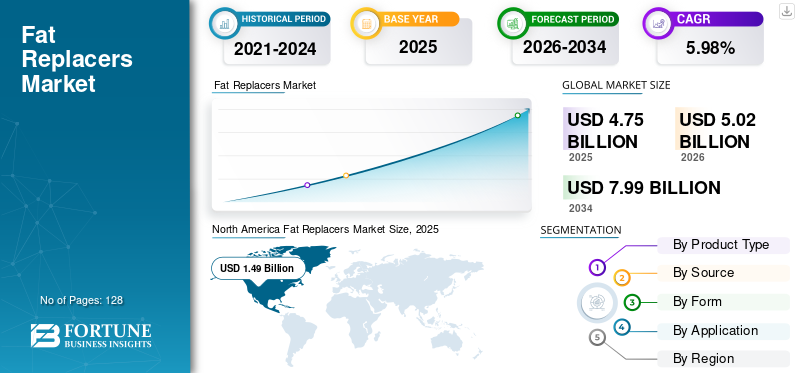
The global fat replacers market size was valued at USD 4.75 billion in 2025 and is projected to grow from USD 5.02 billion in 2026 to USD 7.99 billion by 2034, exhibiting a CAGR of 5.98% during the forecast period. North America dominated the fat replacers market with a market share of 31.36% in 2025.
Fat replacers are functional food ingredients designed to mimic the sensory and functional properties of fats in food products while reducing overall calorie and fat content. These ingredients include carbohydrate-based, protein-based, and fat-based systems that replicate texture, mouthfeel, and creaminess in food formulations. They are widely used in bakery products, dairy items, meat products, sauces, and processed foods, where they help reduce fat levels while maintaining product stability and consumer acceptability.
These ingredients play a critical role in low-fat and reduced-calorie formulations, particularly as consumers increasingly demand healthier foods with lower saturated fat content. Growing public health concerns regarding obesity, cardiovascular disease, and metabolic disorders have encouraged food manufacturers to reformulate products using fat replacers to meet regulatory and consumer nutrition expectations.
The global industry demand is led by major companies namely Cargill Incorporated, Ingredion Incorporated, Tate & Lyle PLC, Kerry Group Plc, and Archer Daniels Midland Company.
Download Free sample to learn more about this report.
Fat Replacers Market KEY TAKEAWAYS
 Global Market Size & Forecast
- 2025 Market Size: USD 4.75 billion
- 2026 Market Size: USD 5.02 billion
- 2034 Forecast Market Size: USD 7.99 billion
- CAGR: 5.98% from 2026–2034
 Market Share
- North America dominated the fat replacers market with a 31.36% share in 2025.
- The Protein-based segment is projected to witness the fastest growth at a 6.93% CAGR during the forecast period.
- The Beverages segment is projected to register the fastest growth with a 7.50% CAGR during 2026–2034.
 Key Regional Highlights
North America
The market was valued at USD 1.49 billion in 2025, driven by strong demand for reduced-fat food products.
Asia Pacific
The market was valued at USD 1.21 billion in 2025, supported by rapid urbanization, expanding processed food production.
Europe
The market reached USD 1.34 billion in 2025, fueled by stringent regulations promoting lower saturated fat intake.
U.S.
The market was valued at USD 1.18 billion in 2025.
Japan
Japan is expected to witness steady growth in the fat replacers market.
Read More

Fat Replacers Market Trends
Rising Demand for Low-Fat and Calorie-Reduced Food Products is a Prominent Industry Trend
Consumers are increasingly seeking healthier alternatives to traditional high-fat foods, prompting food manufacturers to reformulate products with fat-reducing ingredients such as carbohydrate- and protein-based fat replacers. These ingredients help maintain the sensory characteristics of fats while reducing calorie density and saturated fat levels.
- According to the World Health Organization (WHO), global obesity rates have nearly tripled since 1975, with more than 1 billion people living with obesity in 2023, encouraging food manufacturers to reformulate products with lower fat content.
MARKET DYNAMICS
Market Drivers
Download Free sample to learn more about this report.
Increasing Global Demand for Low-Fat Processed Foods to Support Market Growth
Growing consumer awareness regarding the health risks associated with excessive fat consumption has significantly increased demand for fat replacers. As a result, food manufacturers are incorporating fat replacers in bakery products, dairy items, sauces, and processed foods to reduce the calorie density while maintaining product quality.
- The USDA Economic Research Service also reports that processed and ultra-processed foods account for over 55% of total caloric intake in the U.S., reinforcing the need for ingredient reformulation strategies to reduce fat content.
Market Restraints
Technical Formulation Challenges and Sensory Limitations to Restrict Market Expansion
Although fat replacers are widely used in food processing, replicating the full sensory and functional characteristics of fats still remains technically challenging. Fat contributes to flavor release, lubrication, and texture in food products, and replacing it affects taste or stability can require complex formulation strategies.
Additionally, certain replacers may alter product texture or require additional stabilizers, increasing formulation complexity and production costs for food manufacturers.
Market Opportunities
Expansion of Functional and Reduced-Calorie Food Products to Create Ingredient Demand
The expansion of functional foods, which cater to health-conscious consumers, is further creating new opportunities for fat replacers industry. Manufacturers are increasingly developing low-fat dairy products, reduced-calorie snacks, and plant-based foods that utilize fat replacers to maintain texture and taste while improving nutritional profiles.
Fat Replacers are particularly effective in oil-in-water emulsions, making them suitable for plant-based beverages, dairy alternatives, and vegan desserts where traditional emulsifiers may not perform efficiently.
- According to the Good Food Institute (GFI), global retail sales of plant-based foods exceeded USD 29 billion in 2023, reflecting a strong demand for alternative food formulations that frequently rely on fat replacers to improve texture and stability.
SEGMENTATION ANALYSIS
By Product Type
Carbohydrate-Based Segment Dominated As They Provide Viscosity, Bulk, And Mouthfeel as Same as Fat
Based on product type, the market is segmented into protein-based, fat-based, and carbohydrate-based.
The carbohydrate-based fat replacers segment dominated the global market demand and was valued at USD 2.73 billion in 2025, accounting for the largest share due to the widespread use of starches, cellulose derivatives, and gums in reduced-fat bakery, dairy, and sauce formulations. These ingredients provide viscosity, bulk, and mouthfeel similar to fat, making them suitable for large-scale food processing applications.
The protein-based segment is projected to grow at the fastest CAGR of 6.93% during the global market forecast period, driven by increasing use of milk proteins and soy proteins as fat mimetics in dairy products, meat substitutes, and functional foods, where protein ingredients provide both nutritional value and improved texture.
To know how our report can help streamline your business, Speak to Analyst
By Source
Plant-Based Segment Dominated Due to Rising Demand for Clean-Label and Plant-Derived Ingredients
Based on the source, the market is segmented into plant-based and animal-based.
The plant-based segment dominated the global fat replacers market share with valuation of USD 3.60 billion in 2025, as plant-derived ingredients such as starches, fibers, and soy proteins are widely used in food processing due to their cost-effectiveness and compatibility with clean-label and vegan product formulations.
The animal-based segment is expected to grow steadily with a CAGR of 6.30%, supported by the use of dairy proteins and gelatin in certain fat replacement systems, particularly in dairy and dessert applications.
By Form
Powder Segment Dominated Due To Processing Compatibility With Dry Ingredient Systems And Longer Shelf Life
Based on form, the market is segmented into powder and liquid.
The powder segment dominated the global market, valued at USD 3.60 billion in 2025, driven by ease of transportation, longer shelf life, and compatibility with dry ingredient systems in bakery mixes, dairy powders, and processed foods.
The liquid segment is projected to grow at the fastest CAGR of 6.35% during 2026-2034 due to its increasing adoption in beverage emulsions, sauces, and ready-to-drink formulations, as liquid systems enable easier dispersion and processing.
By Application
Bakery & Confectionery Segment Dominated Due to Large-Scale Use in Bakery Products
Based on application, the market is segmented into bakery & confectionery, dairy & frozen desserts, poultry & meat products, processed foods, beverages, sauces & dressings, and others.
The bakery & confectionery segment dominated the market, valued at USD 1.47 billion in 2025, as fat replacers are widely used in cakes, cookies, pastries, and chocolates to reduce fat content while maintaining texture and shelf life.
The beverages segment is projected to grow at the fastest CAGR of 7.50% from 2026 to 2034.
Fat Replacers Market Regional Outlook
Regionally, the report covers analysis across North America, Europe, Asia Pacific, South America, and the Middle East & Africa.
North America
North America Fat Replacers Market Size, 2025 (USD Billion)
To get more information on the regional analysis of this market, Download Free sample
North America dominated the global market and was valued at USD 1.49 billion in 2025. The regional is projected to reach USD 2.41 billion by 2034, growing at a CAGR of 5.52% during the forecast period. Growth is driven by strong demand for reduced-fat foods, rising obesity awareness, and large-scale processed food manufacturing.
U.S. Fat Replacers Market
The U.S. dominates the North American region, valued at approximately USD 1.18 billion in 2025, supported by the country’s large bakery, snack, and dairy industries as well as increasing demand for healthier food reformulations.
Europe
Europe accounted for USD 1.34 billion in 2025 and is projected to reach USD 2.23 billion by 2034, registering a CAGR of 5.83% from 2026 to 2034. The region benefits from strong regulatory emphasis on reducing saturated fat intake and a presence of well-established food processing industry.
Germany Fat Replacers Market
Germany leads the European market with a value of approximately USD 0.28 billion in 2025, supported by its large bakery and dairy processing sectors.
U.K. Fat Replacers Market
The U.K. market was valued at approximately USD 0.27 billion in 2025, driven by growing demand for healthier packaged food products and reformulated snacks.
Asia Pacific
Asia Pacific was valued at USD 1.21 billion in 2025, dominating the global market, and is projected to reach USD 2.28 billion by 2034, growing at a CAGR of 7.31% (2026-2034). Growth is supported by rapid urbanization, expanding processed food industries, and rising consumer awareness regarding healthier diets.
China Fat Replacers Market
China represents the largest market in the Asia Pacific, valued at approximately USD 0.49 billion in 2025, supported by the rapid expansion of packaged food manufacturing and growing demand for functional food ingredients.
South America and the Middle East & Africa
South America reached USD 0.45 billion in 2025, registering a CAGR of 4.97% during the timeframe of 2026-2034. Expansion of the bakery and snack food industries in Brazil and Argentina supports regional demand for fat replacers.
The Middle East & Africa market was valued at USD 0.26 billion in 2025, expanding at a CAGR of 4.36% over the forecast period, driven by increasing adoption of healthier food formulations and growing processed food consumption.
Brazil Fat Replacers Market
Brazil represents the largest market within South America market due to its developed food processing sector and expanding packaged food industry.
COMPETITIVE LANDSCAPE
Key Industry Players
Key Players are Focusing on Functional Ingredient Innovation and Health-Oriented Food Reformulation to Gain Competitive Edge
The global fat replacers market is moderately consolidated, with major food ingredient companies developing innovative fat replacement systems to support reduced-calorie and healthier food formulations. Companies are focusing on plant-derived ingredients, functional starches, and protein-based fat mimetics to improve product texture and nutritional value.
Leading Players in the Market
|
Rank |
Company Name |
|
1 |
Cargill Incorporated |
|
2 |
Ingredion Incorporated |
|
3 |
Tate & Lyle PLC |
|
4 |
Kerry Group Plc |
|
5 |
Archer Daniels Midland Company |
List of Key Fat Replacers Companies Profiled
- Cargill Incorporated (U.S.)
- Ingredion Incorporated (U.S.)
- Tate & Lyle PLC (U.K.)
- Kerry Group Plc (Ireland)
- Archer Daniels Midland Company (U.S.)
- DSM-Firmenich (Netherlands)
- Ashland Global Holdings Inc. (U.S.)
- Corbion N.V. (Netherlands)
- Fiberstar Inc. (U.S.)
- CP Kelco U.S., Inc. (U.S.)
KEY INDUSTRY DEVELOPMENTS
- September 2025: Schouten Europe, a Dutch pioneer in plant-based proteins since 1990, launched a new plant-based sausage featuring a novel fat replacer solution for enhanced juiciness and mouthfeel. This innovation builds on their expertise in meat analogues, using proteins from wheat, soya, and potato, while keeping the product low in saturated fats, high in fiber, and encased in a fully plant-based casing for an authentic bite.
- December 2024: Gavan Technologies, an Israeli food tech company founded in 2018, raised USD 8 million in a Series A funding round in December 2024 to commercialize its plant-based fat solution, FaTrix and establish a European production facility.
- October 2024: MicroLub, a U.K.-based biotech firm, secured USD 4.44 million in funding to advance its fat replacement technology, enabling low-calorie plant-based foods that maintain a delicious taste and texture. This innovation aligns with growing demand in the plant-based sector, similar to recent developments like Schouten Europe's sausage fat replacer.
- June 2023: Gavan Technologies, an Israeli food tech startup, unveiled FaTrix, a protein-enriched fat ingredient designed as a clean-label alternative to butter and other fats in pastries and baked goods. It slashes saturated fat by 80% compared to butter while boosting protein content, using just three ingredients: protein isolate (primarily from peas), vegetable oil, and water.
REPORT COVERAGE
The global fat replacers market industry report analyzes the market in depth and highlights crucial aspects such as global market trends, market dynamics, prominent companies, investment in research and development, and end-use. Besides this, the report also provides insights into the global market analysis and highlights significant industry developments.
Request for Customization to gain extensive market insights.
Report Scope & Segmentation
| ATTRIBUTE | DETAILS |
| Study Period | 2021-2034 |
| Base Year | 2025 |
| Estimated Year | 2026 |
| Forecast Period | 2026-2034 |
| Historical Period | 2021-2024 |
| Growth Rate | CAGR of 5.98% from 2026 to 2034 |
| Unit | Value (USD Billion) |
|
Segmentation |
By Product Type
|
|
By Source
|
|
|
By Form
|
|
|
By Application
|
|
|
By Region
|
Frequently Asked Questions
Fortune Business Insights says that the global market was valued at USD 4.75 billion in 2025 and is anticipated to reach USD 7.99 billion by 2034.
At a CAGR of 5.98%, the global market will exhibit steady growth over the forecast period.
By source, the plant-based segment led the market.
North America held the largest market share in 2025.
Increasing global demand for low-fat processed foods to support market growth.
Cargill Incorporated, Ingredion Incorporated, Tate & Lyle PLC, Kerry Group Plc, and Archer Daniels Midland Company are the leading companies in the market.
Rising demand for low-fat and calorie-reduced food products is shaping industry trends.



- 2021-2034
- 2025
- 2021-2024
- 128
-
(Offer valid till 15th Oct 2026)
Get 30-60 hrs Free Customization
Expand Regional and Country Coverage, Segments Analysis, Company Profiles, Competitive Benchmarking, and End-user Insights.




















Related Reports
-
US +1 833 909 2966 ( Toll Free )
-
Get In Touch With Us