Handheld Ultrasound Market Size, Share & Industry Analysis, By Transducer Type (Linear, Phased Array, and Others), By Application (Radiology, Gynecology, Cardiology, Urology, and Others), By End User (Hospitals, Specialty Clinics, Diagnostic Imaging Centers, and Others), and Regional Forecast, 2026-2034
 Download Free Sample
KEY MARKET INSIGHTS
 Listen to Audio Version
The global handheld ultrasound market size was valued at USD 397.29 million in 2025. The market is projected to grow from USD 448.28 million in 2026 to USD 1,131.43 million by 2034, exhibiting a CAGR of 12.27% during the forecast period. North America dominated the handheld ultrasound market with a market share of 41.07% in 2025.
Handheld ultrasound refers to a small, portable ultrasound device that easily connects to a mobile device or another ultrasound system and helps in making quick diagnostic decisions for healthcare providers. The market is primarily driven by the growing prevalence of acute and chronic disorders, such as urological diseases, cancer, cardiovascular diseases, and others, resulting in an increasing diagnosis and treatment rate among the patient population. Along with this, the rising geriatric population, increasing per capita healthcare expenditure, and growing awareness about the benefits of early diagnosis of these conditions are some additional factors supporting the growing adoption rate for these products globally.
- According to data published by the World Health Organization (WHO), there were an estimated 20.0 million new cancer cases globally in 2022.
Additionally, the increasing number of key players, such as GE Healthcare, Koninklijke Philips N.V., and others, is focusing on research and development activities to launch novel ultrasound products.
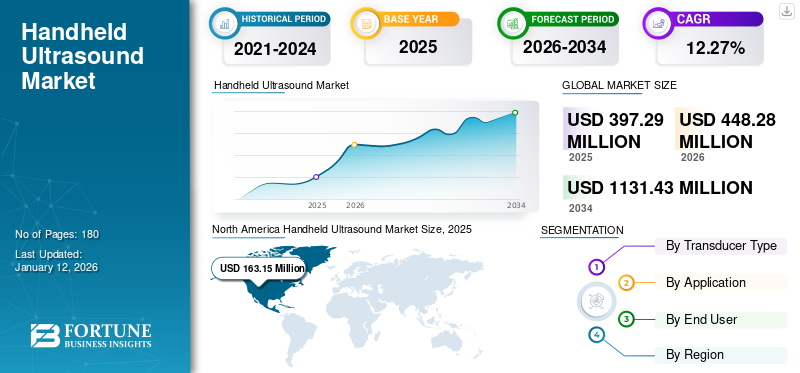
Download Free sample to learn more about this report.
Handheld Ultrasound Market Key Takeaways
 Global Market Size & Forecast
- 2025 Market Size: USD 397.29 million
- 2026 Market Size: USD 448.28 million
- 2034 Forecast Market Size: USD 1,131.43 million
- CAGR: 12.27% from 2026–2034
 Market Share
- North America dominated the handheld ultrasound market with a 41.07% share in 2025.
- The phased array segment accounted for the largest market share.
- The radiology segment held the leading market share.
 Key Regional Highlights
North America
North America held a 41.07% market share in 2025, valued at USD 163.15 million in 2026.
Europe
Europe generated USD 93.21 million in 2025, accounting for 23.46% of the global market.
Asia Pacific
Asia Pacific contributed 32.15% of the global market in 2025, with a valuation of USD 127.74 million in 2026.
U.S.
U.S. Expected to witness steady market growth during the forecast period.
Japan
Japan Anticipated to experience stable market growth during the forecast period.
Read More

MARKET DYNAMICS
MARKET DRIVERS
Increasing Prevalence of Acute and Chronic Disorders Drives Product Demand
The growing prevalence of acute and chronic conditions, such as cardiovascular conditions, cancer, and urological conditions, among others, is resulting in a growing number of patient admissions for diagnosis and treatment globally. Additionally, the growing geriatric population is another major factor supporting the growing patient population suffering from these disorders.
- For instance, according to the statistics published by the U.S. Population Reference Bureau (PRB), about 58.0 million Americans were aged 65 years and above in 2022, which is anticipated to increase to around 82 million by 2050.
The increasing diagnosis and treatment rates among patients, along with growing awareness about the benefits of early diagnosis, are further resulting in increasing demand for these novel ultrasound systems in the market. This, along with the growing benefits of this ultrasound equipment, including ease of use and portability, is one of the additional factors supporting the increasing demand for these products. Additionally, increased adoption and demand are driving the focus of major companies toward R&D activities to develop and introduce novel products, further contributing to the global handheld ultrasound market growth.
MARKET RESTRAINTS
High Cost Associated with Advanced Devices to Hamper Market Growth
There is an increasing adoption and demand for handheld ultrasound in healthcare settings. However, the high cost associated with advanced ultrasound devices is expected to limit their adoption rate, especially in Brazil, China, and other emerging countries.
Rising technological advancements in ultrasound products by key players have resulted in an increased manufacturing cost, which is expected to hamper the market growth significantly, especially in developing countries.
- For instance, according to 2024 data published by the DRSONO, it was reported that the price of DRSONO Tri-scan Max is around USD 3,599.0.
Other Prominent Restraints
- Limited Advanced Features to Limit Its Adoption: Despite rapid technological advancements, handheld units still lag behind high-end machines in terms of advanced Doppler imaging, 3D/4D capability, and deep tissue penetration, which is expected to limit its product adoption.
MARKET OPPORTUNITIES
Improving Healthcare Infrastructure in Emerging Countries to Augment Market Growth
The increasing prevalence of acute and chronic conditions in China, India, Mexico, and other countries, along with a rising geriatric population in these countries, is expected to present a large patient pool requiring diagnosis. Thereby helps to boost the demand for ultrasound systems in these countries.
There is a growing healthcare expenditure in emerging countries, including China, India, and others, along with improvements in healthcare infrastructure. This growth is one of the crucial factors supporting the increasing diagnosis of various acute and chronic conditions among the general population.
- For instance, according to the 2023 data published by the International Trade Administration (ITA), healthcare expenditure is about 9.47% of Brazil's GDP.
Additionally, the increasing R&D funding by the academic and research institutes in developing countries to promote the production of ultrasound systems is expected to present a lucrative opportunity.
MARKET CHALLENGES
Regulatory Challenges for Portable Ultrasound Systems to Limit Market Growth
There is an increasing demand for these systems owing to their increasing benefits, including portability, among others. However, several regulatory hurdles, such as complex compliance requirements, device security, limited reimbursement policies, and others, present challenges that impact its adoption. Regulatory agencies, such as the Food and Drug Administration (FDA) and the European Union (EU), impose rigorous regulatory standards that can become challenging and time-consuming for manufacturers.
Moreover, the development and emergence of an established and regulated market for refurbished ultrasound devices, particularly in emerging countries such as Brazil and India, is expected to reduce the demand for new equipment, further hampering the growth of the market.
- For instance, according to the 2025 data published by the Focus Technology Co., Ltd., the price of a refurbished in-A5I handheld ultrasound scanner ranges from USD 1,600.0 to USD 1,800.0
Handheld Ultrasound Market Trends
Technological Advancements in Ultrasound Devices are a Key Market Trend
There has been a preferential shift toward the integration of artificial intelligence and machine learning into ultrasound systems by major players. The adoption of technology integration enhances the diagnostic capabilities of handheld ultrasound by offering automated measurements and accurate image interpretation, further improving scanning capabilities.
Additionally, ultrasound machines integrated with technology have also enabled the detection of tumors, musculoskeletal injuries, and other various conditions among patients with improved accuracy and efficiency. Along with this, researchers are emphasizing the expansion of the range of applications covered by ultrasound systems with an aim to allow clinicians to diagnose a wide spectrum of chronic conditions among the patient population.
Moreover, the increasing advantages of advanced ultrasound systems, such as wireless devices, are resulting in their rising adoption rate. Thus, further driving the focus of key players toward the development and introduction of novel AI-integrated medical imaging products, such as ultrasound systems.
- For instance, in April 2024, GE Healthcare launched CaptionAI artificial intelligence (AI)-driven software on the Vscan Air SL handheld ultrasound system for rapid cardiac assessments with an aim to expand access to cardiac care among patients.
Other Prominent Trends
- Increasing Adoption of these Products in Home Healthcare & Research Institutes: Increasing adoption rate in homecare agencies and medical schools is resulting in a growing focus of providers toward the introduction of these products.
- Increasing Demand for Point-of-Care Ultrasound Systems: There is an increasing adoption of these systems in emergency care and critical care units owing to their portability.
Download Free sample to learn more about this report.
Segmentation Analysis
By Transducer Type
Increasing Product Launch of Phased Array Ultrasound Systems Drove Segment Growth
Based on transducer type, the market is segmented into linear, phased array, and others.
The phased array segment dominated the market in 2024. The increasing number of advantages, including a small footprint, good penetration depth, and the ability to produce sector image shape, are some factors anticipated to drive the segmental growth. Such factors result in drawing the focus of prominent players toward research and development activities to launch novel products.
- For instance, in August 2023, GE Healthcare introduced Vscan Air SL, a wireless handheld device that includes a sector-phased array transducer for rapid cardiac assessments among the patient population.
On the other hand, the linear segment is expected to grow with a considerable CAGR during the forecast period. The growth is primarily due to increasing demand for these ultrasound devices with linear transducers, resulting in a growing focus of key players toward introducing advanced products.
By Application
Increasing Ultrasound Examinations in Radiology Department Boosted Segment Growth
Based on application, the market is segmented into radiology, gynecology, cardiology, urology, and others.
The radiology segment dominated the market in 2024. The increasing number of patient admissions for ultrasound examination in the radiology department, coupled with the growing number of radiology centers, is likely to support the product adoption and segmental growth.
On the other hand, the cardiology segment is expected to grow considerably during the forecast period. The growth is due to the increasing prevalence of cardiovascular conditions, resulting in an increasing diagnosis and treatment rate among the patient population. The increasing number of ultrasound examinations among patients is further supporting the increasing demand for advanced ultrasound devices in the market.
- For instance, according to 2024 statistics published by the Centers for Disease Control & Prevention (CDC), about 805,000 people have a heart attack every year in the U.S.
By End User
Growing Number of Hospitals Fueled Segmental Growth
Among end user, the market is segmented into hospitals, specialty clinics, diagnostic imaging centers, and others.
The hospitals segment dominated the market in 2024. The increasing number of hospitals, coupled with a growing number of ultrasound examinations, is resulting in a rising adoption rate of handheld ultrasound devices. This, along with growing technological advancements in these ultrasound systems among the key players, is likely to support the segmental growth.
- According to 2025 statistics published by Definitive Healthcare, it was reported that there are 7,300 active hospitals in the U.S.
Additionally, the diagnostic imaging centers segment is also expected to grow with a considerable CAGR in the market during the forecast period. The growth is owing to increasing benefits, including early disease detection, reduced healthcare costs, and others, resulting in a growing adoption rate for these products.
Handheld Ultrasound Market Regional Outlook
By geography, the market is categorized into North America, Europe, Asia Pacific, Latin America, and the Middle East & Africa.
North America
North America Handheld Ultrasound Market Size, 2025 (USD Million)
To get more information on the regional analysis of this market, Download Free sample
In 2025, North America represented USD 163.15 million, accounting for 41.07% of the worldwide market, and is projected to grow to USD 181.58 million in 2026. The increasing per capita healthcare expenditure and improved regulatory policies are some of the factors supporting the market’s growth. Additional factors include increasing point-of-care ultrasound systems in emergency and paramedic services, adequate reimbursement policies, and a growing number of key players focusing on research and development activities to launch novel products.
- According to the 2023 statistics published by the Centers for Medicare & Medicaid Services (CMS), the per capita healthcare expenditure is USD 14,570.0 in the U.S.
U.S.
The increasing prevalence of acute and chronic conditions, such as cardiology conditions, cancer, and urological conditions, among others, is one of the major factors responsible for the growing demand for these products. Moreover, another growth factor is the integration of technology to offer advanced products. This, coupled with the growing number of key players focusing on the introduction of novel products, is further anticipated to support market growth in the country.
Europe
The Europe market generated USD 93.21 million in 2025, representing 23.46% of the global market landscape, and is expected to reach USD 104.68 million in 2026. Europe is expected to grow at a considerable CAGR during the forecast period. The growth is due to the increasing geriatric population, increasing awareness of early diagnosis among patients, and growing product launches for advanced ultrasound products. Such factors are supporting the rising adoption rate for handheld ultrasound in European countries such as Germany, the U.K., and Scandinavia. This, along with increasing strategic initiatives among governmental organizations to promote the benefits of ultrasound examinations, supports the regional market growth.
- For instance, according to 2025 statistics published by the Centre for Ageing Better, it was reported that over 10.0 million people are currently aged 65 and over in the U.K.
Asia Pacific
Asia Pacific contributed 32.15% to the global market in 2025, with a valuation of USD 127.74 million, and is projected to reach USD 147.11 million in 2026. Asia Pacific is expected to witness the highest growth during the forecast period. The increasing prevalence of acute and chronic conditions and improving healthcare infrastructure, especially in China, India, and Southeast Asia, are a few crucial factors expected to drive the market's growth. Additional factors include growing acquisitions and mergers among other players.
- For instance, according to 2023 statistics published by the National Center for Biotechnology Information (NCBI), it was reported that about 330.0 million individuals are affected by cardiovascular diseases in China.
Latin America
The market in Latin America reached USD 9.2 million in 2025, representing 2.32% of total market revenue, and is projected to reach USD 10.37 million in 2026. Latin America is also expected to grow with a considerable CAGR during the forecast period. Increasing development of healthcare infrastructure and a rising number of ultrasound examinations are some of the crucial factors supporting the growth of the market in the region. However, other factors include a growing number of healthcare facilities such as hospitals and specialty clinics, growing awareness about the benefits of early diagnosis for chronic diseases, among others.
- For instance, according to 2023 statistics published by the International Trade Administration (ITA), it was reported that there are about 7,191 hospitals in Brazil.
Middle East & Africa
The Middle East & Africa market was valued at USD 3.98 million in 2025, capturing 1.00% of global revenue, and is estimated to reach USD 4.54 million in 2026. The Middle East & Africa region is expected to grow with a considerable CAGR during the forecast period. The growing number of medical and diagnostic centers and access to improved healthcare are some of the major factors contributing to the increased adoption rate of these products. Additionally, the growing introduction of novel ultrasound products among the prominent players is also one of the factors supporting the region’s growth.
- For instance, according to the U.S.-UAE Business Council, Gulf Healthcare International operates 19 medical and diagnostic centers across UAE and Kuwait. Thus, the increasing number of medical and diagnostic centers in the region is projected to increase the demand for medical equipment for diagnostic purposes.
COMPETITIVE LANDSCAPE
Key Industry Players
Increasing Product Launches for Ultrasound Systems by Key Players Resulted in Their Dominating Positions
The global market is semi-consolidated, with players such as GE Healthcare, Koninklijke Philips N.V., and Butterfly Network, Inc., accounting for a significant market share.
GE Healthcare is one of the dominant players operating in the market. The growth is primarily due to distinct factors, including a growing focus on R&D activities for novel products and a significant focus on the expansion of their geographical network to strengthen their market footprint.
On the other hand, Shenzhen Mindray Bio-Medical Electronics Co., Ltd., among other players, is also growing. This growth is due to its rising focus on the development and introduction of new ultrasound products to strengthen its product portfolio. It is further anticipated to contribute to the global handheld ultrasound market share.
- In July 2023, Shenzhen Mindray Bio-Medical Electronics Co., Ltd., launched a 2-in-1 TE Air Wireless handheld device with multi-device connectivity with the aim of strengthening its product portfolio in the market.
LIST OF KEY HANDHELD ULTRASOUND COMPANIES PROFILED
- GE Healthcare (U.S.)
- Shenzhen Mindray Bio-Medical Electronics Co., Ltd. (China)
- Butterfly Network, Inc. (U.S.)
- Koninklijke Philips N.V. (Netherlands)
- Clarius (Canada)
- CHISON Medical Technologies Co., Ltd. (China)
- Konica Minolta, Inc. (Japan)
- SuperSonic Imagine (France)
KEY INDUSTRY DEVELOPMENTS
- December 2024: SuperSonic Imagine launched PocketVu, a new handheld device for diagnostic medical ultrasound imaging, with an aim to strengthen its business segment for ultrasound products.
- June 2024: Clarius received FDA approval for the Clarius Obstetrical artificial-intelligence fetal biometric measurement tool, which is available in Clarius C3 HD3, a wireless handheld system in the U.S. and Canada. This helped the company to increase its brand presence.
- April 2024: Exo Imaging, Inc., received U.S. FDA approval for its artificial intelligence tools available on its Iris handheld system. This helped the company to increase its brand presence.
- July 2023: Konica Minolta, Inc., launched PocketPro H2, a new wireless handheld device for general imaging in point-of-care applications, with an aim to strengthen its product portfolio.
- March 2021: GE Healthcare launched Vscan Air, a handheld device, with the aim of increasing its brand presence in the market.
REPORT COVERAGE
The global handheld ultrasound market report provides market size and forecast by all segments. It includes details on the dynamics of the trends expected to drive the market over the forecast period. It offers insights on the prevalence of key conditions in key countries, key industry developments, and new product launches. The report covers a detailed competitive landscape with information on the market share and profiles of key players.
Request for Customization to gain extensive market insights.
Report Scope & Segmentation
|
ATTRIBUTE |
DETAILS |
|
Study Period |
2021-2034 |
|
Base Year |
2025 |
|
Estimated Year |
2026 |
|
Forecast Period |
2026-2034 |
|
Historical Period |
2021-2024 |
|
Growth Rate |
CAGR of 12.27% from 2026-2034 |
|
Unit |
Value (USD Million) |
|
Segmentation |
By Transducer Type
|
|
By Application
|
|
|
By End User
|
|
|
By Region
|
Frequently Asked Questions
Fortune Business Insights says that the global market value stood at USD 397.29 million in 2025 and is projected to reach USD 1,131.43 million by 2034.
In 2025, North Americas market value stood at USD 163.15 million.
The market is expected to exhibit a CAGR of 12.27% during the forecast period.
The phased array segment led the market by transducer type.
The key factors driving the market are the increasing prevalence of acute and chronic conditions, rising healthcare expenditure, growing awareness about early diagnosis, and an increase in the number of product launches.
GE Healthcare, Koninklijke Philips N.V., and Butterfly Network, Inc., are the top players in the market.
North America dominated the market in 2025.
Increasing technological advancements in these products and their increasing demand from emerging countries will favor product adoption.



- 2021-2034
- 2025
- 2021-2024
- 180
Get 30-60 hrs Free Customization
Expand Regional and Country Coverage, Segments Analysis, Company Profiles, Competitive Benchmarking, and End-user Insights.













.webp)






Related Reports
-
US +1 833 909 2966 ( Toll Free )
-
Get In Touch With Us