High Voltage Cables Market Size, Share & Industry Analysis, By Installation (Overhead, Submarine, and Underground), By Voltage (100 kV-250 kV, 251 kV-400 kV, and Above 400 kV), By End-User (Industrial and Utility), By Conductor Material (Copper, Aluminium, and Others), By Insulation Type (XLPE, EPR, Mass-Impregnated Paper (MI), Oil-Filled Cables, Gas-Insulated Cables, and Others), and Regional Forecast, 2026-2034
 Download Free Sample
High Voltage Cables Market Size and Future Outlook
 Listen to Audio Version
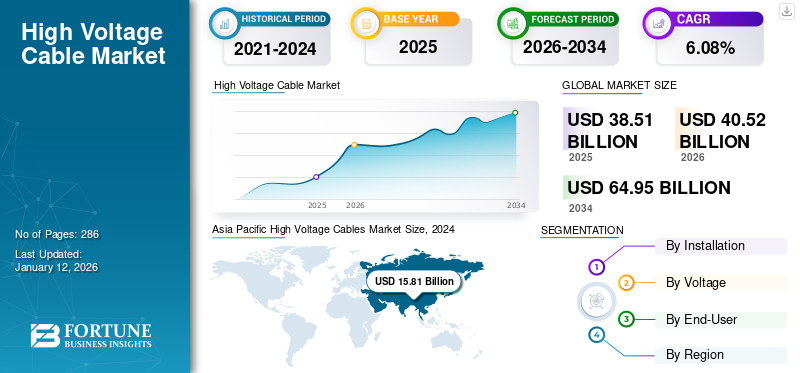
The high voltage cables market size was valued at USD 37.80 billion in 2025. The market is projected to grow from USD 39.76 billion in 2026 to USD 65.88 billion by 2034, with a CAGR of 6.52% over the forecast period. Asia Pacific dominated the high voltage cables market with a market share of 44.25% in 2025.
High-voltage cables are insulated electrical cables designed to transmit large amounts of electrical power at voltages typically ranging from 35 kV to 230 kV. However, the exact classification varies by region and standards. The market is growing due to increasing investments in power transmission infrastructure, grid modernization, renewable energy integration, and cross-border electricity interconnections. The expansion of offshore wind farms, solar power projects, and remote renewable generation facilities is creating strong demand for underground and submarine high-voltage cables to transmit electricity over long distances with lower losses. Rapid urbanization, industrialization, data-center development, and rising electricity consumption are also encouraging utilities to expand and upgrade aging transmission networks. In addition, the growing adoption of high-voltage direct current systems for long-distance and subsea power transmission is supporting demand for advanced, reliable, and high-capacity cable solutions. The rapid deployment of smart grid technology is accelerating the demand for high-voltage cables by enabling real-time power monitoring, automated fault detection, and efficient integration of renewable energy sources. The increasing adoption of renewable energy sources such as wind and solar power and need for efficient power transmission are major factors driving the demand for high-voltage cables. As electricity consumption increases due to rapid urbanization, industrialization, and the expansion of renewable energy projects, utilities require transmission systems that can deliver large amounts of electricity over long distances with minimal power losses.
Leading high-voltage cable manufacturers are focusing on expanding production capacity, developing advanced HVDC and HVAC cable technologies, securing long-term transmission contracts, and investing in sustainable manufacturing to support the accelerating global energy transition. Companies such as Prysmian Group, Nexans S.A., NKT A/S, LS Cable & System Ltd, Sumitomo Electric Industries, Ltd., Furukawa Electric Co., Ltd., and Hellenic Cables S.A. are strengthening their capabilities in underground and submarine cable systems for offshore wind farms, cross-border interconnectors, grid modernization, and large-scale renewable energy projects.
In July 2026, in order to facilitate grid modernization and the integration of renewable energy, the Indian government increased its investments in power transmission infrastructure. The initiative is anticipated to boost demand for high-voltage transmission equipment, such as overhead and subterranean high-voltage cables, while also promoting more domestic manufacturing through localization standards.
Download Free sample to learn more about this report.
HIGH VOLTAGE CABLES MARKET TRENDS
Accelerating Grid Modernization and Transmission Network Expansion is Emerging Market Trend
Governments and utilities worldwide are significantly increasing investments in grid modernization and transmission network expansion to improve power reliability, integrate renewable energy, and accommodate rising electricity demand. The replacement of aging transmission infrastructure with advanced underground, overhead, and submarine high-voltage cable systems is creating substantial market opportunities. Additionally, growing investments in smart grids, cross-border interconnections, and high-voltage direct current (HVDC) transmission projects are driving the deployment of high-performance cable solutions capable of transmitting large volumes of electricity over long distances with minimal losses.
In July 2026, Prysmian and NKT received significant contracts from the U.K. for EGL4 and Eastern Green Link (EGL) 3 HVDC transmission projects, respectively, demonstrating the growing demand for high-voltage cable systems and investment in next-generation transmission infrastructure.
MARKET DYNAMICS
MARKET DRIVERS
Download Free sample to learn more about this report.
Rising Electricity Demand from Electrification and Data Centers to Drive Market Growth
The rapid electrification of transportation, industrial operations, and buildings, combined with the expansion of AI-powered data centers and digital infrastructure, is significantly increasing global electricity demand. To ensure reliable power delivery and maintain grid stability, utilities are investing in new high-voltage transmission networks, including underground, overhead, and HVDC cable systems. At the same time, governments are expanding transmission capacity to support electric vehicle charging infrastructure, industrial electrification, renewable energy integration, and large-scale data center developments, all of which are accelerating demand for advanced high-voltage cables.
In January 2026, Prysmian announced that it is bolstering its Asia Pacific operations to meet the increasing power and connectivity demands of AI-ready data centers. The company announced it wants to increase its participation in data center projects by offering integrated cable solutions for in-building power distribution and transmission networks.
MARKET RESTRAINTS
High Installation and Project Costs to Restrain Market Growth
The deployment of high-voltage cable systems requires substantial capital investment due to the high cost of cable manufacturing, specialized insulation materials, civil works, installation equipment, testing, and commissioning. Underground and submarine cable projects are particularly expensive, as they require trenching, cable-laying vessels, seabed preparation, and advanced monitoring systems, resulting in significantly higher project costs than conventional overhead transmission lines. These high upfront investments can delay utility procurement decisions and limit adoption in cost-sensitive markets, particularly where funding or regulatory approvals are constrained. These factors collectively hamper the overall high voltage cables market growth.
MARKET OPPORTUNITIES
Rising Adoption of HVDC Transmission Networks Offers Lucrative Market Opportunities
The increasing deployment of High-Voltage Direct Current (HVDC) transmission systems is creating significant growth opportunities for the market. HVDC technology enables efficient long-distance power transmission with lower electrical losses than conventional HVAC systems, making it the preferred solution for integrating offshore wind farms, cross-border electricity interconnections, and remote renewable energy projects into national grids. As countries accelerate grid modernization and renewable energy integration, utilities are investing in ±320 kV, ±525 kV, and ±640 kV HVDC cable systems to improve transmission efficiency, enhance grid stability, and increase cross-border power exchange. This trend is driving strong demand for advanced underground and submarine high-voltage cable solutions.
In May 2025, Terna awarded Prysmian a contract worth approximately USD 2.17 billion to provide, install, and commission 525 kV HVDC cable systems for Italy's Adriatic Link project. Through a 250 km underwater and buried HVDC transmission connection, the initiative will connect the Marche and Abruzzo areas, strengthening Italy's electrical network and making it easier to integrate renewable energy sources. The expanding demand for high-voltage cable systems and the increasing global investment in HVDC transmission infrastructure are highlighted by the award.
MARKET CHALLENGES
Technical Challenges in Ultra-High Voltage and HVDC Systems to Hamper Market Growth
The development and deployment of ultra-high-voltage (UHV) AC and HVDC cable systems involve significant technical complexities related to insulation performance, thermal management, jointing reliability, cable accessories, and long-term operational stability. Manufacturing cables capable of operating at voltages of ±525 kV, ±640 kV, and above requires advanced materials, precision engineering, and rigorous testing to withstand high electrical stress and harsh environmental conditions. In addition, the installation and maintenance of long-distance underground and submarine HVDC cable systems demand specialized expertise and sophisticated equipment, increasing project complexity, execution risks, and lifecycle costs.
Segmentation Analysis
By Installation
Overhead Segment Dominated Due to its Lower Installation Costs and Faster Deployment
Based on installation, the market is classified into overhead, submarine, and underground.
Overhead segment dominated the market, accounting for 65.34% in 2025. This growth is owing to its lower installation costs, faster deployment, and widespread use in long-distance electricity transmission. Overhead transmission lines require significantly less capital investment than underground or submarine cable systems as they eliminate the need for extensive trenching, tunneling, or specialized cable-laying equipment. They are also easier to inspect, maintain, repair, and upgrade, making them the preferred choice for utilities and transmission system operators, particularly for cross-country and rural power networks.
Submarine is the fastest-growing segment, projected to grow at a 7.09% CAGR during the forecast period. The submarine segment is the second dominating segment owing to the rapid expansion of offshore wind farms, cross-border electricity interconnectors, and offshore oil & gas infrastructure. Governments worldwide are investing heavily in offshore renewable energy and regional grid integration, driving strong demand for high-voltage submarine cable systems capable of transmitting large volumes of electricity over long distances with minimal losses.
By Voltage
251 kV–400 kV Segment Leads Due to its Extensive Use in National Transmission Networks and Grid Expansion Projects
By voltage, the market is categorized into 100 kV-250 kV, 251 kV-400 kV, and above 400 kV.
The 251 kV-400 kV segment dominated the market and accounted for 44.24% share in 2025. This is due to its widespread deployment in national transmission networks, grid modernization projects, and renewable energy integration. This voltage range provides an optimal balance between transmission capacity, efficiency, and cost, making it the preferred choice for long-distance power transmission, inter-regional grid connections, and utility-scale infrastructure projects across developed and emerging economies.
The above 400 kV is predicted to grow with a CAGR of 7.47% over the forecast period. This growth is due to increasing deployment of ultra-high-voltage (UHV) and HVDC transmission networks for long-distance bulk power transmission. This voltage range is widely used to connect large-scale renewable energy projects, cross-border interconnections, and national grid expansion initiatives while minimizing transmission losses.
By End-User
Increasing Investment in Transmission Network Development and Grid Modernization Leads to Utility Segment Dominance
By end-user, the market is categorized into industrial and utility.
The utility segment captured the largest high voltage cables market share in 2025. This is due to increasing investments in grid modernization, transmission network expansion, and renewable energy integration. Utilities are upgrading aging power infrastructure and deploying new high-voltage transmission lines to meet rising electricity demand, improve grid reliability, and connect large-scale renewable energy projects.
The industrial segment is expected to grow with a CAGR of 4.22% over the forecast period. This growth is due to rising investments in energy-intensive industries, including oil & gas, mining, metals, chemicals, manufacturing, and data centers. These industries require reliable, high-capacity power transmission for continuous operations and large-scale facilities.
To know how our report can help streamline your business, Speak to Analyst
By Conductor Material
Copper Segment Dominated Due to its Excellent Electrical Conductivity and High Current-Carrying Capacity
By conductor material, the market is categorized into copper, aluminium, and others.
The copper segment captured the largest market share of 61.01% in 2025. This is due to its high electrical conductivity, superior mechanical strength, and long-term reliability. Copper cables offer lower transmission losses, higher current-carrying capacity, and excellent durability under demanding operating conditions, making them the preferred choice for critical transmission infrastructure, underground cable networks, and industrial power applications.
The aluminium segment will grow with a CAGR of 7.17% over the forecast period. This is due to its lightweight nature, cost-effectiveness, and improved conductivity-to-weight ratio. Aluminum cables are increasingly preferred for long-distance overhead transmission projects and large-scale grid expansion, as they reduce installation costs and structural loads while supporting growing investments in renewable energy and transmission infrastructure.
By Insulation Type
XLPE Segment Accounted for Dominating Share Owing to Their High Thermal Resistance
By insulation type, the market is categorized into XLPE, EPR, Mass-Impregnated Paper (MI), oil-filled cables, gas-insulated cables, and others.
The XLPE segment captured the largest market share, accounting for 72.37% in 2025. This is due to its excellent electrical insulation, high thermal resistance, and low transmission losses. Its superior durability, longer service life, and suitability for underground and HVDC transmission applications make XLPE the preferred insulation material for modern power transmission projects.
The EPR segment is expected to grow with a CAGR of 6.67% over the forecast period. The EPR (Ethylene Propylene Rubber) segment is growing due to its excellent flexibility, superior moisture resistance, and strong thermal performance. EPR-insulated cables are increasingly adopted in industrial facilities, renewable energy projects, and harsh operating environments where high reliability and resistance to heat and environmental stress are essential.
HIGH VOLTAGE CABLES MARKET REGIONAL OUTLOOK
By geography, the market is categorized into Europe, North America, Asia Pacific, Latin America, and the Middle East & Africa.
Asia Pacific
Asia Pacific High Voltage Cables Market Size, 2025 (USD Billion)
To get more information on the regional analysis of this market, Download Free sample
Asia Pacific is the dominant region in market. It was valued at USD 16.73 billion in 2025 and is expected to reach USD 17.76 billion by 2026. This is due to rapid urbanization, industrialization, and large-scale investments in power transmission infrastructure. Expanding renewable energy capacity, increasing electricity demand, and government-led grid modernization projects in countries such as China, India, Japan, and South Korea are accelerating the deployment of high-voltage cable systems across the region.
CHINA HIGH VOLTAGE CABLES MARKET
In 2025, the China market reached USD 8.09 billion. This is due to the country's aggressive deployment of Ultra-High Voltage (UHV) AC and DC transmission corridors, designed to transport electricity from renewable energy-rich western provinces to major industrial and urban centers in the east. Supported by large-scale investments from the State Grid Corporation of China and ongoing expansion of UHV networks, China continues to drive demand for advanced high-voltage cable systems for long-distance, high-capacity power transmission.
INDIA HIGH VOLTAGE CABLES MARKET
The India market reached around USD 2.91 billion in 2025, accounting for roughly 17.39% of the regional market. The market is growing due to the country's large-scale power transmission expansion and rural electrification initiatives, supported by programs such as the Green Energy Corridor and interstate transmission projects. Rising investments in renewable energy evacuation infrastructure, rapid growth in electricity demand, and increasing domestic manufacturing under the "Make in India" initiative are accelerating the deployment of high-voltage cable systems across the country.
North America
The North America region was valued at USD 3.64 billion in 2024 and reached USD 3.81 billion in 2025. The market is growing due to replacement of aging transmission infrastructure and rising investments in grid resilience. Increasing deployment of offshore wind projects, interregional transmission corridors, and high-capacity connections for data centers and renewable energy facilities is driving demand for advanced high-voltage cable systems across the U.S. and Canada.
U.S. HIGH VOLTAGE CABLES MARKET
The U.S. market stood at around USD 3.38 billion in 2025. The market is growing due to substantial investments in grid resilience, offshore wind transmission, and AI-driven data center infrastructure. Federal funding through grid modernization initiatives, increasing electricity demand from electrification, and the need to connect large-scale renewable energy projects are accelerating the deployment of underground and high-capacity transmission cable systems across the country.
Europe
The Europe market in 2025 was valued at USD 12.90 billion and is expected to reach USD 13.53 billion by 2026. The market is growing due to the region's strong focus on cross-border electricity interconnections and offshore wind power integration. Large-scale subsea transmission projects in the North Sea and Baltic Sea, combined with investments in HVDC networks to support the European energy transition, are driving sustained demand for advanced high-voltage cable systems across the region.
U.K. HIGH VOLTAGE CABLES MARKET
The U.K. market in 2025 stood at around USD 2.55 billion, representing roughly 19.56% of the regional market. The offshore wind transmission infrastructure and electricity network strengthening investments made by the U.K. are accelerating the market growth. The demand for HVDC and high-voltage AC cable systems is being increased by National Grid's investment initiatives, which include the expansion of offshore wind farms, the development of subsea export cables, and the modernization of the country's transmission system. These actions are intended to increase power reliability and incorporate new renewable generation capacity.
GERMANY HIGH VOLTAGE CABLES MARKET
The Germany market in 2025 stood at around USD 3.23 billion, accounting for roughly 25.02% of the regional market. The market is growing due to the country's accelerated energy transition (Energiewende) and the expansion of north-to-south transmission corridors that transport electricity generated by offshore wind farms to major industrial regions. Investments in underground cable deployment, the phase-out of conventional power generation, and the modernization of transmission infrastructure to improve grid stability are driving sustained demand for high-voltage cable systems across the country.
Latin America and Middle East & Africa
Latin America and the Middle East & Africa stood at USD 1.93 billion and USD 2.43 billion, respectively, in 2025. The Latin America market is growing due to increasing investments in long-distance transmission infrastructure required to connect remote hydropower, solar, and wind generation sites with major urban and industrial demand centers. Large geographic distances, rising electricity consumption, and the need to reduce transmission bottlenecks are encouraging countries such as Brazil, Mexico, Chile, and Argentina to expand high-capacity transmission networks, thereby supporting demand for high-voltage cable systems.
The Middle East & Africa market is growing due to increasing investment in large-scale power generation, cross-border transmission corridors, industrial zones, and urban infrastructure. Gulf countries are developing new electricity networks to support megacities, oil and gas facilities, and energy-intensive industries, while African countries are expanding transmission systems to improve electricity access and connect remote generation assets with major demand centers.
GCC HIGH VOLTAGE CABLES MARKET
The GCC market, in 2025, stood at around USD 1.30 billion, representing roughly 53.58% of the regional market. The market is growing due to the region's rapid expansion of energy-intensive industrial clusters, desalination plants, and smart city megaprojects such as NEOM, The Line, and other large-scale urban developments. These projects require reliable, high-capacity underground and high-voltage transmission networks to ensure an uninterrupted power supply across harsh desert environments. In addition, increasing grid interconnections among GCC countries through the GCC Interconnection Authority are driving investments in advanced high-voltage cable infrastructure to strengthen regional power reliability and energy security.
COMPETITIVE LANDSCAPE
Key Industry Players
Growing Investment in Advanced HVDC and Submarine Cable Technologies by Industry Players is Propelling Market Competition
High-voltage cable manufacturers are expanding their businesses by investing in new manufacturing capacity, advanced HVDC and submarine cable technologies, and digital cable monitoring solutions to address rising global demand for grid modernization and renewable energy integration. Leading companies are also strengthening their market presence through strategic acquisitions, long-term utility contracts, and expansion into emerging transmission markets, enabling them to support large-scale interconnection, offshore wind, and cross-border power transmission projects worldwide. A strong competitive edge in the market is achieved through technological innovation, superior product quality, and the ability to meet evolving customer and regulatory requirements. Leading manufacturers are investing in advanced cable materials, high-capacity transmission technologies, and environmentally sustainable solutions to improve performance, reliability, and operational efficiency.
In March 2026, Finolex Cables established an approximate revenue objective of USD 105.13 million from its Tamil Nadu operations in FY2026-27, which is a growth from the state's USD 78.84-84.10 million at the time. This was maintained by increasing demand from the real estate, infrastructure, data center, manufacturing, automotive, and electrical cable industries. Moreover, it is anticipated that there will be opportunities for extra-high-voltage and high-voltage cables due to continuous investments in renewable-energy grid connections, urban electrification, industrial facilities, and power-transmission infrastructure across the region. The firm is well-positioned to profit from rising demand for underground high-voltage cable systems, particularly for large infrastructure projects, substations, and transmission networks, due to its participation in the power-cable sector and its partnership with Finolex J-Power Systems.
LIST OF KEY HIGH VOLTAGE CABLES COMPANIES PROFILED
- Prysmian Group (Italy)
- Nexans S.A. (France)
- NKT A/S (Denmark)
- Sumitomo Electric Industries, Ltd. (Japan)
- LS Cable & System Ltd. (South Korea)
- Furukawa Electric Co., Ltd. (Japan)
- Hellenic Cables S.A. (Greece)
- Taihan Cable & Solution Co., Ltd. (South Korea)
- ZTT Group (Jiangsu Zhongtian Technology Co., Ltd.) (China)
- Orient Cable (Ningbo Orient Wires & Cables Co., Ltd.) (China)
- TBEA Co., Ltd. (China)
- Southwire Company, LLC (U.S.)
- Elsewedy Electric (Egypt)
- Riyadh Cables Group Company (Saudi Arabia)
- KEI Industries Limited (India)
KEY INDUSTRY DEVELOPMENTS
- July 2026: SSEN Transmission entered into a long-term framework agreement with Van Oord Offshore Wind U.K. Ltd and Sumitomo Electric Industries, Ltd. to engineer, supply, transport, and install High Voltage Direct Current (HVDC) subsea cable systems, in support of the continuing expansion and reinforcement of the north of Scotland's electricity transmission network.
- February 2026: Orient Cable secured the world's first 500 kV deep-sea HVAC subsea cable interconnection project in East Asia, supplying a 200 km high-voltage submarine cable system for large-scale cross-border power transmission.
- January 2026: Egypt Cables Company, a subsidiary of Elsewedy Electric, was awarded a contract to design, supply, and install 400 kV high-voltage cable systems for Kuwait's South Sabah Al-Ahmad Residential Project, solidifying its presence in significant power transmission infrastructure throughout the GCC.
- November 2025: Southwire announced a USD 176 million expansion of its Heflin, Alabama facility, enhancing its capabilities in medium- and high-voltage cable production to meet increasing demand from grid modernization and electrification initiatives throughout North America.
- November 2025: ZTTSC solidified its position as a top provider of high-voltage offshore transmission systems by being awarded the contract to provide a ±500 kV HVDC submarine wire system for the Yangjiang Sanshan Island Offshore Wind Project of China Southern Power Grid.
REPORT COVERAGE
The global high voltage cables market analysis provides an in-depth study of the market size & forecast across all market segments included in the report. It contains details on the market dynamics and market trends expected to drive the market in the forecast period. It offers information on technological advancements, new product launches, key industry developments, and partnerships, mergers & acquisitions. The market research report also includes a detailed competitive landscape, providing market share and profiles of key players.
Request for Customization to gain extensive market insights.
Report Scope & Segmentation
| ATTRIBUTE | DETAILS |
| Study Period | 2021-2034 |
| Base Year | 2025 |
| Estimated Year | 2026 |
| Forecast Period | 2026-2034 |
| Historical Period | 2021-2024 |
| Growth Rate | CAGR of 6.52% from 2026-2034 |
| Unit | Value (USD Billion) |
| Segmentation | By Installation, By Voltage, By End-User, By Conductor Material, By Insulation Type, and Region |
| By Installation |
|
| By Voltage |
|
| By End-User |
|
| By Conductor Material |
|
| By Insulation Type |
|
| By Region |
|
Frequently Asked Questions
Fortune Business Insights says that the global market value stood at USD 37.80 billion in 2025 and is projected to reach USD 65.88 billion by 2034.
The market is expected to grow at a CAGR of 6.52% during the forecast period.
The utility segment led the market by end-user.
Rising electricity demand from electrification and data centers to drive market growth.
NKT A/S, Sumitomo Electric Industries, Ltd.,Elsewedy Electric, and Southwire Company, LLC are the top players in the market.
Asia Pacific held the largest share of the market.
Rising integration of HVDC transmission networks favors product adption.


- 2021-2034
- 2025
- 2021-2024
- 102
Get 30-60 hrs Free Customization
Expand Regional and Country Coverage, Segments Analysis, Company Profiles, Competitive Benchmarking, and End-user Insights.













Related Reports
-
US +1 833 909 2966 ( Toll Free )
-
Get In Touch With Us