Human Capital Management (HCM) Market Size, Share & Industry Analysis, By Offering (Software and Services), By Deployment (On-premises and Cloud), By Enterprise Type (Large Enterprises and Small and Medium Enterprises (SMEs)), By End-use Industry (IT and Telecommunications, BFSI, Government and Public Sector, Retail and E-commerce, Healthcare, Education, Manufacturing, and Others), and Regional Forecast, 2026–2034
 Download Free Sample
Human Capital Management (HCM) Market: Growth Trends, Innovations, and Future Outlook
 Listen to Audio Version
The human capital management (HCM) market size was valued at USD 34.76 billion in 2025. The market is projected to grow from USD 37.52 billion in 2026 to USD 77.37 billion by 2034, exhibiting a CAGR of 9.5% during the forecast period. North America dominated the human capital management (HCM) market with a market share of 38.38% in 2025.
Human capital management refers to the software and services organizations used to manage employees throughout the employment lifecycle. The market includes solutions for core HR, payroll and benefits, workforce management, recruitment, talent management, and workforce analytics and planning. It also covers related applications such as Compensation Management, Succession Planning, employee engagement, and HR service delivery. Associated services include implementation, integration, customization, maintenance, support, and platform optimization.
Market growth is supported by the rising adoption of cloud-based HCM platforms, AI-enabled HR automation, workforce analytics, and the growing need to improve employee productivity, compliance, and overall workforce management efficiency. SAP SE, Oracle Corporation, Workday, Inc., and Automatic Data Processing, Inc. are the top players in the market.
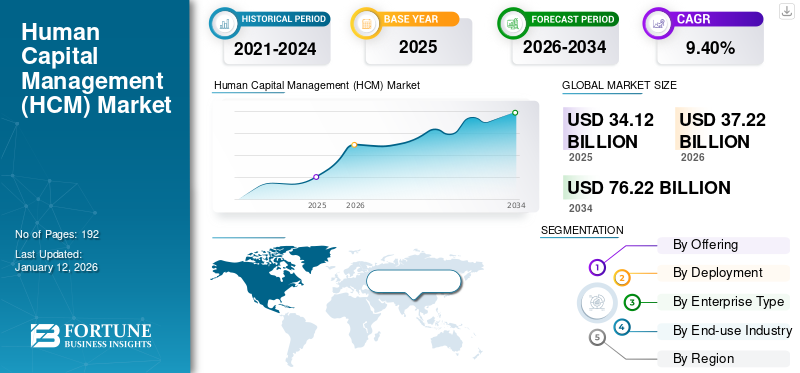
Download Free sample to learn more about this report.
HUMAN CAPITAL MANAGEMENT (HCM) MARKET TRENDS
Growing Use of Artificial Intelligence in HCM Platforms to be a Significant Trend
Artificial intelligence is becoming an important trend in the market as organizations seek to simplify HR functions and improve workforce decisions. HCM providers are adding AI features to recruitment, employee support, talent management, workforce planning, and performance management. These tools help human resource teams screen candidates, identify skill gaps, answer employee queries, and generate useful workforce insights. AI also reduces manual work and improves the speed and accuracy of HR processes. As organizations focus more on productivity and employee experience, AI-enabled HCM software is expected to play a larger role in shaping market trends.
- According to SHRM, 43% of organizations used AI in HR activities in 2025, compared with 26% in 2024.
MARKET DYNAMICS
MARKET DRIVERS
Download Free sample to learn more about this report.
Growing Shift toward Cloud-Based Human Capital Management Solutions
Organizations are increasingly replacing traditional HCM systems with cloud-based platforms to improve flexibility, scalability, and operational efficiency. Cloud deployment enables businesses to manage payroll, recruitment, core HR, workforce planning, and employee data through a single platform while reducing infrastructure and maintenance costs. It also supports remote and hybrid work by providing secure access to HCM solutions from different locations. Regular software updates, easier integration, and subscription-based pricing further improve adoption. These advantages are making cloud-based software solutions a major driver for global human capital management (HCM) market growth.
- According to Flexera's 2025 State of the Cloud Report, 89% of organizations have adopted a multi-cloud strategy, highlighting the growing preference for cloud-based enterprise applications, including HCM platforms.
|
Rank |
Market Drivers |
Overall Impact Rank |
CAGR Contribution (2026-2034) |
Impact 2026-2028 |
Impact 2029-2031 |
Impact 2032-2034 |
|
1 |
Rising adoption of cloud-based HCM platforms for scalable and centralized HR operations |
High |
+3.4% |
High |
High |
Medium |
|
2 |
Growing use of AI and automation across recruitment, talent management, and employee support |
High |
+2.8% |
High |
High |
Medium |
|
3 |
Increasing focus on workforce analytics, employee experience, and data-driven HR decisions |
High |
+2.3% |
Medium |
High |
High |
|
4 |
Expanding adoption of affordable subscription-based HCM solutions among SMEs |
Medium |
+1.9% |
Medium |
Medium |
High |
|
5 |
Rising demand for integrated payroll, core HR, compliance, and workforce management tools |
Medium |
+1.4% |
Medium |
Medium |
Medium |
|
6 |
Others (mobile HR, hybrid work, self-service tools, and learning platforms) |
Low |
+1.0% |
Low |
Medium |
Medium |
|
|
Total Positive Growth Contribution |
|
+12.8% |
|
|
|
MARKET RESTRAINTS
Data Privacy, Security, and Integration Challenges to Restrain Market Growth
The adoption of human capital management solutions can be limited by concerns related to employee data security, cybersecurity, and system integration. HCM platforms store sensitive information such as payroll records, personal details, performance data, and benefits information, making strong protection measures essential. Organizations must also comply with different data protection and employment regulations across countries. In addition, integrating new HCM software with legacy payroll, finance, and enterprise systems can be complex and costly. These challenges may increase implementation time and require professional services, especially for organizations with outdated IT infrastructure.
|
Rank |
Market Restraints |
Overall Impact Rank |
Negative CAGR Contribution (2026-2034) |
Impact 2026-2028 |
Impact 2029-2031 |
Impact 2032-2034 |
|
1 |
Employee data security, privacy, and regulatory compliance concerns |
High |
-1.1% |
High |
High |
Medium |
|
2 |
Complex integration with legacy payroll, ERP, and enterprise systems |
High |
-0.8% |
High |
Medium |
Medium |
|
3 |
High implementation, customization, training, and change-management costs |
Medium |
-0.7% |
Medium |
Medium |
Low |
|
4 |
Others (skill shortages, resistance to change, and limited digital maturity) |
Low |
-0.7% |
Medium |
Low |
Low |
|
|
Total Negative Growth Impact |
|
-3.3% |
|
|
|
MARKET OPPORTUNITIES
Expanding Adoption of HCM Solutions among SMEs to Create Growth Opportunities
The growing adoption of HCM solutions among small and medium enterprises presents a significant market opportunity. Many SMEs still rely on spreadsheets, disconnected payroll systems, and manual HR processes, creating demand for affordable and easy-to-use digital platforms. Cloud-based HCM solutions allow these businesses to access payroll, recruitment, performance management, employee records, and workforce management capabilities without major infrastructure investment. Vendors that offer localized and scalable platforms can strengthen their management strategy and expand market share. This opportunity is particularly strong across Asia Pacific, while North America remains a mature market for advanced HCM adoption.
- According to the World Bank Group, SMEs represent around 90% of businesses and account for more than half of global employment.
SEGMENTATION ANALYSIS
By Offering
Software Segment Led Market Due to Its Wide Range of HR Capabilities
Based on offering, the market is divided into software and services.
In 2025, software held the largest share as it supports core HCM functions such as payroll, recruitment, talent management, workforce planning, and employee data management. It is also expected to record the highest CAGR of 10.0% during the forecast period due to the growing adoption of cloud-based, AI-enabled, and analytics-driven HCM platforms.
Services segment support implementation, integration, customization, maintenance, and consulting requirements across HCM deployments. They are expected to register a slower CAGR of 7.9% during the forecast period, as cloud platforms are becoming easier to deploy, manage, and update, thereby reducing the need for extensive technical support.
By Deployment
Cloud Segment Led Market Due to Its Flexibility and Cost Efficiency
Based on deployment, the market is segmented into on-premises and cloud.
In 2025, cloud segment held the largest share due to its scalability, lower upfront costs, remote access, automatic updates, and easier integration with enterprise applications. It is also projected to grow at the highest CAGR of 11.6% during the forecast period as organizations increasingly replace legacy systems with flexible, subscription-based HCM platforms.
On-premises segment remains relevant among organizations requiring greater control over employee data and highly customized system configurations. However, high implementation costs, ongoing maintenance requirements, and limited scalability are expected to constrain its growth, resulting in a CAGR of 5.0% during the forecast period.
By Enterprise Type
Large Enterprises Segment Led Market Due to their Complex Workforce Management Needs
Based on enterprise type, the market is bifurcated into large enterprises and SMEs.
In 2025, large enterprises segment held the largest share as they manage complex workforces across multiple locations and require advanced payroll, compliance, analytics, and talent management capabilities. Their higher technology budgets and broader digital transformation initiatives further support the adoption of integrated HCM platforms.
SMEs segment is projected to record the highest CAGR of 12.0% during the forecast period due to the increasing availability of affordable, scalable, and easy-to-deploy cloud HCM solutions. Rising digitalization and the growing need to automate payroll, recruitment, and employee management processes are further supporting adoption.
By End-use Industry
To know how our report can help streamline your business, Speak to Analyst
IT and Telecommunications Led Market Due to Early Adoption of Digital HR Solutions
Based on end-use industry, the market is divided into IT and telecommunications, BFSI, government and public sector, retail and e-commerce, healthcare, education, manufacturing, and others.
In 2025, IT and telecommunications held the largest share of 18.3% due to their large skilled workforce, frequent hiring cycles, hybrid work models, and strong adoption of digital HR technologies. Companies in the sector widely use HCM platforms for recruitment, payroll, employee engagement, and talent development.
Retail and e-commerce segment is expected to grow at the highest CAGR of 12.5% during the forecast period due to rapid online retail expansion and the need to manage large seasonal and frontline workforces. Growing demand for scheduling, attendance tracking, payroll automation, and employee experience solutions is accelerating adoption.
Human Capital Management (HCM) Market Regional Outlook
By geography, the market is categorized into North America, South America, Asia Pacific, Europe, and the Middle East & Africa.
North America
North America Human Capital Management (HCM) Market Size, 2025 (USD Billion)
To get more information on the regional analysis of this market, Download Free sample
North America dominates the human capital management (HCM) market share due to the early adoption of cloud-based HR platforms, strong enterprise technology spending, and the presence of leading HCM providers. Organizations across the region increasingly use advanced payroll, talent management, workforce analytics, and AI-enabled HR solutions. The large enterprise base and mature digital infrastructure further support sustained demand for integrated HCM platforms.
To know how our report can help streamline your business, Speak to Analyst
U.S. Human Capital Management (HCM) Market
The U.S. market was valued at around USD 10.89 billion in 2025, accounting for roughly 31.3% of sales.
Asia Pacific
Asia Pacific is expected to grow at the highest CAGR during the forecast period due to rapid enterprise digitization, expanding formal employment, and increasing cloud adoption across emerging economies. Rising demand from SMEs, technology companies, manufacturing businesses, and service providers is supporting HCM implementation. Workforce expansion, mobile-first HR platforms, and growing investment in recruitment, payroll automation, and talent management further accelerate regional market growth.
Japan Human Capital Management (HCM) Market
The Japanese market was valued at USD 1.59 billion in 2025, accounting for roughly 4.6% of global revenues.
China Human Capital Management (HCM) Market
China’s market is projected to be one of the largest globally, with 2025 revenues valued at USD 2.27 billion, roughly 6.5% of global sales.
India Human Capital Management (HCM) Market
The Indian market was valued at USD 1.41 billion in 2025, accounting for roughly 4.0% of global revenues.
Europe
Europe holds the second-largest market share due to widespread enterprise digitization, complex payroll requirements, and strict labor and data protection regulations. Organizations require advanced HCM platforms to manage multinational workforces, employee records, benefits, compliance, and workforce planning. Strong adoption across BFSI, manufacturing, government, and professional services also supports steady demand for localized and integrated HR solutions throughout the region.
U.K. Human Capital Management (HCM) Market
The U.K. market was valued at USD 1.84 billion in 2025, accounting for roughly 5.3% of global revenues.
Germany Human Capital Management (HCM) Market
Germany’s market reached USD 2.18 billion in 2025, equivalent to around 6.3% of global sales.
Middle East & Africa
Middle East & Africa are expected to register the second-highest CAGR during the forecast period due to government digital transformation programs, workforce nationalization initiatives, and expanding cloud infrastructure. Organizations across the GCC, South Africa, Turkey, and Israel are modernizing payroll, recruitment, and employee management processes. Increasing private-sector investment, multinational business expansion, and demand for localized HR compliance solutions are also supporting HCM adoption.
GCC Human Capital Management (HCM) Market
The GCC market reached USD 0.69 billion in 2025, accounting for roughly 2.0% of global revenues.
South America
South America is expected to grow at an average rate as businesses gradually replace manual and legacy HR processes with cloud-based HCM platforms. Demand is supported by payroll complexity, workforce formalization, and expanding digital adoption in Brazil, Argentina, Colombia, and Chile. However, economic uncertainty, uneven technology investment, limited SME budgets, and slower enterprise modernization may restrict growth compared with faster-growing regions.
Brazil Human Capital Management (HCM) Market
The Brazilian market was valued at USD 1.33 billion in 2025, accounting for roughly 3.8% of global revenues.
COMPETITIVE LANDSCAPE
Key Industry Players
Key Players Launch New Solutions to Strengthen their Market Positioning
Key players are strengthening their market positions by expanding cloud-based HCM platforms, integrating AI-driven capabilities, and addressing the growing demand for intelligent workforce management solutions. They are focusing on innovations in core HR, payroll and benefits, workforce management, talent management, recruitment, and workforce analytics. Product enhancements, strategic partnerships, acquisitions, and continuous platform innovation enable HCM vendors to strengthen their competitive presence and support the evolving workforce management needs of organizations globally.
LIST OF KEY HUMAN CAPITAL MANAGEMENT (HCM) COMPANIES PROFILED IN REPORT
- SAP SE (Germany)
- Oracle Corporation (U.S.)
- Workday, Inc. (U.S.)
- Automatic Data Processing, Inc. (U.S.)
- UKG Inc. (U.S.)
- Dayforce, Inc. (Canada)
- Infor (US), LLC (U.S.)
- Cornerstone OnDemand, Inc. (U.S.)
- Paycom Software, Inc. (U.S.)
- The Sage Group plc (U.K.)
KEY INDUSTRY DEVELOPMENTS
- November 2025: Automatic Data Processing, Inc. (ADP) launched its Unified Global Workforce Management Suite, integrating scheduling, attendance, and workforce analytics. The platform simplifies workforce operations through a unified solution.
- September 2025: Oracle Corporation introduced new AI Agents for Oracle Fusion Cloud HCM to automate recruitment, onboarding, and employee support. The launch expanded AI capabilities across HR operations.
- September 2025: Workday, Inc. expanded Illuminate AI across Workday HCM with AI agents for recruiting, talent management, and workforce planning. The update improved HR automation and employee productivity.
- September 2025: UKG Inc. introduced enhanced AI-powered workforce management capabilities within UKG Pro. The new features improve workforce scheduling, labor forecasting, and employee engagement.
- September 2025: Dayforce, Inc. enhanced Dayforce Copilot AI with automation for HR, payroll, and workforce management. The update streamlines HR operations and improves workforce efficiency.
- May 2025: The Sage Group plc introduced new AI-powered HR and payroll capabilities for Sage HR. The enhancements simplify employee management, payroll administration, and compliance processes.
- April 2025: SAP SE launched the SAP SuccessFactors 1H 2025 Release, introducing over 250 AI-powered enhancements across Core HR, recruiting, and talent management. The update strengthened HR automation and workforce planning.
REPORT COVERAGE
The human capital management (HCM) market report provides a comprehensive overview of market size, forecasts, and key segments. It evaluates market dynamics, emerging trends, technological advancements, and the growing adoption of cloud-based, AI-enabled, and data-driven HR solutions supporting the market growth. The report highlights major developments, including product launches, partnerships, mergers, acquisitions, and strategic initiatives undertaken by leading market participants. It also presents the competitive landscape, market share analysis, and detailed profiles of prominent companies operating in the global market.
Request for Customization to gain extensive market insights.
REPORT SCOPE & SEGMENTATION
| ATTRIBUTE | DETAILS |
| Study Period | 2021-2034 |
| Base Year | 2025 |
| Estimated Year | 2026 |
| Forecast Period | 2026-2034 |
| Historical Period | 2021-2024 |
| Growth Rate | CAGR of 9.5% from 2026 to 2034 |
| Unit | Value (USD Billion) |
| Segmentation | By Offering, By Deployment, By Enterprise Type, By End-use Industry, and By Region |
| By Offering |
|
| By Deployment |
|
| By Enterprise Type |
|
| By End-use Industry |
|
| By Region |
|
Frequently Asked Questions
Fortune Business Insights says that the global market value stood at USD 34.76 billion in 2025 and is projected to reach USD 77.37 billion by 2034.
In 2025, the North America’s market value stood at USD 13.34 billion.
The market is expected to grow at a CAGR of 9.5% over the forecast period.
By end-use industry, the IT and telecommunications segment led the market.
The growing adoption of cloud-based HCM solutions and AI-enabled HR automation drives the market.
SAP SE, Oracle Corporation, Workday, Inc., and Automatic Data Processing, Inc. are the top players in the market.
North America held the largest market share in 2025.
The adoption is supported by scalability, cost efficiency, easy integration, and improved HR operations.



- 2021-2034
- 2025
- 2021-2024
- 160
Get 30-60 hrs Free Customization
Expand Regional and Country Coverage, Segments Analysis, Company Profiles, Competitive Benchmarking, and End-user Insights.




















Related Reports
-
US +1 833 909 2966 ( Toll Free )
-
Get In Touch With Us