IoT in Manufacturing Market Size, Share & Industry Analysis, By Platform (Device Management, Application Management, and Network Management), By Offering (Software Solutions and Services), By Application (Predictive Maintenance, Asset Tracking and Management, Logistics and Supply Chain Management, Real-Time Workforce Tracking and Management, Emergency and Incident Management, and Others), and Regional Forecast, 2026–2034
 Download Free Sample
IoT in MANUFACTURING MARKET SIZE AND FUTURE OUTLOOK
 Listen to Audio Version
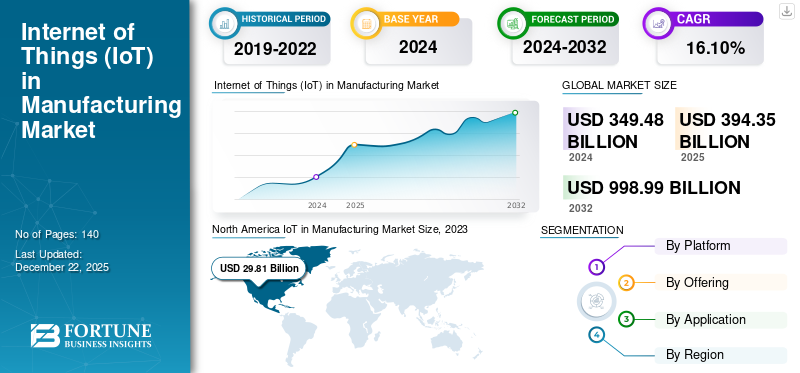
The global IoT in manufacturing market size was valued at USD 141.18 billion in 2025 and is projected to grow from USD 172.65 billion in 2026 to USD 1,108.42 billion by 2034, exhibiting a CAGR of 26.20% during the forecast period. The North America dominated global market with a share of 30.00% in 2025.
The global market has witnessed significant growth in recent years, driven by the increasing need for real-time data analytics, automation, and optimization across production processes. IoT technologies, including sensors, connected devices, and cloud-based platforms, have enabled manufacturers to enhance operational efficiency, reduce downtime, and improve decision-making. Industries, such as automotive, electronics, and heavy machinery, have rapidly adopted IoT solutions to streamline production, enhance predictive maintenance, and foster a more agile supply chain. Furthermore, the ongoing shift toward Industry 4.0 has solidified IoT as a cornerstone in smart manufacturing environments, offering benefits, such as enhanced product quality and resource management.
Download Free sample to learn more about this report.
Further, the global market is poised for robust growth, fueled by advancements in 5G connectivity, artificial intelligence (AI), and edge computing. These innovations will enable faster, more reliable data transmission and processing, allowing manufacturers to adopt more sophisticated IoT applications. Sustainability initiatives and the drive for digital transformation across sectors are expected to accelerate the market expansion. However, challenges such as cybersecurity risks and integration complexities may hinder adoption rates. Nonetheless, the market's outlook remains highly optimistic, with projections indicating that IoT will play a pivotal role in reshaping the global manufacturing landscape over the coming decade.
Download Free sample to learn more about this report.
INTERNET OF THINGS IN MANUFACTURING MARKET KEY TAKEAWAYS
 Global Market Size & Forecast
- 2025 Market Size: USD 141.18 billion
- 2026 Market Size: USD 172.65 billion
- 2034 Forecast Market Size: USD 1,108.42 billion
- CAGR: 26.20% from 2026–2034
 Market Share
- Europe dominated the global robotic refueling system market with a market share of 36.29% in 2025.
- Application management is projected to holds the highest market with a share of 41.93% in 2026.
- The services segment anticipated to holds the highest market with a share of 66.05% in 2026.
 Key Regional Highlights
North America
The regional market value in 2025 was ISD 42.3 billion, and is projecte to reached in 2026, the market value led the region by USD 51.05 billion.
Europe
Europe recorded a market size of USD 31.23 billion in 2025, capturing 22.10% of the global market share, and is projected to reach USD 36.8 billion in 2026.
Asia Pacific
The region is anticipated to account for the second-highest market size of USD 40.81 billion in 2025, exhibiting the second-fastest growing CAGR of 28.8% during the forecast period.
U.S.
The U.S. market is projected to reach USD 27.61 billion by 2026.
Japan
The Japan market is projected to reach USD 10.07 billion by 2026.
Read More

IMPACT OF GENERATIVE AI
Generative AI to Accelerate the Adoption of IoT in the Manufacturing Sector
Generative AI is set to have a transformative impact on the market for IoT in manufacturing by significantly enhancing the capabilities of IoT systems through advanced data analysis, automation, and predictive insights. By leveraging generative AI, manufacturers can harness vast amounts of data collected from IoT sensors to automatically generate innovative design solutions, optimize production workflows, and predict equipment maintenance needs with greater accuracy. This enables more efficient use of resources, reduces downtime, and enhances overall operational agility. Furthermore, generative AI can facilitate the creation of digital twins, allowing manufacturers to simulate and refine processes before actual implementation, thus minimizing risks and maximizing productivity.
In addition, generative AI enhances decision-making by providing actionable insights derived from complex datasets, enabling manufacturers to identify patterns, anomalies, and opportunities that might not be evident through traditional IoT analytics. This integration also drives more personalized and adaptive manufacturing processes, leading to more customized products and improved supply chain management. While the integration of generative AI into IoT brings immense potential, it also raises challenges around data security, privacy, and the need for skilled labor to manage increasingly complex AI-driven systems. Nonetheless, the synergy between generative AI and IoT is expected to accelerate the adoption of smart manufacturing, unlocking new levels of innovation and efficiency in the industry.
MARKET DYNAMICS
Market Drivers
Demand for Automation and Operational Efficiency to Drive Widespread IoT Adoption in Manufacturing
The increasing demand for automation and operational efficiency is a major factor fueling the adoption of IoT in the manufacturing industry. As global competition intensifies, manufacturers are under pressure to optimize their production processes, reduce costs, and improve output quality. IoT technologies enable the automation of repetitive tasks, minimize human error, and allow for better real-time monitoring and control of machinery, leading to more streamlined operations.
Additionally, IoT solutions provide manufacturers with real-time data and insights, allowing them to identify inefficiencies, track production metrics, and enhance decision-making. This helps reduce downtime, prevent equipment failures through predictive maintenance, and maximize resource utilization. The focus on operational efficiency and cost reduction is driving the integration of IoT systems as companies strive to remain competitive and responsive to market demands. Consequently, the demand for automation and efficiency is accelerating the adoption of IoT technologies in manufacturing, reshaping the industry into smarter and more connected ecosystems.
Market Trends
Adoption of Digital Twin Accelerates Operational and Production Efficiency in IoT-Driven Manufacturing
The growing adoption of digital twin technology in the IoT-driven manufacturing market is profoundly affecting operational efficiency. A digital twin is a virtual replica of a physical asset, system, or process, allowing manufacturers to simulate, monitor, and optimize real-world operations in a digital environment. By integrating IoT data from sensors and connected devices, digital twins provide manufacturers with real-time insights into equipment performance, product lifecycle management, and potential system failures.
This trend is driven by the need for more predictive, data-driven approaches to manufacturing. Digital twins enable manufacturers to test and refine processes virtually, reducing the risk of errors and minimizing downtime. They also support advanced analytics and machine learning algorithms, allowing manufacturers to predict maintenance needs, optimize resource allocation, and enhance product quality. As a result, companies adopting digital twin technology experience improved operational efficiency, reduced costs, and increased agility in responding to changing market demands.
Furthermore, digital twins facilitate collaboration across different departments, enhancing supply chain transparency and innovation in product design. As manufacturers increasingly recognize the benefits of this technology, its adoption is expected to continue growing, playing a key role in the future of smart manufacturing.
Market Restraints
Cybersecurity and Data Privacy Concerns Hinder IoT Adoption in Manufacturing
Cybersecurity and data privacy concerns represent a significant restraint in the global IoT in manufacturing market, influencing companies' willingness to embrace IoT solutions fully. As manufacturing processes become increasingly interconnected through IoT devices, the potential for cyber threats escalates. Manufacturers are vulnerable to various risks, including data breaches, ransomware attacks, and unauthorized access to critical operational systems. These threats not only jeopardize sensitive company information but also disrupt production, leading to financial losses and reputational damage.
The fear of these security breaches compels many manufacturers to adopt a cautious approach toward IoT implementation, often delaying investments in new technologies. Additionally, regulatory requirements surrounding data protection and privacy add another layer of complexity, as manufacturers must ensure compliance with various standards and frameworks. The need to invest in robust cybersecurity measures can further escalate the costs and resources required for IoT integration. Consequently, concerns over cybersecurity and data privacy significantly hinder the broader adoption of IoT in the manufacturing sector, limiting the potential benefits of increased automation and operational efficiency.
Market Opportunities
Development of Smart Factories to Create Lucrative Opportunities
The development of smart factories is driving significant opportunities for the market as companies increasingly seek to digitize and optimize their production processes. Smart factories leverage IoT technologies, along with AI, machine learning, and robotics, to create highly automated, data-driven environments where machines, systems, and humans collaborate seamlessly. These factories rely on IoT devices to collect and analyze real-time data, enabling manufacturers to enhance operational efficiency, improve product quality, and minimize downtime.
As more industries transition to smart manufacturing practices, the demand for IoT solutions continues to grow. IoT allows manufacturers to monitor equipment performance, track inventory, and manage supply chains with greater precision. Additionally, the integration of IoT with smart factories supports predictive maintenance, automated decision-making, and adaptive manufacturing, further increasing production agility and scalability. The development of smart factories, therefore, creates a vast array of opportunities for IoT providers to deliver innovative solutions that help manufacturers stay competitive and meet the demands of Industry 4.0.
SEGMENTATION ANALYSIS
By Platform Analysis
Application Management to Dominate the Market Owing to Its Growing Demand
In the global market for IoT in manufacturing, the platform segment is categorized into device management, application management, and network management.
Among these, application management is projected to holds the highest market with a share of 41.93% in 2026, and exhibits the fastest CAGR. This dominance can be attributed to the increasing need for efficient IoT application development, deployment, and monitoring, which enables manufacturers to optimize operations and increase productivity through data-driven insights. The segment held 41% of the market share in 2024.
Following closely, network management ranks second in IoT in manufacturing market share, driven by the growing demand for seamless connectivity and communication between IoT devices. As manufacturers continue to expand their IoT ecosystems, network management solutions play a critical role in ensuring reliable data flow across devices and systems.
Meanwhile, device management demonstrates a high CAGR, highlighting the rising importance of managing, updating, and securing growing number of connected devices in the manufacturing environment, especially as more devices become integrated into smart factories and automated processes.
To know how our report can help streamline your business, Speak to Analyst
By Offering
Services Due to Their Widespread Usage, Hold Majority of the Market Share
Based on offering, the global market is segmented into software solutions and services.
The services segment anticipated to holds the highest market with a share of 66.05% in 2026, and also exhibits the fastest CAGR. This growth is driven by the increasing demand for implementation, integration, and ongoing support services required to manage complex IoT systems in manufacturing environments. As manufacturers adopt IoT technologies, the need for consulting, training, maintenance, and managed services continues to grow, positioning services as a key revenue driver in the market. The segment is likely to acquire 65.6% of the market share in 2025.
Meanwhile, software solutions remain essential for enabling the functionality of IoT platforms, providing critical tools for device management, analytics, and automation. However, the higher growth of the services segment highlights the increasing reliance on external expertise to fully leverage the potential of IoT technologies in optimizing manufacturing processes. The segment is likely to record a CAGR of 23.4% during the forecast period.
By Application
Predictive Maintenance to Constitute Majority Share Due to Its Transformative Impact
Based on application the global market is segmented into predictive maintenance, asset tracking and management, logistics and supply chain management, real-time workforce tracking and management, emergency and incident management, and others.
Predictive maintenance projected to holds the largest market with a share of 30.22% in 2026, and highest CAGR in the global market due to its transformative impact on operational efficiency. By utilizing IoT sensors and analytics, predictive maintenance enables manufacturers to monitor equipment performance in real time, predict potential failures, and schedule maintenance before breakdowns occur. This minimizes unplanned downtime, reduces repair costs, and extends the life of machinery, making it a critical application for manufacturers aiming to optimize productivity and reduce operational disruptions. The segment to hold 30% of the market share in 2025.
Other key applications include asset tracking and management, which enhances the visibility and control of physical assets throughout the production cycle, and logistics and supply chain management, which improves inventory accuracy and supply chain coordination.
Real-time workforce tracking enables manufacturers to monitor workforce efficiency and safety, while emergency and incident management helps ensure rapid response to operational hazards. Each of these applications plays an important role in streamlining manufacturing processes, though predictive maintenance remains the most crucial for driving overall efficiency and cost savings.
The logistics and supply chain management segment is projected to record a CAGR of 26.8% during the forecast period.
IoT IN MANUFACTURING MARKET REGIONAL OUTLOOK
North America
North America holds a major share of the global market for IoT in manufacturing, driven by the region's advanced industrial infrastructure and high adoption of IoT technologies in sectors, such as automotive, aerospace, and electronics. The regional market value in 2025 was ISD 42.3 billion, and is projecte to reached in 2026, the market value led the region by USD 51.05 billion. The U.S., in particular, leads the region, benefiting from strong investments in smart manufacturing and industrial automation. Major U.S. manufacturers are increasingly integrating IoT solutions to enhance productivity, reduce operational costs, and improve supply chain management. The presence of key IoT solution providers and a strong focus on technological innovation also bolster the IoT in Manufacturing market growth in the region.
North America IoT in Manufacturing Market Size, 2025 (USD Billion)
To get more information on the regional analysis of this market, Download Free sample
The U.S.’s dominance in the region is based on its leadership in industrial automation and advanced manufacturing technologies which has driven high IoT adoption rates. U.S. manufacturers, particularly in the automotive, aerospace, and consumer electronics sectors, are leveraging IoT to improve operational efficiency, enhance supply chain visibility, and implement predictive maintenance. The strong presence of technology giants, such as Cisco, Microsoft, and Intel, coupled with government support for smart manufacturing initiatives, further strengthens the U.S. market. Additionally, the focus on sustainability and energy-efficient manufacturing is pushing U.S. companies to adopt IoT solutions that optimize resource utilization. The U.S. market is projected to reach USD 27.61 billion by 2026.
Asia Pacific
Asia Pacific is the fastest-growing region in the market, driven by rapid industrialization and the growing adoption of IoT in manufacturing hubs such as China, Japan, and South Korea. The region is anticipated to account for the second-highest market size of USD 40.81 billion in 2025, exhibiting the second-fastest growing CAGR of 28.8% during the forecast period. China, in particular, is a key player, as its government pushes for the modernization of manufacturing through initiatives, such as "Made in China 2025." The region is witnessing a surge in demand for IoT solutions that enhance operational efficiency and automation in industries, such as electronics, automotive, and consumer goods. Increasing investments in smart factories and industrial IoT (IIoT) are also contributing to the market's growth. The Japan market is projected to reach USD 10.07 billion by 2026, the China market is projected to reach USD 19.33 billion by 2026, and the India market is projected to reach USD 6.31 billion by 2026.
South America
South America is an emerging market for IoT in manufacturing, with Brazil and Argentina leading the way. South America contributed approximately USD 10.26 billion to the global market in 2025, accounting for 7.30% share, and is expected to reach USD 12.43 billion in 2026. The region's growth is supported by the increasing adoption of IoT in industries, such as automotive, food & beverage, and consumer goods. However, the region faces challenges such as economic instability and infrastructure gaps, which could slow down the pace of IoT implementation.
Europe
Europe is another prominent market, led by countries such as Germany, France, and the U.K. The adoption of Industry 4.0 initiatives and the digital transformation of manufacturing facilities are key factors driving IoT implementation in Europe. Europe recorded a market size of USD 31.23 billion in 2025, capturing 22.10% of the global market share, and is projected to reach USD 36.8 billion in 2026. Germany, with its strong manufacturing base and focus on smart factory development, plays a crucial role in the region’s market. European manufacturers are increasingly deploying IoT technologies for predictive maintenance, energy management, and improved production automation. The UK market is projected to reach USD 8.95 billion by 2026, while the Germany market is projected to reach USD 8.19 billion by 2026 and France is likely to hold USD 7.04 billion in 2025.
Middle East & Africa
Middle East & Africa is experiencing steady growth in IoT adoption, particularly in the oil & gas, manufacturing, and logistics sectors. Middle East & Africa contributed 11.70% to the global market in 2025, with a valuation of USD 16.58 billion, and is projected to reach USD 20.83 billion in 2026. Countries, such as the UAE and Saudi Arabia are investing in smart manufacturing initiatives as part of broader economic diversification efforts. These regions are focusing on improving industrial efficiency through IoT solutions that optimize production processes and reduce downtime. The South Africa market is expected to hit USD 8.73 billion in 2025.
COMPETITIVE LANDSCAPE
Key Industry Players
Key Players are Driving Market Growth through Investments in R&D
Top players in the global market for IoT in manufacturing exhibit a combination of key characteristics that contribute to their competitive advantage. They possess strong technological expertise and extensive experience in industrial automation, enabling them to offer innovative IoT solutions tailored to the unique needs of manufacturers. These companies prioritize research and development, continually advancing their product offerings to incorporate emerging technologies such as artificial intelligence, machine learning, and edge computing. They also emphasize strategic partnerships and collaborations with other technology providers, enabling seamless integration of IoT systems across various manufacturing processes.
List of Companies Profiled:
- Cisco Systems, Inc. (U.S.)
- Siemens (Germany)
- Rockwell Automation (U.S.)
- General Electric (U.S.)
- SAP SE (Germany)
- Software GmbH (Germany)
- Zebra Technologies Corp. (Germany)
- PTC (U.S.)
- Microsoft (U.S.)
- Schneider Electric (France)
- IBM Corporation (U.S.)
- Intel Corporation (U.S.)
- Honeywell International Inc. (U.S.)
- Advantech (Taiwan)
- Robert Bosch GmbH (Germany)
- Amazon Web Services (U.S.)
- NXP Semiconductors (Netherlands)
- Micron Technology (U.S.)
- Ericsson (Sweden)
- Litmus Automation (U.S.)
KEY INDUSTRY DEVELOPMENTS:
- August 2023: iot squared took over Saudi-based IoT company Machinestalk to solidify their market position in Saudi and expand their IoT offering for the manufacturing sector
- June 2023: China Telecom and ABB collaborated to open an industrial IoT laboratory in Hangzhou. The laboratory will focus on building end-to-end industrial IoT solutions for Chinese manufacturers.
- March 2023: Aeris, a leading provider of Internet of Things (IoT) solutions, acquired the IoT Accelerator (IoT-A) and Connected Vehicle Cloud (CVC) business of Ericsson along with its related assets to strengthen their global footprint
- December 2022: Wipro Infrastructure Engineering’s industrial automation business signed a definitive agreement to acquire Linecraft.AI, an Indian industrial Internet of Things (IoT) product start-up in the manufacturing sector.
- September 2020: Accenture acquired SALT Solutions AG, a German-based technology consultancy company that builds cloud-based industrial Internet of Things (IoT) platforms to help clients with their manufacturing and logistics operations.
INVESTMENT ANALYSIS AND OPPORTUNITIES
The integration of IoT with manufacturing processes is enabling industries to optimize production, enhance predictive maintenance, and improve supply chain efficiency. The growing use of advanced technologies, such as AI, machine learning, and 5G in IoT systems, is a key driver attracting substantial investment. Companies such as Siemens and General Electric are at the forefront of these innovations, pouring resources into IoT-enabled platforms that improve factory operations and decision-making processes.
The global IoT in manufacturing market is expected to grow at a strong CAGR, driven by the increased adoption of smart manufacturing practices. As more factories shift to Industry 4.0 solutions, there is immense potential for investors to earn high returns. For instance, PTC and Rockwell Automation have seen substantial investor interest due to their IoT platforms designed to enhance productivity in manufacturing, indicating a strong investment case for companies leading this transformation.
Governments across various regions are promoting smart manufacturing through initiatives and programs that incentivize the adoption of IoT technology. In regions, such as Europe and North America, significant funds are being directed toward digital infrastructure and smart manufacturing hubs. Investors are particularly attracted to companies benefiting from these government programs, as they provide a financial boost and ensure faster market growth. For example, Germany’s “Industrie 4.0” initiative has accelerated investments in IoT-enabled manufacturing systems.
REPORT COVERAGE
The report provides a detailed analysis of the market and focuses on key aspects such as leading companies, platform/offerings, and leading applications of the product. Besides, the report offers insights into the market trends and highlights key industry developments. In addition to the factors above, the report encompasses several factors that contributed to the growth of the market in recent years.
Request for Customization to gain extensive market insights.
REPORT SCOPE & SEGMENTATION
|
ATTRIBUTE |
DETAILS |
|
Study Period |
2021-2034 |
|
Base Year |
2025 |
|
Forecast Period |
2026-2034 |
|
Historical Period |
2021-2024 |
|
Growth Rate |
CAGR of 26.20% from 2026 to 2034 |
|
Unit |
Value (USD Billion) |
|
Segmentation
|
By Platform
|
|
By Offering
|
|
|
By Application
|
|
|
By Region
Rest of South America |
|
|
Key Market Players Profiled in the Report |
Cisco Systems, Inc. (U.S.), Rockwell Automation (U.S.), General Electric (U.S.), SAP SE (Germany), Software GmbH (Germany), Zebra Technologies Corp. (Germany), PTC, (U.S.) Microsoft (U.S.), Siemens (Germany , and Schneider Electric (France). |
Frequently Asked Questions
The market is projected to reach USD 1,108.42 billion by 2034.
In 2025, the market was valued at USD 141.18 billion.
The market is projected to grow at a CAGR of 26.20% during the forecast period.
The application management segment leads the market.
Demand for automation and operational efficiency is the key factor driving market growth.
Cisco Systems, Inc., Rockwell Automation, General Electric, SAP SE, Software GmbH, Zebra Technologies Corp., PTC, Microsoft, Siemens, and Schneider Electric are the top players in the market.
North America is expected to hold the highest market share.
By offering, the services are expected to grow with the highest CAGR during the forecast period.


- 2021-2034
- 2025
- 2021-2024
- 140
Get 30-60 hrs Free Customization
Expand Regional and Country Coverage, Segments Analysis, Company Profiles, Competitive Benchmarking, and End-user Insights.















Related Reports
-
US +1 833 909 2966 ( Toll Free )
-
Get In Touch With Us