Internet of Things (IoT) Market Size, Share & Industry Analysis, By Component (Platform and Solution & Services), By Deployment (On-premise and Cloud), By Enterprise Type (SMEs and Large), By Industry (BFSI, Retail, Government, Healthcare, Manufacturing, Agriculture, Sustainable Energy, Transportation, IT & Telecom, and Others), and Regional Forecast, 2026-2034
 Download Free Sample
 Internet of Things (IoT) Market Size
 Listen to Audio Version
The global Internet of Things (IoT) market size was valued at USD 864.32 billion in 2025. The market is projected to grow from USD 1,055.02 billion in 2026 to USD 5,552.48 billion by 2034, exhibiting a CAGR of 23.10% during the forecast period. North America dominated the Internet of Things (IoT) market with a market share of 32.40% in 2025.
The Internet of Things refers to the network of physical objects that are inserted with software, sensors, and other mechanisms for exchanging and connecting data with other systems and devices over the Internet.
The Internet of Things technology operates as a global infrastructure for the information society, empowering modernized services to connect and communicate things based on prevailing and evolving communication mechanisms. Also, it delivers interoperable data and can communicate self-sufficiently without human intervention.
As a result, the technology is anticipated to generate new revenue streams, enhance business efficiencies, aid new business models, and process how current services are delivered across various sectors. For instance,
- In November 2023, IDEMIA and TEAL announced a strategic partnership to enable unified connectivity for upcoming IoT applications. This alliance focuses on the recent GSMA SGP.32 model, which places the groundwork for a more streamlined and efficient deployment model desired in this market.
The IoT market created a significant opportunity to enhance the quality of life, with the probability of having a wide-reaching impact on society, predominantly during COVID-19's new normal. The pandemic encouraged enterprises and governments to reconsider their business actions and objectives. Moreover, these adjustments proved to be a driving factor for innovation and technology.
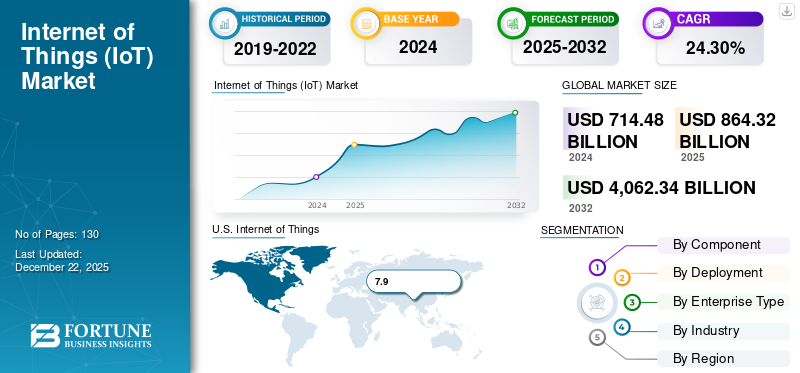
Download Free sample to learn more about this report.
IMPACT OF GENERATIVE AI
Different Applications of Generative AI within IoT Devices to Fuel Market Growth
With the rising importance of IoT applications, the necessity to analyze and process huge amounts of data also increases. Generative AI involves the usage of machine learning mechanisms to generate new data and, thus, has emerged as an encouraging technology that can help resolve various challenges.
Generative AI can be implemented in Internet of Things solutions to enhance predictive maintenance. IoT sensors can collect massive amounts of data regarding machine health and performance that can be used to train generative AI models and generate synthetic data for upkeep predictive analysis. Other prominent applications of generative AI include anomaly detection, synthetic data modeling, fraud detection, personalized recommendations and customizations, energy optimization, and many more. Such applications of generative AI, along with IoT, can be used across different industries, such as manufacturing, automotive, healthcare, and others. For instance,
- In December 2023, Microsoft and TomTom unveiled generative AI for linked vehicles. The partnership resulted in the improvement of a wholly incorporated AI-driven conversational assistant that improves voice communication with infotainment, vehicle command systems, and location search.
Thus, generative AI has the potential to transform the process and collection of data from different Internet of Things devices. Producing new data that is comparable to the input data (synthetic data) can aid in overcoming the limits of traditional data-gathering procedures and increase the precision of ML models.
Internet of Things (IoT) Market Trends
Adoption of Blockchain Technologies to Upsurge Progress of IoT Market
Internet-linked devices collect an enormous amount of information and data for processing. However, the Internet of Things standard security access increases numerous privacy and security complications. The blockchain-based architecture provides linked devices with minimal and decentralized security solutions.
Moving freight is a complex process comprising several parties with variable priorities in freight transportation applications. An IoT-driven blockchain can record the arrival times, the status of shipping containers, temperatures, and position when in a movable state.
Similarly, in the component tracking and compliance application, the Internet of Things data kept in shared blockchain ledgers permits all parties to track component provenance throughout the product life cycle. Hence, the technology is being used across different sectors. For instance,
- In December 2023, Vodafone and Deloitte collaborated to introduce blockchain IoT services to simplify operations in supply chains. The alliance with Nexxiot, a Zurich-based DAB platform, and Deloitte uses blockchain to automatically validate transactions over IoT devices. It is being pitched to the energy, automotive, supply chain, and manufacturing sectors.
Thus, blockchain could help improve connected technology's scalability and security concerns.
Download Free sample to learn more about this report.
Internet of Things (IoT) Market Growth Factors
Growing Adoption of Smart Cities to Strengthen Progress of Market
With the rising population and urbanization, several countries are introducing smart city projects and implementing smart city solutions to accomplish resources. Connected devices, such as sensors, smart meters, and smart lights, help advance the functions and proficiency of set-up and related services.
The rising number of smart homes and buildings, Industry 4.0, smart manufacturing, and smart infrastructure developments are projected to generate a vast transformation in business areas, driving the Internet of Things market growth. For instance,
- According to the World Economic Forum, 1.3 million individuals move to metropolises each week, and by 2040, an overwhelming 65% of the global population will live in cities. Thus, more population is moving toward urbanization and using smart devices.
- As per the World Economic Forum 2022 report, 131.4 million households were using smart speakers in 2022, and 335.3 million are predicted to use smart speakers by 2027. Similarly, 73.1 million households were using smart big appliances in 2022, and 177.6 million are predicted to use these smart devices by 2027.
Moreover, smart city solutions, such as smart utility meters, smart transportation, smart waste management, smart grids, and smart air quality controllers, are being implemented by consumers, elevating the market potential of connected devices worldwide.
RESTRAINING FACTORS
Limitations Associated with Security, Integrity, and Privacy of Data in Connected Devices to Inhibit Growth
Internet of Things technology has various applications, ranging from gathering biometric data through wearable devices to monitoring connected equipment via cloud platforms and communication networks. These devices have exclusive IP addresses that enable them to exchange information and communicate with other devices.
However, as the number of devices connected, mobile devices, smart devices, and platforms grows, so does the necessity for data protection and privacy. These devices and networks could comprise personal and sensitive data that attackers could use. Data misuse may emerge due to the rising dependence on connected devices, replicating design flows, and the susceptibilities of connected devices.
Such limitations over the security and privacy of customer’s data can hamper Internet of Things (IoT) market market growth.
Internet of Things (IoT) Market Segmentation Analysis
By Solution & Services
Solution : 2023 : 253.49 Million= 0.25 Billion
2024 : 299.78 Million= 0.30 Billion
Highest CAGR : Services : 24.7%
By Component Analysis
Integration of Emerging Technologies Drives Growth in IoT Platforms
On the basis of component, the market is bifurcated into platforms and solutions & services.
The platform is sub-segmented into network management, cloud platform, and device management. The solution is categorized into real-time streaming analytics, security, data management, remote monitoring, and network band management.with a share of 71.12% in 2026
The platform segment is expected to record the highest CAGR due to the rising demand for effective downstream data servers and enterprise application connectivity platforms. Also, various market players are enhancing IoT platforms by integrating them with new emerging technologies. For instance,
- In June 2023, Ayla collaborated with Etisalat to offer an IoT Platform for a new smart home solution from Etisalat by e&, the brand, demonstrating the telecoms of UAE. The partnership with Ayla added further value to smart home services and solutions with its streamlined cloud infrastructure and capability to aid a variety of devices.
Further, network management is expected to hold a significant market share during the forecast period due to businesses' growing demand for remote monitoring systems and internet-ready devices. The network management solution is device-independent and easily integrates cross-vendor hardware models and data structures into the workflow. The segment is set to hold 54.10% of the market share in 2025.
However, solutions & services are expected to dominate the market with the highest market share. Several industries are implementing intelligent solutions to improve their present systems. For instance, healthcare facilities deploy connected devices to improve medical outcomes. The segment captured 72.20% of the market share in 2024.
The cloud platform segment is likely to grow with a considerable CAGR of 29.50% during the forecast period (2024-2032).
By Deployment Analysis
Convergence Of IoT And Cloud Deployment To Drive Innovation, Optimize Operations, And Compelling Experiences To End-Users
Based on deployment, the market is bifurcated into cloud and on-premise.Cloud deployment of Internet of Things (IoT) devices continues to evolve, driven by various trends, shaping how organizations leverage IoT combined with cloud computing. Cloud remains crucial for IoT data processing and analytics. There's a growing trend toward integrating edge computing with cloud deployments. Cloud platforms offer advanced AI and machine learning services that complement IoT deployments. Organizations leverage these capabilities to derive actionable insights from IoT data, enabling predictive maintenance, anomaly detection, and optimization of IoT systems. Integrating AI and ML into cloud-based IoT solutions enhances decision-making and drives innovation. The segment is expected to capture 78.38% of the market share in 2026, recording a substantial CAGR of 26.40% during the forecast period (2024-2032).
While cloud deployment of Internet of Things (IoT) solutions is gaining momentum, on-premise deployments remain relevant, particularly for organizations with stringent data privacy requirements, latency-sensitive applications, or limited connectivity to the cloud.
By leveraging on-premise infrastructure, organizations can address unique requirements related to data sovereignty, latency, compliance, and connectivity while unlocking the full potential of IoT for operational efficiency and business innovation.
By Enterprise Type Analysis
SMEs To Adopt Affordable And Easy-To-Deploy IoT Solutions To Enhance The Customer Experience
On the basis of enterprise type, the market is bifurcated into large enterprises and SMEs.The adoption of Internet of Things (IoT) technology varies between large and small to medium-sized enterprises (SMEs) due to differences in resources, priorities, and organizational structures.
Large enterprises holds major market share in 2025. Large enterprises often have the resources to implement end-to-end IoT solutions. They integrate IoT data with existing enterprise systems, such as ERP (Enterprise Resource Planning) and CRM (Customer Relationship Management), to derive actionable insights and improve decision-making. This segment is estimated to attain 64.36% of the market share in 2026.
SMEs will grow at highest CAGR of 27.00% during forecast period (2024-2032). SMEs adopt IoT solutions that are cost-effective and easy to implement. They often start with basic IoT applications, such as remote equipment monitoring, inventory management, and environmental monitoring, to address immediate business needs.
While large enterprises and SMEs embrace IoT technology, their adoption trends differ based on scale, budget, industry focus, and technological maturity. Large enterprises prioritize comprehensive, customized IoT solutions integrated with existing enterprise systems, while SMEs prefer affordable, easy-to-deploy IoT solutions tailored to their specific business needs.
By Industry Analysis
Agriculture Industry to Have Fastest Growth Rate Due to Growing Demand for Field-Based Equipment and Sensors
Based on industry, the market is segmented into agriculture, BFSI, healthcare, government, retail, manufacturing, sustainable energy, transportation, IT & telecom, and others.
The agriculture industry is anticipated to grow at the leading CAGR owing to the growing demand for field-based equipment and sensors. Some key applications of the high-tech in the agricultural sector are smart greenhouses, smart farming, precision farming, smart agriculture, smart drones, and many others. The implementation of IoT in agriculture includes various benefits, such as reducing expenses while multiplying yields and improving the decision-making of farmers with accurate data. Such factors create numerous opportunities for the market’s progress. For instance,
- In January 2024, Morse Micro and Zetifi collaborated to announce modernized distant-area connectivity for smart IoT Farming at CES 2024. The inventive technology allows farmers and rural populations to access, expand, and improve coverage from existing cellular, radio, and satellite networks.
Healthcare is anticipated to account for the highest market share during the forecast period. Industry 4.0 technologies, such as the industrial internet of things, big data, and machine learning, are allowing the healthcare sector to move its focus to digital transformation to upsurge quality and productivity, minimize downtime, and help in supply chain management. These devices make the remote monitoring sector feasible in healthcare, enabling the potential to keep patients healthy and safe and allowing physicians to provide excellent care. The segment is set to capture 20.10% of the market share in 2026.
The sustainable energy segment is estimated to document a substantial CAGR of 30.40% during the forecast period (2024-2032).
To know how our report can help streamline your business, Speak to Analyst
REGIONAL INSIGHTS
The market has been analyzed across five major regions: North America, Asia Pacific, Europe, the Middle East & Africa, and South America.
North America Internet of Things (IoT) Market Size, 2025 (USD Billion) To get more information on the regional analysis of this market, Download Free sample
North America
In 2025, North America generated USD 279.73 billion, contributing 32.40% to global market revenue, and is projected to grow to USD 338.85 billion in 2026. The region has witnessed noteworthy growth in the healthcare, industrial, and automotive sectors, owing to the growing customer base for cloud-based platforms. Also, the rising adoption of 5G technology contributes majorly to the region’s market progress. Additionally, cloud platforms are experiencing extensive adoption in the region due to the expansion of IoT-enabled devices, rising R&D investments in advanced technology, and the prominence of key market players, such as Amazon Web Services (AWS), Google, Cisco, Microsoft, and IBM. The U.S. market is foreseen to reach USD 183.24 billion in 2026.
- According to the GSMA Intelligence Report 2023, in North America, cellular IoT connections are estimated to reach 535 million by 2030. The U.S. accounts for the region's highest number of IoT connections, accounting for over 90% of overall connections.
To know how our report can help streamline your business, Speak to Analyst
Europe
The Europe market accounted for USD 197.79 billion in 2025, representing 22.90% of the global industry, and is expected to reach USD 233.88 billion in 2026. The region is expected to dominate the market in the coming future by crossing North America with the largest Internet of Things market share. As healthcare is forecasted to hold a considerable market share in Europe, the industry is becoming progressively linked to big databases. The U.K. market continues to grow, projected to reach a market value of USD 56.91 billion in 2026. Connected devices combined with big data are expected to gain traction in Europe. Germany is estimated to be worth USD 52.03 billion in 2026, while France is expected to gain USD 44.56 billion in the same year.
Moreover, the demand for this technology is rising among enterprises and organizations in Germany, France, the U.K., Spain, Italy, and the Netherlands, thus driving the region's market growth. Similarly, Nordic and Eastern European countries show a substantial adoption rate of such advanced technologies.
- According to industry experts, European organizations are estimated to spend USD 345 billion by 2027 on IoT-related technology. Thereby contributing to the region’s market progress.
Asia Pacific
Asia Pacific recorded a market size of USD 302.28 billion in 2025, capturing 27.70% of the global market share, and is projected to reach USD 384.74 billion in 2026. The region is anticipated to showcase the highest CAGR during the forecast period owing to the rising smart city plans and initiatives, such as the Intelligent Disease Prediction Project (China), Smart Wellington (New Zealand), and cloud spending in the region. China is set to be valued at USD 113.38 billion in 2026.
Also, the region's communication service providers and producers, such as Taiwan Mobile and Samsung Electronics Co., Ltd., are intensifying their portfolios to exploit smart device opportunities by adopting advanced analytics capabilities into existing systems. Also, various market players are investing in the region to fortify their business position there. For instance,
- In October 2023, SoftBank Corp. expanded its IoT business in Asia Pacific. The company expanded its sales within 19 countries and regions, including Japan. SoftBank would emphasize the marketing of IoT services.
India is foreseen to acquire USD 36.98 billion in 2026, while Japan is preficted to reach a value of USD 59.04 billion in the same year.
Middle East & Africa and South America
The Middle East & Africa market generated USD 114.86 billion in 2025, representing 10.80% of the global market landscape, and is expected to reach USD 143.22 billion in 2026. Latin America accounted for USD 65.14 billion in 2025, representing 6.30% of the global market share, and is projected to reach USD 78.99 billion in 2026. The Middle East & Africa and South America are expected to witness significant growth during the forecast period due to the growing internet access services and regional users. Middle Eastern countries, such as Saudi Arabia and UAE, have been actively engaged in building smart cities, preferring to build and create them from scratch rather than integrating technology into existing ecosystems. The GCC market is estimated to reach USD 27.96 billion in 2025.
Key Industry Players
Established Players Invest in Core Technologies and Startups to Stay Competitive
Major key players, such as Intel Corporation, Microsoft Corporation, Cisco Systems, Inc., Amazon Web Services, Inc., Siemens AG, PTC Inc., and others are making substantial investments in advanced technologies, such as AI, cloud computing, and others. Established market players are making substantial investments in startups and midscale companies to offer efficient solutions to the end-use verticals, such as healthcare, manufacturing, retail, and others.
List of Top Internet of Things (IoT) Companies:
- Amazon Web Services, Inc. (U.S.)
- Intel Corporation (U.S.)
- Microsoft Corporation (U.S.)
- PTC Inc. (U.S.)
- GE (U.S.)
- Cisco Systems, Inc. (U.S.)
- IBM Corporation (U.S.)
- Oracle Corporation (U.S.)
- SAP SE (Germany)
- Siemens AG (Germany)
KEY INDUSTRY DEVELOPMENTS:
- November 2023: AWS and Siemens expanded their alliance to connect physical devices with the cloud more effortlessly. With the extended collaboration, AWS's IoT SiteWise Edge software can be installed directly from Siemens' Industrial Edge Marketplace.
- June 2023: Rockwell and PTC extended their partnership to emphasize sales of IoT and AR (augmented reality) Software of PTC. Rockwell Automation continues to resell PTC's ThingWorx IoT software, comprising the DPM (Digital Performance Management) manufacturing solution, to new and present customers across process and discrete manufacturing sectors.
- March 2023: Siemens announced the launch of Connect Box, a smart IoT solution to handle small-sized buildings. The Connect Box enables users to achieve crucial daily building management jobs from one place through a cloud-driven interface with no extra software.
- January 2023: Intel launched the Intel Core 13th Gen. mobile processor. The hybrid architecture of Intel powers the advancement and has thirty-two mobile processors. Intel's Core P-, H-, and U- -range mobile processors are driven by thin, light laptops and Internet of Things devices.
- December 2022: Deloitte launched Olympus with AWS (Amazon Web Services). Olympus is an investment fund for building industry cloud solutions globally, along with progressive technologies, such as IoT, AI, machine learning, 5G, quantum computing, AR/VR, and everything on the cloud. The initiative aims to resolve the issues associated with food waste, financial product access, clean energy, and many other problems.
REPORT COVERAGE
The market research study highlights leading regions worldwide to provide the consumer with a better insight. Additionally, the research focuses on the most recent market growth patterns and examines technologies that are being deployed at a quick speed on a global scale. It also provides some drivers and restraints, allowing the reader to obtain a thorough understanding of the market.
Request for Customization to gain extensive market insights.
REPORT SCOPE & SEGMENTATION
|
ATTRIBUTE |
DETAILS |
|
Study Period |
2021-2034 |
|
Base Year |
2025 |
|
Estimated Year |
2026 |
|
Forecast Period |
2026-2034 |
|
Historical Period |
2021-2024 |
|
Growth Rate |
CAGR of 23.10% from 2026 to 2034 |
|
Unit |
Value (USD Billion) |
|
Segmentation |
By Component
By Deployment
By Enterprise Type
By Industry
By Region
|
Frequently Asked Questions
According to Fortune Business Insights, the global market size is expected to record a valuation of USD 5,552.48 billion by 2034.
In 2025, the market value stood at USD 864.32 billion.
The market is projected to grow at a CAGR of 23.10% during the forecast period.
The solution & services segment is expected to dominate the market.
The growing adoption of smart cities is expected to drive market growth.
North America held the highest market share.
Asia Pacific is expected to grow at the highest CAGR.
Based on industry, agriculture is expected to register a leading CAGR during the study period.



- 2021-2034
- 2025
- 2021-2024
- 130
Get 20% Free Customization
Expand Regional and Country Coverage, Segments Analysis, Company Profiles, Competitive Benchmarking, and End-user Insights.




















Related Reports
-
US +1 833 909 2966 ( Toll Free )
-
Get In Touch With Us