Lung Cancer Therapeutics Market Size, Share and Industry Analysis By Therapy (Targeted, Therapy, Immunotherapy, Chemotherapy), By Cancer Type (Non-small cell lung cancer (NSCLC), Small cell lung cancer (SCLC)), By Distribution Channel (Hospital Pharmacies, Retail Pharmacies, Online Pharmacies), and Regional Forecast 2026-2034
 Download Free Sample
KEY MARKET INSIGHTS
 Listen to Audio Version
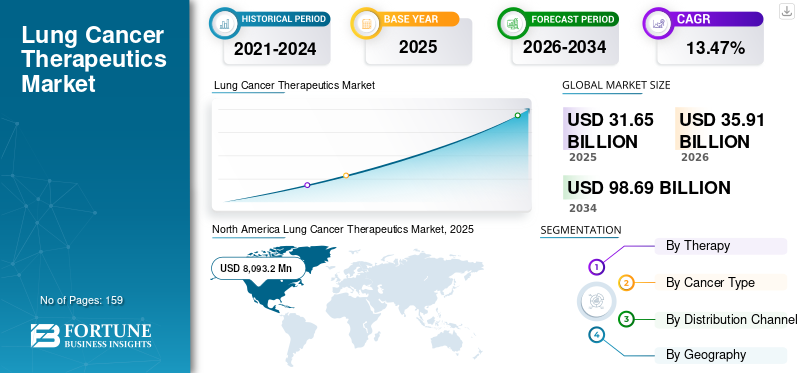
The global lung cancer therapeutics market size was valued at USD 31.65 billion in 2025. The market is projected to grow from USD 35.91 billion in 2026 to USD 98.69 billion by 2034, exhibiting a CAGR of 13.47% during the forecast period. North America dominated the lung cancer therapeutics market with a market share of 44.16% in 2025.
Rise in cancer awareness in both developing and developed nations, and the emergence of new medical diagnostic equipment and advanced therapeutics have increased the number of lung cancer diagnoses, thus propelling the lung cancer therapeutics market growth. This, coupled with, increasing investments by major players in research and development activities are also boosting the global market growth. The change in the market is primarily driven by a greater focus towards the R&D initiatives due to increasing instances of lung cancer.
Existing market players operating in the global market are focusing on constant innovation and up gradation of their product portfolio with new and efficient product offerings for better treatment outcomes for the patients. Lung cancer is among the most commonly occurring cancers in the world and contributes to a significant number of deaths worldwide.
Download Free sample to learn more about this report.
Lung Cancer Therapeutics Market KEY TAKEAWAYS
 Global Market Size & Forecast
- 2025 Market Size: USD 31.65 billion
- 2026 Market Size: USD 35.91 billion
- 2034 Forecast Market Size: USD 98.69 billion
- CAGR: 13.47% from 2026–2034
 Market Share
- North America dominated the lung cancer therapeutics market with a 44.16% share in 2025.
- Hospital pharmacies accounted for the largest share among distribution channels.
- Targeted therapy dominated the market due to its high treatment efficacy and precision.
 Key Regional Highlights
Asia Pacific
Asia Pacific is the fastest-growing region, driven by a large patient pool and improving healthcare infrastructure.
North America
North America generated USD 8.09 billion in 2025, supported by high adoption of advanced lung cancer therapies.
Europe
Europe holds a significant market share, fueled by early diagnosis programs and strong government healthcare support.
U.S.
The U.S. leads the regional market, driven by widespread adoption of immunotherapy, targeted therapy, and advanced oncology care.
Japan
Japan is expected to witness steady growth, supported by advanced healthcare infrastructure and increasing adoption of innovative cancer treatments.
Read More

Lung Cancer Therapeutics Market Trends
Download Free sample to learn more about this report.
Some of the other factors which are also contributing to the lung cancer therapeutics market growth is the increase in the proportion of individuals who smoke and also due to other contributing factors such as exposure to toxins. The introduction of new and sophisticated targeted therapies such as VIZIMPRO by Pfizer Inc. is expected to drive the global lung cancer therapeutics growth in developed as well as emerging countries, during the forecast period 2026-2034.
Growth Factors
"Increasing R&D advances leading to greater adoption of sophisticated and advanced therapies such as immunotherapy combined with the increasing prevalence of lung cancer is driving the growth of the global market"
Increasing adoption and demand for targeted therapies, which is considered to be the foundation of precision medicine due to the increasing R&D initiatives, is one of the most prominent driving factors for the growth of the global lung cancer therapeutic market in 2018. The targeted therapy segment is estimated to have the largest market share among therapy types. The targeted therapy segment accounted for a market share of 51.1% in 2018 and is expected to rise during the forecast period. Increasing focus towards the diagnosis of lung cancer and the subsequent treatment based on the accurate targeting of the tumor or the source of the cancer is also driving the growth in the targeted therapy segment.
The immunotherapy segment is estimated to grow at a faster CAGR during the forecast period. This is attributed to the increasing number of new product launches especially in the immunotherapy segment. Currently, there is increasing adoption of immunotherapy in the markets in developed nations due to its higher achievement in terms of efficient treatment leading to improved patient outcomes, and this is expected to contribute to the growth of the market at higher CAGRs during the forecast period.
Lung Cancer Therapeutics Market Key Takeaways
- The lung cancer therapeutics market is witnessing significant growth due to the rising global burden of lung cancer, which remains one of the leading causes of cancer-related mortality.
- Increasing adoption of advanced treatment options such as targeted therapy and immunotherapy is transforming the treatment landscape with improved patient outcomes.
- Growing focus on precision medicine and biomarker-based therapies is enabling more personalized and effective treatment approaches.
- Non-small cell lung cancer (NSCLC) continues to dominate the market owing to its high prevalence and broader availability of treatment options.
- Strong investments in research and development, along with frequent drug approvals, are accelerating innovation in the market.
- Expansion of online and specialty pharmacy channels is improving access to lung cancer therapeutics globally.
Lung Cancer Therapeutics Market Segmentation Analysis
By Therapy
The therapy segment includes targeted therapy, immunotherapy, chemotherapy, and other treatment approaches such as radiation and combination therapies. Targeted therapy holds a dominant position due to its ability to specifically attack cancer cells while minimizing damage to healthy tissues. Immunotherapy is rapidly gaining traction as it enhances the body’s immune response against cancer and offers long-term benefits. Chemotherapy remains widely used, particularly in advanced stages and in combination with newer therapies. Other approaches, including radiation and combination treatments, are also commonly adopted to improve overall treatment effectiveness.
To know how our report can help streamline your business, Speak to Analyst
By Cancer Type
Based on cancer type, the market is segmented into non-small cell lung cancer (NSCLC) and small cell lung cancer (SCLC). NSCLC accounts for the largest share of the market due to its high prevalence and the availability of multiple treatment options, including targeted and immunotherapies. On the other hand, SCLC is less common but more aggressive, requiring intensive treatment regimens and often diagnosed at advanced stages, which drives the need for effective therapeutic solutions.
By Distribution Channel
The segment accounted for 51.1% share of the market in 2018. Based on distribution channel, the global market segments include hospital pharmacies, retail pharmacies, online pharmacies, and others. Based on cancer type, the lung cancer therapeutics market segments include non-small cell lung cancer (NSCLC), and small cell lung cancer (SCLC). Hospital pharmacies dominate the segment as most lung cancer treatments, especially injectable and advanced biologics, are administered in clinical settings. Retail pharmacies play an important role in providing oral medications and maintenance therapies. Online pharmacies are witnessing rapid growth due to increasing digital adoption and convenience, while other channels, including specialty oncology centers, contribute to expanding access to treatments.
By Geography
Geographically, the lung cancer therapeutics market is segmented into North America, Europe, Asia-Pacific, Latin America, and the Middle East & Africa. North America holds the largest market share due to advanced healthcare infrastructure, strong research capabilities, and early adoption of innovative therapies. Europe follows with a well-established healthcare system and growing awareness programs. Asia-Pacific is the fastest-growing region, driven by a rising patient population, improving healthcare access, and increasing investments in the healthcare sector. Meanwhile, Latin America and the Middle East & Africa are gradually emerging markets supported by improving medical infrastructure and growing awareness initiatives.
Regional Analysis
"Growing prevalence of lung cancer and increasing adoption of lung cancer therapeutics expected to result in the highest CAGR in the Asia Pacific"
North America
North America generated a lung cancer therapeutics market revenue of US$ 8.0932 Billion in 2025 and is anticipated to account for a dominant share in the global market during the forecast period. Growth witnessed in the region is likely to be driven by the increasing adoption of advanced lung cancer therapeutics and rising prevalence and diagnoses of lung cancer. This is especially applicable in instances where the lack of adequate treatment leads to metastasis and subsequently, death. In developed countries, the adoption of advanced immunotherapies is increasing along with the existing therapies of chemotherapy and targeted therapy.
North America Lung Cancer Therapeutics Market, 2025
To get more information on the regional analysis of this market, Download Free sample
Europe
Europe represents a significant share of the market, driven by increasing cancer awareness, early diagnosis programs, and supportive government healthcare initiatives. Countries across the region are focusing on improving access to innovative treatments, while regulatory frameworks and funding for oncology research further contribute to market growth.
Asia-Pacific
Asia-Pacific is the fastest-growing region in the lung cancer therapeutics market due to a large patient pool, rising incidence of lung cancer, and improving healthcare infrastructure. Rapid urbanization, increasing tobacco consumption in some countries, and growing investments in healthcare are driving demand. Additionally, expanding access to advanced therapies and government initiatives are supporting market expansion.
Latin America
Latin America is an emerging market characterized by gradual improvements in healthcare infrastructure and increasing awareness about cancer treatment. While access to advanced therapeutics is still developing, rising healthcare investments and expansion of private healthcare providers are expected to drive future growth.
Middle East & Africa
The Middle East & Africa region is witnessing steady growth due to improving healthcare systems, increasing awareness of cancer diagnosis and treatment, and government efforts to enhance medical facilities. Although the market is still at a developing stage, growing investments and partnerships are expected to create new opportunities in the region.
Key Market Drivers
"Genentech, Inc. (F. Hoffmann-La Roche Ltd), Bristol Myers Squibb and Merck Sharp & Dohme Corp. to be dominant players in the lung cancer therapeutics market"
Genentech, Inc. (F. Hoffmann-La Roche Ltd), emerged as the leading player with the highest lung cancer therapeutics market share in 2018, as the company has a number of product offerings in the targeted therapy and chemotherapy segment, though it trails behind in terms of immunotherapies. The company accounts for the highest revenue shares in the lung cancer therapeutics from regions such as North America and Europe.
In addition, other market players are also getting product approvals such as Pfizer, Inc., product offering of VIZIMPRO. Other players operating in the market are Boehringer Ingelheim Pharmaceuticals, Inc., Eli Lilly, and Company, Celgene Corporation, AstraZeneca, Pfizer Inc., Sanofi, Novartis AG, Millennium Pharmaceuticals, Inc. (Takeda), Bristol Myers Squibb, Merck Sharp & Dohme Corp., Astellas, etc.
List of Companies Profiled
- Genentech (F. Hoffmann-La Roche Ltd)
- Eli Lilly and Company
- Celgene Corporation
- AstraZeneca
- Pfizer Inc.
- Sanofi
- Novartis AG
- Astellas
- Bristol Myers Squibb
- Boehringer Ingelheim Pharmaceuticals, Inc.
- Millennium Pharmaceuticals, Inc. (Takeda)
- Merck Sharp & Dohme Corp.
- Other players
Key Industry Developments
- In March 2019, Adorx Therapeutics Limited., announced that it had entered into a strategic partnership with Johnson & Johnson Innovation LLC and Lung Cancer Initiative at Johnson & Johnson (LCI) for the development of new novel lung cancer therapeutics.
- In June 2016, the American Society of Clinical Oncology (ASCO) announced that a new antibody drug conjugate showed early promise in the treatment of small cell lung cancer (SCLC).
Report Coverage
The increasing prevalence of all types of cancers are prevalent in the general population and lung cancer is one of the most common forms of cancer. The increasing prevalence and rising incidence of lung cancer across all demographics and across all the age groups have led to increasing demand for lung cancer therapeutics. According to the American Cancer Society (ACS), about 13% of all new cancer diagnosis are lung cancers.
The lung cancer therapeutics market report provides qualitative and quantitative insights on the industry trends and detailed analysis of market size and growth rate for all possible segments in the market. The market segments include therapy, distribution channel, cancer type, and geography. On the basis of therapy, the market segments include targeted therapy, immunotherapy, and chemotherapy.
Targeted therapy is further sub-segmented into bevacizumab, dabrafenib/trametinib, erlotinib hydrochloride, osimertinib, and others. Immunotherapy is further sub-segmented into durvalumab, nivolumab, atezolizumab, and pembrolizumab. On the basis of distribution channel, the market is categorized into hospital pharmacies, retail pharmacies, online pharmacies, and others, while the market is classified on the basis of cancer type into non-small cell lung cancer (NSCLC) and small cell lung cancer (SCLC).
Along with this, the report analysis includes lung cancer therapeutics market dynamics and competitive landscape. Various key insights provided in the report are the prevalence of lung cancer therapeutics by key countries, regulatory scenario by key regions, key industry developments and overview of current advances in R&D for lung cancer therapeutics.
Request for Customization to gain extensive market insights.
Report Scope & Segmentation
|
ATTRIBUTE |
DETAILS |
|
Study Period |
2021-2034 |
|
Base Year |
2025 |
|
Forecast Period |
2026-2034 |
|
Historical Period |
2021-2024 |
|
Unit |
Value (USD Billion) |
|
CAGR |
13.47 |
|
Segmentation |
By Therapy
|
|
By Cancer Type
|
|
|
By Distribution Channel
|
|
|
By Geography
|
Frequently Asked Questions
As per our (Fortune Business Insights) study, the lung cancer therapeutic market is predicted to reach USD 98.69 Billion by 2034.
In 2025, the lung cancer therapeutic market was valued at USD 31.65 Billion.
The lung cancer therapeutic market is projected to grow at a CAGR 13.47% during the forecast period (2026-2034).
Targeted therapy is the leading segment in lung cancer therapeutic market by therapy.
Growing prevalence of lung cancer, increase in the adoption of lung cancer therapeutics, and growing therapy launch through persistent investments in R&D by key players are the key factors driving the growth of the lung cancer therapeutic market.
Genentech, Inc. (F. Hoffmann-La Roche Ltd), Bristol Myers Squibb and Merck Sharp & Dohme Corp. are the top players in the lung cancer therapeutic market.
North America is expected to hold the highest share in the lung cancer therapeutic industry.



- 2021-2034
- 2025
- 2021-2024
- 159
Get 30-60 hrs Free Customization
Expand Regional and Country Coverage, Segments Analysis, Company Profiles, Competitive Benchmarking, and End-user Insights.













.webp)






Related Reports
-
US +1 833 909 2966 ( Toll Free )
-
Get In Touch With Us