Magnetic Resonance Imaging (MRI) Equipment Market Size, Share & Industry Analysis, By Strength (Less than 1.5T, 1.5T, and More than 1.5T), By Application (Musculoskeletal, Neurology, Cardiology, General Body Imaging, and Others), By Design (Closed MRI Systems, Open MRI Systems, and Dedicated/Extremity MRI Systems), By End-user (Hospitals & ASCs, Diagnostic Imaging Centers, Academic & Research Institutes, and Others), and Regional Forecast, 2026-2034
 Download Free Sample
Magnetic Resonance Imaging (MRI) Equipment Market Size and Future Outlook
 Listen to Audio Version
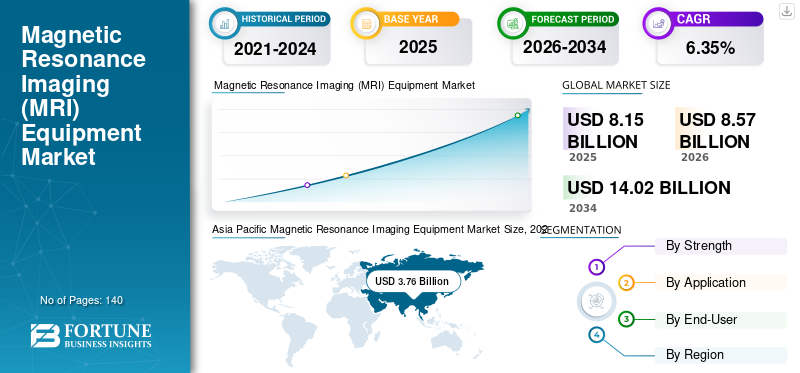
The global magnetic resonance imaging (MRI) equipment market size was valued at USD 8.15 billion in 2025. The market is projected to grow from USD 8.57 billion in 2026 to USD 14.03 billion by 2034, exhibiting a CAGR of 6.4% during the forecast period.
Magnetic resonance imaging (MRI) equipment is one of the most common diagnostic imaging techniques used in several healthcare settings, including hospitals and clinics, among others. The equipment uses strong magnetic fields and radio waves to produce detailed images of the body's insides. The rising prevalence of various chronic conditions, such as cancer and neurological disorders, among others, along with an increasing number of trauma cases, is leading to growing demand for the equipment globally, thereby contributing to the market’s growth.
GE HealthCare, Siemens Healthineers AG, and Koninklijke Philips N.V. held the largest global market share due to their robust focus on developing and introducing technologically advanced products to cater to the rising global demand among healthcare providers and patient populations.
Download Free sample to learn more about this report.
Magnetic Resonance Imaging (MRI) Equipment Market Trends
Shifting Preference Toward High-Strength MRI Scanners Drives Market Expansion
The rising focus of the major players operating in the market is leading to growing technological advancements in MRI scanners, such as high-strength scanners. Conventional MRI scanning has been using 1.5T magnetic resonance imaging (MRI) equipment; however, with the advent of technology in recent years, 3T MRI equipment, or even higher, such as 7T MRI equipment, is being utilized. These high-field and ultra-high-field MRI devices are commonly used in routine clinical diagnostics. Earlier, much of this high-strength MRI equipment was confined to research settings only.
The higher field strength of the MRI equipment enables the production of cross-sectional images of the knee and the head and is meant for patients who weigh more than 66 lbs. These devices have wide-ranging applications, such as those for diagnosis. This is due to the fact that MRI equipment enhances the imaging process by revealing the functional and anatomical details, which are otherwise not visible at the lower strengths. The aforementioned benefits associated with stronger field strength magnetic resonance imaging (MRI) equipment have caused the shift from lower tesla to a comparatively higher tesla, such as 7T and 3T.
- For instance, according to the data published by the National Center for Biotechnology Information (NCBI) in October 2024, the utilization of ultra-high-field 7-Tesla (7T) MRI in multiple sclerosis (MS) research has increased substantially in the last 20 years.
Market Dynamics
Market Drivers
Download Free sample to learn more about this report.
Rising Prevalence of Chronic Conditions and Diagnosis Among Global Population to Enhance Market Growth
The growing prevalence of chronic conditions, such as cancer and various neurological disorders, including epilepsy, Alzheimer’s disease, and Parkinson’s disease, among others, drives market expansion. The rising initiatives by healthcare organizations, major companies, and others to increase awareness regarding these conditions are expected to fuel the diagnosis rate among the population.
- For instance, according to a 2026 report published by the Alzheimer's Association, more than 7.0 million Americans are living with Alzheimer’s disease in the U.S. This number is expected to rise to nearly 13.0 million by 2050.
The rising diagnosis rate among the population and the improvement of healthcare infrastructure in emerging countries such as China, India, Brazil, and others are owed to increasing healthcare expenditure, favoring the adoption of these devices.
The increasing adoption and the advantages of magnetic resonance imaging (MRI) equipment over other diagnostic imaging equipment are expected to boost the global magnetic resonance imaging (MRI) equipment market growth during the forecast period.
Market Drivers - Impact & CAGR Contribution (2026–2034)
| Rank | Market Drivers | Overall Impact Rank | CAGR Contribution (2026-2034) | Impact: 2026-2028 | Impact: 2029-2031 | Impact: 2032-2034 |
|---|---|---|---|---|---|---|
| 1 | Rising Prevalence of Chronic Conditions and Diagnosis Among the Global Population | High | 2.6% | High | High | High |
| 2 | Replacement and Modernization of Aging MRI Installed Base, Including Migration Toward Advanced 1.5T and 3T Systems | High | 2.1% | High | High | High |
| 3 | Increasing Adoption of AI-Enabled Image Reconstruction, Automated Workflows, and Faster MRI Scanning Technologies | Medium-High | 1.8% | Medium | High | High |
| 4 | Expansion of Hospital, Diagnostic Imaging, and Healthcare Infrastructure in Emerging Markets | Medium-High | 1.5% | Medium | High | High |
| 5 | Commercialization of Low-Helium, Helium-Free, Compact, Open, and Portable MRI Systems | Medium | 1.2% | Medium | Medium | Medium |
| 6 | Others (Rising Preventive Imaging, Wider Use of Cardiac and Functional MRI, Public–Private Investments, Mobile Imaging, and Research Applications) | Low | 0.8% | Low | Low | Low |
| Total Positive Growth Contribution | 10.00% | |||||
Source: Fortune Business Insights
Market Restraints
High Costs Associated with Systems to Hamper Market Growth
One of the major limitations of the market is the high costs associated with the installation and maintenance. Installation and proper care of these systems often require complex infrastructure and incur various related costs, which many medical institutions cannot undertake.
The higher cost of MRI scanners compared to other diagnostic imaging equipment, such as CT scans and others, and the longer time taken to complete the scan are some of the factors expected to hinder the adoption of these devices in the emerging countries in the market.
- For instance, according to a 2023 article published by Health Images, the average time taken by the Computed Tomography (CT) Scanner is around 10-15 minutes. In contrast, the MRI scanner can take up to an hour or longer.
Thus, the high cost of these systems can prompt hospitals and diagnostic centers in developing countries to purchase refurbished systems to meet their imaging needs. The refurbished systems are available at a substantially lower cost than a new system. Hospitals and other healthcare institutions in developing countries often opt for these systems due to their cost-effectiveness. Another critical limitation is the voluntary recall of many imaging systems due to human error, which might trigger a decline in market growth.
Market Restraints - Impact & Negative CAGR Contribution (2026–2034)
| Rank | Market Restraints | Overall Impact Rank | Negative CAGR Contribution (2026-2034) (2026-2034) |
Impact: 2026-2028 | Impact: 2029-2031 | Impact: 2032-2034 |
|---|---|---|---|---|---|---|
| 1 | High Costs Associated with the Systems to Hamper Market Growth | High | -1.5% | High | High | Medium |
| 2 | Shortage of Skilled Radiologists, MRI Technologists, and Service Personnel, Particularly in Emerging Markets | Medium | -0.9% | Medium | Medium | Medium |
| 3 | Capital-Budget Constraints, Lengthy Procurement Cycles, Regulatory Requirements, and Uneven Reimbursement | Medium-Low | -0.8% | Medium | Medium | Low |
| 4 | Others (Patient Contraindications and Claustrophobia, Competition from Alternative Imaging Modalities, Supply-Chain Disruptions and Limited MRI Access) | Low | -0.4% | Low | Low | Low |
| Total Negative Growth Impact | -3.60% | |||||
Source: Fortune Business Insights
Market Opportunities
Advancements in AI-Enabled MRI Imaging to Create Significant Growth Opportunities
Advancements in AI-enabled MRI imaging have been improving scan speed, image quality, workflow efficiency, and diagnostic consistency. Also, AI-based reconstruction reduces image noise and acquisition time, enabling healthcare providers to perform more examinations per system and improve throughput. Additionally, automated patient positioning, protocol selection, image segmentation, and quantitative analysis reduce operator dependence and support facilities facing shortages of experienced MRI technologists and radiologists. These capabilities are strengthening the value proposition for new MRI installations and encouraging hospitals to upgrade existing systems with AI-enabled software and reconstruction packages.
- For instance, in November 2024, Philips unveiled its next-generation 1.5T BlueSeal MRI system with AI-enabled Smart Workflow and SmartSpeed reconstruction.
Such improvements are expected to fuel the replacement demand and broaden MRI adoption across high-volume and resource-constrained healthcare facilities.
Market Challenges
Shortage of Skilled Workforce to Challenge Market Growth
Operating advanced systems requires specialized expertise in patient positioning, protocol selection, image acquisition, safety management, and diagnostic interpretation. Insufficient staffing can also leave MRI systems underutilized, extend appointment waiting times, increase employee workloads, and discourage smaller hospitals from investing in new equipment.
- For instance, the data from the Radiological Society of North America in March 2025 reported an estimated shortage of between 37,800 and 124,000 physicians, including thousands of radiologists, by 2034.
The challenge is particularly significant in rural and developing markets, where trained imaging professionals are concentrated in major urban healthcare centers. Such a scenario is anticipated to limit market expansion in the forthcoming years.
SEGMENTATION ANALYSIS
By Strength
Increasing Number of Product Launches with 1.5T Strength Led to Dominance of Segment
To know how our report can help streamline your business, Speak to Analyst
Based on strength, the market is segmented into less than 1.5T, 1.5T, and more than 1.5T.
The 1.5T segment dominated the market share in 2025. The dominance is due to the rising number of installed bases of MRI machines with 1.5T strength, owing to their efficiency and wide range of brand and model options based on affordability, quality, and other factors. The rising focus of the key players on introducing products with 1.5T strength is another major factor contributing to the segment's growth.
The segment with more than 1.5T is expected to grow at a CAGR of 6.8% during the forecast period.
By Application
Growing Number of Musculoskeletal Injured Among Population Led to Dominance of Musculoskeletal Segment
Based on application, the market is segmented into musculoskeletal, neurology, cardiology, general body imaging, and others.
The musculoskeletal segment dominated the market in 2025. The segment’s dominance can be attributed to several factors, such as the rising number of musculoskeletal injuries among the population, increasing imaging procedures, and the increasing prevalence of various musculoskeletal conditions among the population. The segment is expected to hold a share of 32.2% in 2026.
- For instance, according to the data from GOV.UK, the prevalence of individuals aged 16 and over self-reporting a long-term musculoskeletal condition was 17.9% in 2024.
The neurology segment is expected to grow at a CAGR of 6.8% over the forecast period.
By Design
Availability of Closed Designs in Mainstream 1.5T and 3T Scanners Led to Dominance of Closed MRI Systems Segment
Based on design, the market is segmented into closed MRI systems, open MRI systems, and dedicated/extremity MRI systems.
The closed MRI systems segment dominated the market in 2025. As mainstream 1.5T and 3T scanners used by hospitals and diagnostic centers primarily employ cylindrical superconducting configurations, major OEM portfolios remain heavily concentrated in these designs, which is expected to contribute to the segment’s growth. Furthermore, the segment is expected to hold a share of 82.9% in 2026.
The open MRI systems segment is expected to grow at a CAGR of 7.1% over the forecast period.
By End-user
Increasing Number of Equipment Installed in Hospitals & ASCs Globally Led to Dominance of Segment
Based on end-user, the market is segmented into hospitals & ASCs, diagnostic imaging centers, academic & research institutes, and others.
The hospital & ASCs segment accounted for the largest Magnetic Resonance Imaging (MRI) equipment market share in 2025. One of the critical factors helping this segment dominate is the large installation base of these systems in these settings. The increasing number of hospitals & ASCs in developed and emerging countries is another crucial factor favoring the segment's growth. The segment is projected to hold a share of 58.6% in 2026.
- For instance, according to OECD statistics published in 2025, the total number of MRI exams performed in the Australian ambulatory surgery centers using the MRI system was around 41 per 1000 individuals.
The diagnostic imaging centers segment is anticipated to grow at a considerable growth rate of 5.8% during the forecast period.
Magnetic Resonance Imaging (MRI) Equipment Market Regional Outlook
Based on geography, the market is categorized into North America, Europe, Asia Pacific, Latin America, and the Middle East & Africa.
Asia Pacific
Asia Pacific Magnetic Resonance Imaging (MRI) Equipment Market Size, 2025 (USD Billion)
To get more information on the regional analysis of this market, Download Free sample
Asia Pacific accounted for the largest share of revenues in 2024, valued at USD 3.56 billion, and also reached USD 3.76 billion in 2025. The dominance is due to the increasing adoption of advanced systems, a strong potential patient base, and rising awareness regarding advanced diagnostics due to the growing prevalence of chronic disorders. Also, the increasing number of healthcare settings in the regional countries is another major factor supporting the rising adoption of the devices in the market.
- For instance, according to a 2024 blog published by Rentech Digital, there are approximately 893 medical diagnostic imaging centers in Australia.
To know how our report can help streamline your business, Speak to Analyst
Japan Magnetic Resonance Imaging (MRI) Equipment Market
Japan is projected to reach approximately USD 1.23 billion in revenue in 2026, representing nearly 14.4% of the global sales.
China Magnetic Resonance Imaging (MRI) Equipment Market
China’s market is anticipated to reach around USD 1.29 billion in 2026, accounting for nearly 15.1% of global revenues.
India Magnetic Resonance Imaging (MRI) Equipment Market
India’s market is expected to reach approximately USD 0.96 billion in 2026, accounting for around 11.2% of global revenues.
Europe
Europe is projected to be the second-largest region in the market with a value of USD 1.86 billion in 2026 and is estimated to hold a CAGR of 6.1% during the forecast period. Regional market growth is supported by the increasing volume of medical imaging procedures, growing healthcare expenditure, and adoption of technologically advanced systems.
U.K. Magnetic Resonance Imaging (MRI) Equipment Market
The U.K. market is projected to reach USD 0.27 billion in 2026, representing approximately 3.1% of global revenues.
Germany Magnetic Resonance Imaging (MRI) Equipment Market
Germany's market is expected to reach USD 0.67 billion in 2026, accounting for approximately 7.8% of global revenues.
North America
The North America market is projected to be the third-largest market with a value of USD 1.81 billion in 2026. Some factors contributing to the region’s growth include the increasing adoption of high-strength and expensive imaging systems, substantial healthcare expenditure and infrastructure, and a high volume of imaging procedures due to the rising prevalence of chronic diseases. Such factors, coupled with a significant patient population, awareness about new advances in diagnostics, and the presence of major medical imaging companies, will contribute to the region’s dominance in the global market.
U.S. Magnetic Resonance Imaging (MRI) Equipment Market
In 2026, the U.S. is anticipated to reach USD 1.75 billion, accounting for approximately 20.4% of the global sales.
Latin America and Middle East & Africa
Both Latin America and the Middle East & Africa are anticipated to witness moderate growth, with the Latin America market estimated to reach approximately USD 0.64 billion by 2026. The growth of Latin America is due to the increasing development of healthcare infrastructure, such as diagnostic systems and a growing number of medical imaging procedures. The Middle East & Africa’s growth is attributed to increasing adoption of advanced healthcare systems backed by rising patient awareness and developing economic parameters.
GCC Magnetic Resonance Imaging (MRI) Equipment Market
By 2026, the GCC market is estimated to reach approximately USD 0.13 billion, representing around 1.6% of global revenues.
COMPETITIVE LANDSCAPE
Key Industry Players
Robust Focus of Key Players to Strengthen their Product Portfolio to Favor Market Growth
The global Magnetic Resonance Imaging (MRI) market is consolidated with a few prominent players operating in the market and having a wide product portfolio. GE Healthcare, Siemens Healthineers AG, and Koninklijke Philips N.V. are the prominent players in the market, accounting for a majority of the market share. The robust R&D focus of these companies to strengthen their product portfolio with technologically advanced products is a significant factor supporting the growing market shares of these companies globally. Also, the rising number of collaborations and partnerships among universities and other companies is another crucial factor favoring the growing brand presence globally.
- In November 2023, GE Healthcare collaborated with The University of Wisconsin School of Medicine and Public Health at UW–Madison to expand the existing scope beyond medical imaging to the introduction of new digital technologies and disease-focused solutions.
CANON MEDICAL SYSTEMS CORPORATION, FUJIFILM Holdings Corporation, and ESAOTE SPA are a few other players operating in the global market. The rising efforts of these companies to expand their geographical presence to developed countries and strengthen their product portfolio are some of the factors contributing to their growing market shares.
LIST OF KEY MAGNETIC RESONANCE IMAGING (MRI) EQUIPMENT COMPANIES
- GE Healthcare (U.S.)
- Koninklijke Philips N.V. (Netherlands)
- Siemens Healthineers AG (Germany)
- CANON MEDICAL SYSTEMS CORPORATION (Japan)
- FUJIFILM Holdings Corporation (Japan)
- ESAOTE SPA (Italy)
- Time Medical Holding (China)
- FONAR Corp. (U.S.)
- Neusoft Medical Systems Co., Ltd. (China)
- Medonica Co. LTD (South Korea)
KEY INDUSTRY DEVELOPMENTS
- July 2026: HYPERFINE, INC. launched the next-generation Swoop portable MRI system in initial European markets following CE and UKCA authorization.
- May 2026: Shanghai United Imaging Healthcare Co., LTD highlighted the 5T uMR Jupiter, 3T uMR Ultra, dynamic whole-body MRI, and sustainable gradient technology at ISMRM 2026.
- May 2026: GE HealthCare presented next-generation SIGNA MRI systems, AI-powered workflow tools, SIGNA Studio, and neuroscience research technologies at ISMRM 2026.
- March 2026: Shanghai United Imaging Healthcare Co., LTD and Bayer AG signed a collaboration framework to explore opportunities in medical imaging, contrast-enhanced diagnostics, and digital health.
- February 2026: GE HealthCare received FDA clearances for SIGNA Sprint with Freelium, SIGNA Bolt 3T, and the SIGNA One AI-driven MRI workflow ecosystem.
- January 2026: Siemens Healthineers AG received FDA clearance for the 70 cm MAGNETOM Flow 1.5T MRI platform with virtually helium-free DryCool technology.
- November 2025: Siemens Healthineers AG introduced the 0.55T MAGNETOM Free.XL MRI system for interventional radiology and MR-guided procedures.
- December 2023: Siemens Healthineers AG announced the availability of the MAGNETOM Cima.X, a 3 T MRI system, in Canada.
- November 2023: Koninklijke Philips N.V. expanded the partnership agreement with SyntheticMR, which aims to introduce SyMRI 3D.
- November 2023: GE Healthcare launched a 1.5T wide-bore Magnetic Resonance Imaging (MRI) system, SIGNA Champion. The system is designed to improve the standard of care for patients by integrating advanced AI and innovative features that enable faster and more precise MRI scans.
- August 2023: FUJIFILM Corporation launched a new 1.5Tesla MRI system, ECHELON Synergy, integrated with deep learning reconstruction technology.
REPORT COVERAGE
The global Magnetic Resonance Imaging (MRI) equipment market research report provides a detailed market analysis. It focuses on key aspects, such as market size, forecast, market segmentation based on strength, application, and end-user, and competitive landscape. Besides, the report offers insights into the latest market trends, market statistics, and key industry developments. In addition to the factors mentioned above, the report encompasses several factors that have contributed to the market's growth in recent years.
Request for Customization to gain extensive market insights.
Report Scope & Segmentation
| ATTRIBUTE | DETAILS |
| Study Period | 2021-2034 |
| Base Year | 2025 |
| Estimated Year | 2026 |
| Forecast Period | 2026-2034 |
| Historical Period | 2021-2024 |
| Growth Rate | CAGR of 6.4% from 2026-2034 |
| Unit | Value (USD Billion) |
| Segmentation | By Strength, Application, Design, End-user, and Region |
| By Strength |
|
| By Application |
|
| By Design |
|
| By End-user |
|
| By Region |
|
Frequently Asked Questions
Fortune Business Insights says that the global market was valued at USD 8.15 billion in 2025 and is projected to reach USD 14.03 billion by 2034.
In 2025, Asia Pacific’s market value stood at USD 3.76 billion.
The market will exhibit a steady CAGR of 6.4% during the forecast period of 2026-2034.
The 1.5T segment is the leading segment in the market based on strength.
The key driving factors of the market include the rising prevalence of chronic conditions and diagnoses among the global population.
GE Healthcare, Siemens Healthineers AG, and Koninklijke Philips N.V. are the leading players in the global market.
Asia Pacific dominated the market share in 2025.



- 2021-2034
- 2025
- 2021-2024
- 180
Get 30-60 hrs Free Customization
Expand Regional and Country Coverage, Segments Analysis, Company Profiles, Competitive Benchmarking, and End-user Insights.













.webp)






Related Reports
-
US +1 833 909 2966 ( Toll Free )
-
Get In Touch With Us