Material Handling Equipment Market Size, Share & Industry Analysis, By Equipment Type (Transport Equipment, Handling Equipment, Racking & Storage Equipment, and Others), By Industry (Consumer Goods & Electronics, Automotive, Food & Beverages, Chemical & Pharmaceuticals, Construction & Recycling, Metal & Mining, Semiconductors, and Others), By Automation Type (Manual, Semi-Automated, and Fully Automated), and Regional Forecast, 2026-2034
 Download Free Sample
Material Handling Equipment Market Size and Future Outlook
 Listen to Audio Version
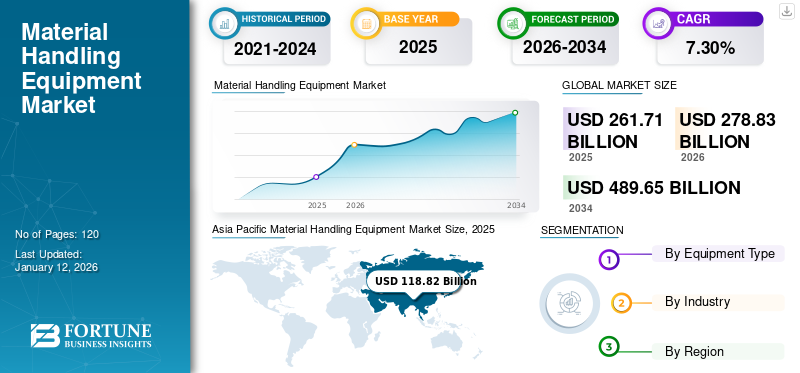
The material handling equipment market size was valued at USD 261.71 billion in 2025. The market is projected to grow from USD 278.83 billion in 2026 to USD 492.46 billion by 2034, exhibiting a CAGR of 7.4% during the forecast period. Asia Pacific dominated the material handling equipment with a market share of 45.4% in 2025.
Material handling equipment is becoming increasingly important across manufacturing, warehousing, logistics, construction, mining, automotive, consumer goods, food & beverages, pharmaceuticals, and semiconductor operations as it improves material movement, storage efficiency, workplace safety, and operational productivity. The market growth is being supported by rising need to modernize warehouses, optimize supply chains, reduce manual handling, and improve throughput across industrial and distribution facilities. The industry is steadily expanding as warehouse automation, automated material handling systems, conveyor systems, forklifts, Automated Guided Vehicles (AGVs), Autonomous Mobile Robots (AMRs), palletizing systems, industrial trucks, and Automated Storage and Retrieval Systems (AS/RS) gain wider adoption. This is becoming increasingly important as companies face growing pressure to manage labor shortages, accelerate order fulfillment, improve inventory control, and strengthen operational visibility across complex logistics and production environments.
Major companies in the market include Daifuku Co., Ltd., Liebherr Group, SSI SCHAEFER, Toyota Industries Corporation and Beumer Group. These companies are progressively developing advanced supply chain equipment, bulk material handling systems, Warehouse Management Systems (WMS), logistics automation platforms, and integrated intralogistics solutions to improve material flow, equipment utilization, and warehouse performance. In the long run, increasing adoption of fully automated warehouses, connected fleets, robotics-based handling systems, and intelligent storage and retrieval solutions will support sustained market growth.
Download Free sample to learn more about this report.
Material Handling Equipment Market Trends
Rising Adoption of Physical AI and Digital Twins is an Emerging Market Trend
The market is witnessing a shift toward AI enabled and digitally simulated warehouse operations as companies seek to improve equipment coordination, material flow, route planning, and space utilization. Warehouses and distribution centers are increasingly integrating digital twins, intelligent cameras, warehouse management systems, automated guided vehicles, autonomous mobile robots, industrial trucks, and automated material handling systems into unified operating environments.
Physical AI and real time simulation help operators test warehouse layouts, optimize fleet movements, identify congestion, improve safety, and coordinate manual and automated equipment before making physical changes. These capabilities are supporting more adaptive warehouse automation and logistics automation by enabling intralogistics solutions to respond dynamically to changing inventory volumes, order patterns, and operating conditions.
- For instance, in October 2025, KION Group expanded its collaboration with NVIDIA and Accenture to demonstrate a physical AI powered warehouse solution using real time digital twins, intelligent cameras, autonomous forklifts, third party autonomous mobile robots, fleet management software, and warehouse management systems to improve interoperable warehouse operations.
MARKET DYNAMICS
MARKET DRIVERS
Download Free sample to learn more about this report.
Rapid E-commerce Expansion and Rising Fulfillment Requirements are Driving Market Growth
The rapid expansion of e-commerce, omnichannel retail, and high-volume distribution operations is one of the major factors driving the material handling equipment market growth. Warehouses and fulfillment centers are under growing pressure to process larger order volumes, shorten delivery times, improve picking accuracy, and manage wider product assortments. Material handling equipment such as conveyor systems, forklifts, industrial trucks, palletizing systems, automated guided vehicles, and storage and retrieval systems helps operators accelerate product movement, reduce manual handling, and maintain consistent throughput during peak demand periods.
Product demand is particularly strong across consumer goods & electronics, food & beverages, automotive, pharmaceuticals, and third-party logistics operations, where companies are expanding warehouse and logistics automation to strengthen fulfillment capacity. Automated material handling systems, warehouse management systems, supply chain equipment, and intralogistics solutions are increasingly being deployed to coordinate inbound handling, storage, picking, packing, and outbound distribution. This shift is supporting higher adoption of scalable and integrated equipment across large distribution centers, regional warehouses, and specialized fulfillment facilities.
- For instance, in June 2025, SSI SCHAEFER completed a fully automated warehouse for Apotea in Sweden, integrating shuttle systems, automated storage, conveyor systems, picking robots, and warehouse control software to process more than 50,000 orders per day and support faster e-commerce fulfillment.
Market Drivers - Impact & CAGR Contribution (2026–2034)
| Rank | Market Drivers | Expected Impact on Market Growth | Estimated Gross Market Growth Contribution (USD Billion) (2026-2034) |
Impact: 2026-2028 | Impact: 2029-2031 | Impact: 2032-2034 |
|---|---|---|---|---|---|---|
| 1 | Rapid e-commerce expansion and rising fulfillment requirements are driving adoption of material handling equipment | High | 72.00% | High | High | High |
| 2 | Increasing warehouse automation and deployment of automated material handling systems | High | 58.00% | High | High | High |
| 3 | Growing adoption of automated guided vehicles (AGVs), autonomous mobile robots (AMRs), and intelligent industrial trucks | Medium-High | 46.00% | Medium | High | High |
| 4 | Expansion of manufacturing, construction, mining, and logistics infrastructure across emerging markets | Medium | 39.00% | Medium | High | High |
| 5 | Rising demand for warehouse management systems (WMS), storage and retrieval systems (AS/RS), and integrated intralogistics solutions | Medium-Low | 35.00% | Medium | Medium | High |
| 6 | Others (cold chain expansion, pharmaceutical warehousing, bulk material handling, safety improvements, and replacement demand) | Low | 26.00% | Low | Medium | Medium |
| Total Positive Growth Contribution | 276.00% | |||||
Source: Fortune Business Insights
MARKET RESTRAINTS
High Upfront Investment and Complex Facility Integration are Limiting Faster Product Adoption
High upfront investment remains one of the key restraints for market growth. Automated material handling systems often require substantial expenditure on conveyor systems, automated guided vehicles , autonomous mobile robots, storage and retrieval systems, palletizing systems, industrial trucks, control software, sensors, safety infrastructure, and facility modifications. These costs can restrict adoption among small and mid-sized warehouses, manufacturers, and logistics operators with limited capital budgets or uncertain return on investment.
In addition, integrating new warehouse automation with existing layouts, warehouse management systems, legacy equipment, racking structures, and operating workflows can be complex and time-consuming. Brownfield facilities may require floor reinforcement, aisle redesign, electrical upgrades, network improvements, and customized interfaces before advanced intralogistics solutions can be deployed. Implementation may also disrupt ongoing operations and require skilled system integrators, trained technicians, and extended testing. These challenges can delay adoption across cost-sensitive industries, particularly where manual equipment, conventional forklifts, and basic supply chain equipment remain economically viable.
|
Rank |
Market Restraint |
Expected Impact on Market Growth |
Estimated Reduction in Market Size (USD Billion) |
Impact: 2026-2028 |
Impact: 2029-2031 |
Impact: 2032-2034 |
|
1 |
High upfront investment and complex facility integration are limiting faster market adoption |
High |
25.00 |
High |
High |
Medium |
|
2 |
Shortage of skilled technicians, automation engineers, and maintenance personnel |
Medium-High |
16.50 |
High |
Medium |
Medium |
|
3 |
Operational disruption, cybersecurity exposure, and interoperability challenges across legacy warehouses |
Medium |
12.00 |
Medium |
Medium |
Low |
|
4 |
Others (raw material price volatility, supply chain delays, equipment downtime, regulatory compliance, and space constraints) |
Low |
8.87 |
Low |
Low |
Low |
|
Total Market Reduction |
62.37 |
MARKET OPPORTUNITIES
Expansion of Cold Chain and Pharmaceutical Warehousing is Creating New Growth Opportunities
The expansion of temperature-controlled logistics, pharmaceutical distribution, and regulated storage facilities is creating strong growth opportunities for the market. Food & beverages, pharmaceuticals, chemicals, and healthcare companies increasingly require specialized warehouses capable of maintaining product quality, traceability, safety, and regulatory compliance. This is encouraging adoption of storage and retrieval systems, conveyor systems, automated guided vehicles, palletizing systems, industrial trucks, and automated material handling systems designed for chilled, frozen, cleanroom, and controlled-temperature environments.
Cold chain facilities also require equipment capable of operating reliably under low-temperature conditions while reducing worker exposure to demanding environments. Integrated warehouse management systems, automated storage, robotic handling, and logistics automation can improve inventory accuracy, product rotation, order traceability, and space utilization across pharmaceutical and food distribution centers. As cold chain networks expand across developed and emerging markets, specialized intralogistics solutions are expected to create new opportunities for equipment manufacturers, automation integrators, and lifecycle service providers.
- For instance, in September 2025, Swisslog partnered with Cardinal Health to implement an industry-first robotic storage and retrieval system at a new pharmaceutical distribution center in Indianapolis, supporting real-time inventory visibility, intelligent order fulfillment, and coordinated material flow across robotics, conveyor, and sorting systems.
Segmentation Analysis
By Equipment Type
Transport Equipment Segment Dominates Owing to Extensive Use Across Warehousing, Manufacturing, and Logistics Operations
Based on equipment type, the market segmentation is divided into transport equipment, handling equipment, racking & storage equipment, and others. Transport equipment is further segmented into conveyors, cranes, industrial trucks, automated guided vehicles, and others. Conveyors are further segmented into roller, chain, wheel, and others. Cranes are segmented into jib cranes, bridge cranes, gantry cranes, and others. Industrial trucks are segmented into hand trucks, pallet trucks, lift trucks, and others.
The transport equipment segment held the largest material handling equipment market share in 2025, driven by its extensive use across warehouses, manufacturing plants, distribution centers, construction sites, ports, and mining operations for the continuous movement of goods, components, raw materials, and finished products. Conveyor systems, forklifts, industrial trucks, cranes, and automated guided vehicles form a major part of supply chain equipment by supporting loading, unloading, internal transport, order movement, pallet transfer, and bulk material handling. Compared with handling and storage equipment, transport equipment serves a wider range of operational environments and remains essential across both manual and automated material flow processes.
- For instance, in August 2025, Crown Equipment introduced the WJ 50 Series compact pallet truck, expanding its transport equipment portfolio for efficient pallet movement across warehouses, retail facilities, and confined logistics environments.
Racking & storage equipment segment is expected to witness the second-highest growth rate of 7.2% during the forecast period, driven by increasing demand for warehouse optimization, higher storage density, and efficient inventory management across logistics, manufacturing, and distribution facilities.
To know how our report can help streamline your business, Speak to Analyst
By Industry
Construction & Recycling Segment Held Largest Share Due to High Equipment Demand Across Infrastructure and Material Processing Activities
Based on industry, the market segmentation is divided into consumer goods & electronics, automotive, food & beverages, chemical & pharmaceuticals, construction & recycling, metal & mining, semiconductors, and others (aviation, chemicals, etc.).
The construction & recycling segment held the largest market share in 2025, driven by substantial demand for cranes, industrial trucks, conveyors, lifting systems, and bulk material handling equipment across infrastructure projects, demolition activities, waste-processing facilities, aggregate handling, and construction-material movement. These operations require durable equipment capable of handling heavy loads, irregular materials, and continuous movement across demanding environments. Material handling equipment also supports recycling facilities by improving sorting, transfer, loading, storage, and processing efficiency across metals, plastics, aggregates, and construction waste streams.
- For instance, in October 2025, Liebherr highlighted its LR 636 G8 crawler loader and T 48-8s telescopic handler for recycling and waste-handling applications, supporting loading, stacking, sorting, and transport operations across demanding material-processing environments.
Automotive segment is expected to witness the second-highest growth rate of 8.0% during the forecast period, driven by increasing adoption of material handling solutions across vehicle production facilities, electric vehicle manufacturing, and automotive supply chain operations requiring efficient movement of components and assemblies.
By Automation Type
Balanced Cost, Flexibility, and Operational Control Leads to Semi-Automated Segment’s Dominance
Based on automation type, the market segmentation is divided into manual, semi-automated, and fully automated.
The semi-automated segment captured the largest market share in 2025, driven by its ability to combine human supervision with automated movement, storage, picking, and handling functions. Semi-automated systems enable warehouses and manufacturing facilities to improve productivity, reduce manual effort, and increase throughput without the higher capital expenditure and integration complexity associated with fully automated systems. These solutions commonly include conveyor systems, assisted picking technologies, semi-automated forklifts, palletizing systems, and storage and retrieval systems supported by warehouse management systems.
- For instance, in December 2025, Jungheinrich deployed three EAE 212a mobile robots at DURABLE’s distribution center, combining autonomous pallet transport with manual unloading and storage activities to support scalable semi-automated warehouse operations.
Fully automated segment is expected to witness the second-highest growth rate of 7.4% during the forecast period, driven by rising adoption of autonomous handling systems, robotic solutions, and smart warehouse technologies to improve productivity, reduce labor dependency, and enhance operational accuracy.
Material Handling Equipment Market Regional Outlook
By geography, the market is categorized into North America, Europe, Asia Pacific, South America, and Middle East & Africa.
North America
Asia Pacific Material Handling Equipment Market Size, 2025 (USD Billion)
To get more information on the regional analysis of this market, Download Free sample
North America’s market accounted for USD 52.43 billion in revenue in 2025, supported by strong e-commerce activity, advanced warehousing infrastructure, rising adoption of warehouse automation, and increasing investment in modern distribution centers across the U.S. and Canada. Regional demand is strongly influenced by labor shortages, growing fulfillment volumes, reshoring of manufacturing activities, and the need to improve inventory movement across automotive, consumer goods, food & beverages, pharmaceuticals, and semiconductor industries. The region benefits from high adoption of automated material handling systems, conveyor systems, forklifts, autonomous mobile robots, warehouse management systems, and storage and retrieval systems.
U.S. Material Handling Equipment Market
The U.S. is expected to dominate the North America market with an estimated revenue of around USD 44.59 billion in 2026, representing roughly 16.0% of global sales. Growth is driven by the country’s extensive network of warehouses and fulfillment centers, increasing logistics automation, high labor costs, and rising adoption of advanced supply chain equipment. Demand remains particularly strong across e-commerce, retail, automotive, food distribution, pharmaceuticals, manufacturing, and third-party logistics operations requiring efficient storage, picking, pallet movement, and order fulfillment.
Europe
The Europe market is expected to witness steady growth during the forecast period, driven by a strong manufacturing base, expansion of e-commerce logistics, stringent workplace safety requirements, and rising adoption of energy-efficient material handling equipment across Germany, the U.K., France, Italy, and the rest of Europe. Regional product demand is closely associated with automotive production, food & beverages, chemicals, pharmaceuticals, consumer goods, and industrial manufacturing. Europe remains an important market for industrial trucks, conveyor systems, automated guided vehicles, palletizing systems, and intralogistics solutions as companies modernize warehouses and reduce dependence on manual handling.
U.K. Material Handling Equipment Market
The U.K. market is estimated at around USD 15.26 billion in 2026, representing roughly 5.5% of global revenues.
Germany Material Handling Equipment Market
Germany’s market is projected to reach USD 20.75 billion in 2026, equivalent to around 7.4% of global sales.
Asia Pacific
Asia Pacific accounted for USD 118.82 billion in revenue in 2025 and will continue to dominate the global market over the forecast period. Regional growth is strongly supported by rapid industrialization, large-scale manufacturing, expanding e-commerce activity, infrastructure development, and increasing warehouse automation across China, Japan, India, South Korea, Southeast Asia, and the rest of Asia Pacific. The region continues to witness strong demand for forklifts, industrial trucks, conveyor systems, cranes, automated guided vehicles , autonomous mobile robots, and bulk material handling equipment across manufacturing plants, ports, warehouses, construction sites, and mining operations.
China Material Handling Equipment Market
China’s market is projected to remain dominant in Asia Pacific, with 2026 revenues estimated at around USD 50.30 billion, representing roughly 18.0% of global sales.
Japan Material Handling Equipment Market
The Japanese market is estimated at around USD 30.86 billion in 2026, accounting for roughly 11.1% of global sales.
India Material Handling Equipment Market
The Indian market is estimated at around USD 23.40 billion in 2026, accounting for roughly 8.4% of global sales.
Middle East & Africa
The Middle East & Africa market is driven by increasing investment in logistics hubs, ports, airports, construction projects, mining activities, and industrial infrastructure across GCC countries, South Africa, and other regional markets. Demand is closely linked to bulk material handling, warehouse development, construction-material movement, mining operations, and expansion of regional distribution networks. GCC countries lead regional adoption due to investment in economic diversification, large-scale infrastructure, free-trade zones, and modern logistics facilities requiring cranes, forklifts, conveyor systems, industrial trucks, and automated material handling systems.
GCC Material Handling Equipment Market
The GCC market is projected to reach around USD 5.52 billion in 2026, representing roughly 2.0% of global sales.
Latin America
The Latin America market is driven by increasing warehousing activity, mining production, construction development, food & beverage processing, and gradual modernization of supply chain infrastructure across Brazil, Mexico, Argentina, Chile, and other regional economies. Demand for material handling equipment is primarily associated with industrial trucks, forklifts, cranes, conveyor systems, storage equipment, and bulk material handling solutions. Although automation adoption remains comparatively gradual, the region offers long-term opportunities as manufacturers and logistics operators upgrade facilities and deploy scalable warehouse automation and intralogistics solutions.
Brazil Material Handling Equipment Market
The Brazil market is projected to reach around USD 3.54 billion in 2026, representing roughly 1.3% of global sales.
COMPETITIVE LANDSCAPE
Key Industry Players
Key Industry Players Focus on Warehouse Automation and Intelligent Equipment Portfolios to Strengthen Market Position
The material handling equipment market is highly competitive and continues to expand as manufacturers, warehouse operators, retailers, logistics providers, and industrial users shift from conventional handling processes toward connected, automated, and data-driven material flow environments. Competition is shaped by the strength of conveyor systems, forklifts, industrial trucks, automated guided vehicles , autonomous mobile robots, palletizing systems, warehouse management systems, storage and retrieval systems, cranes, and bulk material handling capabilities. Companies are focusing on material handling equipment that improves throughput, reduces manual handling, enhances workplace safety, optimizes warehouse space, and strengthens supply chain visibility across complex industrial and logistics operations.
Daifuku Co., Ltd., Liebherr Group, SSI SCHAEFER, Toyota Industries Corporation and Beumer Group are among the major companies being tracked in this market. Several of these players are developing advanced warehouse automation and logistics automation solutions, ranging from automated material handling systems, industrial trucks, conveyor systems, and palletizing systems to integrated intralogistics solutions, warehouse management systems, storage and retrieval systems, and autonomous transport technologies. As the market expands, partnerships with manufacturers, warehouse operators, system integrators, robotics companies, and software providers are expected to become important competitive strategies.
List of Key Material Handling Equipment Companies Profiled
- Daifuku Co., Ltd. (Japan)
- Liebherr Group (Switzerland)
- SSI SCHAEFER (Germany)
- Toyota Industries Corporation (Japan)
- BEUMER Group (Germany)
- Jungheinrich AG (Germany)
- Godrej Group (India)
- Kion Group AG (Germany)
- Action Construction Equipment Ltd. (India)
- Swisslog Holding AG (Germany)
- Crown Equipment Corporation (U.S.)
- Hyster-Yale Materials Handling, Inc. (U.S.)
- Mitsubishi Logisnext Co., Ltd. (Japan)
- KUKA AG (Germany)
KEY INDUSTRY DEVELOPMENTS
- May 2026: Toyota Industries Corporation signed an agreement to acquire 80% of IHI Logistics & Machinery Corporation, strengthening its warehouse automation portfolio through automated storage and retrieval systems, conveyor systems, cold storage solutions, and logistics equipment services.
- February 2026: Daifuku launched the SOTR-M mobile sorting solution, expanding its intralogistics portfolio for flexible and scalable sorting operations across warehouses and distribution centers.
- December 2025: Action Construction Equipment Limited signed a strategic memorandum of understanding with Sanghvi Movers to increase deployment of domestically manufactured truck and crawler cranes across major infrastructure and industrial projects in India.
- November 2025: Toyota Industries Corporation announced the reorganization of its warehouse automation businesses in Europe and the U.S. under the Toyota Automated Logistics structure to strengthen coordination across automated storage, retrieval, picking, and fulfillment solutions.
- October 2025: Godrej Enterprises Group launched the GEPT 20, India’s first 48V lithium ion electric hand pallet truck, to improve productivity, maneuverability, and energy efficiency across warehouses, retail facilities, and industrial operations.
- September 2025: Swisslog partnered with Bünting Group to develop an automated fresh-goods warehouse equipped with shuttle storage, robotics, conveyor systems, refrigeration technology, and SynQ warehouse control software.
- September 2025: BEUMER Group introduced BEUMER Guardian, a digital solution providing condition monitoring, performance analysis, proactive support, and predictive maintenance for conveyor, palletizing, packaging, and bulk material handling systems.
REPORT COVERAGE
The material handling equipment market analysis includes a comprehensive study of the market size & forecast by all the market segments included in the report. It includes details on the market activities and market patterns expected to drive the market over the forecast period. It provides information on primary aspects, including an overview of material handling equipment, warehouse automation, automated material handling systems, conveyor systems, forklifts, automated guided vehicles, autonomous mobile robots, palletizing systems, industrial trucks, warehouse management systems, storage and retrieval systems, logistics automation, supply chain equipment, bulk material handling, and intralogistics solutions across manufacturing, warehousing, construction, mining, automotive, consumer goods, food & beverages, pharmaceuticals, and semiconductor applications. Additionally, it details product launches, partnerships, mergers & acquisitions, technology developments, automation solutions, intelligent warehouse systems, and key industry developments and regional adoption trends. The global market research report also provides an in-depth competitive landscape with information on the market share and profiles of key operating players.
Request for Customization to gain extensive market insights.
Report Scope & Segmentation
| ATTRIBUTE | DETAILS |
| Study Period | 2021-2034 |
| Base Year | 2025 |
| Estimated Year | 2026 |
| Forecast Period | 2026-2034 |
| Historical Period | 2021-2024 |
| Growth Rate | CAGR of 7.4% from 2026 to 2034 |
| Unit | Value (USD Billion) |
| Segmentation | By Equipment Type, Industry, Automation Type, and Region |
| By Equipment Type |
|
| By Industry |
|
| By Automation Type |
|
| By Region |
|
Frequently Asked Questions
According to Fortune Business Insights, the global market size was valued at USD 261.71 billion in 2025 and is projected to reach USD 492.46 billion by 2034.
In 2025, the market in Asia Pacific was valued at USD 118.82 billion.
The market is expected to exhibit a CAGR of 7.4% during the forecast period of 2026-2034.
By equipment type, the transport equipment segment led the market.
Rapid e-commerce expansion and rising fulfillment requirements are driving the market.
Daifuku Co., Ltd., Toyota Industries Corporation, KION Group AG, Jungheinrich AG, SSI SCHAEFER, and Liebherr Group are among the top players in the market.
Asia Pacific held the largest market share in 2025.


- 2021-2034
- 2025
- 2021-2024
- 160
Get 30-60 hrs Free Customization
Expand Regional and Country Coverage, Segments Analysis, Company Profiles, Competitive Benchmarking, and End-user Insights.















Related Reports
-
US +1 833 909 2966 ( Toll Free )
-
Get In Touch With Us