Micro Seismic Monitoring Market Size, Share & Industry Analysis, By Process (Data Processing, Data Interpretation, Data Acquisition, and Data Triangulation), By Component (Hardware, Software, and Services), By End-use Industry (Mining, Oil & Gas, Energy & Utilities, and Others), and Regional Forecast, 2026-2034
 Download Free Sample
Micro Seismic Monitoring Market Size
 Listen to Audio Version
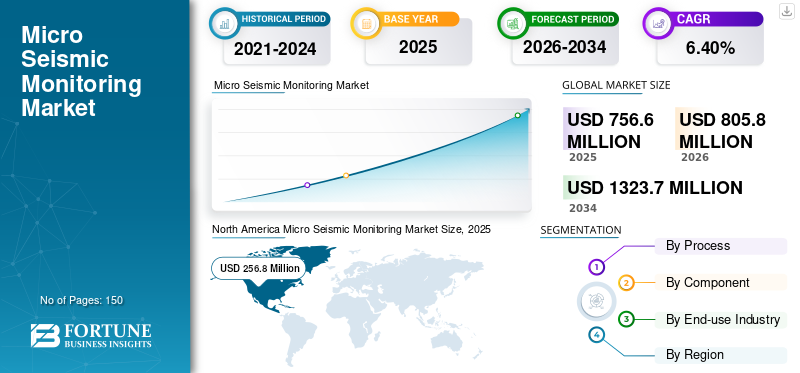
The global micro seismic monitoring market size was valued at USD 756.6 million in 2025 and is projected to grow from USD 805.8 million in 2026 to USD 1,323.70 million by 2034, exhibiting a CAGR of 6.40% during the forecast period. North America dominated the global micro seismic monitoring market with a share of 35.40% in 2025. Additionally, the U.S. micro seismic monitoring market is projected to reach an estimated value of USD 195.7 million in 2026.
Micro seismic monitoring refers to the practice of utilizing sensitive seismometers to detect and analyze micro-earthquakes or small-scale seismic events. These events are typically induced by human activities, such as hydraulic fracturing, mining operations, or underground construction. By monitoring and analyzing these micro seismic events, industry stakeholders can better understand the behavior of subsurface formations, assess reservoirs or mining productivity, and ensure the safety of operations.
The terms ‘induced seismicity’ and ‘passive seismic monitoring’ are also frequently used to refer to micro seismic monitoring. The micro seismic fracture mapping schematic is a passive method that listens for seismic energy that is already occurring underground, in contrast to traditional 3D seismic technologies that rely on measuring acoustic reflections from an energy source. Unlike traditional 3D seismic methods, which provide discrete-time snapshots, passive wave energy methods offer a continuous 4D record of seismicity in the monitoring region. Micro seismic results offer video recordings of underground occurrences resulting from industrial operations, often provided in real time.
In the scope of study, the report includes companies providing micro seismic monitoring services to end-use industries, such as oil and gas, mining, energy & utilities, and infrastructure.
Download Free sample to learn more about this report.
micro seismic monitoring market KEY TAKEAWAYS
 Global Market Size & Forecast
- 2025 Market Size: USD 756.6 million
- 2026 Market Size: USD 805.8 million
- 2034 Forecast Market Size: USD 1,323.70 million
- CAGR: 6.40% from 2026–2034
 Market Share
- North America dominated the global micro seismic monitoring market with a share of 35.40% in 2025.
- In 2026, Oil & Gas dominated the segment with a market share of 35.05%.
- Based on component, the market is divided into hardware, software, and services. In 2026, hardware dominated the segment with a market share of 37.14%%.
 Key Regional Highlights
North America
In 2025, the North America market stood at USD 267.5 Million, representing 35.40% of global demand, and is projected to grow to USD 279.4 Million in 2026.
Europe
e Europe region captured 24.40% of the global market in 2025, generating USD 184.8 Million.
Asia Pacific
Asia Pacific maintained a strong presence in the global market, reaching USD 151.2 Million in 2025, accounting for 20.00% share, and is expected to reach USD 165.1 Million in 2026.
U.S.
The U.S. market is projected to reach USD 195.7 Million in 2026.
Japan
Japan market is projected to reach USD 36.4 Million in 2026.
Read More

micro seismic monitoring market Trends
Governments Investments in Infrastructure to Accelerate Market Growth
The market has witnessed an increasing amount of investments from governments across the globe in recent years. For instance, in January 2023, The Indian Center planned to install micro seismic observatories in the Joshimath area, which faces land subsidence cases. These installations are expected to help earth scientists monitor and record micro seismic activities.
Currently, India has 152 seismological centers, with plans to add 100 more, enhancing real-time data monitoring and collection in the coming years. Moreover, in October 2023, Tamil Nadu is expected to have new seismic observatories in Thanjavur, Tuticorin, Coimbatore, and Villupuram as part of the National Centre for Seismology’s initiative to set up 100 seismological centers nationwide. In June 2023, MicroSeismic, Inc. was awarded around USD 1 million from the Department of Energy (DOE) as part of a Phase 2 DOE SBIR Grant program, supporting clean energy development and scientific energy innovation.
These strategic investments encourage companies to develop new and advanced products, ultimately benefiting end-users by providing optimal solutions.
Download Free sample to learn more about this report.
micro seismic monitoring market Growth Factors
Strategic Alliances and collaborations to Fuel Market Growth
The market is driven by several factors, including growth in the low-cost seismometers market, substantial investments in geotechnical and environmental engineering applications, increased exploration and production activities in the oil and gas sector, and heightened awareness of safety and risk management. Additionally, companies have strategically embraced partnerships and collaborations to enhance their capabilities. This strategy enables them to integrate the strengths of their concepts and technologies with those of established partners, facilitating the development of more advanced and scalable micro seismic monitoring solutions.
For instance, in August 2023, Terra15 collaborated with MicroSeismic, Inc. (MSI) with the objective of providing an efficient turnkey monitoring solution for civil and geoscience engineering applications, utilizing distributed acoustic sensing and distributed fiber optic sensors. Through this collaboration, MSI aims to better address evolving customer needs and deliver advanced technological solutions aligned with the Department of Energy (DOE) Energy Transition. This collaboration is also expected to support geothermal stimulation, carbon sequestration, hydraulic fracturing, and karst growth and development for sinkhole detection. Therefore, these factors contribute to propelling market growth.
RESTRAINING FACTORS
Market Dynamics and Economic Shifts Affect Growth of Seismic Exploration Technologies
The demand for micro seismic monitoring systems primarily depends on the level of global oil and gas exploration activity, as the majority of market revenue depends on the O&G industry. These activities are hugely affected by prevailing oil and gas prices, with a prominence on crude oil prices and market expectations regarding potential changes in such prices. Thus, any changes in oil and gas prices or other market trends, such as sluggish growth of the global economy, could negatively impact seismic exploration activity and further create a decrease in the demand for microseismic monitoring technology. Moreover, failure to attract a skilled workforce, reliance on key suppliers for certain parts, and high initial investments can impact market growth negatively.
micro seismic monitoring market Segmentation Analysis
By Process Analysis
Growing Need for Precise Interpretation and Actionable Information to Drive Segmental Growth
Based on process, the market is divided into data processing, data interpretation, data acquisition, and data triangulation. In 2026, Data Processing dominated the segment with a market share of 32.27%. This allows for accurate identification of potential risks, optimizing reservoir performance, and enhancing overall safety in various industries, such as oil and gas.
The data acquisition segment is expected to grow with the highest CAGR during the forecast period due to the increasing demand for real-time and accurate seismic data in industries such as oil and gas for reservoir monitoring, geothermal exploration, and civil engineering projects.
To know how our report can help streamline your business, Speak to Analyst
By Component Analysis
Rising Popularity of High-Quality Sensors and Reliable Communication Modules Drives Hardware Segment Growth
Based on component, the market is divided into hardware, software, and services. In 2026, hardware dominated the segment with a market share of 37.14%%.
The hardware segment holds the largest share of the market owing to its versatility in capturing, processing, and transmitting seismic data. High-quality sensors, robust data acquisition systems, and reliable communication modules are crucial for accurate and real-time monitoring of microseismic events.
The services segment is expected to grow with the highest CAGR owing to the increasing demand for specialized expertise, ongoing maintenance, and data interpretation services.
By End-use Industry Analysis
Growing Reliance of Oil & Gas Industry on Hydraulic Fracturing to Drive the Oil & Gas Industry Segment Growth
Based on the end-use industry, the market is divided into mining, oil & gas, energy & utilities, and others.
In 2026, Oil & Gas dominated the segment with a market share of 35.05%. Such monitoring helps assess and optimize fracking operations, enhance reservoir recovery, and ensure overall operational efficiency in the extraction process.
The energy & utilities is expected to grow with the highest CAGR attributed to increasing demand for efficient and safe extraction of oil and gas. Micro seismic monitoring helps improve the extraction process and reduce environmental risks, driving its adoption in the energy sector.
REGIONAL INSIGHTS
By geography, the market is studied across North America, South America, Europe, Asia Pacific, and the Middle East & Africa.
North America Micro Seismic Monitoring Market Size, 2025
To get more information on the regional analysis of this market, Download Free sample
North America
North America holds the highest market share due to rising investments in the region. In 2025, the North America market stood at USD 267.5 Million, representing 35.40% of global demand, and is projected to grow to USD 279.4 Million in 2026. The U.S. is increasing its production of natural gas to reduce carbon and methane emissions while boosting exports, particularly to Europe. Additionally, the market for micro seismic monitoring technologies has expanded due to significant technological advancements in this field. The U.S. market is projected to reach USD 195.7 Million in 2026.
Europe
Europe's market is being driven by growing reservoir development projects in the region. The Europe region captured 24.40% of the global market in 2025, generating USD 184.8 Million in revenue, and is projected to reach USD 197.5 Million in 2026. The market is expected to benefit from increasing exploration and production (E&P) activities in deepwater and ultra-deepwater reserves, along with heightened efforts by oil and gas majors to access untapped resources. The UK market is projected to reach USD 41.5 Million in 2026 and the Germany market is projected to reach USD 44.7 Million in 2026.
Asia Pacific
Asia Pacific is expected to grow significantly owing to the use of micro seismic monitoring techniques in various energy sectors. Asia Pacific maintained a strong presence in the global market, reaching USD 151.2 Million in 2025, accounting for 20.00% share, and is expected to reach USD 165.1 Million in 2026. The adoption of these technologies is notably increasing in environmental and geotechnical engineering, particularly within the oil and gas exploration industry. The China market is projected to reach USD 39.5 Million in 2026, the Japan market is projected to reach USD 36.4 Million in 2026, and the India market is projected to reach USD 29.5 Million in 2026.
Middle East & Africa
The Middle East & Africa market growth can be attributed to the expanding oil and gas industry, which presents lucrative growth prospects for regional market players. The Middle East & Africa market accounted for USD 91.3 Million in 2025, representing 12.10% of the global industry, and is expected to reach USD 98.5 Million in 2026. The region is witnessing a rise in offshore exploration, providing opportunities for oil and gas exploration companies.
Latin America
South America's growth is propelled by the escalating prospects within the mining industry in the region. In 2025, Latin America represented USD 61.8 Million, accounting for 8.20% of the worldwide market, and is projected to grow to USD 65.3 Million in 2026. Increased demand for essential minerals and commodities is expected to support market growth in the coming years.
KEY INDUSTRY PLAYERS
Collaborations and Partnerships among Vendors to Propel Market Growth
Key players in the market are engaging in strategic partnerships and acquiring businesses. They adopt this strategy to enhance their product portfolios and expand their operational scale. Major global corporations are forming alliances with other players to streamline and grow their business operations. For instance,
In August 2022, Halliburton Company collaborated with TGS-NOPEC Geophysical ASA to introduce advanced and improved seismic imaging through fiber optic sensing. The collaboration integrates Halliburton’s FiberVSP and Odassea distributed acoustic sensing solutions with IGS’s seismic imaging workflows, enabling the processing of the complete seismic wavefield to create high-resolution reservoir images.
List of Top Micro Seismic Monitoring Companies:
- Geospace Technologies (U.S.)
- Baker Hughes Company (U.S.)
- Halliburton (U.S.)
- Schlumberger (U.S.)
- Güralp Systems Ltd. (U.K.)
- MicroSeismic, Inc. (U.S.)
- ESG Solutions (Deep Imaging Technologies, Inc.) (U.S.)
- Silixa Ltd (U.K.)
- OptaSense (Luna Innovations) (U.K.)
- Weir-Jones Group (U.S.)
KEY INDUSTRY DEVELOPMENTS:
- October 2023: Silixa Ltd launched DScover, a different well surveillance and optimization service. It enables operators to optimize well placement and completion design by integrating analysis with improved data quality from DTS, DAS, and the new DSS measurements.
- May 2023: Güralp Systems Ltd. forged a new distribution alliance with California-based Rift Systems Inc. for the U.S. market. Rift Systems is well-equipped to provide localized support to U.S. customers, possessing a comprehensive understanding of the distinctive challenges and requirements faced by operators in the industry.
- May 2023: TGS, in collaboration with SLB and PGS, obtained funding for a multi-client 3D seismic survey covering 6,885 square km offshore Malaysia, specifically in the North Luconia Province of the Sarawak Basin.
- February 2023: MicroSeismic, Inc. introduced MicroThermal Energy, a service providing monitoring and analysis for enhanced geothermal systems (EGS). This offering, supporting initiatives such as Enhanced Geothermal Shot and Utah FORGE, measures the success of EGS stimulation and offers valuable insights to enhance heat-rock connectivity through advanced engineering analysis.
- December 2022: Weir-Jones Group broadened its offerings in the mining industry by enhancing the ShakeMonitor and MicroSeismic product lines. ShakeMonitor automatically computes natural frequencies and analyzes real-time vibrational data to identify anomalous responses caused by seismic or other disturbances.
REPORT COVERAGE
The micro seismic monitoring market report provides a detailed analysis of the market and focuses on key aspects such as leading companies, products/services, and leading applications of the product. Besides, the report offers insights into the market trends and highlights key industry developments. In addition to the factors above, the report encompasses several factors that contributed to the growth of the market in recent years.
Request for Customization to gain extensive market insights.
Report Scope & Segmentation
| ATTRIBUTE |
DETAILS |
|
Study Period |
2021-2034 |
|
Base Year |
2025 |
|
Forecast Period |
2026-2034 |
|
Historical Period |
2021-2024 |
|
Growth Rate |
CAGR of 6.40% from 2026 to 2034 |
|
Unit |
Value (USD Million) |
|
Segmentation |
By Process
By Component
By End-use Industry
By Region
|
Frequently Asked Questions
According to Fortune Business Insights, the market is projected to reach USD 1,323.70 million by 2034.
In 2025, the market was valued at USD 756.6 million.
The market is projected to grow at a CAGR of 6.40% during the forecast period (2026-2034).
By process, the data processing segment holds the largest share in the market.
The increasing number of strategic alliances among enterprises is fueling market growth.
Geospace Technologies, Baker Hughes Company, Halliburton, Schlumberger, Güralp Systems Ltd., MicroSeismic, Inc., ESG Solutions, Silixa Ltd, OptaSense, and Weir-Jones Group are the top players in the market.
North America holds the highest market share.
By component, the services segment is expected to grow with the highest CAGR during the forecast period.



- 2021-2034
- 2025
- 2021-2024
- 150
Get 30-60 hrs Free Customization
Expand Regional and Country Coverage, Segments Analysis, Company Profiles, Competitive Benchmarking, and End-user Insights.




















Related Reports
-
US +1 833 909 2966 ( Toll Free )
-
Get In Touch With Us