Semiochemicals Market Size, Share & Industry Analysis, By Type (Pheromones and Allelochemicals), By Function (Mass Trapping, Detection & Monitoring, and Mating Disruption), By Crop Type (Field Crops, Orchard Crops, Vegetable Crops, and Others), and Regional Forecast, 2026-2034
 Download Free Sample
(Offer valid till 30th Sep 2026)

KEY MARKET INSIGHTS
 Listen to Audio Version
The global semiochemicals market size was valued at USD 6.29 billion in 2025. The market is projected to grow from USD 7.24 billion in 2026 to USD 23.68 billion by 2034, exhibiting a CAGR of 15.97% during the forecast period. Based on our analysis, the global market exhibited an average growth of 7.0% in 2020 as compared to 2019. North America dominated the semiochemicals market with a market share of 30.22% in 2025.
Moreover, the U.S. semiochemicals market is projected to reach USD 2.77 billion by 2032, owing to demand for eco-friendly pest control.
The rising demand for organic food products to lower the health related repercussion of conventional products grown with the application of chemical fertilizers and pesticides has increased the need for sustainable bio-pesticides such as semiochemicals. The application of bio pesticides in agriculture has swelled over the past decade due to the widespread application of integrated pest management (IPM) and crop protection. Increasing knowledge about the benefits of abandoning conventional pesticides, gentle pest control, reducing chemical residues on plants, and managing pest resistance are essential components of crop protection. Semiochemicals, therefore, has emerged as one of the critical tools in the management of various high-value vegetables, fruits, and crops.
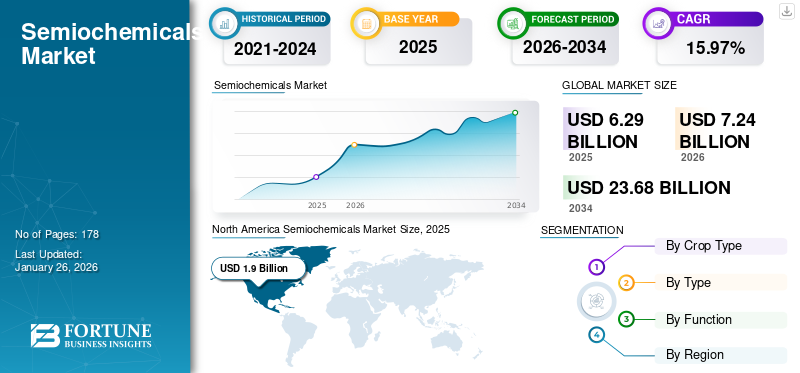
Download Free sample to learn more about this report.
SEMIOCHEMICALS MARKET KEY TAKEAWAYS
 Market Size & Forecast
- 2025 Market Size: USD 6.29 billion
- 2026 Market Size: USD 7.24 billion
- 2034 Forecast Market Size: USD 23.68 billion
- CAGR: 15.97% from 2026–2034
 Market Share
- North America dominated the market with a 30.22% share in 2025.
- Pheromones will lead the type segment with an 83.98% share in 2026.
- Orchards will dominate the application segment with a 46.96% share in 2026.
 Key Regional Highlights
North America
North America generated USD 1.90 billion in 2025 (30.22%) and will reach USD 2.17 billion in 2026.
Europe
Europe accounted for USD 1.76 billion in 2025 (28.03%) and is projected to reach USD 2.02 billion in 2026, growing at a 15.35% CAGR.
Asia Pacific
Asia Pacific recorded USD 1.60 billion in 2025 (25.44%) and will reach USD 1.85 billion in 2026.
U.S.
The market is projected to reach USD 1.19 billion by 2026, driven by increasing adoption of IPM solutions.
Japan
The market is projected to reach USD 0.14 billion by 2026, up from USD 0.13 billion in 2025.
Read More

COVID-19 IMPACT
Transport Disruptions amid COVID-19 to Significantly Impact Market
The COVID-19 pandemic had a major impact on the agricultural sector worldwide. Supply chain disruptions, marketing disruptions, and travel restrictions are adversely affecting the market. For example, according to the Organization for Economic Co-operation and Development (OECD), the production of pesticides declined sharply in the initial months of the pandemic due to nationwide lockdowns imposed in many countries. However, growing food and health concerns have led to a resurgence in demand for organic foods, fruits, and vegetables, which is anticipated to pursue after the pandemic. Growing consumer interest in eating natural food is expected to increase demand for products from farmers after the pandemic.
Semiochemicals Market Trends
Surging Popularity of Organic Farming to Fuel Market Growth
The adoption of organic farming is spreading globally as organic foods gain popularity among consumers. This has been attributed to rising knowledge about the health benefits of consuming organic food products. Growing consciousness about the harmful effects of chemical pesticides and fertilizers has largely driven the market growth of organic farming globally. As per the statistics released by the Institute of Organic Agriculture, the area cultivated under organic farming grew by 2 Mn hectares in 2017 to reach 71.5 Mn hectares in 2018. The growing area of organic farming around the world has increased the demand for bio-based and environmentally friendly pest control management solutions.
Developed markets in North America and Europe are major consumers of organic and clean-label foods. Growing awareness among farmers in these regions about the sustainable approaches is driving the overall market growth.
Download Free sample to learn more about this report.
Semiochemicals Market Growth Factors
Increasing Demand for Sustainable Crop Protection Solutions to Drive Market Growth
Agricultural sectors around the world actively use pesticides and pesticides for effective pest control and high yields. According to the Food & Agricultural Organization (FAO), 4,100 thousand tons of pesticides were used worldwide in 2018. However, in recent years, rising consumer awareness of the harmful effects of chemical pesticides and pesticides on crops and resultantly on human health has forced farmers around the world to opt for better agricultural practices. This has led to increased commissioning of sustainable crop management systems and increased use of bio pesticides.
Semiochemicals are bio pesticides, ecologically and organically safe. An increase in research and development activities aimed at expanding the coverage of these pesticides is expected to boost the market growth over the semiochemicals market forecast period.
Strong Demand for High Value Crops to Boost Growth
Consumer preference has shifted to healthier and safer foods to maintain good health in recent years. Emerging trends such as the consumption of organic, clean-label, natural and pesticide-free foods have also developed the agricultural sector around the world. Increasing demand for high-value crops such as organic raw materials, organic fruits, and vegetables is driving the growth of the market across the globe. Consumers have become more conscious of the safety of the food they consume, and this has led to significant changes in pesticide use and pest control programs. Today, farmers are beginning to implement sustainable and environmentally friendly approaches to lower the use of traditional pesticides that consumers perceive as unsafe. Growing consumer awareness of the benefits of quality crops is expected to drive the market growth in the coming years.
Furthermore, as vegan diets become more acceptable in developed countries, especially in Europe, so does the consumption of high-value crops such as fruits, vegetables, and nuts.
RESTRAINING FACTORS
Lack of Awareness and High Cost of Active Ingredients to Hamper Market Growth
Although biological pesticides are considered safer for harvest and the environment, the absence of knowledge about the semiochemicals among farmers in developing markets in the Asia Pacific, Middle East and Africa is driving the market growth is expected to be hindered. Moreover, high maintenance requirements coupled with high costs compared to conventional pesticides are expected to significantly restrain the growth of the global market. The high cost of these biopesticides discourages smallholder farmers from incorporating these methods into their agricultural practices. Moreover, the additional labor costs required for the application further increases its cost and hinders the growth of the market. However, increased government support for increased use by farmers is expected to help address these issues in the near future.
Semiochemicals Market Segmentation Analysis
By Type Analysis
Pheromones to Emerge as Most Preferred Type in the Industry
The pheromone segment holds a large share as it is the most commonly used type of crop security by farmers. Pheromones are produced by species that can alter the behavior of other species belonging to the same family. Therefore, pheromones are popular as species-specific in nature. Low toxicity and high activity in small doses are responsible for the increased application of pheromones. This segment is expected to grow at her highest CAGR as these compounds help overcome host resistance and provide attractive growth opportunities. The pheromones segment is projected to generate USD 5.26 billion in revenue by 2025. & 83.98% share in 2026.
To know how our report can help streamline your business, Speak to Analyst
The allelochemicals segment is exhibiting notable growth owing to growing utilization and effectiveness to control insect pests on weeds and field crops. In field crops, allelochemicals can be utilized following plant extracts, rotation, mulching, and using cover crops for natural pest control.
By Function Analysis
Mating Disruption to Emerge as the Leading Function among Function Segment
Based on function, the market is bifurcated into detection and monitoring, mass trapping, and pair destruction. Mating disruption has emerged as a major feature as it is more effective at low to modest pest infestations. Moreover, mating disruption especially controls target species, greatly reducing the number of mating and preventing species from reproducing.
Detection and surveillance is primarily used for early spotting of insects, especially when there is an otherwise undetectable infestation. Early detection and monitoring of insects enables more effective integrated pest management programs by optimizing pesticide application periods and calculating the effectiveness of control options. Mast trapping is a highly effective feature against low to moderate pest infestations. However, at times when insects’ populations are dense, mass trapping is used in co-ordination with other control methods. According to the pheromone maker, using bulk traps allows him to reduce the number of chemical treatments by more than 70%. Therefore, the use of semiochemicals to monitor insects via bulk traps is increasing.
By Crop Type Analysis
Orchard Crops Segment Holds Major Market Share Backed by High Demand for High Value Crops
Due to the increasing consumer demand for high quality crops, semiochemicals are mainly applied in orchards as compared to other crops such as vegetables and crops. Orchards are also susceptible to pests such as codling moths, fruit flies, and peach borers. The orchards segment is expected to hold a 46.96% share in 2026.
They also have become one of the key tools in integrated pest management (IPM) of various vegetable crops. This is because the mechanism of action of semiochemicals on target pests is indirect, affecting pest behavior by attracting or deterring them, thereby preventing damage.
The increasing popularity of bio pesticides in crops such as rice, wheat, soybean, and sorghum has increased the demand for bio pesticides among crop farmers. Emerging trends towards the consumption of organic and clean-label foods are expected to encourage the organic use of pesticides on these crops.
REGIONAL INSIGHTS
North America Semiochemicals Market Size, 2025 (USD Billion)
To get more information on the regional analysis of this market, Download Free sample
North America
In 2025, the North America market stood at USD 1.9 billion, representing 30.22% of global demand, and is projected to grow to USD 2.17 billion in 2026, and is anticipated to lead the market during the forecast period due to the increasing implementation of Integrated Pest Management (IPM) solutions for crop protection across the region. The growing awareness regarding sustainable cultivation among farmers in the U.S. and Canada has significantly contributed to market growth in the region. The rising government interventions to increase the utilization of sustainable pesticides are anticipated to drive market growth in the coming years. The U.S. market is projected to reach USD 1.19 billion by 2026.
Europe
The Europe region captured 28.03% of the global market in 2025, generating USD 1.76 billion in revenue, and is projected to reach USD 2.02 billion in 2026. According to the Food and Agriculture Organization, Europe has the second-largest area under organic agriculture. Europe holds the second-highest semiochemicals market share in terms of value. The strong demand for organic commodities in countries, including the U.K., France, Italy, and Germany, has necessitated farmers to implement biological crop protection methods in pest management programs. Recent innovations, such as remote sensing and spatial imaging, in the region, help farmers to tackle their pest issues and will further drive market growth. Europe is anticipated to grow at a CAGR of 15.35% during the forecast period. The UK market is projected to reach USD 0.12 billion by 2026, while the Germany market is projected to reach USD 0.14 billion by 2026.
Asia Pacific
Asia Pacific maintained a strong presence in the global market, reaching USD 1.6 billion in 2025, accounting for 25.44% share, and is expected to reach USD 1.85 billion in 2026. The growth of the market in the Asia Pacific is primarily attributed to the growing awareness regarding crop protection and methods to increase crop yield among farmers. The growing agricultural area that is under organic farming is expected to further fuel the demand in the region. Numerous policies for improving the agriculture sector are underway in the Asia Pacific region at the national and global levels, aiming to increase agricultural yield and enhance working conditions. In ASEAN countries, the ASEAN Master Plan on Rural Development, Agriculture and Forestry and the ASEAN Guidelines for Responsible Investment in Food are the major policies working towards it. Such policies will enable farmers to access innovative chemicals, such as semiochemicals, adapt them to agricultural practices, and increase yield. Moreover, in Asia Pacific, nearly 32% of the total employed workforce is in the agriculture industry, and many are small farmholders. However, there is a lucrative growth prospective for agricultural development and enhanced working conditions with the adoption of new technologies. The Japan market is projected to reach USD 0.14 billion by 2026, the China market is projected to reach USD 0.87 billion by 2026, and the India market is projected to reach USD 0.42 billion by 2026.
- The semiochemicals market in Japan is expected to reach USD 126.6 million by 2025.
- India is projected to witness a strong CAGR of 16.90% during the forecast period.
Rest of The World
The Middle East & Africa market accounted for USD 0.14 billion in 2025, representing 2.23% of the global industry, and is expected to reach USD 0.16 billion in 2026. The market in South America is estimated to grow at the fastest CAGR in the coming years. This can be attributed to the increasing commercial cultivation of commodity crops. The rising knowledge regarding biological pesticides and agricultural sustainability is predicted to significantly drive the growth of the market in the region. In 2025, Latin America represented USD 0.89 billion, accounting for 14.08% of the worldwide market, and is projected to grow to USD 1.03 billion in 2026.
To know how our report can help streamline your business, Speak to Analyst
List of Key Companies in the Semiochemicals Market
Corteva Agriscience to Focus on Strategic Collaborations to Fortify its Market Presence
Corteva Agriscience is actively focused on collaborations with already established players to strengthen its presence in the market. For instance, in May 2020, the company announced its agreement with M2i, a leader in biological crop protection to bring M2i’s semiochemicals portfolio to the market.
The market exhibits a consolidated structure, dominated by a few multinational companies. Leading players, such as Shin-Etsu, Pacific Biocontrol Corp, and Bedoukian Research, focus on new product developments (product launches), acquisitions, and partnerships to further consolidate the market. The arrival of small and niche players in the biological pesticide market will also contribute to escalating competition within the market, which will have a positive effect on its growth.
LIST OF KEY COMPANIES PROFILED:
- SEDQ Healthy Crops SL (Spain)
- Pacific Biocontrol Corporation (U.S.)
- Bedoukian Research, Inc. (U.S.)
- Suterra LLC (U.S.)
- Pherobank B.V. (Netherlands)
- CBC Co., Ltd. (Japan)
- Certis USA LLC (U.S.)
- Koppert (Netherlands)
- Isagro S.p.A. (Denmark)
- Russell IPM (U.K.)
KEY INDUSTRY DEVELOPMENTS:
- October 2020 – Trécé Inc announced the launch of its new mating disruption product, CIDETRAK IMM MEC. The product is specifically designed to control the five most destructive moth pests that destroy agricultural food commodities.
- October 2020 – Suterra LLC announced the launch of a new Puffer pheromone pest control range to reduce the crop damage due to Navel Orangeworm, Codling Moth, and Oriental Fruit moth. This launch will help the company to boost its position in this market.
- April 2020 - Provivi entered into a collaboration with CABI, in registering a new biocontrol product, Pherogen SPOFR dispenser in Kenya. The product launch was primarily aimed to control the attack of fall armyworm
- March 2020 - Advanced Research (JNCASR) and the Indian Council of Agricultural Research, India developed a powdered formula of semiochemicals that can make the pheromone-based pest control method cheaper.
- October 2018 - Koppert Biological Systems acquired the biological crop activities of Horticoop B.V., which aids in expanding the consumer base. By this acquisition, the company aims to serve its consumers better with effective crop protection solutions.
REPORT COVERAGE
The research report provides a detailed analysis of the market and focuses on key aspects such as leading companies, type, and crop types. Besides this, the report offers insights into the market trends and highlights key industry developments. In addition to the aforementioned factors, the report encompasses several factors that have contributed to the growth of the market in recent years.
Request for Customization to gain extensive market insights.
Report Scope & Segmentation:
|
ATTRIBUTE |
DETAILS |
|
Study Period |
2021-2034 |
|
Base Year |
2025 |
|
Estimated Year |
2026 |
|
Forecast Period |
2026-2034 |
|
Historical Period |
2021-2024 |
|
Growth Rate |
CAGR of 15.97% from 2026 to 2034 |
|
Unit |
Value (USD billion) |
|
Segmentation |
By Crop Type
By Type
By Function
By Geography
|
Frequently Asked Questions
Fortune Business Insights says that the global market size was USD 6.29 billion in 2025 and is projected to reach USD 23.68 billion by 2034.
In 2025, the North America market value stood at USD 1.9 billion.
Growing at a CAGR of 15.97%, the market will exhibit steady growth over the forecast period (2026-2034).
The orchard crops segment is expected to be the leading crop type segment in the market during the forecast period.
Increasing demand for sustainable crop protection solutions is the key factor driving the markets growth.
SEDQ Healthy Crops SL, Pacific Biocontrol Corporation, and Bedoukian Research, Inc. are the major players in the market.
North America dominated the market share in 2025.
Strong demand for high value crops is expected to drive the overall product sales in the global market.



- 2021-2034
- 2025
- 2021-2024
- 178
-
(Offer valid till 30th Sep 2026)
Get 30-60 hrs Free Customization
Expand Regional and Country Coverage, Segments Analysis, Company Profiles, Competitive Benchmarking, and End-user Insights.














Related Reports
-
US +1 833 909 2966 ( Toll Free )
-
Get In Touch With Us