Autonomous Cars Market Size, Share & Industry Analysis, By Level of Automation (Level 1, Level 2, Level 3, and Level 4 & Level 5), By Vehicle Type (Hatchback & Sedan, SUV, LCV, and HCV), By Propulsion Type (ICE and EV), By Component (Hardware and Software), By End Use (Personal and Shared Mobility), and Regional Forecast, 2026–2034
 Download Free Sample
(Offer valid till 30th Sep 2026)

Autonomous Cars Market Size and Future Outlook
 Listen to Audio Version
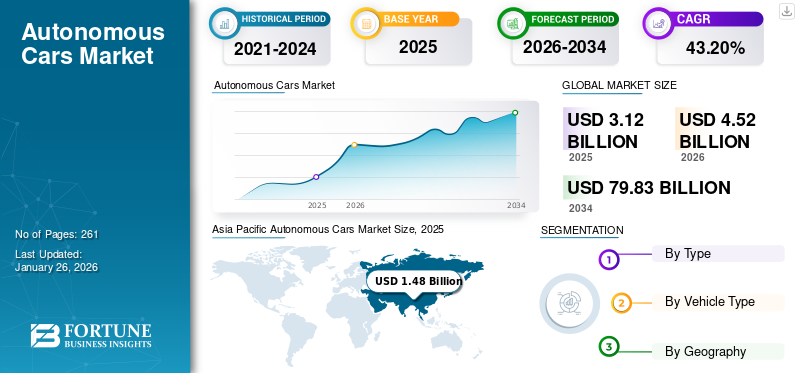
The global autonomous cars market size was valued at USD 44.74 billion in 2025 and is projected to grow from USD 54.97 billion in 2026 to USD 218.59 billion by 2034, exhibiting a CAGR of 18.8% during the forecast period. Asia Pacific dominated the autonomous cars market with a market share of 39.45% in 2025.
Autonomous cars include Advanced Driver Assistance System (ADAS), sensors, cameras, radar, LiDAR, artificial intelligence, software, connectivity, and control technologies. The global market encompasses the development, production, integration, and commercialization of vehicles capable of operating with limited or no human intervention. The market serves passenger mobility, shared transportation, and fleet applications, driven by safety improvements, traffic efficiency, regulatory support, electrification, and growing demand for intelligent, connected mobility solutions worldwide across urban environments.
Key drivers of the market include rising demand for safer mobility, advancements in artificial intelligence, and increasing adoption of advanced driver assistance systems. Government initiatives, demand for reduced traffic accidents, expanding robotaxi services, and integration with electric vehicles further accelerate the deployment and commercialization of autonomous driving solutions globally.
Major players in the global market include Waymo, Tesla, Mercedes-Benz, Baidu Apollo, and Mobileye, competing through artificial intelligence, advanced sensor technologies systems, autonomous driving software, high-definition mapping, connected vehicle technologies, safety validation, and the commercial deployment of self-driving vehicles.
Download Free sample to learn more about this report.
AUTONOMOUS CARS MARKET TRENDS
Growing Shift Toward Software-Defined Vehicles to Transform Autonomous Driving
The shift toward software-defined vehicles is an important trend shaping the global market. Automakers are replacing fragmented electronic control units with centralized computing platforms capable of processing data from cameras, navigation systems, and connected infrastructure. This architecture enables over-the-air software updates, allowing manufacturers to improve perception, driving behavior, safety functions, and user features after vehicle delivery. Artificial intelligence models are increasingly trained using large driving datasets and simulation environments to enhance decision-making across varied scenarios. Vehicle-to-everything communication is also being integrated to provide information about traffic signals, road hazards, pedestrians, and nearby vehicles. As hardware platforms become more standardized, software capabilities, data quality, and continuous updates are emerging as key differentiators among autonomous vehicle developers globally.
MARKET DYNAMICS
MARKET DRIVERS
Download Free sample to learn more about this report.
Advancing Vehicle Safety Technologies to Accelerate Autonomous Car Adoption
Rising demand for safer transportation is a major driver of the global autonomous cars market growth. Automakers are increasingly integrating Level 2 and Level 3 capabilities, including adaptive cruise control, lane centering, automated parking, and traffic-jam assistance, across premium and mass-market models. Governments and safety organizations are also encouraging technologies that can reduce collisions caused by distraction, fatigue, speeding, and impaired driving. Continuous improvements in computing power, sensor accuracy, and real-time decision-making are increasing consumer confidence. As safety performance improves and deployment expands, autonomous functions are expected to become central to future passenger mobility and transportation strategies globally.
Market Drivers - Impact & CAGR Contribution (2026–2034)
| Rank | Market Drivers | Overall Impact Rank | CAGR Contribution (2026–2034) (2026-2034) |
Impact: 2026-2028 | Impact: 2029-2031 | Impact: 2032-2034 |
|---|---|---|---|---|---|---|
| 1 | Advancing Vehicle Safety Technologies to Accelerate Autonomous Car Adoption | High | 7.0% | High | High | High |
| 2 | Increasing Demand for Lightweight Yet High-Crashworthiness Door Structures | High | 5.7% | High | High | High |
| 3 | Growing Adoption of AHSS, UHSS and Press-Hardened Steel Door Beams | Medium-High | 4.9% | Medium | High | High |
| 4 | Rising SUV, Crossover, Pickup and Light Commercial Vehicle Production | Medium | 4.0% | High | High | High |
| 5 | Increasing Safety-Component Localization and Adoption in Emerging Automotive Markets | Medium-Low | 3.1% | Medium | High | High |
| 6 | Others | Low | 2.3% | Low | Low | Low |
| Total Positive Growth Contribution | 27.00% | |||||
Source: Fortune Business Insights
MARKET RESTRAINTS
Fragmented Regulations and Liability Uncertainty to Limit Market Growth
Unclear regulations and unresolved liability frameworks remain significant restraints for the global market. Autonomous vehicles operate across jurisdictions with different rules regarding testing, driver supervision, data recording, insurance, cybersecurity, and accident responsibility. Manufacturers must therefore customize systems and approval processes for individual jurisdictions, increasing development costs and delaying commercialization. Liability becomes particularly complex when control shifts between the human driver, vehicle software, sensor suppliers, mapping providers, and automakers. Regulators also require evidence that automated systems perform safely under diverse road, weather, and traffic conditions. Slow harmonization of technical standards limits cross-border scalability and discourages rapid fleet expansion. Until governments establish consistent certification and accountability requirements, companies may continue deploying autonomous vehicles gradually and within restricted operating areas globally.
Market Restraints - Impact & Negative CAGR Contribution (2026–2034)
| Rank | Market Restraints | Overall Impact Rank | Negative CAGR contribution (2026–2034) (2026-2034) |
Impact: 2026-2028 | Impact: 2029-2031 | Impact: 2032-2034 |
|---|---|---|---|---|---|---|
| 1 | Fragmented Regulations and Liability Uncertainty | High | -2.8% | High | High | Medium |
| 2 | Strong OEM Cost-Reduction Pressure and Commoditization of Conventional Steel Door Beams | Medium-High | -2.2% | Medium | High | High |
| 3 | Increasing Integration of Side-Impact Load Management into Multifunctional Door and Body Structures | Medium | -1.8% | Medium | Medium | High |
| 4 | Others | Low | -1.4% | Low | Low | Low |
| Total Negative Growth Impact | -8.20% | |||||
Source: Fortune Business Insights
MARKET OPPORTUNITIES
Expanding Robotaxi Services to Create New Revenue Opportunities
Robotaxi services present a major opportunity for the global market. Urban transportation providers can use driverless vehicles to reduce dependence on human drivers, improve fleet utilization, and offer mobility continuously. Autonomous fleets can support first-mile and last-mile connectivity, airport transfers, corporate travel, elderly transportation, and mobility services for people unable to drive. Geofenced operations allow companies to launch services in controlled areas before expanding to more complex environments. Partnerships among automakers, technology companies, ride-hailing platforms, municipalities, and fleet operators can accelerate commercialization. Electric autonomous vehicles may further lower operating and maintenance costs through efficient routing and centralized charging. As cities seek scalable and accessible mobility solutions, autonomous ride services could become an important revenue stream for market participants.
MARKET CHALLENGES
Complex Edge-Case Validation to Challenge Large-Scale Deployment
Managing unpredictable driving situations remains a challenge for the global market. Autonomous systems must safely interpret unusual events such as temporary roadworks, unclear lane markings, emergency vehicles, unexpected pedestrian behavior, debris, severe weather, and inconsistent traffic signals. These edge cases are difficult to capture in training datasets and costly to validate through physical testing alone. Developers increasingly rely on simulation, synthetic data, closed-course testing, and supervised road trials, but proving reliability across millions of possible scenarios remains complex. Systems must also recognize when confidence is low and execute a safe fallback action without creating additional risk. Achieving dependable performance across different countries, road designs, driving cultures, and environmental conditions is essential before large-scale autonomous deployment becomes widely accepted.
Segmentation Analysis
By Level of Automation
Level 2 Segment Leads Market Due to Its Compatibility with Existing Vehicle Platforms
Based on level of automation, the market is categorized into level 1, level 2, level 3, and level 4 & level 5.
The level 2 segment dominates the autonomous cars market share due to widespread integration of adaptive cruise control, lane centering, automatic emergency braking, and automated parking across premium and mass-market vehicles. Its relatively lower system cost, established regulatory acceptance, and compatibility with existing vehicle platforms support large-scale deployment. Rising consumer demand for convenience and safety, combined with continuous software upgrades and expanding OEM availability, reinforces level 2 adoption across global passenger vehicle markets.
The level 4 & level 5 segment is projected to grow at a CAGR of 23.5% during the forecast period. Advancements in AI, sensor fusion, high-performance computing, and geofenced robotaxi deployment are accelerating commercialization, particularly across shared mobility and controlled urban applications.
By Vehicle Type
Rising Consumer Preference and Advanced Feature Integration Propel SUV Segment Growth
Based on vehicle type, the market is categorized into hatchback & sedan, SUV, LCV, and HCV.
The SUV segment dominates the market due to strong global demand, higher consumer spending, and extensive integration of premium safety and driver-assistance technologies. Their larger body structure provides sufficient space for sensors, computing systems, batteries, and redundant control equipment. Automakers frequently introduce advanced autonomous features first in SUVs, supported by higher vehicle margins. Expanding urban ownership, family mobility demand, and premium electric SUV launches further reinforce the segment’s leading market position.
The hatchback & sedan segment is projected to grow at a CAGR of 18.9% during the forecast period. High passenger vehicle volumes, increasing availability of affordable ADAS features, and expanding deployment across personal mobility and ride-hailing fleets support adoption in urban markets.
To know how our report can help streamline your business, Speak to Analyst
By Propulsion Type
Extensive Vehicle Availability and Established Infrastructure Boost ICE Segmental Dominance
Based on propulsion type, the market is categorized into ICE and EV.
The ICE segment dominates the market due to the large installed base of conventional vehicles and widespread availability of fueling and service infrastructure. Automakers initially deploy Level 2 and Level 3 technologies across gasoline and diesel models, enabling faster commercialization without major powertrain redesign. Strong consumer familiarity, longer driving ranges, and broad model availability support demand, particularly in markets where charging networks and electric vehicle adoption remain comparatively limited.
The EV segment is projected to grow at a CAGR of 19.8% during the forecast period. Drive-by-wire architecture, centralized electronics, lower operating costs, and compatibility with autonomous fleets support adoption, while expanding charging networks and robotaxi investments accelerate deployment.
By Component
High Sensor Content and Computing Requirements Result in Hardware Segmental Dominance
Based on component, the market is categorized into hardware and software.
The hardware segment dominates the market; as autonomous driving systems require multiple high-value components. Rising installation of ADAS features across passenger and commercial vehicles increases hardware content per vehicle. Continuous improvements in sensor accuracy, computing performance, and redundancy requirements further support spending, while automakers prioritize reliable physical systems for perception, navigation, braking, and steering control.
The software segment is projected to grow at a CAGR of 20.1% during the forecast period. Expanding use of artificial intelligence, sensor-fusion algorithms, simulation platforms, cybersecurity, mapping, and over-the-air updates is increasing software value and enabling continuous improvement of autonomous driving capabilities.
By End Use
Personal Segment Leads Market Due to Growing Demand for Safe and Convenient Mobility
Based on end use, the market is categorized into personal and shared mobility.
The personal segment dominates the market as privately owned vehicles account for a substantial share of global passenger mobility. Rising integration of Level 2 and Level 3 functions in premium and mass-market models supports adoption. Consumers increasingly value enhanced safety, driving convenience, automated parking, and reduced fatigue during long journeys. Expanding disposable income, connected-car penetration, and OEM-led feature availability further reinforce the segment’s leading market position.
The shared mobility segment is projected to grow at a CAGR of 22.2% during the forecast period. Expanding robotaxi pilots, fleet-based economics, geofenced operations, and demand for affordable urban transportation are accelerating autonomous vehicle deployment across ride-hailing and mobility-service platforms.
Autonomous Cars Market Regional Outlook
By geography, the market is categorized into Europe, North America, Asia Pacific, Latin America, and the Middle East & Africa.
Asia Pacific
Asia Pacific Autonomous Cars Market Size, 2025 (USD Billion)
To get more information on the regional analysis of this market, Download Free sample
Asia Pacific dominates the global market, supported by strong vehicle production, rapid urbanization, expanding electric mobility, and substantial investments in intelligent transportation infrastructure. China, Japan, and South Korea lead autonomous driving development through advanced electronics, artificial intelligence, 5G connectivity, and supportive testing programs. Growing demand for safer mobility, smart-city initiatives, and shared transportation services further accelerates deployment. The presence of automakers, technology suppliers, and semiconductor manufacturers strengthens regional commercialization and large-scale adoption across passenger and commercial vehicle applications.
China Autonomous Cars Market
The China market in 2026 is estimated at around USD 15.35 billion. Large vehicle production, smart-city investment, supportive policies, advanced connectivity, and robotaxi commercialization reinforce national market leadership.
Japan Autonomous Cars Market
The Japan market in 2026 is estimated at around USD 0.35 billion. Aging population, advanced robotics, strong automotive manufacturing, and demand for safer mobility support gradual autonomous adoption.
North America
North America represents the second largest market share and is projected to grow at a CAGR of 17.9% during the forecast period. The region benefits from extensive autonomous vehicle testing, strong venture funding, advanced digital infrastructure, and the presence of leading technology companies and automakers. Favorable state-level testing frameworks, and consumer demand for premium driver-assistance features support market growth. Continuous investment in artificial intelligence, mapping, sensors, and vehicle connectivity further strengthens commercial deployment across the U.S. and Canada.
U.S. Autonomous Cars Market
The U.S. market in 2026 is estimated at around USD 14.28 billion. Technology investment, favorable testing frameworks, and strong AI capabilities drive widespread autonomous vehicle adoption.
Europe
Europe holds the third-largest share of the global market, driven by stringent vehicle safety standards, strong automotive engineering capabilities, and rising adoption of advanced driver assistance systems. Germany, the U.K., and France support development through testing corridors, research programs, and connected mobility initiatives. Premium automakers increasingly integrate automated driving functions across new vehicle platforms. Investments in smart roads, vehicle-to-everything communication, and electric mobility further support growth, although complex cross-border regulations encourage gradual rather than uniform regional commercialization across Europe.
U.K. Autonomous Cars Market
The U.K. market in 2026 is estimated at around USD 1.81 billion. Strong premium vehicle demand, supportive testing regulations, connected infrastructure, and ADAS adoption are accelerating commercial deployment.
Germany Autonomous Cars Market
The Germany market in 2026 is estimated at around USD 2.95 billion. Advanced automotive engineering, premium OEM investment, safety innovation, and autonomous testing programs support sustained market expansion.
Middle East & Africa
The Middle East & Africa market is expanding, as Gulf countries invest in smart cities, intelligent transportation systems, and future mobility projects. The UAE and Saudi Arabia are supporting autonomous shuttle, robotaxi, and connected infrastructure trials within planned urban developments. High investment capacity, road networks, and government-led economic diversification create favorable conditions for adoption. Growth across Africa remains gradual due to infrastructure and affordability limitations, but logistics automation, mining applications, and controlled-route mobility offer emerging commercial opportunities across selected markets.
UAE Autonomous Cars Market
The UAE market in 2026 is estimated at around USD 0.34 billion. Government-led mobility trials and modern road infrastructure accelerate early commercial market development.
Latin America
Latin America is witnessing gradual growth in the market, supported by expanding urban mobility demand, rising connected-vehicle penetration, and increasing adoption of advanced driver-assistance features. Brazil and Mexico lead regional activity due to their automotive manufacturing bases and large passenger vehicle markets. Autonomous technologies are expected to enter primarily through premium vehicles, fleet services, and controlled logistics applications. Infrastructure gaps, high technology costs, and uneven regulations limit rapid deployment, while smart-city projects and mobility partnerships create longer-term opportunities.
Brazil Autonomous Cars Market
The Brazil market in 2026 is estimated at around USD 1.71 billion. Expanding vehicle production, rising ADAS penetration, and connected vehicle adoption support steady growth.
COMPETITIVE LANDSCAPE
Key Industry Players
Strategic Technology Integration and Partnerships to Intensify Competition in Global Market
The global autonomous cars market is highly competitive, with established automakers, technology companies, semiconductor suppliers, and mobility service providers pursuing distinct commercialization strategies. Key participants such as Waymo, Tesla, Mercedes-Benz, Baidu Apollo, and Mobileye compete through artificial intelligence, sensor fusion, high-performance computing, mapping, and large-scale driving data. Companies are investing heavily in research, simulation, road testing, and safety validation to improve system reliability. Strategic partnerships between vehicle manufacturers, software developers, and component suppliers are also accelerating platform integration and reducing autonomous driving development timelines across major global automotive markets.
Competitive differentiation increasingly depends on automation capability, operational design domain, software scalability, safety performance, and cost efficiency. Leading firms are expanding through robotaxi pilots, premium passenger vehicles, autonomous shuttles, and fleet-based mobility services. Over-the-air updates, proprietary datasets, and vertically integrated hardware-software architectures provide important advantages. At the same time, regional regulations, liability requirements, cybersecurity risks, and high validation costs create entry barriers for smaller companies. Market participants are therefore prioritizing alliances, acquisitions, and localized testing programs to strengthen commercialization, secure regulatory acceptance, and expand geographic reach.
LIST OF KEY AUTONOMOUS CAR COMPANIES PROFILED
- Waymo (U.S.)
- Tesla (U.S.)
- Mercedes-Benz (Germany)
- BMW Group (Germany)
- Volkswagen Group (Germany)
- Toyota Motor Corporation (Japan)
- Baidu Apollo (China)
- Mobileye (Israel)
- NVIDIA Corporation (U.S.)
- Zoox (U.S.)
- AI (China)
- WeRide (China)
KEY INDUSTRY DEVELOPMENTS
- December 2025: Mercedes-Benz and Momenta announced an SAE Level 4 robotaxi program using the new S-Class. Initial test vehicles were planned for Abu Dhabi, where mobility provider Lumo would operate the fleet before potential deployment across additional international locations.
- November 2025: Waymo introduced fully autonomous driving in Miami, Dallas, Houston, San Antonio, and Orlando. Rider-only operations began in Miami, with the remaining cities scheduled to follow, demonstrating the company’s increasingly repeatable approach to entering and validating new markets.
- March 2025: Volkswagen Group, Valeo, and Mobileye announced a Level 2+ driver-assistance system for future MQB passenger vehicles at scale. The centralized platform combines cameras, radars, EyeQ6 processing, mapping, parking functions, driver monitoring, hands-free capability, and over-the-air software updates.
- November 2024: Lyft and Mobileye announced an alliance intended to accelerate commercial autonomous mobility services. The partnership aimed to connect Mobileye’s self-driving technology with Lyft’s transportation network and fleet operators, supporting scalable deployment of autonomous vehicles across ride-hailing markets.
- May 2024: Baidu Apollo introduced Apollo ADFM, an autonomous-driving foundation model designed to support Level 4 applications. The platform combines multimodal perception, multi-source planning, and end-to-end capabilities to improve safety, generalization, and broad coverage of complex urban driving scenarios.
REPORT COVERAGE
The global autonomous cars market analysis provides an in-depth study of market size and forecast by all the market segments included in the report. It includes details on the market dynamics and market trends expected to drive the market over the forecast period. It offers information on the technological advancements, new product launches, key automotive industry developments, and details on partnerships, mergers & acquisitions. The market research report also encompasses a detailed competitive landscape, including market share and profiles of key operating players.
Request for Customization to gain extensive market insights.
Report Scope and Segmentation
| ATTRIBUTE | DETAILS |
| Study Period | 2021-2034 |
| Base Year | 2025 |
| Estimated Year | 2026 |
| Forecast Period | 2026-2034 |
| Historical Period | 2021-2024 |
| Growth Rate | CAGR of 18.8% from 2026 to 2034 |
| Unit | Value (USD Billion) |
| Segmentation | By Level of Automation, By Vehicle Type, By Propulsion Type, By Component, By End Use, and By Region |
| By Level of Automation |
|
| By Vehicle Type |
|
| By Propulsion Type |
|
| By Component |
|
| By End Use |
|
| By Region |
|
Frequently Asked Questions
Fortune Business Insights says that the global market value stood at USD 44.74 billion in 2025 and is projected to reach USD 218.59 billion by 2034.
In 2025, the market value in Asia Pacific stood at USD 17.65 billion.
The market is expected to exhibit a CAGR of 18.8% during the forecast period of 2026-2034
The ICE segment leads the market by propulsion type.
Advancing vehicle safety technologies to accelerate autonomous car adoption.
Asia Pacific dominated the market in 2025.



- 2021-2034
- 2025
- 2021-2024
- 150
-
(Offer valid till 30th Sep 2026)
Get 30-60 hrs Free Customization
Expand Regional and Country Coverage, Segments Analysis, Company Profiles, Competitive Benchmarking, and End-user Insights.




















Related Reports
-
US +1 833 909 2966 ( Toll Free )
-
Get In Touch With Us