Starch Derivatives Market Size, Share & Industry Analysis, By Product Type (Glucose Syrup, High Fructose Syrup, Modified Starch, and Others), By Form (Dry and Liquid), By Source (Corn, Wheat, Tapioca, and Others), By Application (Food & Beverage, Pharmaceuticals, Animal Feed, Cosmetics & Personal Care, and Others), and Regional Forecast, 2026-2034
 Download Free Sample
(Offer valid till 15th Oct 2026)

Starch Derivatives Market Size and Future Outlook
 Listen to Audio Version
The global starch derivatives market size was valued at USD 53.70 billion in 2025 and is projected to grow from USD 55.57 billion in 2026 to USD 73.96 billion by 2034, exhibiting a CAGR of 3.64% during the forecast period. Asia Pacific dominated the starch derivatives market with a market share of 43.54% in 2025.
Starch derivatives are value-added carbohydrates produced by modifying starch through chemical, physical, and enzymatic processes. These components are water-soluble and offer controlled gelation and thickening, especially in aqueous systems. A few known derivatives include high-fructose syrup, maltodextrins, and dextrose. It is used in the food and beverage, pharmaceutical, biofuels, and paper & adhesives sectors. In terms of usage, Asia Pacific and North America are recognized as the major leaders in the starch derivative industry.
Companies such as Cargill, Incorporated, Archer Daniels Midland Company, and Roquette Frères are prominent players in the market. A key strategy used by leading companies is to introduce new products to enhance their market position.
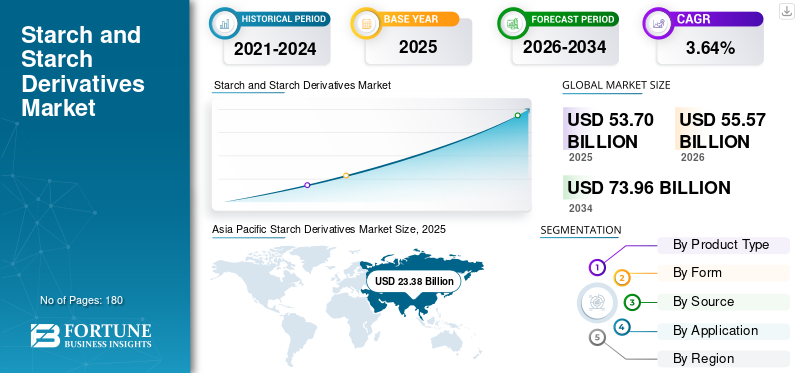
Download Free sample to learn more about this report.
Starch Derivatives Market Key Takeaways
 Market Size & Forecast
- 2025 Market Size: USD 53.70 billion
- 2026 Market Size: USD 55.57 billion
- 2034 Forecast Market Size: USD 73.96 billion
- CAGR: 3.64% from 2026–2034
 Market Share
- Asia Pacific dominated the starch derivatives market with a 43.54% share in 2025.
- The others segment is projected to grow at a CAGR of 6.22% during the forecast period.
- The dry segment is anticipated to expand at a CAGR of 4.53% through 2034.
 Key Regional Highlights
Asia Pacific
reached USD 23.38 billion in 2025, maintaining market leadership due to strong demand from the food and beverage industry and increasing consumption of potato starch across major economies.
North America
was valued at USD 13.27 billion in 2025, driven by rising demand for packaged foods, growing preference for natural ingredients, and advancements in starch processing technologies.
Europe
accounted for USD 10.49 billion in 2025 and is expected to witness steady growth, supported by increasing use of modified starch and expanding health and wellness trends.
U.S
The market was valued at USD 11.10 billion in 2025, representing approximately 20.67% of global sales, supported by strong demand from food processing and industrial applications.
Japan
The market reached USD 2.65 billion in 2025, accounting for around 4.94% of global revenue, driven by demand for functional food ingredients and advanced food manufacturing capabilities.
Read More

STARCH DERIVATIVES MARKET TRENDS
Increasing Use of Derivatives in Skincare Formulations is a Prominent Trend
The global market is witnessing a remarkable and growing trend toward starch-based cosmetic formulations. This shift is primarily driven by rising consumer preference for eco-friendly, natural components. Starch derivatives such as rice, corn, potato, and tapioca are being utilized as alternatives to petroleum-based thickeners and synthetic polymers. Incorporating these components into dry shampoos and face creams imparts a matte, non-greasy finish. Moreover, it is used in baby care items for their soothing and anti-irritant properties. Additionally, these derivatives enhance the application and compressibility of pressed powders. Due to these advantages, companies in the global market are aiming to manufacture starch-based beauty products for consumers.
MARKET DYNAMICS
MARKET DRIVERS
Download Free sample to learn more about this report.
Expansion of Processed/Convenience Food Consumption Boosts the Use of Derivatives
The spike in convenience or packaged food consumption is a main driver fueling the use of derivatives. Sudden changes in lifestyle, rising women's workforce participation, and surging disposable income have minimized the time available for home cooking. To fulfill their demands, consumers are moving toward ready-to-eat snacks, beverages, sauces, processed meals, and instant noodles. These items highly depend on derivatives for shelf-life extension, texture, moisture retention, and stability. For instance, glucose syrups are utilized to eliminate the risk of crystallization in chocolates and enhance mouthfeel in drinks. Moreover, modified starches offer freeze-thaw stability in sauces and ready-to-eat meals. Additionally, it helps extend the freshness and softness of baked goods. Thus, recognizing these benefits, manufacturers are focusing on launching new food & beverage derivatives.
MARKET RESTRAINTS
Growing Health Concerns Related to Glucose/High Fructose Syrup Limit Its Adoption
One of the pivotal hurdles in the global market is health concerns about sweeteners. Globally, starch-based derivatives, such as high-fructose and glucose syrups, are widely utilized in processed foods, soft drinks, and bakery items. These syrups are high in sugar, which increases the risk of diabetes, obesity, and other metabolic challenges. Moreover, it contributes to fatty liver disease and gum disease. Additionally, in some cases, corn-sourced syrup causes severe allergic reactions. To curb this, a few countries have introduced calorie labeling requirements and sugar taxes to minimize sugar consumption. These measures influence beverage and food producers to reduce sugar content in their finished items or switch toward sweeteners such as monk fruit and stevia. These factors hinder the global starch derivatives market share.
MARKET OPPORTUNITY
Technological Advancements in the Derivatives Sector Open Various Market Opportunities
The implementation of advanced technologies in the derivatives sector unlocks several growth opportunities globally. In the starch derivatives industry, businesses are adopting advanced enzymatic hydrolysis technologies to enhance the catalytic efficiency and pH stability of maltodextrins, high-fructose syrups, and glucose syrups. Catalytic and fermentation hydrogenation is also gaining popularity in the market as it minimizes by-product formation and improves yield efficiency. Moreover, businesses are adopting encapsulation technologies to incorporate starch-based derivatives into controlled-release systems for nutrients and flavors. In addition, food manufacturers are using digital formulation platforms to select desirable starch derivatives tailored to specific functional requirements.
Segmentation Analysis
By Product Type
Glucose Syrup Segment Dominated Leads Due to Its Extended Shelf Life
On the basis of product type, the market is divided into glucose syrup, high fructose syrup, modified starch, and others.
The glucose syrup segment led the global market in 2025. Glucose syrup provides a balanced combination of moisture retention, sweetness, and viscosity, unlike maltodextrins (which offer low sweetness and bulking) and dextrose (which is known mostly for its sweetness). Moreover, it reduces sugar crystallization in the confectionery industry and offers lower sweetness than high-fructose syrup. Additionally, glucose syrup has a better moisture-retention advantage, which extends its shelf life. Additionally, it is inexpensive, which further adds to its growth. As a result, the aforementioned factors propel the segment's potential.
The others segment is set to grow at a CAGR of 6.22% over the forecast period.
By Form
Liquid Segment Dominated the Market Owing to Its Improved Dosing Accuracy
Based on form, the market is segmented into dry and liquid.
In 2025, the liquid segment led the global market. In comparison to dry derivatives, liquid starch can be easily dissolved in aqueous systems, reducing or eliminating the need for additional steps. Liquids offer enhanced dosing accuracy, as they can be measured precisely with automated pumping systems. Moreover, it has minimal risk of agglomeration, whereas solid starch can easily absorb moisture during transportation and storage. Additionally, it offers improved fermentation efficiency, further boosting the global starch derivatives market growth.
The dry segment is anticipated to grow at a CAGR of 4.53% over the forecast period.
By Source
Corn Dominates the Market Due to its Large-Scale Availability
Based on the source, the market is divided into corn, wheat, tapioca, and others.
Corn segment dominated the global industry in 2025. Compared with wheat and tapioca, corn is one of the large-scale cultivated crops, especially in Argentina, the U.S., Brazil, and China. Moreover, corn is less expensive than potatoes and rice, further enhancing its growth potential. Corn starch is especially suited for enzymatic conversion into high-fructose and glucose syrups compared to other sources. In addition, it has long-standing market and regulatory acceptance across the pharmaceuticals, textile, paper, and food & beverages sectors.
The tapioca segment is likely to grow at a CAGR of 6.06% over the forecast period.
To know how our report can help streamline your business, Speak to Analyst
By Application
Food & Beverages Sector Led the Market Due to High Usage of Derivatives in Culinary Applications
Based on application, the market is segmented into food & beverages, pharmaceuticals, animal feed, cosmetics & personal care, and others.
Food & beverages segment dominated the global industry in 2025. In the beverages and food sector, derivatives are widely used as they enhance viscosity, sweetness, and texture enhancement. Moreover, these derivatives, when added to products, enhance product stability, taste, and mouthfeel in food systems. For instance, modified starch helps control thickness in sauces, whereas syrup reduces the risk of crystallization. Moreover, compared to proteins and fats, derivatives are cost-effective, allowing producers to utilize them in large volumes.
The cosmetics & personal care segment is expected to grow at a CAGR of 10.51% over the forecast period.
Starch Derivatives Market Regional Outlook
By geography, the market is categorized into North America, South America, Europe, Asia Pacific, and the Middle East & Africa.
Asia Pacific
Asia Pacific Starch Derivatives Market Size, 2025 (USD Billion)
To get more information on the regional analysis of this market, Download Free sample
Asia Pacific dominated the market with a valuation of USD 23.38 billion in 2025. The rising demand for potato starch and the expanding food and beverage sector are key factors boosting the region's potential. In the region, India and China reached the valuations of USD 4.26 billion and USD 10.03 billion, respectively, in 2025.
India Starch Derivatives Market
The Indian market in 2025 was valued at USD 4.26 billion, accounting for roughly 7.92% of the global market revenues. The growing production of raw materials and the flourishing food processing industry are driving factors in the market.
China Starch Derivatives Market
China's market is projected to be one of the largest worldwide. It was valued at USD 10.03 billion in 2025, representing roughly 18.69% of the global market sales.
Japan Starch Derivatives Market
The Japanese market in 2025 was valued at USD 2.65 billion, accounting for approximately 4.94% of the global market revenues.
North America
The North America market reached a valuation of USD 13.27 billion in 2025 and holds the second position globally. The market in North America is likely to grow due to surging demand for packaged food products and the rising trend toward natural ingredients. Moreover, technological advancements in production and increased awareness of the benefits of starch in the snacks sector are driving regional growth.
U.S. Starch Derivatives Market
Based on North America's strong contribution and the U.S. dominance within the region, the U.S. market was valued at USD 11.10 billion in 2025, accounting for roughly 20.67% of global sales.
Europe
Europe reached the valuation of USD 10.49 billion in 2025, recording a growth rate of 2.86% in the coming years, and secured the third position. The surging use of modified starch and the growing health & wellness trends are propelling the region's potential.
Germany Starch Derivatives Market
The Germany’s market in 2025 was valued at USD 2.39 billion, representing around 4.44% of the global market revenues.
U.K. Starch Derivatives Market
The U.K. market reached USD 1.21 billion in 2025, equivalent to around 2.25% of the global market sales.
South America, the Middle East, and Africa
The Middle East & Africa and South America regions are likely to experience moderate market growth over the forecast period. The South America market was valued at USD 3.72 billion in 2025. The rise in private-label brands and a strong distribution network are expected to drive demand for starch derivatives. The Middle East & Africa market reached USD 2.83 billion in 2025.
South Africa Starch Derivatives Market
The South Africa market reached around USD 1.40 billion in 2025, representing roughly 2.61% of global revenues.
COMPETITIVE LANDSCAPE
Key Industry Players
New Product Launches Help the Firms to Improve Their Market Positions
The market comprises numerous global ingredient producers and regional players competing for market share. The companies operating in the industry are adopting new product launch strategies to gain a competitive advantage. Moreover, to improve their market position, the producers are opening new production facilities and pursuing mergers and acquisitions.
LIST OF KEY STARCH DERIVATIVES COMPANIES PROFILED
- Cargill, Incorporated (U.S.)
- Archer Daniels Midland Company (U.S.)
- COFCO Biochemical (China)
- Tereos Group (France)
- BENEO (Germany)
- AGRANA Beteiligungs-AG (Austria)
- Roquette Frères (France)
- Tate & Lyle PLC (U.K.)
- Ingredion Incorporated (U.S.)
- Global Bio-chem Technology Group Company Limited (Hong Kong)
KEY INDUSTRY DEVELOPMENTS
- January 2026: Emsland-Stärke GmbH, a German starch products manufacturer, unveiled a functional component, "Emjel LC 15," a starch known for creating an elastic, smooth texture.
- October 2025: Roquette Frères, a plant-based ingredients company in France, revealed AMYSTA™ L 123, a pea starch ideal for dried soup and ready-to-mix beverages.
- August 2024: Roquette Frères, a French raw ingredients manufacturer, announced the launch of its texturizing solutions range by introducing tapioca-based starches. These starches help improve the elasticity and consistency of dairy desserts and sauces.
- April 2022: Royal Avebe, a Dutch ingredients firm, introduced multifunctional starch across the Netherlands, suitable for clean-label dairy formulation.
- November 2020: Ingredion Incorporated, a U.S.-based ingredients manufacturer, launched a range of low-sugar glucose syrups across Canada and the U.S.
REPORT COVERAGE
The global starch derivatives market provides an in-depth study of the market size and forecast for all the market segments included in the report. Market forecast analysis includes details on the market dynamics and trends expected to drive the market during the forecast period. The market analysis offers information on the technological advancements, new product launches, key industry developments, and details on partnerships, mergers, and acquisitions. The market forecast also encompasses a detailed competitive landscape with information on the market segmentation, market share, and profiles of key operating players.
Request for Customization to gain extensive market insights.
Report Scope & Segmentation
| ATTRIBUTE | DETAILS |
| Study Period | 2021-2034 |
| Base Year | 2025 |
| Estimated Year | 2026 |
| Forecast Period | 2026-2034 |
| Historical Period | 2021-2024 |
| Growth Rate | CAGR of 3.64% from 2026-2034 |
| Unit | Value (USD Billion) |
| Segmentation | By Product Type, Form, Source, Application, Region |
| By Product Type |
|
| By Form |
|
| By Source |
|
| By Application |
|
| By Geography |
|
Frequently Asked Questions
Fortune Business Insights says that the global market value stood at USD 53.70 billion in 2025 and is projected to reach USD 73.96 billion by 2034.
In 2025, the Asia Pacifics market value stood at USD 23.38 billion.
The market is expected to exhibit a CAGR of 3.64% during the forecast period.
By form, the liquid segment led the global market in 2025.
Expansion of processed/convenience food consumption is the key factor driving the market.
Cargill, Incorporated, Archer Daniels Midland Company, and Roquette Frères are among the key players in the market.
Asia Pacific held the largest market share in 2025.
Increasing use of derivatives in skincare formulations is a key market trend.



- 2021-2034
- 2025
- 2021-2024
- 180
-
(Offer valid till 15th Oct 2026)
Get 30-60 hrs Free Customization
Expand Regional and Country Coverage, Segments Analysis, Company Profiles, Competitive Benchmarking, and End-user Insights.




















-
US +1 833 909 2966 ( Toll Free )
-
Get In Touch With Us