Veterinary Chemistry Analyzer Market Size, Share & Industry Analysis By Type (Instruments [Chemistry Analyzers, Urine Analyzers, Glucometers and Others] and Consumables [Reagents & Kits, Calibrators & Controls, and Others]), By Modality (Tabletop and Portable), By Application (Blood Chemistry Analysis, Urinalysis, Glucose Monitoring, and Others), By Animal Type (Companion Animals [Dogs, Cats, and Others] and Livestock [Cattle, Poultry, Swine, and Others]), By End User (Veterinary Hospitals & Clinics, Veterinary Diagnostic Laboratories, and Others), and Regional Forecast, 2026-2034
 Download Free Sample
Veterinary Chemistry Analyzer Market Size and Future Outlook
 Listen to Audio Version
The global veterinary chemistry analyzer market size was valued at USD 3.41 billion in 2025 and is projected to grow from USD 3.62 billion in 2026 to USD 5.45 billion by 2034, exhibiting a CAGR of 5.2% during the forecast period. North America dominated the veterinary chemistry analyzer market with a market share of 38.41% in 2025.
Veterinary chemistry analyzers are medical instruments that are used to measure core blood chemistry markers, including kidney, electrolytes, proteins, and liver function, in animals. The rising prevalence of chronic disorders among animals, and the improvement in medical practices, including shifting to in-house testing and others, are further leading to a higher adoption rate of such instruments in the market. However, growing awareness about routine check-ups is further driving the uptake of veterinary chemistry analyzers in the market.
- For example, based on 2025 data released by the MDPI, about 20-50% of cats over 10 years of age suffer from chronic kidney disease (CKD)
Furthermore, the increasing integration of technological innovations in these products by key players, such as IDEXX Laboratories, Inc., and Zoetis Services LLC, among others, is resulting in the product’s demand in the market.
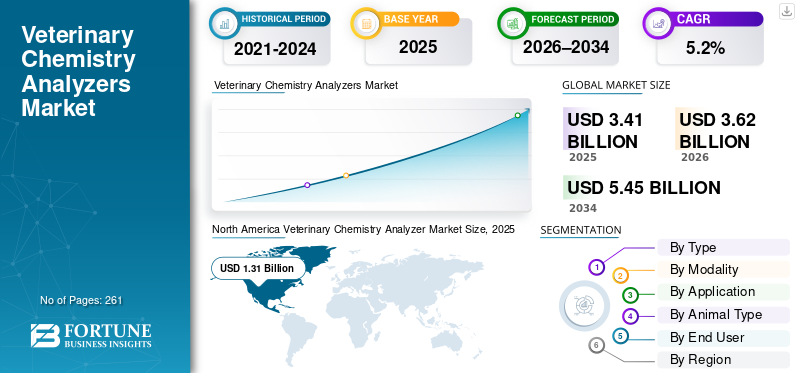
Download Free sample to learn more about this report.
Veterinary Chemistry Analyzer Market Key Takeaways
 Global Market Size & Forecast
- 2025 Market Size: USD 3.41 billion
- 2026 Market Size: USD 3.62 billion
- 2034 Forecast Market Size: USD 5.45 billion
- CAGR: 5.2% from 2026–2034
 Market Share
- North America dominated the veterinary chemistry analyzer market with a 38.41% share in 2025.
- The tabletop modality segment held a 58.3% market share in 2025.
- The veterinary hospitals & clinics segment is projected to account for 72.7% of the market in 2026.
 Key Regional Highlights
North America
Valued at USD 1.31 billion in 2025 and remained the leading regional market.
Europe
Projected to reach USD 0.99 billion in 2026 with a 4.3% growth rate.
Asia Pacific
Expected to reach USD 0.86 billion in 2026, ranking as the third-largest regional market.
U.S
Market is estimated to reach USD 1.23 billion in 2026, accounting for 34.1% of global revenue.
Japan
Market is projected to reach USD 0.16 billion in 2026, representing 4.4% of global revenue.
Read More

Veterinary Chemistry Analyzer Market Trends
Shift Toward Analyzer Ecosystems Pose as a Prominent Market Trend
There is a growing shift toward analyzer ecosystems that prioritize automation, ease of use, and a clean workflow fit. The advanced systems are being developed to minimize hands-on time with improved quality procedures, simplified maintenance workflows, and streamlined sample handling so staff can run tests reliably even during peak hours.
The connectivity is also becoming standard, with significant links to clinical software, artificial intelligence, and patient records to minimize manual entry and enhance traceability. Additionally, manufacturers are emphasizing menu expansion so a single platform can support more clinical decisions from routine wellness panels to targeted follow-up testing, resulting in a growing adoption rate of such products in the market.
- In August 2021, HORIBA Group showcased its new benchtop POCKIT Central in-house veterinary PCR analyzer on Stand C3 at the BEVA Congress.
Other Prominent Trends
- Shift toward point‑of‑care and compact analyzers for faster turnaround times
- Integration with laboratory information systems and cloud reporting
- Multi‑parameter cartridges and reagent panels
- Subscription/reagent‑rental business models
Download Free sample to learn more about this report.
Market Dynamics
Market Drivers
Increasing Prevalence of Chronic Diseases to Fuel Market Growth
The increasing instances of chronic conditions such as endocrine disorders, kidney and liver dysfunction, and others is resulting in the growing demand for repeat testing and trend tracking, subsequently fueling the demand for veterinary chemistry analyzer in the market.
- According to 2025 data released by Merck & Co., Inc., it was stated that about 1 in 300 dogs suffer from diabetes mellitus.
This, combined with the growing demand toward test workflows, where blood chemistry results are generated, which helps the veterinarian to make decisions immediately, adjusting medications, changing diets, and planning rechecks. Therefore, the above-mentioned factors, along with growing awareness regarding routine check-ups and preventive screening, are supporting the global market size.
Market Restraints
High Cost Associated with Continuing Operational and Financial Commitments to Hamper Market Growth
The chemistry analyzers are associated with continuing operational and financial commitments. The veterinary healthcare facilities must manage consumables, maintenance routines, routine quality checks, and staff training to keep performance consistent, which makes it challenging for smaller clinics to adopt these advanced devices.
Along with this, challenges with workflow integration, including the addition of a new analyzer, service contracts, calibration/QC routines, consumables tied to a proprietary ecosystem, and staff time, among others, further increase the burden on technicians. Therefore, the above-mentioned factors are mostly to hamper the adoption rate, further limiting the growth of the market.
- For example, as per the statistics published by the VEEN, the cost of the VetScan Chemistry Analyzer is about USD 495.0.
Market Opportunities
Expansion of Healthcare Infrastructure Drive Market Opportunities
Healthcare facilities are rapidly expanding in developing countries such as India, Mexico, and other emerging economies. The rising prevalence of chronic disorders, expansion of veterinary healthcare infrastructure, and the rising number of veterinary facilities are subsequently favoring the adoption of veterinary chemistry analyzer in the healthcare facilities.
The inclination toward specialized clinics with advanced equipment has increased the demand and the efforts among the key manufacturers to introduce novel analyzers, thereby creating a lucrative opportunity in the market.
- In 2024, as per the data published by xMAP, there are about 5,588 veterinary clinics and animal hospitals in the U.S.
Market Challenges
Lack of Standardization in Practices to Limit Market Growth
A major challenge is the lack of a standardized procedure for the diagnosis of various chronic conditions. Certain tests, such as chemistry testing and others, are sensitive to how the sample is being collected, handled, stored, and prepared, and slight variations in routine, clotting, hemolysis, delays in processing, or inconsistent centrifugation can lead to distortion in the results.
Furthermore, these steps are often shared across multiple technicians, shifts, and skill levels, so standardization is slipping, which makes it challenging to follow a universal workflow for the diagnosis of various conditions and other factors. Therefore, the above factors, along with the limited availability of skilled veterinarians, among others, are supposedly to hamper the market growth.
- For instance, as per the 2023 statistics recorded by the Veterinary Council of India (VCI), there are 81,938 registered veterinary practitioners in India.
Other Prominent Challenges
- Reagent and consumable price sensitivity
- Competition from centralized reference labs and outsourcing
- Regulatory approvals and quality assurance requirements
SEGMENTATION ANALYSIS
By Type
Increasing Number of Instruments Launches Led to Segmental Dominance
Based on type, the market is classified into instruments and consumables. Additionally, instruments are divided into chemistry analyzers, urine analyzers, glucometers, and others. Furthermore, consumables are classified into reagents & kits, calibrators & controls, and others.
The instruments segment in 2025 held the largest revenue share. Such a growth is driven by the increasing incidence of chronic conditions among animals, leading to higher adoption of these products in the market. This, together with the rising focus of prominent companies on introducing novel analyzers, is expected to further support the global veterinary chemistry analyzer market growth.
- In July 2025, Diatron, a STRATEC brand, launched its new clinical chemistry analyzer, the P780, for human medical and veterinary use.
The consumables segment is projected to record a growth at a CAGR of 5.5% over the forecast period.
To know how our report can help streamline your business, Speak to Analyst
By Modality
Increasing Adoption of Tabletop Devices Led to Segmental Dominance
Based on modality, the market is segmented into tabletop and portable.
In 2025, the tabletop segment dominated the global market. Further, based on modality, the tabletop segment held a 58.3% share in 2025. The growth is owing to the growing prevalence of chronic conditions, resulting in a focus of key players toward launching tabletop analyzers, thereby supporting the adoption rate of these devices in the market.
- For instance, in January 2025, BIONOTE, launched the Vcheck H, which provides in-clinic evaluation of white blood cells, red blood cells, platelets, reticulocytes, and hemoglobin for veterinary use.
The segment of portable is witnessed to flourish with a 5.6% growth rate across the forecast period.
By Application
Increasing Adoption of Pets Led to Segmental Dominance
On the basis of application, the market is segmented into blood chemistry analysis, urinalysis, glucose monitoring, and others.
The blood chemistry analysis segment in 2025 dominated the global market for veterinary chemistry analyzer. Based on application, the blood chemistry analysis segment in 2025 held a 53.5% of market share. Such a growth is owing to the increasing adoption of pets, resulting in an rising adoption of analyzers, thereby supporting the adoption rate of these devices in the market.
- According to the statistics published in 2025 by the American Pet Products Association (APPA), 94 million U.S. households own a pet.
However, the urinalysis segment is set to thrive with a 5.3% of growth rate across the forecast period.
By Animal Type
Increasing Adoption of Companion Animals Led to Segmental Dominance
Based on animal type, the market is bifurcated into companion animals and livestock. Additionally, companion animals are further divided into dogs, cats, and others. Furthermore, livestock is divided into cattle, poultry, swine, and others.
The companion animals segment dominated the market in 2025. The increasing prevalence of chronic conditions, rising adoption of companion animals such as dogs, cats, and others, among others, are some of the vital factors supporting the growth of the segment in the market. Furthermore, the segment is set to hold a 65.3% share in 2026.
For instance, according to the 2025 statistics published by the American Pet Products Association (APPA), 68 million U.S. households own a pet dog.
In addition, livestock end users are projected to grow at a 5.2% CAGR during the forecast period.
By End User
Growing Number of Veterinary Hospitals & Clinics Led to Segmental Dominance
On the basis of end user, the market includes veterinary hospitals & clinics, veterinary diagnostic laboratories, and others.
The veterinary hospitals & clinics segment held a dominating position in the market in 2025. The rising cases of chronic conditions, the growing number of veterinary hospitals & clinics, among other vital factors are supporting the growth of the segment in the market. Moreover, the segment is set to hold a share of 72.7% in 2026.
- As per the statistics published in 2022 by the Animal Husbandry Department, it was stated that there are around 12,452 hospitals in India.
In addition, veterinary diagnostic laboratories’ end users are expected to grow at a CAGR of 6.3% during the forecast period.
Veterinary Chemistry Analyzer Market Regional Outlook
Based on region, the market has been studied across North America, Europe, Asia Pacific, Latin America, and the Middle East & Africa.
North America
North America Veterinary Chemistry Analyzer Market Size, 2025 (USD Billion)
To get more information on the regional analysis of this market, Download Free sample
The North America market held the dominant share in 2024, valued at USD 1.24 billion, and also took the leading share in 2025 with USD 1.31 billion. The growing high pet healthcare spending, adoption of pets, advanced veterinary hospital infrastructure, increasing veterinary professionals, and strong demand for advanced devices, among others, are some of the factors supporting the growth of the segment in the market.
- For instance, according to the 2025 statistics published by the American Pet Products Association (APPA), 49 million U.S. households own pet cats.
U.S. Veterinary Chemistry Analyzer Market
Based on North America’s strong contribution and the U.S. dominance within the region, the U.S. market can be analytically approximated at around USD 1.23 billion in 2026, accounting for roughly 34.1% of global veterinary chemistry analyzer sales.
Europe
Europe is projected to record a growth rate of 4.3% in the coming years, which is the second highest among all regions, and reach a valuation of USD 0.99 billion by 2026. The strong companion animal diagnostics and regulatory standards are expected to support the market growth.
U.K. Veterinary Chemistry Analyzer Market
The U.K. market value in 2026 is estimated at around USD 0.17 billion, representing roughly 4.7% of global veterinary chemistry analyzer revenues.
Germany Veterinary Chemistry Analyzer Market
Germany’s market is projected to reach approximately USD 0.21 billion in 2026, equivalent to around 5.7% of global veterinary chemistry analyzer sales.
Asia Pacific
Asia Pacific is estimated to reach USD 0.86 billion in 2026 and secure the position of the third-largest region in the market. The rapid growth in pet adoption and livestock healthcare investments is probably to support the growth of the market. In the region, India and China are both estimated to reach USD 0.14 billion and USD 0.27 billion, respectively, in 2026.
Japan Veterinary Chemistry Analyzer Market
The Japan market in 2026 is estimated at around USD 0.16 billion, accounting for roughly 4.4% of global revenues. Japan has historically reported a relatively high prevalence of chronic diseases among animals, with a large adoption rate for pet animals.
China Veterinary Chemistry Analyzer Market
China’s market is projected to be one of the largest worldwide, with 2026 revenues estimated at around USD 0.27 billion, representing roughly 7.6% of global sales.
India Veterinary Chemistry Analyzer Market
The India market size in 2026 is estimated at around USD 0.14 billion, accounting for roughly 3.9% of global revenues.
Latin America and Middle East & Africa
Latin America and the Middle East & Africa regions are expected to witness moderate growth in this market space during the forecast period. The Latin America market is set to reach a valuation of USD 0.22 billion in 2026. The growth is due to the expansion of emerging veterinary services in these regions. In the Middle East & Africa, the GCC is set to reach a value of USD 0.06 billion in 2026.
South Africa Veterinary Chemistry Analyzer Market
The South Africa market is projected to reach around USD 0.03 billion in 2026, representing roughly 1.0% of global revenues.
Competitive Landscape
Key Industry Players
Increasing Number of Product Launches to Support Their Dominance
A strong product portfolio, along with a significant emphasis on inorganic growth strategies globally, is among the key factors reinforcing the market dominance of major players. IDEXX Laboratories, Inc., and Zoetis Services LLC, were the leading companies in the industry in 2025. In addition, the growing emphasis of key players on research and development activities to launch novel products is largely aimed at enhancing their market presence, further supporting the global veterinary chemistry analyzer market share.
- In August 2020, IDEXX Laboratories, Inc., a global leader in veterinary diagnostics and software, launched the ProCyte One Hematology Analyzer.
Other prominent key players, including Chengdu Seamaty Technology Co., Ltd., among others, are also expanding their presence in the market, primarily owing to their growing focus on collaborations with other players to strengthen brand visibility.
List of Key Veterinary Chemistry Analyzer Companies Profiled
- Chengdu Seamaty Technology Co., Ltd. (China)
- IDEXX Laboratories, Inc. (U.S.)
- Zoetis Services LLC (U.S.)
- ZheJiang HualoMT Biotechnology Co., Ltd. (China)
- ZOM•Dx (U.S.)
- FUJIFILM Corporation (Japan)
- Infitek Co., Ltd. (China)
- BIONOTE (South Korea)
- Diatron (U.S.)
- Genrui Biotech Inc. (China)
KEY INDUSTRY DEVELOPMENTS
- July 2025: BIONOTE launched Vcheck C1 In-Clinic Chemistry Analyzer with an aim to strengthen its product portfolio.
- September 2024: Zoetis Inc., an animal health company, is set to unveil its new hematology analyzer, Vetscan OptiCell, a cartridge-based, AI-powered diagnostic tool that provides advanced Complete Blood Count (CBC) analysis.
- August 2023: Seamaty launched four new veterinary analyzers for pet hospitals including VG2 vet blood gas electrolyte immunoassay analyzer, VG1 veterinary blood gas & electrolyte analyzer, Vi1 veterinary fluorescence immunoassay analyzer and VBC30 vet 3-part and VBC50 5-part hematology analyzers.
- March 2023: Agappe launched VET CARE, a veterinary care division providing diagnostic POC solutions to veterinary hospitals to increase its brand presence.
- March 2021: Carolina Liquid Chemistries Corp. now offers the Seamaty SMT-120V Veterinary Automated Biochemistry Analyzer to strengthen its presence.
- November 2020: Genrui Biotech Inc., a Shenzhen-based Chinese company specialized in developing, manufacturing, and marketing IVD equipment and reagents, announced a new brand named Genvet, and a series of professional veterinary diagnosis equipment.
- June 2019: Trivitron Healthcare, an Indian health technology organisation, recently launched a clinical chemistry analyser, ‘Nanolab 200’ and a part differential haematology analyser with retic, Cellenium 5D Retic.
REPORT COVERAGE
The report provides a detailed global veterinary chemistry analyzer market analysis and focuses on key aspects such as leading companies and market segmentation, including type, modality, application, animal type, and end user. Besides this, the global report offers insights into the market growth trends and highlights key industry developments. In addition to the aforementioned factors, the report encompasses several factors that have contributed to the growth and advancement of the market over recent years.
Request for Customization to gain extensive market insights.
Report Scope & Segmentation
|
ATTRIBUTE |
DETAILS |
|
Study Period |
2021-2034 |
|
Base Year |
2025 |
|
Estimated Year |
2026 |
|
Forecast Period |
2026-2034 |
|
Historical Period |
2021-2024 |
|
Growth Rate |
CAGR of 5.2% from 2026-2034 |
|
Unit |
Value (USD Billion) |
|
Segmentation |
By Type, Modality, Application, Animal Type, End User, and Region |
|
By Type |
· Instruments o Chemistry Analyzers o Urine Analyzers o Glucometers o Others · Consumables o Reagents & Kits o Calibrators & Controls o Others |
|
By Modality |
· Tabletop · Portable |
|
By Application |
· Blood Chemistry Analysis · Urinalysis · Glucose Monitoring · Others |
|
By Animal Type |
· Companion Animals o Dogs o Cats o Others · Livestock o Cattle o Poultry o Swine o Others |
|
By End User |
· Veterinary Hospitals & Clinics · Veterinary Diagnostic Laboratories · Others |
|
By Region |
· North America (By Type, By Modality, By Application, By Animal Type, By End User, and by Country) o U.S. (By Modality) o Canada (By Modality) · Europe (By Type, By Modality, By Application, By Animal Type, By End User, and by Country/Sub-region) o U.K. (By Modality) o Germany (By Modality) o France (By Modality) o Italy (By Modality) o Spain (By Modality) o Scandinavia (By Modality) o Rest of Europe (By Modality) · Asia Pacific (By Type, By Modality, By Application, By Animal Type, By End User, and by Country/Sub-region) o China (By Modality) o Japan (By Modality) o India (By Modality) o Australia (By Modality) o Southeast Asia (By Modality) o Rest of Asia Pacific (By Modality) · Latin America (By Type, By Modality, By Application, By Animal Type, By End User, and by Country/Sub-region) o Brazil (By Modality) o Mexico (By Modality) o Rest of Latin America (By Modality) · Middle East & Africa (By Type, By Modality, By Application, By Animal Type, By End User, and by Country/Sub-region) o GCC (By Modality) o South Africa (By Modality) o Rest of the Middle East & Africa (By Modality) |
Frequently Asked Questions
Fortune Business Insights says that the global market size was USD 3.41 billion in 2025 and is projected to reach USD 5.45 billion by 2034.
In 2025, the North America regional market value stood at USD 1.31 billion.
Growing at a CAGR of 5.2%, the market will exhibit steady growth over the forecast period.
By type, the instruments segment is the leading segment in this market.
The introduction of a novel veterinary chemistry analyzer is one of the major factors driving the market's growth.
IDEXX Laboratories, Inc., and Zoetis Services LLC, are the major players in the global market.
North America dominated the market share in 2025.
The growing prevalence of chronic conditions, the increasing technological advancements in analyzers, among others, are some of the prominent factors expected to boost the adoption of these products worldwide.



- 2021-2034
- 2025
- 2021-2024
- 261
Get 30-60 hrs Free Customization
Expand Regional and Country Coverage, Segments Analysis, Company Profiles, Competitive Benchmarking, and End-user Insights.













.webp)






Related Reports
-
US +1 833 909 2966 ( Toll Free )
-
Get In Touch With Us