Infant Formula Market Size, Share & Industry Analysis, By Type (Infant Milk, Follow-on Milk, and Others), By Distribution Channel (Supermarkets & Hypermarkets, Pharmacies & Drugstores, Baby & Maternity Specialty Stores, and E-Commerce), By Protein System (Cow's Milk Protein-Based, Goat's Milk Protein-Based, Soy Protein Isolate-Based, and Free Amino Acid-Based Formulas), By Physical Form (Powder, Concentrated Liquid, and Ready-to-Feed), By Nature (Conventional and Organic), By Lactose System (Lactose-Predominant, Reduced-Lactose, and Lactose-Free Formula), and Regional Forecast, 2026-2034
 Download Free Sample
(Offer valid till 30th Sep 2026)

Infant Formula Market Size and Future Outlook
 Listen to Audio Version
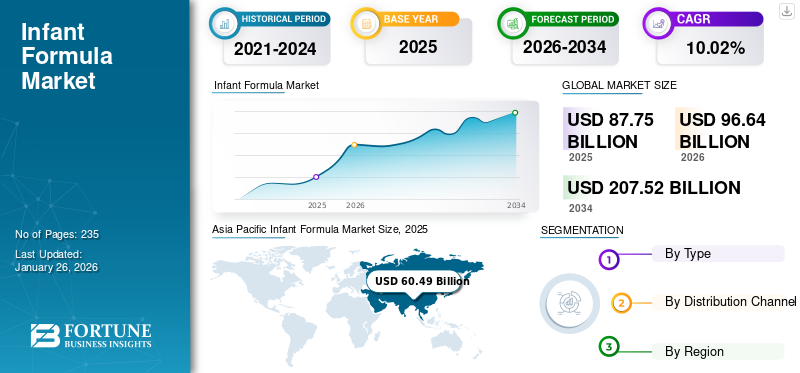
The global infant formula market size was valued at USD 95.38 billion in 2025. The market is projected to grow from USD 105.04 billion in 2026 to USD 234.72 billion by 2034, exhibiting a CAGR of 10.57% during the forecast period. Asia Pacific dominated the infant formula market with a market share of 68.93% in 2025.
Infant or baby formula are specially designed formulations for infants, specifically those below one year of age. Numerous government organizations, such as the Food Safety and Standards Authority of India (FSSAI), the World Health Organization (WHO), and others have specific rules regarding baby food formulation to ensure the high quality of the product. Stringent regulations regarding the quality of the products are expected to encourage consumers to buy new products without hesitation.
Companies such as Nestle S.A., Danone S.A., Arla Foods, and Yili Group are the key players in the market. New product launch is the key strategy which is boosting market expansion and supporting the market growth.
Download Free sample to learn more about this report.
INFANT FORMULA MARKET TRENDS
Safety Testing, Traceability, and Regulatory Oversight are Reshaping Product Development
Product safety is getting more attention in the market after recent recalls, supply shortages, and worries about microbial and chemical contaminants. Manufacturers are improving on controlling pathogens, qualify suppliers, track batches digitally, develop plant based formulas and other innovative products and test for contaminants. The FDA’s current infant formula framework requires manufacturers distributing products in the U.S. to comply with specific federal statutory and regulatory requirements. Recent regulatory initiatives have also focused more on nutritional adequacy, product quality, and reliable supply.
MARKET DYNAMICS
MARKET DRIVERS
Download Free sample to learn more about this report.
Rising Participation of Working Women and Urban Lifestyles Increase Demand for Convenient Infant Nutrition
Increasing female workforce participation and rapid urbanization are among the primary factors driving the infant formula market growth. As more mothers return to work shortly after childbirth, the need for convenient and nutritionally complete feeding solutions continues to rise. Infant formula makes it easier for family members and childcare providers to share feeding duties, and it helps babies get balanced nutrition when breastfeeding is not possible. Families living in cities usually have better access to stores, online shopping, and healthcare, which makes it easier to find infant formula and learn about their options. The International Labour Organization (ILO) reports that about 47% of women globally were part of the workforce in 2024, showing that more mothers are working around the globe. This change in the population keeps increasing the demand for infant milk, follow-on milk, ready-to-feed products, and higher-quality infant nutrition options.
|
Rank |
Market Drivers |
Overall Impact Rank |
CAGR Contribution (2026-2034) |
Impact 2026-2028 |
Impact 2029-2031 |
Impact 2032-2034 |
|
1 |
Growing Demand for Specialized and Condition-Specific Infant Formula |
High |
+3.45% |
High |
High |
High |
|
2 |
Increasing Maternal Employment and Demand for Convenient Infant Feeding |
High |
+3.10% |
High |
High |
Medium |
|
3 |
Premiumization and Development of Advanced Nutritional |
High-Medium |
+2.75% |
Medium |
High |
High |
|
4 |
Urbanization, Improving Purchasing Power, and Expansion of Organized Retail in Emerging Markets |
Medium |
+2.35% |
Medium |
High |
High |
|
5 |
Expansion of E-commerce and Omnichannel Infant Nutrition Distribution |
Medium |
+1.65% |
High |
Medium |
High |
| 6 | Others | Low | +0.75% | Low | Low | Low |
|
Total Positive Growth Contribution |
+14.05% |
MARKET RESTRAINTS
Declining Birth Rates across Major Economies Limit Long-Term Volume Growth
One of the most significant restraints affecting the global market is the sustained decline in fertility and birth rates across several major economies, including China, Japan, South Korea, Germany, Italy, and Spain. A smaller infant population directly reduces the potential consumer base for infant formula, creating structural limitations on volume growth despite continued product innovation. According to the World Bank, China's crude birth rate declined to approximately 7 births per 1,000 population in 2024, while Japan recorded approximately 6 births per 1,000 population, reflecting persistent demographic contraction. Although premiumization helps maintain market value, declining birth cohorts continue to intensify competition among manufacturers for a shrinking customer base.
|
Rank |
Market Restraints |
Overall Impact Rank |
Negative CAGR Contribution (2026-2034) |
Impact 2026-2028 |
Impact 2029-2031 |
Impact 2032-2034 |
|
1 |
Declining Birth Rates and Shrinking Infant Cohorts in Major Markets |
High |
-1.45% |
Medium |
High |
High |
|
2 |
Breastfeeding Promotion and Tightening Formula Marketing Regulations |
High - Medium |
-1.10% |
High |
High |
High |
|
3 |
High Product Prices and Volatility in Dairy and Specialty Ingredient Costs |
Medium |
-0.68% |
High |
Medium |
Medium |
|
4 |
Others |
Low |
-0.25% |
Low |
Low |
Low |
|
|
Total Negative Growth Impact |
|
-3.48% |
|
|
|
MARKET OPPORTUNITIES
Expansion of Human Milk Oligosaccharide-Enriched Formulas Creates Premium Product Opportunities
There is a rising demand for customized blends designed for particular applications, processing conditions, and nutritional targets. In beverages, blended systems can improve sweetness onset, mouthfeel, flavor persistence, and solids content while reducing calories. Polyols such as erythritol can soften the aftertaste of high-intensity sweeteners, while soluble fibers can improve body and provide additional nutritional value. The rapid expansion of functional beverages, hydration products, energy drinks, and low-sugar dairy beverages offers a large platform for such systems. Opportunities are especially strong for suppliers capable of delivering complete formulation solutions rather than individual commodity ingredients. This approach can also support higher margins and stronger customer retention.
Segmentation Analysis
By Type
High Nutritional Dependence During First Six Months Led to Dominance of Infant Milk Segment
By type, the market is segmented into infant milk, follow-on-milk, and growing up milk.
Infant milk segment held the largest infant formula market share in 2025. As it is designed for use during the first six months of life, when infants depend primarily on breast milk or an appropriate breast-milk substitute for nutrition. Demand is supported by maternal employment, breastfeeding difficulties, premature births, low milk supply, adoption, and medical recommendations requiring partial or complete formula feeding. The segment benefits from frequent feeding requirements and high consumption per infant during the early stage of development.
Follow-on-milk segment holds the second-largest market share, and is expected to grow at a CAGR of 10.50% during the forecast period. Demand stays strong as children use these products for longer, parents gradually add other foods, and many still prefer milk products with added nutrients. Manufacturers are launching more products tailored to different growth stages, adding ingredients such as probiotics, HMOs, and prebiotics that support immunity, digestion, and brain development. However, once children start eating other foods, they rely less on milk, so they drink less compared to when they were infants.
By Protein System
Commercial Scalability and Broad Clinical Acceptance Boosted Leadership of Cow's Milk Protein-Based Segment
By protein system, the market is divided into cow’s milk protein-based, goat’s milk protein-based, soy protein isolate-based, free amino acid-based, rice protein hydrolysate-based, and other protein systems.
Cow’s milk protein-based segment held the largest market share in 2025. As it’s easy to find, can be produced on a large scale, and offers a flexible source of nutrition. Manufacturers adjust the protein makeup, whey-to-casein ratio, fat mix, carbohydrate content, and micronutrients to match what infants need for healthy growth and support nutrition of premature infants. It benefits from strong dairy supply chains, large production facilities, wide regulatory approval, and lower costs compared to other protein sources.
Goat’s milk protein-based segment holds the second-largest market share, and is expected to grow at a CAGR of 10.14% during the forecast period. Parents are showing more interest in alternative dairy proteins, high-quality milk sources, and formulas that are easier to digest. Goat milk has a unique mix of proteins, fats, and oligosaccharides. This natural difference sets it apart from regular cow’s milk formulas. Manufacturers often promote goat milk formula as being easy to digest, naturally made, traceable to its source, and produced with high-quality dairy standards.
To know how our report can help streamline your business, Speak to Analyst
By Physical Form
Long Shelf Life, Cost Efficiency, and Easy Distribution Made Powder Formula Segment Lead Market
By physical form, the market is classified into powder, concentrated liquid, and ready-to-feed.
Powder segment held the largest market share in 2025. The dominance is attributed to its longer shelf life, lower transportation costs, efficient storage, and a comparatively lower cost per feeding. These advantages make powder the most commercially viable form across developed and emerging markets. Powder formula also provides manufacturers with greater flexibility in incorporating proteins, carbohydrates, fats, vitamins, minerals, probiotics, and other functional ingredients.
Ready-to-feed segment holds the second-largest market share, and is expected to grow at a CAGR of 9.59% during the forecast period. It provides maximum convenience and eliminates the need for water measurement, mixing, and preparation. It is particularly useful in hospitals, maternity wards, neonatal care, travel situations, emergencies, and nighttime feeding.
By Nature
Affordability and Large-Scale Manufacturing Enabled Conventional Segment to Maintain Market Leadership
By nature, the market is bifurcated into conventional and organic.
Conventional segment held the largest market share in 2025. As it is easy to find, more affordable, and backed by large milk and ingredient supply chains. Manufacturers have more options when sourcing dairy ingredients, vegetable oils, carbohydrates, vitamins, minerals, and other additives. Since they are made in large quantities with well-established methods, conventional formulas can be distributed more widely and cost less per unit than organic options.
Organic segment holds the second-largest market share, and is expected to grow at a CAGR of 11.07% during the forecast period. Organic formulas are well established in Europe and are becoming more popular in North America, China, Australia, and Middle Eastern countries. Manufacturers highlight organic certification, grass-fed milk, simple ingredient lists, and traceable dairy sources to position their products as premium options.
By Lactose System
Closer Nutritional Similarity to Human Milk Made Lactose as a Sole or Predominant Carbohydrate Segment Dominate
By lactose system, the market is segregated into lactose as sole or predominant carbohydrate, mixed lactose and non-lactose carbohydrate system, reduced-lactose formula, and lactose-free formula.
Lactose as sole or predominant carbohydrate segment held the largest market share in 2025. Formulas that use lactose as the main or only carbohydrate are most popular since lactose is the main carbohydrate found in human milk. Lactose gives energy, makes formula taste better, helps the body absorb calcium, and can support the growth of good bacteria in the gut. Most regular infant formulas use lactose as their main carbohydrate, especially those made for healthy, full-term babies. Since lactose is similar to the carbohydrates in human milk, it is widely accepted by regulators and used in many types of formula, including conventional, organic, cow’s milk, and goat milk options.
Mixed lactose and non-lactose carbohydrate system segment holds the second-largest market share, and is expected to grow at a CAGR of 10.63% during the forecast period. These mixed systems are often found in comfort formulas, anti-reflux products, partially hydrolyzed formulas, follow-on milk, and formulas designed for specific digestive needs. Non-lactose carbohydrates can change the thickness, help with powder processing, adjust sweetness, and lower the overall lactose content.
By Distribution Channel
Hypermarkets/Supermarkets Segment Dominated Due to its Convenience and Wide Availability of Brands
In terms of distribution channel, the market is divided into supermarkets and hypermarkets, pharmacies and drugstores, baby and maternity specialty stores, convenience and traditional grocery stores, e-commerce and others, hospitals and neonatal-care units, clinics and medical centers, and other institutional.
Supermarkets and hypermarkets account for the largest portion of global market share in 2025. They provide broad product availability, competitive pricing, convenient access, and the ability to compare multiple brands, pack sizes, and formula types in one location. These outlets typically stock mainstream infant milk, follow-on milk, growing-up formulas, organic products, and selected specialty formulations.
Baby and maternity specialty stores holds the second-largest market share, and is expected to grow at a CAGR of 10.33% during the forecast period. They offer a focused selection of products, clean label premium brands, and personal help for parents. These stores are especially important for products including goat milk formula, organic items, imported brands, A2 protein-based formula, and other unique options.
INFANT FORMULA MARKET REGIONAL OUTLOOK
Based on region, the market has been analyzed across Europe, the Asia Pacific, South America, North America, and the Middle East & Africa.
Asia Pacific
Asia Pacific Infant Formula Market Size, 2025 (USD Billion)
To get more information on the regional analysis of this market, Download Free sample
Asia Pacific’s market was valued at USD 65.75 billion in 2025 and it is the leading region. Consumers in the region are becoming aware of value additions provided by the infant formula and the convenience offered by these products regarding feeding and keeping track of proper nutrition. The region has vast scope for industry developments, such as new product launches, expansion in distribution channels, and rising investments.
India Infant Formula Market
The Indian market was valued around USD 3.24 billion in 2025, accounting for roughly 3.40% of global market revenues.
China Infant Formula Market
China’s market was valued around USD 45.86 billion in 2025, representing roughly 48.08% of global market share. China holds a significant share of the global market and is the top consumer in the Asia Pacific, owing to its higher population and rising consumer awareness about infant nutrition. Moreover, China’s decision to abolish its “one-child” policy and increase the country’s birth rate is predicted to positively impact the market growth during the forecast period. Infant formula companies are also investing in research and development of new ingredients, which can add value to infant formula products.
For instance, in 2023, Junlebao, a Chinese dairy product manufacturer, researched and found that the addition of docosahexaenoic acid (DHA) helps to improve an infant’s brain development. Thus, companies are working to add value to their products to improve brain and infant health development.
Japan Infant Formula Market
The Japanese market reached a valuation of around USD 2.86 billion in 2025, accounting for roughly 3.00% of global market revenues.
North America
The market in North America reached a valuation of USD 10.30 billion in 2025. Families have strong buying power, pediatric healthcare is reliable, many women work outside the home, and retail stores are easy to access. Even though birth rates are fairly low, the region still sees strong value from premium infant formula. This includes ready-to-feed options, organic formulas, extensively hydrolyzed and amino-acid-based products, as well as formulas with human milk oligosaccharides, probiotics, milk fat globule membrane, and A2 protein and support long term development of baby’s health.
U.S. Infant Formula Market
In 2025, the U.S. market reached USD 5.73 billion. The U.S. leads the North American market this is owing to its large infant population, extensive supermarket and pharmacy networks, nutrition-assistance programs, and strong demand for convenient feeding options. Powder formula is widely used in households. Ready-to-feed liquid formula is especially important for hospitals, newborns, travel, and families who value convenience. Premium and specialized products are now driving market growth more than simple increases in population. Formulas with HMOs, probiotics, organic ingredients, hydrolyzed proteins, amino acids, A2 milk, and whole-milk components are becoming more popular. Parents are paying more attention to contaminant testing, traceability, where products are made, and clear ingredient sourcing.
Europe
The European market reached a valuation of USD 12.85 billion in 2025. Europe’s market is technologically advanced, but its growth is limited by demographic factors. Low birth rates in Germany, Italy, Spain, and many Central and Eastern European countries limit overall market growth. The European Union sets strict rules for the composition, labeling, safety, and consumer information of infant and follow-on formulas. These unified rules make it more difficult for new companies to enter the market. However, they also help build consumer trust and encourage competition based on clinical evidence, product quality, and manufacturing standards.
Germany Infant Formula Market
The market in Germany reached around USD 1.66 billion in 2025, representing roughly 1.74% of global market revenues. Germany is one of Europe’s biggest markets and plays a key role in manufacturing and exports. Even with a low birth rate, demand stays strong owing to high purchasing power, well-developed pharmacy and drugstore networks, and consumers who are willing to buy premium infant nutrition. Organic formula is well established, driven by consumer interest in certified milk sources, simple ingredients, and environmental standards. German manufacturers gain advantages from advanced dairy processing, regulatory know-how, and strong export ties with Europe and Asia.
U.K. Infant Formula Market
The U.K. market reached USD 1.65 billion in 2025, equivalent to around 1.73% of global market sales.
South America and Middle East & Africa
The South America market recorded USD 3.46 billion in 2025. South America is one of the most promising markets owing to the rising urbanization in Brazil, Argentina, and other major countries, which is driving the market growth. Thus, the rapid economic development in these countries is expected to boost baby formula sales in the Brazilian market during the forecast period. The Middle East & Africa region reached a valuation of USD 3.30 billion in 2025. The region has seen significant growth in its economic development in recent years. In addition, with new government initiatives to improve infrastructure, the region has been recording significant growth in urbanization, thus positively impacting product demand in the forthcoming years.
UAE Infant Formula Market
UAE market is set to grow at a CAGR of 7.22% during the forecast period. The UAE is a comparatively small but high-value market. Demand is supported by high household purchasing power, a sizeable expatriate population, advanced private healthcare, modern pharmacy and supermarket infrastructure, and strong availability of imported European, Australian, New Zealand, and international brands.
Competitive Landscape
Key Industry Players
Major Companies Focus on Investment and Base Expansion Strategies to Attain Significant Position in Market
The infant formula market comprises a few well-established and several small- and medium-scale players. The key players in the global market rely on two most important strategies: new product developments and base expansion. The companies are also focusing on digitalization, investment, and promotional activities and maintain stringent safety standards, which act as a strategy for strengthening their market presence. Nestle S.A., Perrigo Company Plc, and Danone S.A. are developing new products fortified with vitamins D, A, E, and C. Moreover, parents prefer to buy safe and high-quality products for babies and the new variation of organic formula is a huge growth opportunity for infant formula manufacturers.
LIST OF KEY INFANT FORMULA COMPANIES PROFILED IN REPORT
- Nestle S.A. (Switzerland)
- Danone S.A. (France)
- Arla Foods (Denmark)
- Yili Group (China)
- Abbott (U.S.)
- The Kraft Heinz Company (U.S.)
- Bellamy’s Organic (Australia)
- Reckitt Benckiser Group PLC (U.K.)
- Perrigo Company plc (Ireland)
- FrieslandCampina (Netherlands)
KEY INDUSTRY DEVELOPMENTS
- February 2026: Munchkin Inc., a leading U.S.-based innovative infant and toddler products manufacturer, forayed into the infant formula category and launched Munchkin Infant Formula. The new product offerings include Original and Made with Organic Milk products.
- April 2023: Danone Manifesto Ventures, the corporate venture arm of the French dairy giant Danone SA, invested USD 2 million in Israeli cell-based breast milk startup Wilk. The aim of this investment was to develop cultured breast milk components that resemble breast milk for infant nutrition/formula using cell-based technology.
- March 2023: Danone North America announced the availability of the new hypoallergenic baby formula brand Pepticate in the U.S. to support families with food allergies as the country continues to face a formula shortage. Pepticate is Europe's hypoallergenic, extensively hydrolyzed baby formula designed to relieve cow milk allergy symptoms (CMA) in infants aged 0 to 12 months.
- March 2022: ByHeart, an infant nutrition company offering nutritious food for babies, launched its infant formula. Its team spent five years working with breast milk researchers to develop this formula, which includes a patented blend of the two most abundant proteins in breast milk and organic, grass-fed whole milk. The formula offers benefits such as easy digestion, less spit-up, and immune, gut, and cognitive development, all without corn syrup, maltodextrin, soy, or palm oil.
- January 2021: Timios, an India-based packaged healthy snack brand for children, launched its "Made to Order Porridge" category for infants and toddlers. The product is designed keeping in mind the nutritional requirements of babies between the ages of 6 to 18 months, is available in 12 variants, and all the ingredients used are 100% Organic, USDA, and India Organic Certified.
Report Coverage
The global infant formula market report provides an in-depth study of market size & forecast by all the market segments included in the report. The market analysis includes details on the market dynamics and market trends expected to drive the market during the forecast period. It offers information on the supply chain, new product launches, key industry developments, and details on partnerships, mergers & acquisitions. The market forecast also encompasses detailed competitive landscape with information on the market segmentation, market share and market research of profiles of key operating players.
Request for Customization to gain extensive market insights.
Report Scope & Segmentation
| ATTRIBUTE | DETAILS |
| Study Period | 2021-2034 |
| Base Year | 2025 |
| Estimated Year | 2026 |
| Forecast Period | 2026-2034 |
| Historical Period | 2021-2024 |
| Growth Rate | CAGR of 10.57% from 2026-2034 |
| Unit | Value (USD Billion) |
| Segmentation | By Type, By Distribution Channel, By Protein System, By Physical Form, By Nature, By lactose system, and By Region |
| By Type |
|
| By Protein System |
|
| By Physical Form |
|
| By Nature |
|
| By Lactose System |
|
| By Distribution Channel |
|
| By Region |
|
Frequently Asked Questions
Fortune Business Insights says that the global market value stood at USD 95.38 billion in 2025 and is projected to reach USD 234.72 billion by 2034.
In 2025, the Asia Pacific’s market value stood at USD 65.75 billion.
The market is expected to exhibit a CAGR of 10.57% during the forecast period.
By type, infant milk segment led the global market in 2025.
Hectic lifestyles coupled with product innovations to propel the market growth.
Nestle S.A., Danone S.A., Arla Foods, and Yili Group are the top players in the market.
Asia Pacific held the largest market share in 2025.
Safety testing, traceability, and regulatory oversight are reshaping product development.



- 2021-2034
- 2025
- 2021-2024
- 235
-
(Offer valid till 30th Sep 2026)
Get 30-60 hrs Free Customization
Expand Regional and Country Coverage, Segments Analysis, Company Profiles, Competitive Benchmarking, and End-user Insights.




















Related Reports
-
US +1 833 909 2966 ( Toll Free )
-
Get In Touch With Us