Insulated Lunch Box Market Size, Share & Industry Analysis, By Material (Steel, Plastic, Glass, and Others), By Application (School, Workplace, and Others), By Sales Channel (Retail Stores and E-commerce Stores), and Regional Forecast, 2026-2034
 Download Free Sample
(Offer valid till 15th Oct 2026)

KEY MARKET INSIGHTS
 Listen to Audio Version
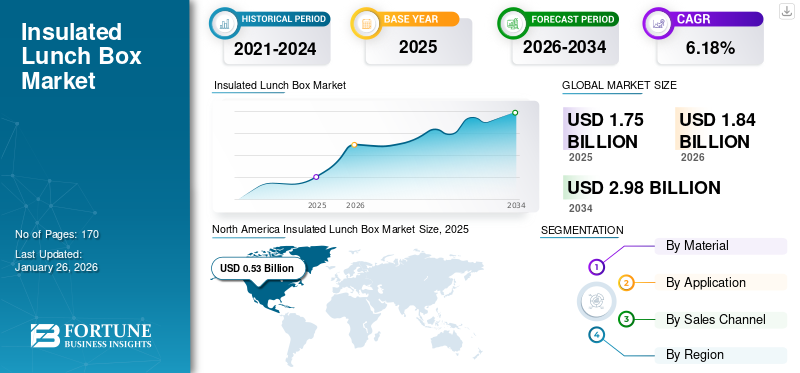
The global insulated lunch box market size was valued at USD 1.75 billion in 2025. The market is projected to grow from USD 1.84 billion in 2026 to USD 2.98 billion by 2034, exhibiting a CAGR of 6.18% during the forecast period. North America dominated the insulated lunch box market with a market share of 30.12% in 2025.
Insulated food containers are designed to keep food and beverages at a desired temperature, either hot or cold, for an extended period. It typically features layers of thermal insulation, such as foam or reflective materials, and may have airtight seals to maintain freshness and temperature. The key market players in the thermal lunch box market are focusing on investing in more durable materials instead of plastic material, which has led to several new product launches.
The market is experiencing steady growth, driven by increasing demand for convenient, eco-friendly food storage solutions. Growing health awareness and the rise in packed meal culture, particularly among working professionals and students, are significantly boosting the market growth. Consumers prefer heat-retaining lunch boxes for their ability to maintain food temperature and freshness, making them ideal for outdoor activities and office use. Advancements in materials, such as stainless steel, BPA-free plastics, and innovative designs have enhanced product appeal. Asia Pacific leads the market due to a large working-class population, while North America and Europe are witnessing rising adoption of premium products. Sustainability trends are shaping the market, with brands focusing on reusable and biodegradable alternatives.
Download Free sample to learn more about this report.
Insulated Lunch Box Market Key Takeaways
 Global Market Size & Forecast
- 2025 Market Size: USD 1.75 Billion
- 2026 Market Size: USD 1.84 Billion
- 2034 Forecast Market Size: USD 2.98 Billion
- CAGR: 6.18% from 2026–2034
 Market Share
- North America dominated the market with a 30.12% share in 2025.
- The Plastic segment is projected to account for 44.02% of the market in 2026.
- The School segment is projected to lead with a 46.74% share in 2026.
 Key Regional Highlights
North America
The market was valued at USD 0.53 billion in 2025 and is projected to reach USD 0.57 billion in 2026.
Asia Pacific
The market was valued at USD 0.59 billion in 2025 and is projected to reach USD 0.62 billion in 2026.
Europe
The market was valued at USD 0.49 billion in 2025 and is projected to reach USD 0.51 billion in 2026.
U.S.
The market is projected to reach USD 0.47 billion by 2026.
Japan
The market is projected to reach USD 0.06 billion by 2026.
Read More

Insulated Lunch Box Market Trends
Growing Demand for Sustainable and Eco-Friendly Lunch Boxes
The market is witnessing a significant shift toward sustainability, driven by increasing consumer awareness about environmental impact. Eco-friendly insulated food container made from biodegradable, reusable, or recyclable materials are gaining popularity. Brands are integrating innovative designs with sustainable practices, such as using bamboo, stainless steel, or food-grade silicone, to cater to environmentally conscious customers. This trend aligns with the broader push for reduced single-use plastics and waste. Moreover, governments and organizations promoting eco-friendly alternatives have amplified demand, making sustainability a key factor influencing purchasing decisions in the lunch box market.
- North America witnessed insulated lunch box market growth from USD 540.79 million in 2023 to USD 563.25 million in 2024.
Download Free sample to learn more about this report.
MARKET DYNAMICS
Market Drivers
Rising Demand for On-the-Go Meals to Boost Market Growth
The increasing pace of urbanization and busy lifestyles has led to a growing preference for carrying home-cooked meals or pre-cooked meals to schools, workplaces, and outdoor activities. Heat-retaining lunch boxes cater to the need for keeping food fresh, warm, or cold for extended periods, making them an essential accessory for consumers. This trend is especially strong among health-conscious individuals who prefer homemade meals over fast food, driving market growth. More people want to lead healthier lifestyles, and they are paying closer attention to what they are consuming. In 2023, Yeti Coolers, LLC, a designer and manufacturer of insulated coolers and lunch boxes, released a back-to-school collection for students of all ages. These newly launched thermal lunch boxes keep sandwiches and snacks cold for hours. This, in turn, has led to a rise in demand for convenient and healthy meal options that can be easily carried around.
Increasing Adoption of Eco-Friendly and Durable Products to Favor Market Expansion
As environmental concerns grow, consumers are seeking sustainable alternatives to single-use plastic containers. Thermal lunch boxes, often made from stainless steel or BPA-free materials, are perceived as eco-friendly and long-lasting. Innovations in design and materials, along with government regulations encouraging the reduction of plastic waste, are fueling the demand for these products. For instance, in 2020, the U.S. Food and Drug Administration (FDA) issued a new regulation for food storage containers, including lunch boxes. This new regulation mandated that all food storage containers be made of materials that are safe for contact with food and that do not leach chemicals into food.
Market Restraints
High Competition from Low-Cost Alternatives to Restrict Market Growth
One major restraint hampering the insulated lunch box market growth is the intense competition from low-cost substitutes. Traditional lunch boxes, made from inexpensive materials, such as plastic or metal, dominate the market due to their affordability and widespread availability. These non-insulated options appeal to cost-sensitive consumers, particularly in developing economies, limiting the adoption of more expensive insulated versions. Additionally, counterfeit products and low-quality replicas often flood the market, further challenging premium thermal lunch box manufacturers. This price-driven competition reduces profit margins and inhibits market expansion, especially in price-conscious segments.
Impact of COVID-19
The COVID-19 pandemic severely impacted the insulated lunch box industry as the product falls under non-essential home utility products. With fewer people commuting to offices and students attending in-person classes, the demand for lunch boxes significantly declined. Additionally, the shift to home cooking and reduced outdoor activities decreased the need for portable food storage solutions. Disruptions in global supply chains, including raw material shortages and logistic challenges, further hindered production and distribution. Consumer spending also shifted toward essential items, deprioritizing non-essential purchases, such as insulated food container. These factors collectively hampered market growth during the pandemic.
SEGMENTATION ANALYSIS
By Material
Durability and Rigidity of Steel Is Contributing to Its Highest Market Share
The market is segregated into steel, plastic, glass, and others, based on material.
The steel material segment accounted for the majority of the global insulated lunch box market share, at 45.65% in 2024, and is expected to continue its prominent position during the forecast period. Steel's long shelf life, extended durability, and easy-to-clean features fueled the segment’s growth. The steel material is also non-reactive and corrosion-resistant, allowing it to be easily cleaned with water and soap. Moreover, the material retains its finish over several years, curbing replacement costs associated with less durable materials, making steel the primary choice of customers.
On the other hand, the plastic material segment is anticipated to attain 44.02% of the market share in 2026, and forecasted to grow at a considerable CAGR from 2025 to 2032. Plastic-insulated food container is easy to carry and lightweight compared to steel and glass, and they are affordable and multifold usable. Known for their excellent thermal retention and lightweight properties, advanced plastics, such as expanded polypropylene (EPP), are being used in lunch boxes to maintain food temperatures for longer durations, thus contributing to the growth of the segment.
To know how our report can help streamline your business, Speak to Analyst
By Application
High Demand for Insulated Lunch Boxes for Children is Leading the Growth of School Segment
The market is segmented by application into school, workplace, and others.
The school segment dominated the application, contributing the highest market. Heat-retaining lunch boxes are essential for school-going children as they keep food fresh and safe throughout the day. Not only do they maintain the right temperature, but they also preserve the quality of hot or cold meals. This helps prevent food spoilage and ensures children consume healthy, nutritious meals instead of unhealthy alternatives. The segment is expected to capture 46.74% of the market share in 2026.
The workplace application held the second-largest share of the market in 2024. The segment's growth is likely to be supplemented by the rising number of working professionals and their need for convenient and healthy food solutions. By effectively preserving heat or cold, thermal lunch boxes cater to diverse meal preferences, enhancing consumer satisfaction and thereby increasing segmental share. The segment is likely to attain a CAGR of 6.35% during the forecast period.
By Sales Channel
E-commerce Stores to Grow at the Fastest CAGR on Account of Rising Consumer Dependency on the Platform
The market is segmented by sales channel into retail stores and e-commerce stores.
The e-commerce stores segment is expected to grow exponentially, with the fastest compound annual growth rate (CAGR) of 6.4% during the forecast period. The growing number of smartphone users and the convenience offered by online platforms fuels the segment’s growth. Additionally, the rising popularity of subscription-based meal delivery services and the increasing number of people opting for such services are prompting consumers to shop online for thermal lunch boxes, supplementing market growth.
The retail store sales channel is likely to account for 67.39% share of the market in 2026 due to higher sales from brick-and-mortar stores such as convenience stores, supermarkets and hypermarkets, and specialty stores, among others. The wide range of product availability and the ability to examine the products' features and quality to boost retail store segment’s growth.
Insulated Lunch Box Market Regional Outlook
Geographically, the market is divided into North America, South America, Europe, Asia Pacific, and the Middle East & Africa.
North America
North America Insulated Lunch Box Market Size, 2025 (USD Billion)
To get more information on the regional analysis of this market, Download Free sample
North America recorded a market size of USD 0.53 billion in 2025, capturing 30.12% of the global market share, and is projected to reach USD 0.57 billion in 2026 owing to the region's increasing working population and changing food habits. The region is anticipated to account for the second-highest market size of USD 0.53 billion in 2025, exhibiting the second-fastest growing CAGR of 6.67% during the forecast period. Growing health consciousness among consumers has led to an increased preference for home-packed meals. A rise in urbanization, busy work schedules, and a growing demand for convenient meal solutions are driving the need for insulated food containers in North America.
The demand for heat-retaining lunch boxes in the U.S. market has been growing considerably as consumers are increasingly shifting toward reusable and sustainable products. These lunch boxes are often made from durable and eco-friendly materials, appealing to environmentally conscious buyers looking to reduce single-use plastic waste. The U.S. market is projected to reach USD 0.47 billion by 2026.
Asia Pacific
The Asia Pacific market generated USD 0.59 billion in 2025, representing 33.52% of the global market landscape, and is expected to reach USD 0.62 billion in 2026. Home-cooked meals are still preferred by the majority of students and working professionals since they help to save money and avoid junk food, which can be injurious to health. This primarily drives the regional market growth. The growth in disposable income across emerging economies in the region has enabled consumers to invest in quality lifestyle products, including insulated food container that offer better functionality and usability. The Japan market is projected to reach USD 0.06324 billion by 2026, and the India market is projected to reach USD 0.15 billion by 2026.
Europe
In 2025, Europe represented USD 0.49 billion, accounting for 27.89% of the worldwide market, and is projected to grow to USD 0.51 billion in 2026. Europe is expected to grow considerably behind North America in the coming years. The region is set to be the third-largest market with a value of USD 0.49 billion in 2025. The regional market growth over the projected years is likely to be driven by manufacturers' advancements in features, such as leak-proof designs, lightweight materials, and vacuum-insulated technology. These innovations enhance the functionality and attractiveness of thermal lunch boxes, boosting consumer interest. The UK market is projected to reach USD 0.06892 billion by 2026, while the Germany market is projected to reach USD 0.09326 billion by 2026.
South America and Middle East & Africa
Middle East & Africa accounted for USD 0.06 billion in 2025, representing 3.24% of the global market share, and is projected to reach USD 0.06 billion in 2026. A strong cultural emphasis on consuming freshly prepared, home-cooked food in different parts of the world has been driving demand for heat-retaining lunch boxes that keep meals warm and fresh during long hours. In 2025, the South America market stood at USD 0.09 billion, representing 5.23% of global demand, and is projected to grow to USD 0.09 billion in 2026. Moreover, the increasing penetration of e-commerce platforms has made thermal lunch boxes more accessible to a wider audience globally. Competitive pricing, discounts, and convenience offered by online shopping channels have significantly contributed to market growth globally. The UAE market size is estimated to be USD 0.01 billion in 2025.
Competitive Landscape
Key Industry Players
Innovations in Design and Sustainability Drive the Competition among Market Players
The insulated lunch box market is competitive, driven by increasing consumer demand for portable and temperature-retaining food storage solutions. Key players, such as Thermos LLC, Yeti, and Zojirushi, dominate the premium segment, offering durable, high-performance products targeted at professionals and outdoor enthusiasts. Mid-range brands, such as Bentgo and Packlt, cater to families and students with affordable and stylish options. Emerging brands focus on eco-friendly materials, such as stainless steel or BPA-free plastics, appealing to environmentally conscious buyers.
E-commerce platforms, including Amazon, play a significant role in market distribution, offering consumers access to a wide range of brands. Customization, such as designs for children or corporate branding, adds differentiation. However, price sensitivity, coupled with the availability of low-cost imports, intensifies competition. Growth opportunities exist in targeting niche markets, such as health-conscious consumers seeking portion control features or parents desiring leak-proof, easy-to-clean designs for children.
LIST OF KEY INSULATED LUNCH BOX COMPANIES PROFILED
- TIGER CORPORATION (Japan)
- Zojirushi America Corporation (U.S.)
- Bentology (U.S.)
- Vaya Life (India)
- My Borosil (India)
- Hamilton Housewares Pvt. Ltd. (India)
- Signoraware (India)
- Tupperware (India)
- Thermos LLC (U.S.)
- LunchBots (U.S.)
Key Industry Developments
- October 2024: Borosil planned to invest USD 29.45 million in expansion and capacity augmentation to meet the demand, and the company planned to invest approximately USD 17.67 million in a new plant in Gujrat for Borosil Ltd.
- December 2020: Vaya Life, an India-based manufacturer of kitchen utilities, launched Tyffyn Flex, a range of microwaveable vacuum-insulated lunchboxes. Tyffyn Flex is available in 3 convenient sizes: the 1200 ml with four containers perfect for an indulgent meal, the 1000 ml with three containers great for a weekday work lunch, and the 600 ml with two containers perfect for a compact meal.
Investment Analysis and Opportunities
Partnerships and Collaboration with Schools, Fitness Centers, and Corporate Wellness Programs to Fuel Market Expansion
The insulated lunch box market is poised for significant growth, driven by rising consumer awareness about healthy eating, urbanization, and demand for sustainable solutions. Increasing adoption among professionals, students, and outdoor enthusiasts highlights its versatile appeal. The market benefits from trends such as eco-friendly materials, portability, and innovation in thermal retention technology. Asia Pacific dominates growth, fueled by expanding middle-class populations and rising disposable incomes. E-commerce platforms provide a lucrative sales channel, enhancing accessibility. Investment opportunities include developing premium, multifunctional designs and smart lunch boxes integrated with IoT features. Partnerships with schools, fitness centers, and corporate wellness programs can boost market penetration. As sustainability becomes a priority, producing biodegradable or recyclable lunch boxes offers an edge, attracting environmentally-conscious consumers.
REPORT COVERAGE
The market research report provides a detailed analysis of the market and focuses on key aspects such as the competitive landscape, services, and leading product types. It also offers global market trends and insights and highlights key industry developments. In addition to the factors mentioned above, the report on the global insulated lunch box market outlook has several factors that have contributed to the market growth in recent years.
Request for Customization to gain extensive market insights.
Report Scope & Segmentation
|
ATTRIBUTE |
DETAILS |
|
Study Period |
2021-2034 |
|
Base Year |
2025 |
|
Estimated Year |
2026 |
|
Forecast Period |
2026-2034 |
|
Historical Period |
2021-2024 |
|
Growth Rate |
CAGR of 6.18% from 2026 to 2034 |
|
Unit |
Value (USD Million) |
|
Segmentation
|
By Material
|
|
By Application
|
|
|
By Sales Channel
|
|
|
By Region
|
Frequently Asked Questions
According to Fortune Business Insights, the worldwide market size was USD 1.75 billion in 2025 and is anticipated to reach USD 2.98 billion by 2034.
The market will grow at a CAGR of 6.18% and exhibit a steady growth rate during the forecast period.
In 2025, the Asia Pacific market stood at USD 0.59 billion.
By material, the steel segment dominated the market.
The growing urbanization and rising demand for on-the-go meals, especially among health-conscious consumers, are primary factors driving market growth.
Thermos LLC, Yeti, Zojirushi, My Borosil, and Tupperware are a few significant players operating in the global market.
Asia Pacific held the highest market share in 2025.
Growing demand for sustainable and eco-friendly lunch boxes is likely to drive product adoption in the near future.



- 2021-2034
- 2025
- 2021-2024
- 170
-
(Offer valid till 15th Oct 2026)
Get 30-60 hrs Free Customization
Expand Regional and Country Coverage, Segments Analysis, Company Profiles, Competitive Benchmarking, and End-user Insights.









Related Reports
-
US +1 833 909 2966 ( Toll Free )
-
Get In Touch With Us