IoT Analytics Market Size, Share & Industry Analysis By Component (Solution and Services), By Deployment (On-premises and Cloud), By Analytics Type (Descriptive Analytics, Diagnostic Analytics, Predictive Analytics, and Prescriptive Analytics), By Enterprise Type (Large Enterprises and SMEs), By Application (Predictive Maintenance, Energy Management, Asset Management, Inventory Management, and Others), By Industry (Manufacturing, IT & Telecom, Energy & Utilities, Retail & E-commerce, Healthcare, and Others), and Regional Forecast, 2026-2034
 Download Free Sample
IoT Analytics Market Size
 Listen to Audio Version
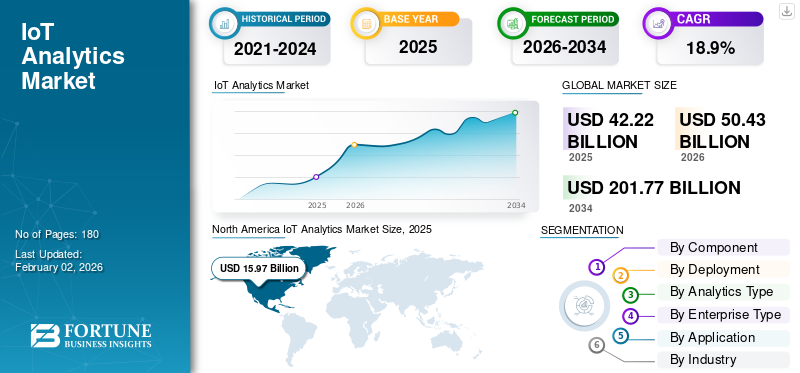
The global IoT analytics market size was valued at USD 42.22 billion in 2025 and is projected to grow from USD 50.43 billion in 2026 to USD 201.77 billion by 2034, exhibiting a CAGR of 18.9% during the forecast period. North America dominated the IoT analytics market, accounting for 38.52% of the market share in 2025. The industry growth is driven by connected device proliferation, real-time data processing demand, and enterprise digital transformation initiatives across industries.
IoT analytics refers to the use of advanced data analytics, AI, and machine learning technologies to develop actionable insights from the large volumes of data generated by Internet of Things (IoT) devices, such as cameras, sensors, wearables, machines, vehicles, and industrial equipment. The integration of AI and ML algorithms into IoT data streams enhances the accuracy of anomaly detection and forecasting, which plays a crucial role in driving market growth.
Government and smart infrastructure initiatives are accelerating the adoption of IoT analytics by embedding data-driven systems into national digital transformation agendas. Large-scale programs, such as intelligent transportation networks, smart city projects, and utility modernization initiatives, require real-time monitoring and predictive analytics to enhance energy efficiency, optimize traffic flow, and improve public safety. This factor is further driving market growth worldwide.
The IoT analytics market is transitioning from experimental deployments toward mission-critical enterprise infrastructure. Organizations increasingly treat IoT-generated data as a strategic asset, requiring advanced analytics capabilities to extract operational and financial value. This shift is accelerating investment across industries, particularly in manufacturing, energy, and telecommunications.
The IoT analytics market size is expanding in line with the rapid proliferation of connected devices and sensor networks. Enterprises are deploying IoT solutions not only to monitor assets but also to enable predictive and prescriptive decision-making. As a result, analytics platforms are evolving from basic visualization tools into integrated intelligence systems capable of real-time processing and automated action.
The IoT analytics market growth is strongly linked to enterprise digital transformation initiatives. Organizations are prioritizing operational efficiency, cost optimization, and asset utilization, all of which depend on actionable insights derived from IoT data. This trend is particularly visible in predictive maintenance and energy management applications.
At the same time, the market remains fragmented, with a diverse mix of platform providers, cloud vendors, and specialized analytics firms. Competitive positioning depends on scalability, interoperability, and the ability to deliver industry-specific solutions. While growth prospects remain strong, decision-makers must navigate challenges related to data security, integration complexity, and return on investment. These factors influence adoption timelines and vendor selection processes.
The market is dominated by established key players, such as Microsoft Corporation, Amazon Web Services, Inc., Google LLC, IBM Corporation, and Oracle Corporation. These players are integrating IoT device management, data analytics, and AI capabilities into unified platforms to offer end-to-end, interoperable solutions. This ecosystem-driven approach streamlines deployment, lowers integration costs, and enhances customer retention through seamless scalability and cross-service compatibility.
Download Free sample to learn more about this report.
IoT Analytics MARKET KEY TAKEAWAYS
 Market Size & Forecast
- 2025 Market Size: USD 42.22 Billion
- 2026 Market Size: USD 50.43 Billion
- 2034 Forecast Market Size: USD 201.77 Billion
- CAGR: 18.9% from 2026–2034
 Market Share
- North America dominated the IoT analytics market with a 38.52% share in 2025.
- The cloud segment is projected to account for 69.89% of the market in 2026.
- The descriptive analytics segment is expected to hold a 44.61% market share in 2026.
 Key Regional Highlights
North American
North America led the market and is projected to reach USD 18.70 billion in 2026.
Europe
Europe is projected to reach USD 10.94 billion in 2026, supported by industrial digitalization initiatives.
Asia Pacific
In 2025, Asia Pacific held 27.00% of the global market, reaching a valuation of USD 11.4 billion, and is projected to grow to USD 14.1 billion in 2026.
U.S.
The market is projected to reach USD 13.27 billion in 2026.
Japan
The market is projected to reach USD 2.75 billion in 2026.
Read More

IMPACT OF GENERATIVE AI
Emergence of Generative AI Enhances Efficiency and Innovation Across IoT Analytics Ecosystems
Generative AI is transforming the market by allowing automated data interpretation, model generation, and natural-language querying of complex sensor datasets. It fuels the development of predictive and prescriptive models, allowing enterprises to rapidly simulate scenarios and enhance asset performance using digital twins. GenAI-powered assistants simplify analytics workflows by translating human prompts into queries, dashboards, and anomaly reports, democratizing access to insights. Additionally, it improves edge intelligence by generating adaptive models that continuously learn from real-time IoT data streams. Overall, Generative AI is shifting Internet of Things analytics from traditional monitoring to autonomous decision-making and self-optimizing systems, significantly improving efficiency and innovation speed. For instance,
- In October 2024, Honeywell partnered with Google to integrate Google’s Gemini generative AI into Honeywell’s Forge industrial data platform, aiming to enable autonomous operations and smart maintenance workflows.
IoT Analytics Market Trends
Rise in Popularity of Sustainability Analytics is Fueling Market Growth
The growing adoption of sustainability analytics is transforming how businesses use IoT data to achieve energy efficiency and carbon reduction targets. IoT sensors embedded in buildings, factories, and utilities continuously collect data on energy consumption, emissions, and equipment performance. This real-time data is analyzed through analytics platforms to identify inefficiencies, optimize resource usage, and support ESG reporting. Governments and corporations are increasingly mandating carbon transparency, driving demand for analytics-driven sustainability dashboards. For instance,
- July 2025, Bivocom launched an IoT-driven energy management solution for smart buildings, industrial automation, and hybrid energy systems to help clients minimize waste and emissions.
The IoT analytics market is increasingly shaped by the convergence of edge computing, artificial intelligence, and real-time data processing. Enterprises are shifting from centralized analytics models toward distributed architectures, enabling faster decision-making at the point of data generation. This transition is particularly relevant in latency-sensitive applications such as industrial automation and smart infrastructure.
One of the most prominent IoT analytics market trends is the integration of AI-driven analytics capabilities. Machine learning models are embedded within IoT platforms to enable predictive insights and automated responses. This reduces reliance on manual analysis and enhances operational efficiency. Another notable trend is the rise of digital twins. Organizations are creating virtual replicas of physical assets to monitor performance and simulate operational scenarios. This capability enhances decision-making and reduces operational risk.
Cloud-native analytics platforms are also gaining traction. These platforms offer scalability and flexibility, enabling enterprises to manage large volumes of IoT data efficiently. However, hybrid models combining cloud and on-premises deployments remain common. These IoT analytics market trends indicate a shift toward intelligent, automated, and distributed analytics ecosystems, driven by the need for real-time insights and operational optimization.
Download Free sample to learn more about this report.
Key Market Dynamics
Market Drivers
Growing Emphasis on Digital Transformation and Industry 4.0 is Driving Market Growth
The growing emphasis on digital transformation and Industry 4.0 is a major driving factor for propelling IoT analytics market growth as organizations increasingly integrate connected sensors, automation, and AI into their operations. Industrial enterprises are leveraging the Internet of Things analytics to enhance production efficiency, monitor equipment health, and reduce downtime through predictive insights. Smart factories and connected supply chains are primarily dependent on analytics to manage complex data flows and ensure real-time decision-making.
Moreover, governments and enterprises globally are investing in digital infrastructure and industrial automation initiatives, further accelerating adoption. This shift toward data-driven, intelligent manufacturing ecosystems is strengthening Internet of Things analytics as a core enabler of next-generation industrial competitiveness. For instance,
- January 2025, Digi International launched Digi X-ON, an edge-to-cloud IoT solution designed to boost digital transformation by unifying device connectivity, analytics, and orchestration.
The IoT analytics market growth is driven by increasing adoption of connected devices and the need to derive actionable insights from large-scale data streams. Enterprises are investing in analytics platforms to improve operational efficiency, reduce costs, and enhance decision-making capabilities.
One of the primary growth drivers is industrial digitalization. Manufacturing and energy sectors are deploying IoT analytics to monitor equipment performance and optimize processes. Predictive maintenance, in particular, reduces downtime and extends asset lifecycles. The telecommunications sector also contributes significantly to market expansion. The rollout of 5G networks increases the volume and velocity of IoT data, necessitating advanced analytics capabilities.
Another critical factor is cost optimization. Organizations are leveraging IoT analytics to identify inefficiencies and improve resource utilization. This capability is particularly valuable in energy management and supply chain operations. Additionally, regulatory requirements related to safety, energy efficiency, and environmental impact are encouraging the adoption of analytics solutions. These regulations often require real-time monitoring and reporting, which IoT analytics platforms can provide.
Market Restraints
Data Privacy and Security Concerns Across Diverse IoT Ecosystems May Hinder Market Growth
Data privacy and security concerns pose a significant restraint to the market as billions of connected devices continuously transmit sensitive operational and personal data. Breaches or unauthorized access to this data can lead to severe financial and reputational risks for organizations, especially in critical sectors such as healthcare, utilities, and manufacturing. The absence of unified global security standards and inconsistent data governance policies across regions further complicates secure IoT analytics deployments. This factor is expected to restrict the market growth in the coming years.
Despite strong growth potential, the IoT analytics market faces several constraints that impact adoption and scalability. Data security and privacy concerns remain a primary challenge. IoT ecosystems generate large volumes of sensitive data, increasing the risk of cyber threats and unauthorized access.
Integration complexity is another significant barrier. Organizations often operate legacy systems that are not easily compatible with modern IoT analytics platforms. Integrating diverse data sources and ensuring interoperability requires substantial investment and technical expertise. Skill shortages further constrain market growth. Implementing and managing IoT analytics solutions requires specialized expertise in data science, machine learning, and system integration.
Scalability challenges also affect adoption. As the number of connected devices increases, managing data volume and processing requirements becomes more complex. Organizations must invest in infrastructure capable of handling these demands. Additionally, return on investment (ROI) uncertainty influences decision-making. While IoT analytics offers clear benefits, quantifying these benefits can be challenging, particularly in early deployment stages.
Market Opportunities
Rapid Adoption of Edge Computing and 5G Connectivity Creates Lucrative Opportunity for Market Growth
The growing adoption of edge computing and 5G connectivity is enabling faster, real-time data processing closer to the source, which fuels the market growth. Edge analytics reduces latency, minimizes bandwidth usage, and allows instant decision-making in mission-critical applications such as autonomous vehicles, industrial automation, and smart healthcare.
Moreover, 5G networks provide the high-speed, low-latency connectivity required to support massive IoT deployments and continuous data streams. Together, these technologies enhance the scalability and responsiveness of IoT analytics tools, unlocking new use cases across industries. For instance,
- In October 2025, Cavli Wireless launched its new ultra-low latency 5G NR IoT modules CQM212 & CQM215. These modules are built for targeting high-throughput industrial and IoT use cases powered by 5G analytics.
The IoT analytics market presents significant opportunities driven by evolving enterprise requirements and technological advancements. One of the most promising opportunities lies in the expansion of edge analytics. Processing data closer to the source reduces latency and enables real-time decision-making, particularly in industrial and mission-critical applications.
Another key opportunity is the integration of IoT analytics with artificial intelligence. Advanced analytics platforms can deliver predictive and prescriptive insights, enabling organizations to optimize operations and improve outcomes. Smart cities represent a significant growth area. IoT analytics is used to manage traffic, energy consumption, and public infrastructure, improving efficiency and sustainability. Governments are increasingly investing in such initiatives.
Healthcare applications also offer opportunities. IoT analytics enables remote patient monitoring, predictive diagnostics, and improved healthcare delivery. These capabilities are particularly valuable in resource-constrained environments. Additionally, advancements in digital twin technology create new possibilities for simulation and optimization. Organizations can model complex systems and predict outcomes, enhancing strategic planning.
SEGMENTATION ANALYSIS
By Component
Growing Adoption of Integrated IoT Platforms Drives Dominance of Solution Segment
Based on the component, the market is bifurcated into solutions and services.
Solutions
Solution captured the largest market share in 2024, estimated at USD 23.77 billion for 2024. The Solution segment is projected to dominate the market with a share of 65.02% in 2026. This is due to enterprises increasingly adopting integrated IoT analytics platforms combining data management, visualization, and AI-driven insights. The growing demand for scalable, cloud-based analytics solutions from sectors including manufacturing, energy, and logistics further strengthened this segment’s dominance.
Solutions represent the dominant segment within the IoT analytics market share, encompassing platforms that enable data ingestion, processing, visualization, and advanced analytics. These platforms are designed to handle large-scale IoT data streams and integrate with enterprise systems.
Enterprise buyers prioritize solutions that offer flexibility and customization. Industry-specific solutions are gaining traction, particularly in manufacturing and energy sectors, where operational requirements are highly specialized. Solution providers are increasingly embedding advanced analytics capabilities, including predictive and prescriptive models. This enhances the value proposition by enabling proactive decision-making rather than reactive analysis.
Services
Services are anticipated to grow at the highest CAGR of 23.4% during the forecast period, owing to rising demand for system integration, managed analytics, and consulting support to customize and optimize Internet of Things analytics deployments.
Services play a critical role in enabling successful IoT analytics deployment. This segment includes consulting, implementation, integration, and managed services. Services are particularly important for organizations transitioning from pilot projects to large-scale deployments. Managed services models are gaining traction, allowing enterprises to outsource analytics operations while focusing on core business functions. As the IoT analytics market matures, services will remain essential in addressing skill gaps and ensuring effective utilization of analytics platforms.
By Deployment
Rising Enterprise Preference for Cloud-Based Analytics Boosts Segment Growth
Based on deployment, the market is categorized into on-premises and cloud.
Cloud
Cloud captured the largest market share and accounted for USD 24.17 billion in 2024. Also, it is expected to grow at the highest CAGR of 21.8% during the forecast period. The Cloud segment dominated the market accounting for 69.89% market share in 2026. This is owing to its scalability, flexibility, and cost-efficiency in handling massive IoT data volumes. Also, the growing preference for cloud-based analytics by enterprises enabled seamless integration of AI, ML, and edge systems for real-time insights and remote monitoring.
Cloud deployment represents the fastest-growing segment within the IoT analytics market. Cloud-based platforms offer scalability, flexibility, and cost efficiency, making them attractive for a wide range of applications. Cloud platforms also enable advanced analytics capabilities through integration with artificial intelligence and machine learning services. Hybrid deployment models are increasingly common, combining cloud scalability with on-premises control.
On-Premises
On-premises is expected to grow at a moderate CAGR during the forecast period. This is due to continued adoption in highly regulated industries that prioritize data security, control, and compliance over scalability. On-premises deployment remains relevant in industries with stringent data security and regulatory requirements. Organizations in sectors such as healthcare, defense, and critical infrastructure often prefer to retain control over data and analytics processes. However, on-premises solutions require significant upfront investment and ongoing maintenance. This limits adoption among smaller organizations.
By Analytics Type
Ease of Implementation and Broad Applicability Propel Descriptive Analytics Growth
Based on analytics type, the market is divided into descriptive analytics, diagnostic analytics, predictive analytics, and prescriptive analytics.
Descriptive Analytics
Descriptive analytics captured the largest market share in 2024, estimated at USD 16.22 billion for 2024. The Descriptive Analytics segment will account for 44.61% market share in 2026. This is due to it serving as the foundational layer for IoT data visualization, monitoring, and reporting across industries. Furthermore, its ease of implementation and critical role in converting raw sensor data into operational insights make it the most widely adopted analytics type.
Descriptive analytics forms the foundation of IoT analytics, providing insights into historical and real-time data. This segment is widely adopted across industries for monitoring and reporting purposes.
Diagnostic Analytics
Diagnostic analytics goes beyond descriptive insights by identifying the root causes of observed events. This capability is critical in industrial applications where understanding system failures is essential.
Predictive Analytics
Predictive analytics is a major growth driver within the IoT analytics market. By leveraging historical data and machine learning models, organizations can forecast future outcomes and optimize operations. Applications include predictive maintenance, demand forecasting, and risk management. This segment is particularly valuable in asset-intensive industries.
Prescriptive Analytics
Prescriptive analytics is expected to grow at the highest CAGR during the forecast period. This is due to enterprises increasingly adopting AI-driven decision automation and digital twin technologies to enable real-time optimization and autonomous operations. Prescriptive analytics represents the most advanced stage of analytics maturity. It provides actionable recommendations and automated decision-making capabilities. This segment is gaining traction as organizations seek to move toward autonomous operations. However, implementation complexity remains a challenge.
To know how our report can help streamline your business, Speak to Analyst
By Enterprise Type
Strong IT Infrastructure and Capital Investments Strengthen Large Enterprise Dominance
Based on enterprise type, the market is bifurcated into large enterprises and SMEs.
Large Enterprises
Large enterprises captured the largest market share and accounted for USD 21.54 billion in 2024, owing to their substantial budgets, advanced IT infrastructure, and early adoption of IoT analytics for large-scale digital transformation. Their focus on operational efficiency, predictive maintenance, and enterprise-wide data integration further reinforced their dominance in the market.
Large enterprises dominate the IoT analytics market due to their extensive resources and complex operational requirements. These organizations deploy large-scale IoT systems and require advanced analytics capabilities. Large enterprises are early adopters of advanced analytics technologies, including AI-driven and real-time analytics.
SMEs
SMEs are anticipated to grow at the highest CAGR of 22.4% during the forecast period, due to increasing adoption of affordable, cloud-based analytics solutions that allow data-driven decision-making without heavy infrastructure investment. Small and medium enterprises (SMEs) represent an emerging segment within the IoT analytics market. Adoption is driven by the availability of cloud-based and subscription models. While SMEs contribute a smaller share, their adoption is expected to increase steadily.
By Application
Rising Focus on Equipment Uptime Drives Predictive Maintenance Adoption
Based on application, the market is classified into predictive maintenance, energy management, asset management, inventory management, and others (remote monitoring, etc.).
Predictive Maintenance
Predictive maintenance captured the largest market share in 2024, estimated at USD 11.74 billion for 2024. Industries are increasingly leveraging IoT analytics to minimize equipment downtime and optimize asset performance. The ability to forecast failures, reduce maintenance costs, and extend machinery lifespan made it the most widely adopted application across manufacturing, energy, and transportation sectors.
Energy Management
Energy management applications focus on optimizing energy consumption and reducing costs. IoT analytics enables real-time monitoring and control of energy usage across facilities.
Asset Management
Asset management involves tracking and optimizing the performance of physical assets. IoT analytics provides visibility into asset conditions and usage patterns. Asset Management is projected to grow at the highest CAGR of 22.4% during the forecast period, due to increasing adoption of IoT-enabled tracking and analytics solutions that enhance asset visibility, utilization, and lifecycle optimization across industries.
Inventory Management
Inventory management applications use IoT analytics to track inventory levels and optimize supply chain operations. Real-time insights improve efficiency and reduce waste.
By Industry
Industry 4.0 Adoption Drives IoT Analytics Demand in Manufacturing
Based on industry, the market is categorized into BFSI, IT & telecom, manufacturing, retail & e-commerce, healthcare, and others (media & entertainment, etc.).
Manufacturing
Manufacturing is a leading segment within the IoT analytics market. Organizations use analytics to optimize production processes, improve quality, and reduce downtime. Manufacturing accounted for the largest market share of USD 9.96 billion in 2024, owing to the widespread adoption of IoT analytics for process optimization, quality control, and predictive maintenance. The rise of Industry 4.0 and smart factory initiatives further accelerated the deployment of analytics-driven production systems to enhance efficiency and reduce downtime.
IT & Telecommunication
This segment drives demand for analytics platforms capable of handling large-scale data flows. Network optimization and performance monitoring are key use cases.
Energy & Utilities
Energy companies use IoT analytics for grid management, resource optimization, and predictive maintenance of infrastructure.
Retail & E-commerce
Retailers leverage IoT analytics to enhance customer experience, optimize inventory, and improve supply chain efficiency.
Healthcare
Healthcare applications include patient monitoring, equipment management, and operational optimization. Data security and reliability are critical considerations. Healthcare is projected to grow at the highest CAGR of 23.2% during the forecast period, owing to increasing adoption of IoT-enabled medical devices and analytics platforms for remote patient monitoring, predictive diagnostics, and real-time health data management.
REGIONAL INSIGHTS
By geography, the market is categorized into North America, Europe, Asia Pacific, South America, and the Middle East & Africa.
North America IoT Analytics Market Analysis
North America accounted for USD 15.97 billion in 2025, representing 37.80% of the global market share, and is projected to reach USD 18.7 billion in 2026. The factors behind the regional growth include enterprises increasingly integrating AI-powered analytics into large-scale industrial and infrastructure operations, particularly in manufacturing, energy, and logistics. North America leads the IoT analytics market, supported by advanced digital infrastructure and strong enterprise adoption. Demand is driven by data centers, manufacturing, and smart infrastructure initiatives. Cloud adoption and AI integration accelerate analytics deployment. Regulatory focus on data governance influences solution design. The presence of major technology vendors strengthens innovation and market maturity, ensuring sustained leadership in the IoT analytics industry.
Additionally, major investments by hyperscalers, including AWS, Microsoft Azure, and Google Cloud, in localized data centers and AI-driven operational intelligence platforms further strengthened North America’s dominance. For instance,
- In April 2024, AWS invested USD 11 billion to build a new data center campus in Indiana, U.S. Through this investment, the company aims to strengthen its localized cloud infrastructure for AI and IoT workloads in the U.S.
North America IoT Analytics Market Size, 2025
To get more information on the regional analysis of this market, Download Free sample
United States IoT Analytics Market
In 2026, the U.S. market is estimated to reach USD 13.27 billion. The large-scale adoption of IoT analytics across manufacturing, logistics, and energy sectors is supported by strong digital infrastructure and an enterprise focus on predictive maintenance and automation. Additionally, government-backed initiatives promoting smart manufacturing and AI integration, along with significant investments from cloud hyperscalers and industrial IoT vendors, are accelerating the country’s leadership in Internet of Things analytics deployment.
The United States dominates regional demand, driven by hyperscale cloud providers, industrial automation, and advanced analytics adoption. Enterprises prioritize real-time insights and operational optimization. Investment in artificial intelligence and edge computing strengthens market expansion. Strong innovation ecosystems support rapid technology adoption. However, data privacy regulations and integration challenges require careful planning, influencing enterprise-level IoT analytics deployment strategies.
Europe IoT Analytics Market Analysis
The Europe market was valued at USD 9.31 billion in 2025, capturing 22.10% of global revenue, and is estimated to reach USD 10.94 billion in 2026. This is primarily due to strong regulatory support for industrial digitalization, sustainability, and energy efficiency, particularly under the European Union’s Digital Europe and Green Deal initiatives.
Europe demonstrates steady growth in the IoT analytics market, supported by industrial digitalization and smart city initiatives. Regulatory frameworks, including data protection standards, influence platform design and deployment. Manufacturing and energy sectors drive demand for analytics solutions. The region emphasizes sustainability and efficiency, encouraging the adoption of IoT analytics across infrastructure and industrial applications despite a moderate technology adoption pace.
Moreover, widespread adoption of Industrial IoT (IIoT) across manufacturing hubs in Germany, the U.K., and the Nordics, coupled with growing investments in edge AI and smart infrastructure, is driving demand for advanced analytics platforms across the region. Backed by these factors, countries including Germany’s market benefit from strong industrial automation and digital manufacturing. Enterprises deploy IoT analytics to improve efficiency and quality. Industry 4.0 programs and energy optimization initiatives drive continued adoption.
Germany IoT Analytics Market
Germany leads the European IoT analytics market, driven by its advanced manufacturing sector and Industry 4.0 initiatives. Enterprises deploy analytics to enhance operational efficiency and automation. Strong engineering capabilities support the integration of IoT systems. Government support for industrial digitization accelerates adoption. However, data security requirements and legacy system integration challenges influence implementation strategies within the IoT analytics industry. Germany is expected to record USD 2.02 billion in 2026, and France is expected to record USD 1.52 billion in 2025.
United Kingdom IoT Analytics Market
The United Kingdom IoT analytics market is characterized by strong adoption in financial services, retail, and telecommunications. Digital transformation initiatives and cloud adoption drive demand for analytics platforms. Enterprises focus on data-driven decision-making and operational efficiency. Government support for digital innovation strengthens market development. However, regulatory compliance and data privacy concerns remain key considerations for organizations deploying IoT analytics solutions. The U.K. is expected to record the valuation of USD 2.08 billion.
Asia-Pacific IoT Analytics Market Analysis
In 2025, Asia Pacific held 27.00% of the global market, reaching a valuation of USD 11.4 billion, and is projected to grow to USD 14.1 billion in 2026. The regional growth is fueled by rapid industrialization and large-scale smart city projects in countries such as China, Japan, India, and South Korea. Also, expanding manufacturing base, coupled with increasing investments in 5G, edge analytics, and AI-powered IoT platforms, is enabling enterprises to enhance operational efficiency and adopt predictive analytics at scale. The Japan market is valued at USD 2.75 billion by 2026, the China market is valued at USD 2.86 billion by 2026, and the India market is valued at USD 2.01 billion by 2026.
Asia-Pacific represents the fastest-growing IoT analytics market, driven by industrial expansion, urbanization, and increasing IoT deployments. Countries such as China, Japan, and South Korea lead adoption. Government initiatives supporting smart cities and digital infrastructure accelerate demand. Manufacturing and telecommunications sectors are key contributors. Rapid technology adoption and large-scale deployments position the region as a major growth engine.
Japan IoT Analytics Market
Japan demonstrates advanced adoption of IoT analytics, particularly in manufacturing and robotics. Enterprises leverage analytics to improve efficiency and support automation. Strong technological capabilities and innovation drive market development. Government initiatives promoting digital transformation enhance adoption. Aging infrastructure and workforce challenges further encourage the use of IoT analytics to optimize operations and improve productivity across industries.
China IoT Analytics Market
China represents a rapidly expanding IoT analytics market, driven by large-scale industrial and smart city initiatives. Government support for digital infrastructure and data-driven technologies accelerates adoption. Enterprises focus on operational efficiency and automation. Strong domestic technology ecosystem supports market growth. However, regulatory policies and data governance frameworks influence deployment strategies and vendor selection within the IoT analytics industry.
Latin America and South America IoT Analytics Market Analysis
The Latin America region captured 5.60% of the global market in 2025, generating USD 2.37 billion in revenue, and is projected to reach USD 2.85 billion in 2026. Latin America shows emerging potential in the IoT analytics market, driven by increasing digital adoption and industrial modernization. Key sectors include manufacturing, energy, and telecommunications. Adoption remains gradual due to infrastructure limitations and budget constraints. However, growing investment in cloud technologies and data analytics is expected to support steady market expansion over the medium term.
South America is expected to witness significant growth in this market. The South American market in 2025 is set to record USD 2.37 billion, driven by increasing adoption of IoT analytics in the energy, utilities, and manufacturing sectors, driven by regional digitalization efforts and rising demand for operational efficiency and asset monitoring.
Middle East & Africa IoT Analytics Market Analysis
Middle East & Africa contributed approximately USD 3.17 billion to the global market in 2025, accounting for 7.50% share, and is expected to reach USD 3.85 billion in 2026, owing to expanding smart city and infrastructure projects, particularly in the GCC countries, alongside increasing investments in industrial IoT and energy analytics to support economic diversification and sustainability goals. In the region, GCC is set to attain the value of USD 0.98 billion in 2025. For instance,
- October 2025, Moro Hub, a subsidiary of Dubai Electricity and Water Authority, signed an MoU with Univers to deploy AI + IoT for advanced energy management and sustainability solutions across industrial and commercial operations
The Middle East and Africa IoT analytics market is developing steadily, supported by smart city projects and infrastructure investments. Demand is concentrated in energy, utilities, and government sectors. Adoption is influenced by digital transformation initiatives. However, limited technical expertise and infrastructure challenges constrain rapid growth, requiring continued investment in technology ecosystems and skills development.
Competitive Landscape
Growing Focus of Key Market Players on Innovation and New Launches Leads to Their Dominating Market Positions
The global market is highly fragmented, with numerous players competing across different regions. Key companies include Microsoft Corporation, Amazon Web Services, Inc., Google LLC, IBM Corporation, Oracle Corporation, and other significant companies. These organizations focus on strategies such as new product launches, mergers and acquisitions, technological advancements, and investments in cloud-based analytics solutions to enhance their market presence.
The IoT analytics market is characterized by a fragmented yet increasingly consolidating competitive landscape. Global technology providers, cloud hyperscalers, and specialized analytics firms compete across platform capabilities, scalability, and industry-specific solutions. Competitive positioning depends less on standalone analytics tools and more on integrated ecosystems that combine connectivity, data processing, and advanced analytics.
Large technology vendors dominate the upper tier of the IoT analytics market share, leveraging cloud infrastructure, artificial intelligence capabilities, and extensive enterprise relationships. These players offer end-to-end platforms that integrate device management, data ingestion, and analytics within a unified environment. Their scale enables continuous innovation and global deployment.
Cloud providers are particularly influential, as they control critical infrastructure layers. Their platforms enable seamless scalability and integration, making them attractive for enterprise deployments. At the same time, traditional enterprise software vendors are enhancing their analytics capabilities through acquisitions and partnerships. Niche players focus on specialized analytics applications, such as predictive maintenance, asset monitoring, and industrial analytics. These firms differentiate through domain expertise and customization capabilities. While their market share is smaller, they play a critical role in addressing specific industry needs.
Partnership ecosystems are expanding. Vendors collaborate with hardware manufacturers, telecom operators, and system integrators to deliver comprehensive solutions. These partnerships reduce implementation complexity and accelerate adoption.
List of Top IoT Analytics Companies Studied:
- Microsoft Corporation (U.S.)
- Amazon Web Services, Inc. (U.S.)
- Google LLC (U.S.)
- IBM Corporation (U.S.)
- Oracle Corporation (U.S.)
- Cisco Systems, Inc. (U.S.)
- Siemens AG (Germany)
- Hitachi Ltd. (Japan)
- PTC Inc. (U.S.)
- Software AG (Germany)
- SAP SE (Germany)
- General Electric (U.S.)
- Teradata Corporation (U.S.)
- Schneider Electric SE (France)
- Bosch GmbH (Germany)
- SAS Institute Inc. (U.S.)
- Hewlett Packard Enterprise (U.S.)
- Intel Corporation (U.S.)
- Dell Inc. (U.S.)
- Open Text Corporation (Canada)
KEY INDUSTRY DEVELOPMENTS
- October 2025: Wiliot announced a collaboration with Walmart to deploy ambient IoT sensors across Walmart’s supply chain to feed AI/analytics systems for improved inventory and cold chain management.
- October 2025: AT&T and Ericsson launched a cloud-based IoT Marketplace to simplify IoT service provisioning, billing, and device management.
- June 2025: Siemens and NVIDIA expanded their partnership to integrate accelerated AI computing with Siemens’ Xcelerator platform, aiming to bolster industrial AI analytics capabilities across manufacturing.
- January 2025: Microsoft introduced advanced IoT analytics integrations within Azure, combining digital twins, machine learning automation, and real-time streaming analytics for enterprise deployments.
- January 2025: AWS plans to invest USD 11 billion in data center infrastructure in Georgia with the aim of supporting future AI, cloud, and IoT analytics capabilities.
- October 2024: IBM launched enhanced prescriptive analytics features for its IoT platform, leveraging AI optimization engines to improve asset and energy management outcomes.
- August 2024: Oracle announced a collaboration with AT&T to embed AT&T IoT connectivity and network APIs into its Enterprise Cloud Apps, facilitating near-real-time data collection from IoT devices via Oracle’s cloud infrastructure.
REPORT COVERAGE
The report provides a detailed analysis of the market and focuses on key aspects such as leading companies, product types, and leading applications of the product. Besides, the report offers insights into the market trends and highlights key industry developments. In addition to the factors above, the report encompasses several factors that contributed to the growth of the market in recent years.
Request for Customization to gain extensive market insights.
REPORT SCOPE & SEGMENTATION
|
ATTRIBUTE |
DETAILS |
|
Study Period |
2021-2034 |
|
Base Year |
2025 |
|
Forecast Period |
2026-2034 |
|
Historical Period |
2021-2024 |
|
Growth Rate |
CAGR of 18.9% from 2026 to 2034 |
|
Unit |
Value (USD Billion) |
|
Segmentation |
By Component
By Deployment
By Analytics Type
By Enterprise Type
By Application
By Industry
By Region
|
| Companies Profiled in the Report |
|
Frequently Asked Questions
The market is expected to reach USD 201.77 billion by 2034.
In 2025, the market was valued at USD 42.22 billion.
The market is expected to grow at a CAGR of 18.9% during the forecast period.
By application, predictive maintenance led the market.
Growing emphasis on digital transformation and industry 4.0 is driving the market growth.
Microsoft Corporation, Amazon Web Services, Inc., Google LLC, IBM Corporation, Oracle Corporation, Cisco Systems, Inc., Siemens AG, Hitachi Ltd., PTC Inc., Software AG are the top players in the market.
North America held the highest market share.
By healthcare, the healthcare segment is expected to grow with the highest CAGR during the forecast period.



- 2021-2034
- 2025
- 2021-2024
- 180
Get 30-60 hrs Free Customization
Expand Regional and Country Coverage, Segments Analysis, Company Profiles, Competitive Benchmarking, and End-user Insights.




















Related Reports
-
US +1 833 909 2966 ( Toll Free )
-
Get In Touch With Us