Kapok Fiber Market Size, Share & Industry Analysis, By Application (Textiles & Apparel, Home Furnishings, Automotive), By Product (Raw Kapok Fiber, Processed Kapok Fiber, Kapok Fiber Fillings), and Regional Forecast, 2026-2034
 Download Free Sample
Kapok Fiber Market Sizr & Overview
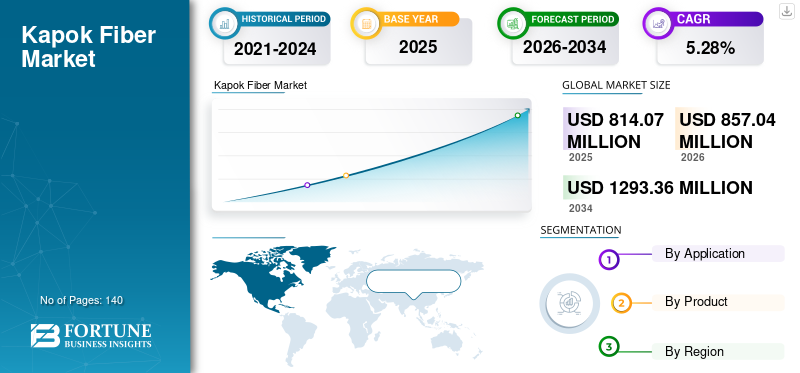
The global kapok fiber market size was valued at USD 814.07 billion in 2025. The market is projected to grow from USD 857.04 billion in 2026 to USD 1293.36 billion by 2034, exhibiting a CAGR of 5.28% during the forecast period.

The kapok fiber market is gaining strong attention across industrial and commercial sectors due to the growing preference for natural, biodegradable, and lightweight fibers. Kapok fiber, obtained from the seed pods of kapok trees, is valued for its hollow structure, buoyancy, thermal insulation, and moisture-resistant characteristics. Industries such as textiles, bedding, furniture, automotive interiors, and sustainable packaging increasingly utilize kapok fiber as an eco-friendly alternative to synthetic materials. The kapok fiber market report highlights rising demand from manufacturers seeking renewable raw materials that align with sustainability goals. kapok fiber market Analysis indicates expanding applications in premium cushioning products, insulation materials, and green manufacturing processes, supporting long-term industry development and broader adoption across multiple sectors.
The United States accounts for approximately 24% of the North American kapok fiber market demand. Growing consumer preference for sustainable bedding products, organic furniture fillings, and environmentally friendly textile materials has accelerated market penetration. American manufacturers increasingly incorporate kapok fiber into mattresses, pillows, cushions, and insulation products due to its lightweight and hypoallergenic properties. Demand from eco-conscious consumers, sustainable home furnishing brands, and green automotive component manufacturers continues to expand. The kapok fiber industry report identifies increasing imports of processed kapok fiber to support domestic production requirements. research institutions and product developers are also exploring advanced fiber blending technologies to improve durability and performance characteristics across commercial applications.
Download Free sample to learn more about this report.
Kapok Fiber Market Key Takeaways
 Global Market Size & Forecast
- 2025 Market Size: USD 814.07 Bill
- 2026 Market Size: USD 857.04 Billion
- 2034 Forecast Market Size: USD 1,293.36 Billion
- CAGR: 5.28% from 2026-2034
 Market Share
- Asia-Pacific dominated with a regional market share of 34% in 2025.
- Textiles and apparel led by application with approximately 41% market share.
- Processed kapok fiber led by product with approximately 39% market share.
 Key Regional Highlights
Asia-Pacific
Asia-Pacific held the largest regional share at 34% of the global market.
North America
North America accounted for 29% of the global market.
Europe
Europe represented 26% of the global market, supported by demand for sustainable natural fibers.
U.S
The U.S. remains a significant market, driven by growing adoption of sustainable fibers in textiles and home furnishings.
Japan
Japan accounted for 12% of the Asia-Pacific market, supported by demand for eco-friendly and natural fiber products.
Read More

kapok fiber market Latest Trends
The kapok fiber market trends demonstrate a significant shift toward environmentally responsible raw materials across manufacturing industries. One notable trend is the integration of kapok fiber into premium bedding and home furnishing products where consumers seek natural alternatives to polyester fillings. Manufacturers are increasingly blending kapok fiber with cotton, wool, and recycled fibers to enhance durability while maintaining softness and breathability. Another emerging trend involves the use of kapok fiber in automotive interiors. Vehicle manufacturers are evaluating bio-based materials to reduce environmental impact and support sustainability initiatives. Kapok fiber's lightweight structure contributes to weight reduction objectives while providing effective cushioning and insulation.
Download Free sample to learn more about this report.
The kapok fiber market research report also identifies growing demand for biodegradable packaging materials. Companies are investing in natural fiber-based protective packaging solutions to replace synthetic fillers. In addition, technological improvements in fiber cleaning, processing, and treatment methods are increasing commercial viability and expanding application possibilities. The furniture sector continues to adopt kapok fiber as a premium filling material for cushions and upholstered products. Increased awareness regarding natural and renewable resources is influencing purchasing decisions across residential and commercial markets. Digital procurement platforms and global supply chain improvements are further supporting international trade and accessibility of kapok fiber products.
kapok fiber market Dynamics
DRIVER
Rising Demand for Sustainable and Biodegradable Fiber Materials
The primary growth driver for the kapok fiber market is the increasing global demand for environmentally sustainable materials. Businesses across textile, furniture, automotive, and packaging industries are actively replacing petroleum-based products with renewable alternatives. Kapok fiber provides exceptional buoyancy, lightweight performance, and biodegradability, making it attractive for manufacturers pursuing sustainability targets. Growing regulatory support for eco-friendly materials further strengthens demand. The kapok fiber market Analysis indicates that consumers increasingly prefer products containing natural fibers, particularly in bedding and furnishing applications. As environmental awareness rises among both businesses and consumers, manufacturers continue expanding production capacities and product portfolios incorporating kapok fiber to meet evolving market requirements and sustainability commitments.
RESTRAINT
Limited Availability of Raw Kapok Resources
A major restraint affecting the kapok fiber market is the limited availability of raw kapok resources. Kapok trees are concentrated in specific tropical regions, creating supply chain dependencies and seasonal production fluctuations. Harvesting and fiber extraction processes remain labor-intensive compared to synthetic fiber manufacturing. Variations in weather conditions can influence raw material availability and quality consistency. The kapok fiber industry Analysis identifies logistical challenges associated with transporting raw fibers from producing countries to processing and manufacturing hubs. These constraints may increase procurement costs and limit large-scale industrial adoption. Furthermore, limited mechanization in certain producing regions can affect productivity and market expansion efforts.
OPPORTUNITY
Expansion of Eco-Friendly Home Furnishing Applications
The growing home furnishing industry presents significant opportunities for the kapok fiber market. Consumers increasingly seek sustainable mattresses, pillows, cushions, and upholstery products manufactured using natural materials. Kapok fiber's softness, thermal regulation properties, and hypoallergenic characteristics make it suitable for premium home furnishing products. The kapok fiber market outlook suggests that manufacturers investing in innovative product development can capitalize on increasing consumer preference for environmentally friendly household goods. growth in online retail channels further supports market accessibility and product visibility. Partnerships between fiber suppliers and furnishing brands are expected to create additional commercial opportunities while expanding global market penetration.
CHALLENGE
Competition from Alternative Natural Fibers
One of the key challenges facing the kapok fiber market is intense competition from alternative natural fibers such as cotton, hemp, jute, bamboo, and wool. Many of these fibers benefit from established supply chains, larger production volumes, and broader market familiarity. Buyers often evaluate material performance, availability, and pricing before making procurement decisions. The kapok fiber market Forecast indicates that producers must continuously improve processing technologies and product quality to maintain competitiveness. Educating manufacturers and end users about the unique benefits of kapok fiber remains essential. Additionally, ensuring consistent supply and standardized quality specifications presents ongoing challenges for industry participants seeking wider adoption.
kapok fiber market Segmentation
By Application
Textiles and apparel represent the largest segment within the kapok fiber market, accounting for approximately 41% market share. Manufacturers increasingly incorporate kapok fiber into sustainable clothing, eco-friendly fabrics, insulation garments, and specialty textile products. The fiber's lightweight structure, moisture resistance, and breathability contribute to growing adoption in premium apparel applications. Textile companies seeking environmentally responsible alternatives to synthetic fibers continue expanding kapok utilization. Blended fabrics combining kapok with cotton and other natural fibers are becoming increasingly popular. The kapok fiber market research report highlights strong demand from sustainable fashion brands focused on reducing environmental impact.
Home furnishings account for approximately 37% of the kapok fiber market Share. Kapok fiber is widely used in pillows, cushions, mattresses, upholstered furniture, and decorative products due to its softness and resilience. Consumers increasingly prefer natural filling materials that provide comfort while supporting sustainability objectives. Manufacturers utilize kapok fiber to develop premium household products targeting environmentally conscious buyers. The fiber's thermal insulation properties enhance comfort and performance in bedding applications. Growing demand for organic and eco-friendly furnishing solutions continues driving market expansion. The kapok fiber industry report identifies furniture.
The automotive segment represents approximately 22% of the kapok fiber market. Automotive manufacturers are incorporating natural fibers into vehicle interiors to reduce environmental impact and improve sustainability performance. Kapok fiber is utilized in seat padding, insulation materials, and interior cushioning components. Its lightweight nature supports vehicle weight reduction initiatives while maintaining comfort and functionality. The kapok fiber market Insights reveal increasing research into bio-based automotive materials as manufacturers pursue greener production methods. Regulatory pressure to reduce environmental footprints is encouraging adoption of renewable fiber solutions.
By Product
Raw kapok fiber accounts for approximately 34% of the kapok fiber market Share. This segment primarily serves manufacturers that perform customized processing according to specific production requirements. Raw fiber is utilized in textile manufacturing, insulation production, and specialty industrial applications. Demand remains strong among companies seeking direct control over processing methods and product specifications. The kapok fiber market Analysis indicates that raw fiber procurement is particularly common among large-scale textile producers and industrial users. Availability of high-quality raw material remains a critical factor influencing purchasing decisions. Continued investment in harvesting and supply chain improvements supports segment development and commercial expansion.
Processed kapok fiber holds approximately 39% market share, making it the leading application segment. Advanced cleaning, treatment, and refinement processes improve fiber consistency and usability across multiple industries. Manufacturers prefer processed fiber because it reduces production complexity and enhances quality assurance. The kapok fiber market growth is supported by increasing demand for ready-to-use materials in textiles, furniture, and industrial applications. Processed fiber offers improved compatibility with modern manufacturing systems and supports large-scale production requirements. Growing emphasis on product standardization and performance optimization continues encouraging adoption across global markets.
Kapok fiber fillings represent approximately 27% of the kapok fiber market. This application is widely used in pillows, cushions, mattresses, toys, and specialty comfort products. The fiber's natural softness and lightweight characteristics make it highly suitable for filling applications. Consumers increasingly favor natural filling materials due to environmental and health considerations. The kapok fiber market Opportunities continue expanding as manufacturers develop innovative filling products targeting premium consumer segments. Growing demand for sustainable bedding and home furnishing products supports segment growth. Improvements in filling technology and product design are further enhancing commercial adoption across residential and commercial markets.
kapok fiber market Regional outlook
North America
North America accounts for approximately 29% of the global kapok fiber market share, supported by growing demand for sustainable and biodegradable materials. The region has witnessed increasing adoption of kapok fiber in bedding products, upholstered furniture, and specialty textile applications. Consumers are actively seeking eco-friendly alternatives to synthetic fillings, encouraging manufacturers to expand natural fiber product lines. The United States remains the leading contributor due to strong demand from home furnishing and wellness-focused consumer segments. Canada is also increasing the use of renewable fibers in insulation and industrial applications. Investment in sustainable sourcing practices and environmentally responsible manufacturing continues to strengthen regional market growth. The expansion of online retail platforms has improved product accessibility. Growing awareness regarding green products and circular economy practices further supports market development across North America.
Europe
Europe represents approximately 26% of the global kapok fiber market and remains one of the leading regions for sustainable material adoption. Strict environmental regulations and circular economy initiatives encourage manufacturers to utilize renewable raw materials. Kapok fiber is increasingly incorporated into furniture fillings, bedding products, and eco-friendly textiles across the region. Countries such as Germany, France, Italy, and the United Kingdom contribute significantly to regional demand. Consumer preference for natural and biodegradable products continues to rise, supporting market expansion. research and development activities focused on advanced fiber processing technologies are improving product quality and performance. Premium home furnishing manufacturers are increasingly using kapok fiber in high-value products. The growing focus on reducing synthetic material consumption continues to create favorable conditions for market growth throughout Europe.
Germany Kapok Fiber Market
Germany accounts for approximately 31% of the European kapok fiber market, making it one of the largest regional contributors. The country's strong manufacturing sector and commitment to sustainable production practices support widespread adoption of natural fibers. Kapok fiber is increasingly used in automotive interiors, furniture cushioning, and eco-friendly bedding products. German manufacturers are investing in innovative material technologies to improve fiber performance and durability. Consumer awareness regarding environmentally responsible products continues to drive demand across residential and commercial sectors. The country's focus on circular economy principles encourages the use of renewable and biodegradable materials. research institutions and industrial companies collaborate to develop advanced fiber applications. Growing demand from premium furniture and automotive industries further strengthens Germany's position within the kapok fiber market.
United Kingdom Kapok Fiber Market
The United Kingdom holds approximately 19% of the European kapok fiber market share. Rising consumer awareness regarding sustainable lifestyles is increasing demand for natural fiber products. Kapok fiber is gaining popularity in bedding, upholstery, cushions, and specialty textile applications. Retailers are expanding product portfolios featuring renewable and biodegradable materials to meet evolving consumer preferences. Environmental regulations and sustainability initiatives support greater adoption of eco-friendly raw materials. Manufacturers are introducing innovative products that combine comfort, durability, and environmental benefits. The hospitality and residential furnishing sectors remain important demand generators. Growing investment in sustainable product development and green manufacturing practices continues to support long-term market expansion. Increasing preference for premium natural materials is expected to further strengthen market performance.
Asia-Pacific
Asia-Pacific dominates the global kapok fiber market with approximately 34% market share and serves as the primary production hub for kapok fiber. The region benefits from favorable climatic conditions for kapok cultivation and extensive agricultural resources. Countries across Southeast Asia play a vital role in harvesting, processing, and exporting kapok fiber to international markets. Strong demand from textile manufacturing, furniture production, and insulation applications supports regional growth. Increasing environmental awareness and government support for sustainable materials are encouraging broader adoption. The region's cost-effective manufacturing infrastructure enhances competitiveness in global trade. Investments in fiber processing technologies are improving product quality and expanding application possibilities. Rising exports to North America and Europe continue to strengthen Asia-Pacific's leadership position in the global market.
Japan Kapok Fiber Market
Japan represents approximately 12% of the Asia-Pacific kapok fiber market and is recognized for its focus on premium-quality products. Demand is primarily driven by high-end bedding, specialty textiles, and environmentally friendly home furnishing applications. Japanese manufacturers emphasize product innovation and material performance, encouraging the adoption of natural fibers. Consumers increasingly prefer sustainable products that offer comfort, durability, and environmental benefits. research and development initiatives continue to explore advanced fiber blending techniques and functional textile applications. The country's commitment to sustainability supports greater utilization of renewable materials across industries. Kapok fiber is also gaining attention in wellness-oriented consumer products. Continuous technological advancements and strong quality standards contribute to stable market growth throughout Japan.
China Kapok Fiber Market
China accounts for approximately 38% of the Asia-Pacific kapok fiber market and remains the largest regional consumer and processor of kapok fiber. The country's extensive textile and manufacturing industries create substantial demand for natural fibers. Kapok fiber is increasingly used in apparel, furniture fillings, industrial textiles, and insulation materials. Growing environmental awareness among consumers and businesses is encouraging adoption of sustainable materials. Manufacturers are investing in advanced processing technologies to improve production efficiency and fiber quality. Strong export-oriented manufacturing operations further contribute to market growth. Government initiatives promoting green manufacturing practices support wider utilization of renewable resources. The continuous expansion of sustainable product development activities strengthens China's leadership position within the regional market.
Rest of World
The Rest of World region holds approximately 11% of the global kapok fiber market share and includes Latin America, the Middle East, and Africa. Growing awareness regarding sustainable materials is encouraging adoption across various industries. Furniture manufacturing, bedding products, and specialty textile applications remain key demand sectors. Several countries are exploring opportunities for local kapok cultivation to strengthen domestic supply chains and reduce import dependence. Government initiatives promoting environmentally responsible manufacturing are supporting market development. Increasing urbanization and rising consumer interest in eco-friendly products are creating new growth opportunities. Investments in fiber processing facilities and product innovation continue to expand regional capabilities. International trade partnerships and improved distribution networks are enhancing access to global markets and supporting long-term industry growth.
List of Top Kapok Fiber Companies
- Lamitex Co. Ltd.
- FibreFill Inc.
- Paradise Fibers Ltd.
- PT. Kapok Natural Fibers
- EuroFiber Solutions GmbH
- Green Earth Products Pvt. Ltd.
- Natural Fiber Company Ltd.
- Southeast Kapok Industries
- EcoFibre International Holdings
Top Two Companies with Highest Market Share
- Lamitex Co. Ltd. – 18%
- PT. Kapok Natural Fibers – 15%
Investment Analysis and Opportunities
The kapok fiber market presents attractive investment opportunities due to increasing global demand for sustainable materials. Investors are focusing on fiber processing facilities, supply chain modernization, and value-added product manufacturing. Rising adoption of natural fibers in textiles, home furnishings, automotive components, and packaging applications creates multiple growth avenues. The kapok fiber market Opportunities are particularly strong in processing technologies that improve fiber consistency, cleanliness, and industrial usability. Companies investing in advanced treatment systems can enhance product quality while expanding commercial applications. Supply chain integration strategies are also attracting investment as businesses seek reliable access to raw materials.
Growing consumer preference for environmentally friendly products encourages manufacturers to expand production capacities and develop innovative solutions. Strategic partnerships between fiber suppliers, textile manufacturers, and furniture producers are becoming increasingly common. The kapok fiber market Forecast indicates continued investment in sustainable material development, research initiatives, and production efficiency improvements. Emerging markets offer additional opportunities due to increasing awareness of biodegradable materials. Investors are evaluating cultivation projects, export operations, and processing infrastructure developments. Digital sales platforms and global distribution networks further enhance market accessibility and commercial potential for industry participants.
New Product Development
Innovation remains a critical component of the kapok fiber market. Manufacturers are introducing advanced fiber blends combining kapok with cotton, bamboo, wool, and recycled materials to improve durability and functionality. These developments support wider adoption across apparel, furnishing, and industrial sectors. New product development efforts increasingly focus on premium bedding products featuring enhanced comfort, breathability, and sustainability characteristics. Companies are launching pillows, mattresses, and cushions containing higher proportions of kapok fiber to satisfy environmentally conscious consumers. The kapok fiber market trends indicate strong demand for natural alternatives to synthetic fillings.
Automotive manufacturers are collaborating with material suppliers to develop lightweight interior components utilizing kapok fiber composites. These innovations support sustainability objectives while maintaining performance standards. research teams are also exploring advanced insulation products designed for residential and industrial applications. Packaging solutions represent another important innovation area. Companies are developing biodegradable protective packaging materials utilizing processed kapok fiber as an alternative to petroleum-based fillers. Enhanced processing technologies are improving fiber uniformity and expanding application possibilities. Continuous research and development investments are expected to generate additional product innovations and strengthen market competitiveness across multiple industries.
Five Recent Developments (2023-2025)
- PT. Kapok Natural Fibers expanded processing capacity in Southeast Asia to support growing export demand during 2023.
- Lamitex Co. Ltd. introduced enhanced kapok fiber blends for premium bedding and furnishing applications in 2024.
- FibreFill Inc. launched sustainable cushion filling products utilizing higher-purity processed kapok fiber in 2024.
- Southeast Kapok Industries invested in automated fiber cleaning technology to improve production efficiency in 2025.
- EcoFibre International Holdings expanded distribution partnerships across Europe and North America during 2025.
report Coverage Of kapok fiber market
The kapok fiber market report provides comprehensive analysis of industry trends, growth factors, opportunities, challenges, competitive developments, and regional performance. The study evaluates market dynamics influencing demand across textiles, home furnishings, automotive, insulation, and specialty applications. Detailed segmentation analysis examines market share distribution by type and application while highlighting evolving consumer preferences and industrial requirements. The report includes extensive assessment of production trends, supply chain structures, processing technologies, and sustainability initiatives affecting market development. Regional analysis covers North America, Europe, Asia-Pacific, and Rest of World markets, providing insights into consumption patterns and growth drivers.
Request for Customization to gain extensive market insights.
Country-level evaluations identify key opportunities and competitive conditions across major markets. The kapok fiber industry report further examines leading manufacturers, strategic developments, product innovations, and investment activities shaping industry evolution. Analysis of emerging applications, technological advancements, and environmental regulations provides valuable business intelligence for stakeholders. The report supports decision-making processes for manufacturers, suppliers, investors, distributors, and industry participants seeking detailed understanding of market structure, competitive positioning, and future opportunities within the global kapok fiber market.
Frequently Asked Questions
Fortune Business Insights says that the global market value stood at USD 814.07 billion in 2025 and is projected to reach USD 1,293.36 billion by 2034.
The market is expected to exhibit a CAGR of 5.28% during the forecast period of 2026-2034.
Processed Kapok Fiber was the leading product segment, accounting for approximately 39% market share, driven by improved fiber consistency, quality, and ready-to-use characteristics.
Key players include Lamitex Co. Ltd., FibreFill Inc., Paradise Fibers Ltd., PT. Kapok Natural Fibers, EuroFiber Solutions GmbH, and Green Earth Products Pvt. Ltd.
Major trends include growing use of kapok fiber in premium bedding and home furnishings and increasing adoption in automotive interiors and biodegradable packaging. Asia-Pacific leads globally with approximately 34% market share, supported by its production base and favorable conditions for kapok cultivation.



- 2021-2034
- 2025
- 2021-2024
- 140
-

(Offer valid till 30th Sep 2026)
Get 30-60 hrs Free Customization
Expand Regional and Country Coverage, Segments Analysis, Company Profiles, Competitive Benchmarking, and End-user Insights.


















-
US +1 833 909 2966 ( Toll Free )
-
Get In Touch With Us