Small Boats Market Size, Share & Industry Analysis, By Boat Type (Motorboats, Sailboats, Inflatable Boats, Fishing Boats, and Others), By Propulsion Type (Fuel-powered and Electric-powered), By Material (Fiberglass, Aluminum, Wood, and Others), By End-User (Individual Consumers and Commercial Operators), By Application (Recreational Boating, Tourism, Water Sports, and Others), and Regional Forecast, 2026-2034
 Download Free Sample
(Offer valid till 30th Sep 2026)

Small Boats Market Size and Future Outlook
 Listen to Audio Version
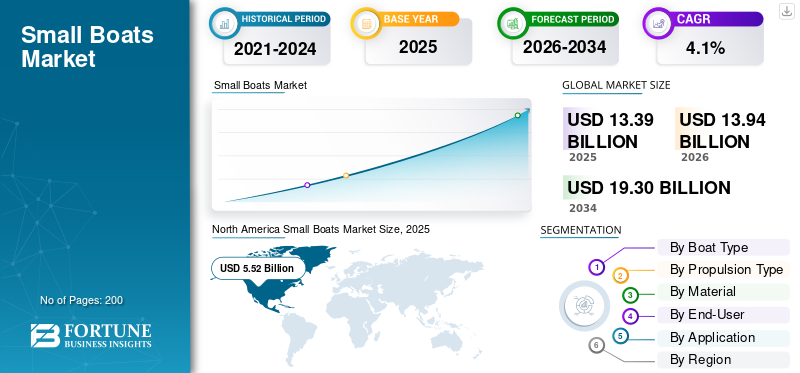
The global small boats market size was valued at USD 13.39 billion in 2025. The market is projected to grow from USD 13.94 billion in 2026 to USD 19.30 billion by 2034, exhibiting a CAGR of 4.1% during the forecast period. North America dominated the global market with a market share of 41.22% in 2025.
The market covers the manufacturing, distribution, and sale of compact watercraft used for recreational, commercial, fishing, rescue, and transportation purposes. Small boats typically include dinghies, inflatable boats, aluminum boats, fishing boats, sailboats, personal watercraft, and small motorboats. The market growth is driven by rising recreational activity boating, coastal tourism, fishing activities, water sports participation, and demand for lightweight, fuel-efficient, and easy-to-maintain vessels.
Major players in the market include Brunswick Corporation, Yamaha Motor Co., Ltd., Groupe Beneteau, Azimut Benetti Group, and Zodiac Nautic. These players are competing through lightweight boat designs, fuel-efficient engines, advanced navigation systems, electric propulsion, customization, and safety-focused marine solutions.
Download Free sample to learn more about this report.
SMALL BOATS MARKET TRENDS
Smart Navigation and Connected Boating is a Key Market Trend
A major trend in the market is the integration of smart navigation, digital controls, IoT-based monitoring, GPS systems, and connected safety features. Boat owners increasingly prefer vessels equipped with real-time diagnostics, route planning, engine monitoring, fish-finding systems, mobile app connectivity, and automated alerts. These technologies enhance safety, convenience, and user experience, especially for new boaters and recreational users. Boat manufacturers are also using lightweight materials, advanced hull designs, and digital dashboards to improve fuel efficiency and performance. The trend is particularly strong in premium recreational boats and personal watercraft, where consumers are willing to pay for comfort, automation, and advanced onboard features. This shift is making small vessels more intelligent, efficient, and user-friendly.
MARKET DYNAMICS
MARKET DRIVERS
Download Free sample to learn more about this report.
Rising Recreational Boating and Marine Tourism to Drive Market Growth
The global small boats market growth is primarily driven by increasing participation in recreational boating, fishing, water sports, and coastal tourism. Consumers are increasingly spending on outdoor leisure activities, especially in coastal and inland waterway regions. These boats are preferred due to their affordability, easy handling, lower maintenance requirements, and suitability for personal and commercial uses. The product demand is also supported by fishing charters, sightseeing tours, adventure tourism, and family leisure boating. Growing disposable income, marina development, and wider availability of boat financing and rental services are further encouraging adoption. As tourism operators and individual buyers seek compact, versatile, and cost-effective vessels, small vessels are expected to witness steady demand across recreational, utility, and tourism applications.
MARKET RESTRAINTS
High Ownership and Maintenance Costs to Restrain Product Adoption
The high ownership costs remain a key restraint for market expansion. Although small boats are more affordable than larger vessels, buyers face expenses related to purchase price, fuel, storage, insurance, registration, docking, engine servicing, and seasonal maintenance. These recurring costs can discourage first-time buyers and middle-income consumers, particularly in price-sensitive markets. In addition, limited marina space and rising storage fees in urban coastal areas further increase the total cost of ownership. Weather-related wear, corrosion, and engine repairs also add to long-term maintenance burdens. As a result, many potential users may prefer rentals, shared boating platforms, or occasional charter services instead of direct ownership, limiting new boat sales in some regions.
MARKET OPPORTUNITIES
Expanding Electric and Hybrid Propulsion to Create Growth Opportunities
The surging shift toward electric and hybrid propulsion presents a strong opportunity for market players. Environmental regulations, rising fuel prices, and consumer interest in cleaner marine mobility are encouraging manufacturers to develop low-emission boats with electric outboards, battery-powered propulsion, and hybrid systems. Small boats are well suited for electrification as they are often used for short-distance trips, inland waterways, lakes, fishing, and leisure cruising. Electric propulsion also offers quieter operation, lower operating costs, and reduced maintenance compared to conventional fuel engines. As charging infrastructure improves at marinas and waterfront destinations, electric boats are expected to gain traction among recreational users, rental operators, tourism companies, and environmentally conscious buyers.
MARKET CHALLENGES
Seasonal Demand and Weather Dependency to Challenge Market Stability
Seasonal demand is a major challenge for the global market. In many regions, boating activity is concentrated during specific months due to weather conditions, tourism seasons, and waterway accessibility. Harsh winters, storms, monsoons, hurricanes, and unfavorable marine conditions can reduce boat usage, delay purchases, and affect rental or tourism revenues. This seasonality creates uneven sales patterns for manufacturers, dealers, and service providers. Inventory planning also becomes difficult, as companies must balance peak-season demand with slow off-season periods. In addition, climate-related disruptions and extreme weather events can damage boats, restrict marine tourism, and increase insurance costs. These factors make revenue generation less predictable across several regional markets.
Segmentation Analysis
By Boat Type
High Recreational Boating Demand to Propel Motorboats Segmental Dominance
Based on boat type, the market is categorized into motorboats, sailboats, inflatable boats, fishing boats, and others.
The motorboats segment dominates the market due to their wide use in recreational boating, fishing, tourism, patrol, and short-distance transportation. Motorboats offer higher speed, easy maneuverability, and better suitability for both personal and commercial applications compared to other boat types. Their strong adoption across lakes, coastal areas, marinas, rental fleets, and water sports facilities supports steady demand. Growing leisure boating participation, rising coastal tourism, and availability of different engine capacities further strengthen the segment’s leading position.
The sailboats segment is expected to grow at a CAGR of 5.4% over the forecast period. The segment growth is supported by rising interest in eco-friendly recreational boating, sailing tourism, training activities, and low-fuel-cost water travel among leisure users and boating enthusiasts.
By Propulsion Type
Strong Availability and Established Infrastructure to Propel Fuel-powered Segmental Dominance
Based on propulsion type, the market is categorized into fuel-powered and electric-powered.
The fuel-powered segment dominates the market due to its widespread availability, strong performance, and established refueling infrastructure across coastal areas, lakes, marinas, and commercial boating hubs. These boats are preferred for longer operating ranges, higher speed, heavy-load capacity, and reliable use in fishing, tourism, patrol, and recreational activities. Their compatibility with existing engines, repair networks, and aftermarket services supports continued adoption among individual consumers and commercial operators.
The electric-powered segment is expected to grow at a CAGR of 6.7% over the forecast period. The segment growth is driven by the rising demand for low-emission boating, quieter operation, reduced fuel costs, and increasing adoption of electric outboard motors across lakes, tourism fleets, and recreational applications.
By Material
Fiberglass Segment Leads the Market Owing to Lightweight Construction and Design Flexibility
Based on segmentation by material, the market is categorized into fiberglass, aluminum, wood, and others.
The fiberglass segment dominates the market due to its lightweight structure, durability, corrosion resistance, and design flexibility. Fiberglass boats are widely preferred for recreational boating, fishing, tourism, and water sports as they offer smooth finishes, better fuel efficiency, and lower maintenance compared to traditional materials. Their ability to support varied hull shapes, comfort features, and long service life makes them suitable for both individual consumers and commercial operators.
The aluminum segment is expected to grow at a CAGR of 6.0% over the forecast period. The segment growth is supported by an increasing demand for lightweight, impact-resistant, and easy-to-maintain boats, especially across fishing, utility, inland waterway, and rental applications.
To know how our report can help streamline your business, Speak to Analyst
By End-User
Rising Leisure Participation to Impel Individual Consumers Segmental Dominance
Based on segmentation by end-user, the market is categorized into individual consumers and commercial operators.
The individual consumers segment dominates the market due to rising participation in recreational boating, fishing, water sports, and personal leisure activities. Consumers increasingly prefer small boats for weekend travel, family recreation, short-distance cruising, and lake or coastal fishing. Their affordability, ease of operation, and availability in multiple designs support strong adoption among private buyers. The growing disposable income, marina access, and interest in outdoor lifestyle activities further strengthen product demand.
The commercial operators segment is expected to grow at a CAGR of 6.2% over the forecast period. The expansion of the segment is supported by expanding marine tourism, boat rental services, fishing charters, sightseeing operations, and water sports businesses seeking durable and cost-efficient small boats.
By Application
Growing Leisure Cruising Participation to Push Recreational Boating Segmental Dominance
Based on segmentation by application, the market is categorized into recreational boating, tourism, water sports, and others.
The recreational boating segment dominates the small boats market share due to increasing consumer participation in leisure cruising, fishing, family outings, and weekend water activities. These boats are widely preferred for recreational use as they are affordable, easy to operate, and suitable for lakes, rivers, and coastal waters. Rising disposable income, marina development, boat rental availability, and growing interest in outdoor lifestyle activities further support strong demand across private ownership and shared boating models.
The water sports segment is expected to grow at a CAGR of 6.5% over the forecast period. The segment growth is supported by increasing popularity of adventure tourism, jet skiing, wakeboarding, parasailing support activities, and rental-based marine sports services across coastal destinations, resorts, and recreational water parks.
Small Boats Market Regional Outlook
By geography, the market is categorized into Europe, North America, Asia Pacific, Latin America, and the Middle East & Africa.
North America
North America Small Boats Market Size, 2025 (USD Billion)
To get more information on the regional analysis of this market, Download Free sample
North America dominates the market due to strong recreational boating culture, high disposable income, extensive marina infrastructure, and widespread participation in fishing, water sports, and leisure cruising. The U.S. accounts for a major share, supported by large coastal areas, lakes, boat ownership, and established boat manufacturing and dealership networks. The product demand is further strengthened by rental services, fishing tourism, and continuous replacement of aging boats with technologically advanced, fuel-efficient, and comfort-focused small boat models.
U.S. Small Boats Market
The U.S. market is estimated to reach a value of around USD 5.03 billion in 2026, supported by strong boat ownership, recreational fishing, lake tourism, marina infrastructure, and high demand for motorboats and fishing boats.
Europe
Europe holds the second-largest share in the market and is expected to grow at a CAGR of 3.9% over the forecast period. The regional market growth is driven by strong marine tourism, sailing culture, inland waterways, and recreational boating across countries such as Italy, France, Germany, Spain, and the U.K. The demand for premium leisure boats, electric propulsion, and sustainable boating solutions is increasing. Coastal tourism, yacht clubs, and boating events further support steady adoption across recreational and commercial applications.
U.K. Small Boats Market
The U.K. market is estimated to touch a valuation of around USD 0.49 billion in 2026, supported by recreational boating, sailing clubs, coastal tourism, and growing demand for compact leisure boats across marinas and inland waterways.
Germany Small Boats Market
The Germany market is estimated to reach a value of around USD 0.56 billion in 2026, driven by inland waterway boating, lake-based recreation, premium boat demand, and rising adoption of electric and low-emission propulsion systems.
Asia Pacific
Asia Pacific represents the third-largest market share and is witnessing steady growth due to rising coastal tourism, increasing disposable income, and expanding interest in recreational boating and water sports. Countries such as China, Japan, India, South Korea, and Australia are seeing growing demand for fishing boats, small motorboats, and tourism-based vessels. Marina development, government focus on marine tourism, and growth of rental-based boating services are supporting market expansion, especially across coastal cities, islands, and inland water destinations.
China Small Boats Market
The China market is estimated to reach around USD 0.68 billion in 2026, driven by rising coastal tourism, growing middle-class leisure spending, water sports participation, and expanding marina and boating infrastructure.
Japan Small Boats Market
The Japan market is estimated to touch a valuation of around USD 0.42 billion in 2026, supported by recreational fishing, coastal leisure boating, compact motorboat demand, and increasing interest in electric propulsion for short-distance marine travel.
Middle East & Africa
The Middle East & Africa market is growing gradually, supported by expanding coastal tourism, luxury leisure activities, fishing operations, and waterfront development projects. Countries such as the UAE and Saudi Arabia are investing in marine tourism, beach destinations, and recreational infrastructure, creating the demand for motorboats and tourism boats. In Africa, the product demand is mainly supported by fishing, transport, and utility applications. However, limited marina infrastructure and affordability constraints may restrict faster market penetration across several countries.
UAE Small Boats Market
The UAE market is estimated to reach a value of around USD 0.13 billion in 2026, driven by luxury coastal tourism, waterfront developments, marine recreation, fishing activities, and growing demand for premium leisure boats.
Latin America
Latin America is expected to witness moderate growth, driven by coastal tourism, fishing activities, recreational boating, and rising water sports participation. Brazil and Mexico lead regional demand due to their long coastlines, tourism hubs, and growing boating culture. Small vessels are widely used for fishing, leisure cruising, sightseeing, and rental services. The regional market growth is also supported by expanding tourism operators, although economic fluctuations and limited premium boating infrastructure may affect large-scale adoption.
Brazil Small Boats Market
In 2026, the Brazil market is estimated to reach a value of around USD 0.28 billion, supported by coastal tourism, recreational fishing, river transport, water sports activities, and expanding demand for affordable motorboats and fishing boats.
COMPETITIVE LANDSCAPE
Leading Companies Focus on Product Innovation to Outpace Competitors
The small boats market is moderately competitive, with established manufacturers focusing on product innovation, lightweight materials, fuel efficiency, and improved onboard safety features. Leading players compete through broad product portfolios covering motorboats, sailboats, inflatable boats, fishing boats, and electric-powered models. Companies are also strengthening their dealer networks, aftersales services, and customization capabilities to attract recreational users, tourism operators, fishing businesses, and rental service providers across mature and emerging boating markets.
Manufacturers are increasingly investing in electric propulsion, connected navigation systems, advanced hull designs, and sustainable materials to differentiate their offerings. Competition is also shaped by brand reputation, pricing, durability, engine compatibility, and regional distribution strength. Larger companies benefit from strong manufacturing capacity and global presence, while smaller players compete through niche designs, local market knowledge, and specialized boats for fishing, water sports, and inland recreational applications.
LIST OF KEY SMALL BOATS COMPANIES PROFILED
- Brunswick Corporation (U.S.)
- Yamaha Motor Co., Ltd. (Japan)
- Groupe Beneteau (France)
- Azimut Benetti Group (Italy)
- Ferretti Group (Italy)
- Malibu Boats, Inc. (U.S.)
- Marine Products Corporation (U.S.)
- Grady-White Boats, Inc. (U.S.)
- Sunseeker International (U.K.)
- Polaris Inc. (U.S.)
KEY INDUSTRY DEVELOPMENTS
- February 2026: MasterCraft Boat Holdings acquired the Chaparral and Robalo boat businesses, expanding its recreational powerboat portfolio across MasterCraft, Crest, Balise, Chaparral, and Robalo brands, while significantly increasing consumer reach and category coverage.
- January 2026: Brunswick Corporation showcased its largest marine technology display at CES 2026. The solution features Simrad AutoCaptain autonomous boating on Sea Ray and NAVAN boats, plus Mercury and Lowrance technologies, highlighting AI, autonomy, electrification, and connected boating innovation.
- October 2025: Zodiac Nautic and Flux Marine partnered to electrify Zodiac’s rigid inflatable boats, integrating Flux Marine’s high-powered electric outboard technology and planning the first electric model on the Medline 6.8 platform.
- June 2025: Yamaha U.S. Marine announced that its portable outboard models from 2.5 to 15 horsepower became available at selected West Marine locations. The move aimed at improving retail access for lightweight, compact, and transportable small boat engine solutions.
- March 2025: Yamaha Marine introduced new Steering Assist Tiller Handle F150 and F200 outboards, expanded mid-range color options, and launched HARMO fully electric outboards. The move aimed at supporting the demand for easier handling, customization, and low-emission small boat propulsion.
- February 2025: Yamaha unveiled the Helm Master EX Wireless Control at the Miami International Boat Show. The solution would enable captains to control compatible boats from anywhere onboard, improving docking, launching, safety, and user convenience for recreational boating.
- August 2024: Malibu Boats launched the redesigned 2025 Wakesetter 25 LSV with the Malibu Command Center and updated digital boat-builder tool. The step would strengthen the company’s premium watersports boat lineup with improved user experience and customization.
REPORT COVERAGE
The global small boats market analysis provides an in-depth study of market size and forecast by all the market segments included in the report. It includes details on the market dynamics and trends expected to drive the market during the forecast period. It offers information on the technological advancements, new product launches, key industry developments, and details on partnerships, mergers, and acquisitions. The market research report also encompasses a detailed competitive landscape, including market share and profiles of key operating players.
Request for Customization to gain extensive market insights.
Report Scope & Segmentation
| ATTRIBUTE | DETAILS |
| Study Period | 2021-2034 |
| Base Year | 2025 |
| Estimated Year | 2026 |
| Forecast Period | 2026-2034 |
| Historical Period | 2021-2024 |
| Growth Rate | CAGR of 4.1% from 2026-2034 |
| Unit | Value (USD Billion) |
| Segmentation | By Boat Type, By Propulsion Type, By Material, By End-User, By Application, and By Region |
| By Boat Type |
|
| By Propulsion Type |
|
| By Material |
|
| By End-User |
|
| By Application |
|
| By Region |
|
Frequently Asked Questions
Fortune Business Insights says that the global market value stood at USD 13.39 billion in 2025 and is projected to reach USD 19.30 billion by 2034.
In 2025, the North America market value stood at USD 5.52 billion.
The market is expected to exhibit a CAGR of 4.1% during the forecast period of 2026-2034.
The fuel-powered segment leads the market by propulsion type.
Rising recreational boating and marine tourism are key factors expected to drive market growth.
North America dominated the market in 2025.



- 2021-2034
- 2025
- 2021-2024
- 200
-
(Offer valid till 30th Sep 2026)
Get 30-60 hrs Free Customization
Expand Regional and Country Coverage, Segments Analysis, Company Profiles, Competitive Benchmarking, and End-user Insights.




















Related Reports
-
US +1 833 909 2966 ( Toll Free )
-
Get In Touch With Us