Racing Boat Market Size, Share, Industry Analysis, By Boat Type (Sailboats, Powerboats, Rowing Boats, Hydroplanes, Canoes and Kayaks, Jet Skis and Personal Watercraft (PWC), and Others), By Propulsion System (Outboard Engine Sterndrive Engine, Inboard Engine, Propellers, and Drive Shaft), By Length (2.5m -7.5 m, 7.6m - 12m, 12.1m - 24m, and Above 24m), By Application (Offshore Racing, Inshore Racing, Drag Racing, Fleet Racing, Marathon Racing, and Others), and Regional Forecast, 2026-2034
 Download Free Sample
KEY MARKET INSIGHTS
 Listen to Audio Version
The global racing boat market size was valued at USD 3.80 billion in 2025. The market is projected to grow from USD 3.91 billion in 2026 to USD 5.16 billion by 2034, exhibiting a CAGR of 3.52% during the forecast period. Europe dominated the racing boat market with a market share of 48.08% in 2025.
Racing boats are performance- and speed-focused competitive racing vessels for racing on the water for speed and agility. They exist in a wide range of constructions and types, but they are all speed- and performance-focused and tend to utilize lightweight materials and aerodynamic shapes in an attempt to minimize drag. They can be powered by oars, sails, or motors, depending on the type of race. Principal categories include rowing shells, powerboats, and sailing yachts, each of which corresponds to specific racing conditions and rules
Racing boats are used primarily for competitive racing where both agility and speed are the main focus. The races can range from short, high-intensity sprints to long-distance endurance races. Racing competitions, such as classic and leisure regattas, play a role in boosting the popularity of water sports, drawing in new fans and encouraging market growth.
Boat racing competitions globally captivate advanced maritime technology, and significantly drive the development and expansion of the boat racing market positions. The competitions are platforms for enthusiasts to showcase the latest aerodynamics designs, materials, and technology. The pressure of intense competition in the competitions forces the boats to be faster, stronger, and more efficient, which in turn drives improvements in materials, drive shaft technology, and electronics integration catalyze the market growth.
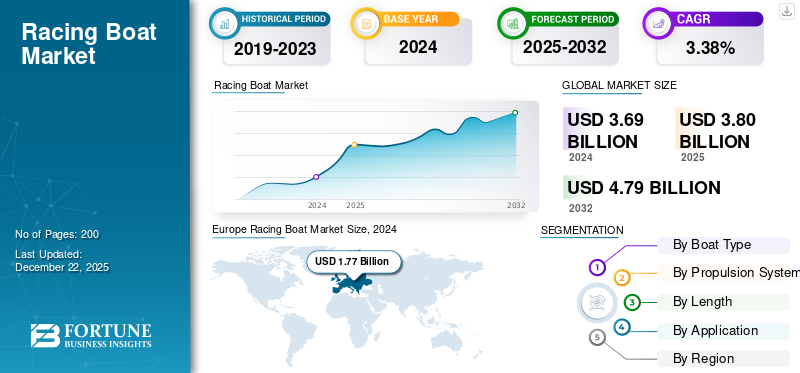
Download Free sample to learn more about this report.
RACING BOAT MARKET KEY TAKEAWAYS
 Market Size & Forecast
- 2025 Market Size: USD 3.80 billion
- 2026 Market Size: USD 3.91 billion
- 2034 Forecast Market Size: USD 5.16 billion
- CAGR: 3.52% from 2026–2034
 Market Share
- Europe dominated the market with a 48.08% share in 2025.
- Powerboats accounted for a 45.36% market share in 2026.
- Inboard engines held a 42.20% market share in 2026.
 Key Regional Highlights
North America
North America accounted for USD 1.15 billion and 30.20% of the market in 2025 and is expected to reach USD 1.18 billion in 2026.
Europe
Europe generated USD 1.83 billion in 2025, held a 48.08% share, and is projected to reach USD 1.89 billion in 2026.
Asia Pacific
Asia Pacific recorded USD 0.58 billion with a 15.32% share in 2025 and is projected to reach USD 0.60 billion in 2026.
U.S.
The market is projected to reach USD 0.93 billion by 2026
Japan
The market is projected to reach USD 0.12 billion by 2026
Read More

Impact of Tariff
Imposition of Tariffs by U.S. Can Have Significant Repercussions on Racing Boat Industry
The global boating economy is experiencing stormy weather. Recent trade policy initiatives from the Trump administration most prominently a fresh round of tariffs on foreign goods are affecting boat manufacturing, marine supply chains, and pricing structures. For boat buyers, builders, and dealers, these crosswinds of tariffs are sure to cause a strategic redo of sourcing, pricing, and where to purchase boats, if even in the short term.
It's also about boats, big, small, racing boats, sailing boats, recreational boats, and the finicky, world-sourced pieces that get them to float. New import tariffs that involve a 10% across-the-board fee on a broad range of goods, with some marine-related products facing rates as high as 34%.
American boat manufacturers depend on foreign components such as engines, electronics, aluminum, stainless steel, wiring harnesses, and even upholstery. Tariffs and boating become complicated at this point. When those components become more costly, production rises. Manufacturers either eat the difference or pass it to the consumer. Tariffs on boats not made in the U.S. increase costs rapidly particularly on boats longer than 25 feet or boats with high-end tech packages imported from abroad.
Supply chains remain vulnerable from the pandemic period. Now add tariffs to the mix. Lead times for components are growing longer, some components are becoming increasingly difficult to obtain, and raw material prices such as aluminum and stainless steel are moving up and down daily. This causes production delays, added uncertainty, and quality problems. A smooth flow of parts and components is vital to ensure timely construction and maintenance of boats.
American tariffs threaten to significantly harm the racing boat industry by adding costs, derailing supply chains, eliciting retaliatory actions, and stalling investment and innovation. Tariffs have more disadvantages than advantages, and policymakers should be mindful of the long-term impact of these policies on the industry and the economy in general.
Market Dynamics
Market Drivers
Growing Modernization in Design, Material, and Propulsion System Accelerates Market Expansion
The racing boat industry, from sailing yachts down to high-speed powerboats, is spurred on by a multifaceted set of factors. Possibly the most prevalent driving force is this one. New materials, design methods, and propulsion systems consistently contribute to increasing speed, efficiency, and agility.
The high level of competition in these events spurs the need for faster, stronger, and more efficient boats, which creates innovation in material, propulsion systems, and computer integration technology. In some cases, carbon fiber, Kevlar, and other advanced composites provide exceptional strength-to-weight ratios, enabling lighter and quicker hulls. This enables boat designers to significantly minimize the weight of the boat, enabling greater speed and acceleration.
Additionally, hydrofoils lift the hull out of the water, cutting drag considerably and enabling much higher speeds. Foiling technology has transformed sailboat and powerboat racing. For instance, in July 2023, French sail manufacturer, Incidence Sails, announced a partnership with the Canadian firm Aluula. This agreement grants Incidence Sails exclusive rights in France to utilize Aluula Durlyte technology for sails designed for extended use in tough conditions, as well as for boat bags.
Additionally, advanced electronics, GPS, and automated control systems improve boat maneuverability and enhance tactical decision-making. Cutting-edge sensors and software maximize performance in real-time. This allows the vessel to navigate more effectively, giving competitors the edge to make more strategic tactical choices. Moreover, improvements in engine technology (both internal combustion and electric), transmission systems, and propeller design result in better power delivery and efficiency. Alongside advancements in engine technology, innovations in propeller design and control systems contribute to enhanced acceleration.
For instance, in March 2024, Mercury Racing introduced its latest innovation, the 60 APX outboard motor, at the renowned Dubai International Boat Show taking place in Dubai Harbor, United Arab Emirates. This engine is specifically designed for the rigorous environment of closed-course circuit racing, representing a significant advancement toward a more sustainable future for the sport.
In addition, enhancing its high-end technical features while matching the design of its counterparts, the 4.6-liter V8 360 APX and 3.4-liter V6 200 APX four-stroke competition outboards solidifies its identity within the Apex series of competitive engines.
Market Restraints
High Cost and Safety Concerns Hinders Market Growth and Innovation
The cost of designing, building, maintaining, and racing in a boat at a competitive level is extremely high, which limits access to affluent individuals and well-financed teams. In this sense, more emphasis on the environment and more stringent control over emissions, waste management, and noise pollution are challenging the industry. For instance, traditional combustion engines used in powerboats lead to air and water pollution.
Powerboats of high speed are hazardous. Safety concerns and the need for robust risk management are the major issues that can hamper the industry. The industry can be considered elitist and exclusive, with an entrance restricted to a specific group of individuals. The industry is not typically gender, race, and socioeconomically diverse. As previously mentioned, high costs limit the entry to the affluent teams.
The availability of suitable infrastructure (e.g., marinas, harbors, and repair shipyards) can limit the growth of the racing boat sector in certain locations. Racing teams and manufacturers will spend a considerable amount of time and money trying to find their way through the complex regulatory environment and bureaucratic process. Environmental law can be complicated to enforce and cost a lot.
Market Opportunities
Emerging New Era of Sustainable Propulsion Technology to Elevate Eco-Friendly Sport Creating Market Opportunities
The electric racing boat marks a new era that will drive the sport to unparalleled heights. All electric RaceBird hydrofoil boats, created by SeaBird Technologies, compete in this championship. Sleek boats powered by batteries and electric motors hydrofoil above the water at speeds of up to 50 knots (93 kph). The series guarantees thrills of velocity at heart-stopping coastal sites.
Moreover, electric power is increasing with Formula 1 embracing hybrid technology and Formula E creating a sport based on electric racing. Apart from that, the market for electric boats is already gaining momentum, led by X-Shore, Candela, Silent Yachts, Navier, and Ark. Partnering with these manufacturers, the E1 Series could potentially reflect the successful collaborations in traditional motorsport, such as Formula 1 or Paris-Dakar Rally. This would be more than a show. This would push technology and bring together a fan community of like-minded enthusiasts.
Earlier in 2024, the Monaco Energy Boat Challenge saw around 50 e-boats, some of which were university and research center projects. Amateur compared to the RaceBirds, these projects are the future of innovation and electric boats. For instance, in April 2025, The UIM E1 World Championship, the inaugural all-electric race boat series, has revealed that Dubrovnik, Croatia will host a race in 2025.
In addition, the growing use of hydrogen-based fuels in propulsion for racing boats, although in an early phase of development, have great potential to help contribute positively impacting the racing boat market trend towards sustainable energy. Hydrogen power represents a close-to-zero emission method of racing, which is appealing to eco-friendly consumers as well as sponsors seeking to sponsor green programs. It is able to create new market segments and revenue sources.
The creation of hydrogen-powered racing craft will produce a niche market for specialized products, driving innovation in electric propulsion systems, hydrogen storage, and fuel cell technology to serve high-performance applications.
Racing is a testing ground for the latest technology. The rigorous nature of racing will spur the evolution and development of hydrogen power systems to become better, more efficient, reliable, and affordable, driving the world market share in forecast period.
Racing Boat Market Trends
Technological Advancements Increases Cost Leading to Market Premiumization Trends
Technological trends in the market are generating immense market growth opportunities. Those businesses that adopt these trends and invest in research and development stand to be successful in the future. These technologies will continue to revolutionize the sport and propel racing boat market growth as they mature and become widely available.
Carbon fiber, Kevlar, and other advanced composites are increasingly being employed in hull construction, masts, and appendages. There are new composite manufacturing methods also being developed. Composites enable lighter, stronger hulls, which lead to better speed, acceleration, and handling. Advanced composite boats have higher prices owing to their superior performance features, increasing revenue for manufacturers.
For instance, in June 2025, Deep Impact Boats, based in Miami, FL, has announced that its latest center console model, the 499 Sport, is now outfitted with six Mercury Racing 500R outboards. This 49-foot vessel is the most powerful Deep Impact ever constructed, boasting an impressive 3,000 horsepower designed for offshore superiority, featuring an exceptional blend of engineering, technology, and high-performance design. The transom and hull have been meticulously designed to accommodate the weight and performance characteristics of six engines, guaranteeing optimal efficiency, handling, and structural strength during demanding offshore conditions.
Spurred by concerns over the environment and advances in technology, electric and hybrid power systems are being adopted in the racing boat market, especially in minor classes and for service boats. Innovative electric motors, batteries, and control units are being designed for racing use by companies.
Advanced sensors, data recorders, and software analysis tools are employed for real-time monitoring of boat performance and maximizing racing strategy. Teams use data analytics to gain competitive advantage, leading to a demand for advanced data recorders and analysis tools. Companies are providing data analysis services for teams to get insights and recommendations from the data on their performance.
While fully autonomous racing boats are still in the early stages of development, research and development in this area are accelerating. AI is being used for tasks such as navigation, route planning, and sail trimming. Autonomous racing boats could revolutionize the sport and attract a new audience. The growing research in autonomous systems is driving the development of new sensors, algorithms, and control systems that could have applications in other areas of the marine industry. While the adoption of autonomous racing boats may be gradual, the long-term growth potential is significant.
VR and AR technologies are being used for training, design, and spectator experiences in the racing boat industry. VR simulators allow racers to practice in realistic scenarios and develop their skills without the risks and costs associated with on-water training. VR and AR technologies can enhance the spectator experience by providing immersive views of the race and real-time performance data.
Download Free sample to learn more about this report.
Market Challenges
Despite Allure of Speed and Innovation Market Faces Challenges That May Hinder Growth and Profitability
The initial and ongoing costs of participating in racing are extremely high, encompassing boat purchase/construction, maintenance, equipment, transportation, crew salaries, and race entry fees. This limits participation to affluent individuals, well-funded teams, and corporate-backed ventures. Restricts market size, limits talent pool, and creates an uneven playing field.
The racing boat industry is highly susceptible to economic downturns, as it relies heavily on discretionary spending by affluent individuals and corporations. Reduced sponsorship, lower boat sales, decreased participation in racing events, and overall instability.
Increasingly stringent environmental regulations regarding emissions, waste disposal, and noise pollution pose significant challenges. Adapting to these regulations requires investments in cleaner technologies and sustainable practices. Higher costs for compliance, limitations on engine choices, and potential backlash from environmentally conscious consumers.
Racing boats, especially high-speed powerboats, are inherently dangerous, leading to high insurance premiums and safety regulations. Increased operating costs, restrictions on racing events, and potential liability issues.
Increasingly stringent environmental regulations regarding emissions, waste disposal, and noise pollution pose significant challenges. Adapting to these regulations requires investments in cleaner technologies and sustainable practices. Higher costs for compliance, limitations on engine choices, and potential backlash from environmentally conscious consumers.
SEGMENTATION ANALYSIS
By Boat Type
Combination of Technological Advancements, Evolving Consumer Preferences, and Supportive Infrastructure Drive Powerboat Segment’s Growth
The racing boat market is classified by boat type into sailboats, powerboats, rowing boats, hydroplanes, canoes and kayaks, jet skis and personal watercraft (PWC), and others
The powerboat segment is estimated to be the fastest-growing segment during the forecast period. The powerboat segment is projected to dominate the market with a share of 45.36% in 2026. Powerboats, particularly engine-powered powerboats, provide greater speeds, heart-stopping acceleration, and superior maneuverability and thus are extremely popular for watersports, and racing activities. Ongoing powerboat design innovation and technology ensure that the segment remains highly attractive. However, advanced navigation systems, automatic controls, and connectivity options improve safety, user friendliness, and operational effectiveness propels the segmental growth throughout the forecast period.
The sailboat segment is estimated to be the second fastest-growing segment during the forecast period of 2025-2032. Increased popularity of sailing as a competitive activity, more people are finding the thrill of sailing as a recreational activity and participating in races. Secondly, growth of sailing schools and club establishments significantly contribute towards introducing new individuals to sailing, supporting an active sailing culture, and the demand for racing sailboats. Additionally, the blend of heightened participation in sailing and growing market through celebrity events, global regattas, such as the America's Cup and the Volvo Ocean Race enhance visibility, entice sponsorships, and generate demand for high-performance racing sailboats in future years.
By Propulsion System
Inherent Advantages and Technological Advancements Drives Inboard Engines Segment Growth
The racing boat market is classified by propulsion system into outboard engine, sterndrive engine, inboard engine, propellers, and drive shaft
The inboard engine segment is estimated to be the fastest-growing segment during the forecast period and accounted for the largest market share. The inboard engine segment is expected to lead the market, contributing 42.20% globally in 2026. Inboard engines, especially high-power diesel and gasoline models, feature high horsepower and considerable torque, which are essential for high-speed acceleration and sustained high-speed operation in racing applications. Ongoing technology development in the inboard engine field, such as improvements in electronic fuel injection systems, digital engine control systems, and creating more efficient and powerful configurations, address competitive racing requirements drive the segmental growth throughout the forecast period.
Sterndrive segment is estimated to be the second fastest-growing segment during the forecast period. Sterndrive are known for their ability to deliver strong horsepower and torque, crucial for achieving speed and quick planning in racing scenarios. Additionally, advancements in fuel injection systems (such as direct injection and EFI) and engine design (such as purpose-built marine blocks) have enhanced fuel efficiency and performance, appealing to both recreational users and racers seeking competitive edges. Furthermore, the industry's shift towards more sustainable solutions, including the development of hybrid and potentially electric sterndrive systems, aligns with tightening environmental regulations and growing consumer demand for eco-friendly boating options, positioning sterndrive for future growth in a greener marine market.
By Length
Higher Adoption of Small Racing Boats(2.5m-7.5m) During Racing Events Catalyze Segmental Growth
The market is divided by Length into 2.5m -7.5 m, 7.6m - 12m, 12.1m - 24m, and above 24m.
The 2.5m -7.5 m segment is estimated to be the fastest-growing segment during the forecast period and accounted for the largest market share. The 2.5m -7.5 m segment will account for 77.31% market share in 2026. These boat sizes are usually less expensive to purchase, upkeep, and ship compared to larger competition boats. This allows for the sport to be more easily played by a greater percentage of the public to expect the need for these segments. This segment is usually quite competitive due to the evenly matched speed of the boats. This creates fast and interesting races. Most of the boat classes have healthy and vibrant communities which offer support, training and social gatherings spur the segmental growth.
7.6m - 12m segment estimated to be the second fastest growing segment during the forecast period. The existing size of 7.6 – 12 m category racing boats are gaining more boats that race as new technologies and design features are being added into medium-sized racing boats, which makes them more attractive. Furthermore, increased development of well-structured and competitive racing circuits specific to medium-sized boats may be drawing more participants driving the segmental market share.
By Application
To know how our report can help streamline your business, Speak to Analyst
Growing Popularity of Inshore Racing Application Due to Easy Handling
The market segmentation is divided by application into offshore racing, inshore racing, drag racing, fleet racing, marathon racing, and others
The inshore racing segment is estimated to be the fastest-growing segment during the forecast period and accounted for the largest market share. The inshore racing segment is expected to account for 34.71% of the market in 2026. This racing is typically more accessible than offshore racing as it is of shorter length, closer to land, and the equipment is lower. Numerous inshore racing programs are actually designed to recruit youth sailors and female sailors. These types of programs usually include training, mentorship, and assistance with costs to promote taking part to anticipate the demand and expansion of the segmental market share. In addition, short-course styles of racing such as windward-leeward courses and stadium sailing, which involve high-speed action, public appeal, and media convenience anticipate the segmental expansion. For instance, in July 2025, Powerboat P1, the global promoter of marine motorsport, revealed that Mercury Racing will once again be the title sponsor for the 3rd Annual Mercury Racing Midwest Challenge, scheduled for August 8-10 along the shores of Lake Michigan in Sheboygan, WI.
Offshore racing segment estimated to be the second fastest-growing during the forecast period. The increasing appeal of these segments as high-tech boats are quicker, safer, and more comfortable offshore racing due to improvements in hull design, drives systems, sail, navigation aids, and communications. This enhances offshore racing as more attractive and viable and anticipates the expansion of the segment over the forecast period. Additionally, regattas such as the Rolex Fastnet Race and the Sydney Hobart Yacht Race have adopted strict safety specifications. Efforts to ensure safety on the high seas via compulsory training programs and equipment standards and this race organizers are focusing increasingly on safety procedures, crew training, and risk control to reduce mishaps and safeguard the health of participants spur future attraction of the growth.
Racing Boat Market Regional Outlook
The market is classified by region into North America, Europe, Asia Pacific, and Rest of the World.
Europe
Europe Racing Boat Market Size, 2025 (USD Billion)
To get more information on the regional analysis of this market, Download Free sample
In 2025, the Europe market stood at USD 1.83 billion, representing 48.08% of global demand, and is projected to grow to USD 1.89 billion in 2026. The region is a leader in the recreational boating and racing boat markets, fueled by a combination of powerful maritime traditions, favorable economic situation, increased interest in watersports, and huge investment in infrastructure. Besides, technological innovation in boat design, such as the use of green and high-performance technologies, propels the market. The increasing concern for sustainability is causing sales of electric and hybrid boats to rise, backed by government support and consumer demand. In addition, the territory is home to premier motorsport events such as Formula 1, MotoGP, and the World Rally Championship, drawing millions of spectators and bringing enormous revenue to the motorsport sector, which adds an estimated USD 40 billion to the European economy every year. The UK market is projected to reach USD 0.3 billion by 2026, while the Germany market is projected to reach USD 0.18 billion by 2026.
North America
North America contributed approximately USD 1.15 billion to the global market in 2025, accounting for 30.20% share, and is expected to reach USD 1.18 billion in 2026. North America is a significant and continuously expanding market for the racing boat industry. The racing events, particularly driven by the U.S., have a well-established and thriving boating culture, which contributes to having a large community of boating enthusiasts and participants in different water sports and racing events. The area has high consumer purchasing power, which translates to higher spending on recreational pursuits such as recreational boating and associated luxury items, racing boats being one of them. There is a developing trend towards water sports and outdoor recreation such as wakeboarding, fishing, waterskiing, and racing by younger groups, driving demand for sport boats as well as racing boats. North America, specifically the U.S. and Canada, has vast coastlines, lots of lakes, and vast river systems that offer plenty of space for varied boating activities and racing competitions. Competition such as the America's Cup raises the level of interest in competitive sailing and spurs investment in high-performance racing sailboats. The U.S. market is projected to reach USD 0.93 billion by 2026.
Asia Pacific
The Asia Pacific region captured 15.32% of the global market in 2025, generating USD 0.58 billion in revenue, and is projected to reach USD 0.6 billion in 2026. The Asia Pacific region is rapidly emerging as a popular and growing hub for the racing boat market trends in the region. Rising income and urbanization result in greater investment in the boat industry. However, nations that have larger sea faces such as China, India, Indonesia, Singapore, and Malaysia utilize their coastlines for developing boating as a part of racing and tourism purposes. Further, Governments are investing in coastal and marine infrastructure such as marinas to enhance adoption of environmentally friendly and smart boat technologies that increase appeal and increase the acceleration for racing events. The area is home to several major racing events and boat shows, especially in India, Indonesia, China, and South Korea, these events add to the growth of the industry. The Japan market is projected to reach USD 0.12 billion by 2026, and the China market is projected to reach USD 0.14 billion by 2026.
Rest of the World
In 2025, Rest of the World represented USD 0.24 billion, accounting for 6.40% of the worldwide market, and is projected to grow to USD 0.25 billion in 2026. The rest of the World consists of the Middle East & Africa and Latin America regions. The Middle East & Africa region, has rising economies, a rich population concentration, and an appreciation for luxury experience, such as luxury yachts and racing boats propels the regional and global market growth. Furthermore, countries such as the UAE, Saudi Arabia, and South Africa are heavily investing in marine infrastructure, such as marinas and docking facilities that appeal to tourists and enable racing events. In addition, increasing development and rising disposable incomes are allowing consumers to spend on water sports activities in the Latin American region spur regional growth. The development of coastal tourism in nations such as Brazil and Mexico, along with the creation of a developing middle class, is increasing demand for racing boats. In addition, the rowing sport is becoming increasingly popular in Latin America, thus fueling demand for racing rowing boats and associated training and facilities.
Competitive Landscape
Key Industry Players
Key Participants Incorporating Cutting-Edge Technologies to Establish Solid Market Presence
The racing boat market is marked by specialization, innovation, and a quest for ultimate performance. This competitive market inspires developments in different areas of boat design, technology, and business models. The bigger players in the boating business might take over smaller specialized racing boat firms to add depth to their product offerings or tap particular expertise or market niches. For instance, in May 2021, Limestone Boat Company's acquisition of Ebbtide Boats and White River Marine Group's purchase of Hatteras Yachts underscore the strategic emphasis on growth and consolidation in the larger boating industry.
Brunswick Corporation and other such companies provide extensive lines of boats, engines, and components to meet various segments of the recreational and race boat market. In addition, R&D investment and the integration of advanced technologies play a significant role in pulling in buyers who seek for high performance and technologically sophisticated boats. Firms are reaching out to emerging markets in areas such as Asia Pacific and Latin America, where expanding economies and an increasing interest in water sports provide new opportunities. Brand awareness and image building through effective marketing and brand building, such as sponsorships and partnerships with racing events and participants, improve the brand presence and generate a strong pull for racing boats.
LIST OF KEY RACING BOAT COMPANIES PROFILED
- Beneteau (France)
- BAYLINER (U.S.)
- Outerlimits Offshore Powerboats (U.K.)
- Fountain Powerboat Industries, Inc. (U.S.)
- Donzi Marine (U.S.)
- MTI – Marine Technology Inc. (U.S.)
- Formula Boats (U.S.)
- Asia Boats (UAE)
- Blue Wing Honda Marine (New Zealand)
- OceansLab SAS (France)
KEY INDUSTRY DEVELOPMENTS
- August 2025 - DWR/Doug Wright Powerboats, located at Lake of the Ozarks, MO, has revealed its latest model: a 44-foot catamaran powered by stern drives. The new DWR 44' stern-drive package will feature changes to the bustle, along with a completely revamped backseat layout. Additionally, it will incorporate advanced features designed to enhance the ergonomics of the seating and the overall setup.
- July 2025 - The E1 World Championship for electric powerboat racing is to raise USD 23.55 million to support the expansion of the series. The organization aims to increase the number of teams from nine to 12 and the number of races from seven to 15, while also incorporating new locations in Asia and South America, with a target valuation of USD 500 million by 2030.
- July 2025 - Scott McCormick, the owner of Velocity Powerboats located in Sanford, FL, has revealed the purchase of Checkmate Powerboats. The molds and assets of Checkmate will be transferred to Velocity’s 40,000-square-foot manufacturing plant in Sanford, FL.
- November 2024 - American Marine Performance (AMP), located in Pompano Beach, FL, has revealed an exciting new development in the high-performance boating sector. The company has officially ended its collaboration with Smart Performance Marine and is now introducing its own innovative catamaran series to the market. The initial hull and deck of this competitive lineup have already been infused, with a second hull currently under development.
- April 2024 - Powerboat P1 has revealed that it will continue and extend its collaboration with Mercury Racing. This agreement will allow Mercury Racing, a prominent global supplier of high-performance marine engines, to remain the Official Engine for both the UIM Class 1 World Championship and Powerboat P1 racing.
REPORT COVERAGE
The research report provides a detailed analysis of the market insights and focuses on important aspects, such as key players, boat type, propulsion system, length, and applications depending on various regions and countries. Moreover, it offers deep insights into the market global racing boat market trends, competitive landscape, company profiles, market competition, comparative analysis, market status, and highlights key industry developments. Also, it encompasses several direct and indirect factors that have contributed to the expansion of the global market in recent years.
Request for Customization to gain extensive market insights.
Report Scope & Segmentation
|
ATTRIBUTE |
DETAILS |
|
Study Period |
2021-2034 |
|
Base Year |
2025 |
|
Estimated Year |
2026 |
|
Forecast Period |
2026-2034 |
|
Historical Period |
2021-2024 |
|
Growth Rate |
CAGR of 3.52% from 2026 to 2034 |
|
Unit |
Value (USD Billion) |
|
Segmentation |
By Boat Type
|
|
By Propulsion System
|
|
|
By Length
|
|
|
By Application
|
|
|
By Region
|
Frequently Asked Questions
As per the Fortune Business Insights study, the Land Survey Equipment Market size was valued at USD 3.91 Billion in 2026 and is anticipated to USD 5.16 Billion by 2034.
The market is expected to grow at a CAGR of 3.52% over the forecast period.
The top players in the industry are Hexagon AB (Sweden), Trimble Inc. (U.S.), and Topcon Corporation (Japan).
Europe dominated the market in 2025 with USD 1.83 Billion.
Europe region is estimated to be the fastest growing during the forecast period.



- 2021-2034
- 2025
- 2021-2024
- 200
Get 30-60 hrs Free Customization
Expand Regional and Country Coverage, Segments Analysis, Company Profiles, Competitive Benchmarking, and End-user Insights.




















-
US +1 833 909 2966 ( Toll Free )
-
Get In Touch With Us