Knife Gate Valve Market Size, Share & Industry Analysis, By Type (Wafer Knife Gate Valves, Flanged Knife Gate Valves, Lug Knife Gate Valves, and Through Conduit Knife Gate Valves), By Actuation Type (Manual, Pneumatic Actuated, Electric Actuated, and Hydraulic Actuated), By Flow Direction (Unidirectional and Bidirectional Knife Gate Valves), By End Use Industry (Mining & Mineral Processing, Water & Wastewater Treatment, Pulp & Paper, Chemical & Petrochemical, Oil & Gas, Power Generation, Food & Beverage, Pharmaceutical & Biotechnology, Marine, and Others), and Regional Forecast, 2026-2034
 Download Free Sample
Knife Gate Valve Market Size & Future Outlook
 Listen to Audio Version
The knife gate valve market size was valued at USD 1,401.4 million in 2025. The market is projected to grow from USD 1,473.1 million in 2026 to USD 2,239.4 million by 2034, exhibiting a CAGR of 5.3% during the forecast period. Asia Pacific dominated the knife gate valve market with a market share of 38.96% in 2025.
The market comprises manufacturing and commercial sale of specialized industrial valves designed to isolate liquids, slurries, viscous fluids, powders, granular materials, wastewater, pulp stock, and other solids-laden process media. These valves use a sharp-edged gate that moves across the flow path to cut through suspended solids and provide dependable shut-off across thickener underflow lines, cyclone feed circuits, sludge dewatering systems, stock-preparation lines, ash-handling networks, dry-bulk discharge points, and other difficult-isolation duties. Key players offer a broad product portfolio comprising wafer, flanged, lug, through-conduit, unidirectional, and bidirectional knife gate valves with manual, pneumatic, hydraulic, and electric actuation. Stainless steel, cast iron, carbon steel, and alloy steel are widely used raw materials, depending on pressure, corrosion, abrasion, and process-media requirements. Product development increasingly focuses on abrasion-resistant seats, polyurethane liners, full-bore designs, self-cleaning gates, corrosion-resistant materials, replaceable sleeves, bubble-tight isolation, automated positioning, and reduced maintenance requirements. Rising mining activity, expanding wastewater infrastructure, increasing industrialization, industrial automation, and process-plant modernization are driving global demand for durable knife gate valves.
- For instance, in August 2024, ORBINOX launched its EP polyurethane-lined lug-type knife gate valve for mining applications. The valve was introduced in DN 80–300 sizes with a 10-bar working-pressure rating, non-clogging shut-off capability, and manual or pneumatic actuation options.
DeZURIK, Inc., Emerson Electric Co., ORBINOX, Bray International, Stafsjö Valves, Metso Corporation, KSB SE & Co. KGaA, and VAG Group are among the leading companies operating in the market. These companies focus on advanced sealing systems, slurry-resistant materials, high-pressure designs, automated actuation, easier maintenance, and industry-specific valve solutions to strengthen their market positions.
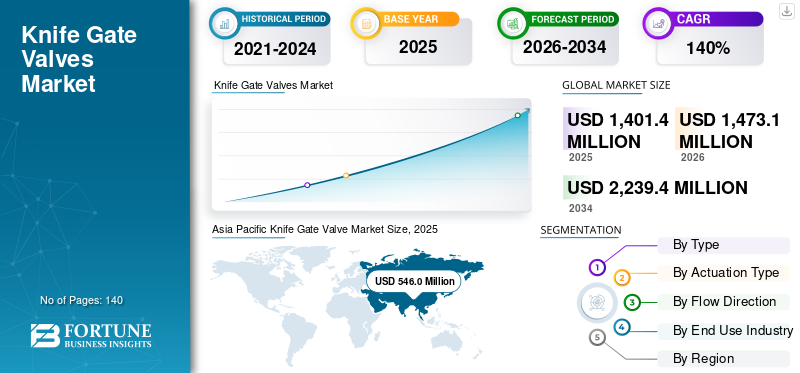
Download Free sample to learn more about this report.
KNIFE GATE VALVE MARKET TRENDS
Increasing Adoption of Automated, Smart, and Maintenance-Efficient Valve Solutions is Reshaping Market
The market is witnessing a shift from conventional manually operated isolation valves toward advanced valve solutions integrated with automation, digital monitoring, and improved reliability features. Manufacturers are increasingly developing knife gate valves with pneumatic, hydraulic, and electric actuation systems, intelligent position monitoring, remote operation capabilities, and compatibility with industrial control platforms such as PLC and SCADA systems to enhance process efficiency and reduce manual intervention. Modern knife gate valves are also incorporating advanced sealing technologies, abrasion-resistant materials, replaceable seat designs, full-port flow paths, and self-cleaning gate mechanisms to improve performance in demanding slurry, wastewater, mining, and bulk material handling applications. Growing demand for reliable flow isolation in mining operations, wastewater treatment facilities, pulp and paper mills, chemical plants, and power generation facilities is encouraging industries to adopt automated valve systems that provide improved operational safety, reduced downtime, and longer service life. Digital valve monitoring, predictive maintenance capabilities, and condition-based servicing are further supporting the transition toward intelligent industrial flow-control systems. Manufacturers are also focusing on compact, modular, and application-specific knife gate valve designs that provide enhanced performance for abrasive, corrosive, and high-solid-content media across diverse industrial environments.
- For instance, In April 2025, Metso expanded its Neles knife gate valve offering with enhanced valve solutions designed for demanding mining and minerals processing applications, focusing on improved wear resistance, reliable shut-off performance, and optimized maintenance requirements for slurry handling operations.
MARKET DYNAMICS
MARKET DRIVERS
Download Free sample to learn more about this report.
Rising Demand for Slurry Handling and Industrial Process Isolation Applications to Drive Market Growth
The market is benefiting from increasing demand for reliable isolation solutions across industries handling abrasive, viscous, and solids-laden media. As processing facilities scale pipeline diameters and throughput, valve specifications are increasingly emphasizing sufficient actuator thrust, gate rigidity, and stable operation across larger bore sizes, creating demand for knife gate valves engineered for heavier isolation duties. The growing expansion of mineral extraction activities, water treatment infrastructure, and industrial processing capacity is increasing the requirement for durable valves capable of operating under harsh conditions. Knife gate valves offer advantages such as compact design, low pressure drop, bidirectional sealing capability, and reduced clogging compared to conventional isolation valves in high-solids applications. Demand is further supported by investments in mine tailings management, wastewater recycling, and industrial effluent treatment systems requiring robust flow-control equipment. Manufacturers are also enhancing valve performance through abrasion-resistant materials, advanced sealing technologies, and automated actuation systems to improve reliability and reduce maintenance requirements across critical industrial operations.
- For instance, in June 2025, DeZURIK announced updates to its APCO and industrial valve product solutions, highlighting enhanced valve performance, reliability, and application suitability for demanding industrial flow-control environments, including slurry, water, and process applications.
Market Drivers - Impact & CAGR Contribution (2026–2034)
| Rank | Market Drivers | Expected Impact on Market Growth | Estimated Gross Market Growth Contribution (USD Million) | Impact: 2026-2028 | Impact: 2029-2031 | Impact: 2032-2034 |
|---|---|---|---|---|---|---|
| 1 | Rising demand for slurry handling and industrial process isolation applications to drive market growth | High | 280.6% | High | High | High |
| 2 | Expansion of wastewater treatment infrastructure and demand for reliable flow-control solutions | High | 211.9% | High | High | High |
| 3 | Growing adoption of automated knife gate valves and smart industrial flow-control systems | Medium-High | 154.8% | Medium | High | High |
| 4 | Increasing investments in pulp and paper, chemical processing, and power generation industries | Medium-High | 124.7% | Medium | High | High |
| 5 | Rising replacement demand for aging industrial valve infrastructure and process modernization | Medium | 97.0% | Medium | Medium | High |
| 6 | Others (bulk material handling expansion, food processing applications, marine infrastructure, and industrial automation adoption) | Low | 64.5% | Low | Medium | Medium |
| Total Gross Growth Contribution | 933.50% | |||||
Source: Fortune Business Insights
Download Free sample For In-Depth Market Drivers & Impact Forecasts
MARKET RESTRAINTS
High Maintenance Requirements and Wear Challenges in Abrasive Applications to Limit Market Growth
Knife gate valve market growth is constrained by maintenance challenges associated with highly abrasive, corrosive, and high-cycle operating environments. Although knife gate valves are designed for challenging media, continuous exposure to slurry, suspended solids, and aggressive chemicals can result in wear of seats, gates, packing systems, and sealing components over extended operating periods. Mining and mineral processing applications, in particular, require periodic inspection and replacement of wear components to maintain leakage performance and operational reliability. The requirement for specialized materials, such as hardened alloys, elastomer liners, and corrosion-resistant coatings, can increase equipment costs and limit adoption among cost-sensitive end users. Additionally, improper valve selection, inadequate sizing, and unsuitable operating conditions can accelerate component degradation and increase downtime risks. Industries with strict process continuity requirements may therefore evaluate alternative flow-control solutions depending on application conditions, limiting market penetration in certain segments. Manufacturers are addressing these challenges through improved seat designs, replaceable components, advanced coatings, and predictive maintenance technologies; however, lifecycle maintenance considerations remain an important purchasing factor.
Market Restraints - Impact & Negative CAGR Contribution (2026–2034)
| Rank | Market Restraints | Expected Impact on Market Growth | Estimated Reduction in Market Size (USD Million) (2026-2034) |
Impact: 2026-2028 | Impact: 2029-2031 | Impact: 2032-2034 |
|---|---|---|---|---|---|---|
| 1 | High maintenance requirements and wear challenges in abrasive applications to limit market growth | High | 64.3% | High | High | Medium |
| 2 | Complex customization requirements across diverse industrial applications | Medium-High | 46.8% | High | Medium | Medium |
| 3 | Competition from alternative valve technologies for specific flow-control applications | Medium | 34.6% | Medium | Medium | Low |
| 4 | Others (raw material price volatility, certification requirements, supply-chain disruptions, and installation complexities) | Low | 21.5% | Low | Low | Low |
| Total Market Reduction | 167.20% | |||||
Source: Fortune Business Insights
Download Free sample For In-Depth Market Restraints & Risk Analysis
MARKET OPPORTUNITIES
Expansion of Industrial Automation and Smart Valve Technologies to Create Growth Opportunities
The market is witnessing increasing opportunities from adoption of automated valve systems integrated with digital monitoring and industrial control platforms. Industries are increasingly transitioning from manually operated valves toward pneumatic, hydraulic, and electric actuated knife gate valves to improve process efficiency, reduce human intervention, and enhance operational safety. Integration of smart positioners, remote monitoring systems, condition sensors, and predictive maintenance capabilities is enabling end users to monitor valve performance and identify potential failures before operational disruptions occur. Parallel growth in prefabricated process skids and modular plant packages is creating additional opportunities for compact knife gate valves supplied as preassembled valve-actuator units, particularly where OEMs and system integrators require standardized dimensions, simplified installation, and faster commissioning. Furthermore, modernization of aging industrial infrastructure and replacement of manually operated valves with automated solutions provide significant opportunities for manufacturers offering connected and energy-efficient valve technologies.
- For instance, in February 2025, Emerson announced updates to its digital valve technologies portfolio, enhancing automation and monitoring capabilities for process industries seeking improved equipment reliability and operational efficiency.
MARKET CHALLENGES
Increasing Complexity of Global Valve Certification and Compliance Requirements to Challenge Market Expansion
The market faces challenges due to the increasing complexity of regional certification, quality standards, and documentation requirements across industrial applications. Manufacturers supplying configurable knife gate valve platforms across multiple pressure classes, seat compounds, body materials, and actuator combinations must comply with multiple international standards related to pressure ratings, material traceability, leakage testing, environmental compliance, and safety performance. Differences in regional standards, customer-specific specifications, and project-level approval procedures can increase engineering workload and extend product qualification timelines. Large industrial projects often require extensive documentation, including material certificates, inspection reports, testing records, and performance validation, increasing administrative requirements for manufacturers. Smaller valve suppliers may face difficulties in maintaining compliance capabilities across multiple markets, while global manufacturers must continuously update product certifications to support international expansion.
Segmentation Analysis
By Type
Wafer Knife Gate Valves Dominated Owing to Compact Design, Cost Efficiency, and Wide Industrial Adoption
By type, the market is segmented into wafer knife gate valves, flanged knife gate valves, lug knife gate valves, through conduit knife gate valves, and others.
The wafer knife gate valves segment accounted for the largest market share in 2025, supported by their suitability for brownfield piping retrofits, where existing flange spacing and structural load constraints favor short face-to-face valve bodies requiring compact and economic isolation solutions. Wafer knife gate valves are widely preferred due to their lightweight construction, reduced installation space requirements, lower material usage, and compatibility with various pipeline configurations. Their ability to handle slurries, powders, and suspended solids makes them suitable for applications where conventional valves may experience clogging or reduced performance. Growing investments in municipal wastewater infrastructure, mineral processing facilities, and industrial process modernization are further supporting demand for wafer configurations. The segment also benefits from easier installation, lower maintenance requirements, and availability across manual and automated actuation options, enabling broader adoption among industrial end users.
- For instance, in March 2025, DeZURIK introduced updates to its industrial valve solutions portfolio, strengthening its range of resilient seated and slurry-handling valve technologies designed for demanding industrial applications, including water and wastewater processing.
The through conduit knife gate valves segment is projected to register the highest CAGR of approximately 5.9% during the forecast period, supported by increasing demand for reliable isolation solutions in highly abrasive and solids-laden applications.
To know how our report can help streamline your business, Speak to Analyst
By Actuation Type
Manual Knife Gate Valves Led Owing to Cost Effectiveness and Wide Adoption Across Industrial Isolation Applications
By actuation type, the market is segmented into manual, pneumatic actuated, electric actuated, and hydraulic actuated.
The manual knife gate valves segment accounted for the largest knife gate valve market share in 2025, supported by their widespread adoption across water and wastewater treatment, mining, pulp and paper, and general industrial applications requiring simple and reliable flow isolation. Manual knife gate valves are preferred in applications with lower operating frequency due to their lower initial cost, simplified construction, reduced maintenance requirements, and independence from external power or compressed air systems. The segment continues to benefit from demand in small and medium-scale industrial facilities, utility applications, and replacement installations where automated operation is not essential. Additionally, manual configurations provide advantages in remote locations and non-critical isolation points where operational simplicity and long service life remain key purchasing considerations.
The electric actuated knife gate valves segment is projected to register the highest CAGR of approximately 6.8% during the forecast period, driven by increasing industrial automation, remote operation requirements, and integration of intelligent valve systems across process industries.
By Flow Direction
Unidirectional Knife Gate Valves Leads Due to Broad Industrial Adoption and Reliable Isolation Performance
By flow direction, the market is segmented into unidirectional knife gate valves and bidirectional knife gate valves.
The unidirectional knife gate valves segment accounted for largest market share in 2025, supported by their frequent specification at pump-discharge, transfer, and drain-isolation points where piping layouts maintain a defined upstream pressure side and reverse-pressure sealing is not required. Unidirectional knife gate valves are widely preferred for applications where flow occurs primarily in one direction and where reliable shut-off performance is required under abrasive and solids-containing media conditions. These valves provide effective isolation in slurry pipelines, sludge handling systems, and industrial processing lines due to their optimized sealing design and ability to handle challenging materials. The segment benefits from established application acceptance, lower complexity compared with bidirectional designs, and strong demand from industries requiring dependable on-off control rather than frequent flow reversal. Increasing investments in mining operations, wastewater infrastructure, and industrial process expansion are further supporting the adoption of unidirectional knife gate valves globally.
The bidirectional knife gate valves segment is projected to register the highest CAGR of approximately 6.3% during the forecast period, driven by increasing demand for flexible flow isolation solutions in complex industrial piping systems.
By End Use Industry
Mining & Mineral Processing Segment Led due to High Demand for Slurry Handling and Abrasive Media Isolation Applications
By end use industry, the market is segmented into mining & mineral processing, water & wastewater treatment, pulp & paper, chemical & petrochemical, oil & gas, power generation, food & beverage, pharmaceutical & biotechnology, marine & shipbuilding, and others (agriculture, general manufacturing, etc.).
The mining & mineral processing segment accounted for the largest market share in 2025, supported by extensive adoption of knife gate valves across slurry transportation, tailings management, mineral separation, and ore processing applications. Mining operations rely on knife gate valves due to their ability to handle highly abrasive media containing suspended solids, particles, and high-density slurries while maintaining reliable isolation performance. The segment benefits from increasing global investments in mineral extraction, critical mineral production, mine expansion projects, and modernization of existing processing facilities. Knife gate valves are widely preferred in mining applications due to their compact design, low-pressure drop characteristics, and suitability for demanding environments where conventional valves may experience clogging or accelerated wear. Growing focus on operational efficiency, water management in mining operations, and improved slurry handling reliability is further supporting demand for advanced knife gate valve solutions.
The pharmaceutical & biotechnology segment is projected to register the highest CAGR of approximately 6.1% during the forecast period, driven by increasing demand for hygienic and reliable flow isolation solutions in pharmaceutical manufacturing, biotechnology processing, and specialized chemical handling applications.
Knife Gate Valve Market Regional Outlook
By geography, the market is categorized into Europe, North America, Asia Pacific, South America, and Middle East & Africa.
North America
The North America market accounted for over USD 352.1 million in revenue in 2025, supported by the region’s high concentration of continuously operated process assets, stringent plant-availability targets, and widespread use of engineered valve specifications in capital and maintenance projects, alongside increasing adoption of automated flow-control solutions. The region benefits from extensive demand for knife gate valves across coal-combustion-residual handling, oil-sands tailings transport, potash processing, aggregate washing, and biomass and ash conveying systems. Increasing investments in wastewater infrastructure upgrades, mine expansion projects, and industrial facility modernization are supporting demand for durable isolation valves capable of handling abrasive slurries and solids-containing media. The presence of leading valve manufacturers, established distribution networks, stringent industrial safety requirements, and growing adoption of automated pneumatic and electric actuated valves further strengthen regional market growth.
U.S. Knife Gate Valve Market
The U.S. is expected to dominate the market with an estimated revenue of about USD 245.4 million in 2026, supported by extensive turnaround-driven valve maintenance activity and mature industrial aftermarket, where operators prioritize short lead times, local repair support, and readily available replacement gates, seats, packing, and actuator components. The country benefits from continuous investments in water infrastructure modernization, mineral processing capacity expansion, and replacement of aging industrial valve systems. Increasing adoption of automated knife gate valves with electric and pneumatic actuation, remote monitoring capabilities, and integration with industrial control systems is driving replacement and new installation demand.
Europe
The Europe market is expected to witness steady growth during the forecast period, supported by advanced industrial infrastructure, strong environmental regulations, established wastewater treatment networks, and significant demand from resource-recovery, recycling, anaerobic digestion, and waste-to-energy facilities where valves must isolate fibrous residues, digestate, ash mixtures, and other heterogeneous process streams. Countries such as Germany, the U.K., France, Italy, and Spain contribute significantly through their developed manufacturing base, process industries, and industrial modernization initiatives. The region is experiencing increasing adoption of automated and digitally enabled knife gate valve solutions as industries focus on improving operational efficiency, reducing downtime, and enhancing process reliability. Growing investments in wastewater treatment upgrades, renewable energy infrastructure, and sustainable industrial processes are further supporting demand for advanced flow-control equipment across European facilities.
U.K. Knife Gate Valve Market
The U.K. market in 2026 is estimated at around USD 51.5 million, representing roughly 3.5% of global sales.
Germany Knife Gate Valve Market
Germany’s market is projected to reach approximately USD 68.6 million in 2026, equivalent to around 4.7% of global sales.
Asia Pacific
Asia Pacific Knife Gate Valve Market Size, 2025 (USD Million)
To get more information on the regional analysis of this market, Download Free sample
Asia Pacific market will continue to dominate over the forecast period and accounted for over USD 546.0 million in 2025 globally, supported by a broad regional valve-production ecosystem, increasing localization of castings and actuator components, and strong participation of domestic suppliers in EPC-led industrial projects. China represents a major regional market due to its large mining, chemical, steel, power generation, and manufacturing industries requiring reliable isolation valves for slurry and abrasive media applications. Japan and South Korea remain high-value markets supported by advanced industrial facilities, process automation adoption, and demand for efficient valve solutions. India is gaining momentum due to rising infrastructure investments, wastewater treatment expansion, mining development, and industrial capacity growth. Southeast Asian countries are also witnessing increasing adoption of knife gate valves across mining, food processing, palm oil, and industrial wastewater applications. Growing industrial modernization and replacement of aging valve systems are further supporting market growth across the region.
China Knife Gate Valve Market
China’s market is projected to remain the dominant in the Asia Pacific region, with 2026 revenues estimated at around USD 244.2 million, representing roughly 16.6% of global sales.
Japan Knife Gate Valve Market
The Japan market in 2026 is estimated at around USD 74.4 million, accounting for roughly 5.1% of the global sales.
India Knife Gate Valve Market
The India market in 2026 is estimated at around USD 92.7 million, accounting for roughly 6.3% of global sales.
Middle East & Africa
The Middle East & Africa market is expected to witness steady growth during the forecast period, supported by local-content procurement requirements, approved-vendor frameworks, and growing preference for suppliers with regional assembly, stocking, and technical support capabilities. GCC countries contribute significantly to regional demand due to their large oil and gas, petrochemical, desalination, and industrial processing sectors requiring reliable isolation valves for demanding applications. South Africa supports market growth through facilities prioritizing actuator redundancy and manual override capability to maintain isolation functions during power interruptions or control-system outages. North African countries are witnessing increasing adoption of knife gate valves driven by industrial development, water management projects, mining activities, and infrastructure modernization. The region is further supported by growing investments in industrial automation, replacement of aging valve systems, and increasing demand for durable solutions capable of handling slurry, corrosive media, and high-solid-content applications.
GCC Knife Gate Valve Market
The GCC market is projected to reach around USD 37.9 million in 2026, representing roughly 2.6% of the global sales.
South America
The South America market is expected to witness steady growth during the forecast period, supported by geographically dispersed processing sites and elevation-intensive pipeline layouts that require multiple intermediate isolation points for sectional flow control and controlled line draining. Brazil leads regional demand due to its large mining industry, mineral processing operations, chemical manufacturing base, and wastewater treatment requirements. Chile and Peru contribute significantly through copper mining, mineral extraction, and slurry handling applications requiring durable knife gate valve solutions. Argentina supports market growth through industrial manufacturing, food processing, agriculture-related activities, and infrastructure development. Increasing investments in mine expansion, water management projects, and industrial modernization are encouraging adoption of abrasion-resistant and automated knife gate valves. The region is also benefiting from growing replacement demand, improving distribution networks, and increasing presence of global valve manufacturers serving critical industrial applications.
Brazil Knife Gate Valve Market
The Brazil market is projected to reach around USD 68.7 million in 2026, representing roughly 4.7% of the global sales.
COMPETITIVE LANDSCAPE
Key Industry Players
Competitive Advantage Driven by Product Breadth, Integrated Propulsion Systems, and Distribution Capabilities
The knife gate valve market is moderately fragmented, with competition shaped by valve design capability, sealing technologies, material expertise, actuation options, application-specific solutions, geographic presence, and after-sales support. Leading manufacturers compete for engineered project packages where supplier selection depends on validated cycle-life data, hydrostatic integrity, seat-leakage results, and application-specific performance testing.
Competitive differentiation increasingly depends on the ability to offer abrasion-resistant valve designs, advanced sealing systems, full-port flow paths, automated actuation solutions, smart valve monitoring capabilities, and customized configurations for demanding industrial environments. DeZURIK provides specialized knife gate valve solutions for water, wastewater, and industrial applications, while Metso and Weir focus strongly on mining and minerals processing applications requiring high-performance slurry handling valves. Bray International and Emerson offer broad industrial valve portfolios with automation capabilities, whereas Valmet and Stafsjö specialize in process industries such as pulp, paper, and energy applications. Manufacturers are increasingly strengthening their market positions through product innovation, digital valve technologies, strategic partnerships, and expanded service networks.
- For instance, in July 2026, Valmet completed its USD 480 million acquisition of Severn Group, adding Severn Glocon, ValvTechnologies, and LB Bentley to its Flow Control business and expanding its severe-service valve technologies, installed base, and addressable market.
LIST OF KEY KNIFE GATE VALVE COMPANIES PROFILED IN REPORT
- DeZURIK, Inc. (U.S.)
- Emerson Electric Co. (U.S.)
- Flowserve Corporation (U.S.)
- Bray International, Inc. (U.S.)
- Weir Group PLC (U.K.)
- Metso Corporation (Finland)
- Velan Inc. (Canada)
- ORBINOX S.p.A. (Spain)
- Stafsjö Valves AB (Sweden)
- Pentair plc (U.S.)
KEY INDUSTRY DEVELOPMENTS
- March 2026: Emerson announced enhancements to its industrial valve automation solutions, strengthening digital valve management capabilities through improved monitoring, automation integration, and process control support for industrial applications.
- November 2025: Metso expanded its Flow Control product capabilities with advancements in valve technologies designed to improve reliability, wear resistance, and operational efficiency across mining and minerals processing applications.
- October 2025: Metso updated its knife gate valve portfolio with enhanced KGH series high-pressure slurry knife gate valves designed for demanding mineral processing applications. The valves feature bidirectional tight sealing capability, modular construction, and compatibility with automation accessories for challenging slurry environments.
- September 2025: Valmet introduced updates to its Flow Control solutions portfolio, enhancing valve performance, automation compatibility, and service capabilities for pulp, paper, energy, and process industries.
- February 2025: Metso highlighted the successful application of its KGV Series wafer-style knife gate valves at NFCA Africa Mining Plc in Zambia’s copper operations.
REPORT COVERAGE
The knife gate valve market report provides a comprehensive analysis of market size and forecast estimates across all segments covered in the study. It offers detailed insights into market trends, drivers, restraints, opportunities, challenges, technology advancements, segments, regulatory developments, and competitive strategies expected to influence market growth during the forecast period. It further analyzes regional and country-level market performance, valve shipments, average selling prices, adoption trends, industrial infrastructure expansion, replacement demand, and competitive positioning. In addition, the study includes a detailed competitive landscape covering market share analysis, product benchmarking, strategic initiatives, company profiles, recent developments, technology innovations, distribution networks, partnerships, acquisitions, and product-launch strategies of leading manufacturers operating in the global market.
Request for Customization to gain extensive market insights.
Report Scope & Segmentation
| ATTRIBUTE | DETAILS |
| Study Period | 2021-2034 |
| Base Year | 2025 |
| Estimated Year | 2026 |
| Forecast Period | 2026-2034 |
| Historical Period | 2021-2024 |
| Growth Rate | CAGR of 5.3% from 2026-2034 |
| Unit | Value (USD Million) |
| Segmentation | By Type, Actuation Type, Flow Direction, End Use Industry, and Region |
| By Type |
|
| By Actuation Type |
|
| By Flow Direction |
|
| By End Use Industry |
|
| By Region |
|
Frequently Asked Questions
According to Fortune Business Insights, the global market value is expected to stand at USD 1,473.1 million in 2026 and reach USD 2,239.4 million by 2034.
In 2025, Asia Pacific market value stood at USD 546.0 million.
The market is expected to grow at a CAGR of 5.3% during the forecast period (2026-2034).
By End Use Industry, the mining & mineral processing segment leads the market.
Increasing mining activities, wastewater projects, industrial automation, slurry handling demand, process safety requirements, and reliable flow isolation needs drive market growth.
DeZURIK, Inc. Emerson Electric, Co., Flowserve Corporation, Bray International, Inc. and Metso Corporation are among the leading players in the market.
Asia Pacific held the largest market share in 2025.



- 2021-2034
- 2025
- 2021-2024
- 140
Get 30-60 hrs Free Customization
Expand Regional and Country Coverage, Segments Analysis, Company Profiles, Competitive Benchmarking, and End-user Insights.















Related Reports
-
US +1 833 909 2966 ( Toll Free )
-
Get In Touch With Us